
_%E0%B8%A7%E0%B8%B1%E0%B8%94%E0%B8%AA%E0%B8%B8%E0%B8%97%E0%B8%B1%E0%B8%A8%E0%B8%99%E0%B9%80%E0%B8%97%E0%B8%9E%E0%B8%A7%E0%B8%A3%E0%B8%B2%E0%B8%A3%E0%B8%B2%E0%B8%A1%E0%B8%A3%E0%B8%B2%E0%B8%8A%E0%B8%A7%E0%B8%A3%E0%B8%A1%E0%B8%AB%E0%B8%B2%E0%B8%A7%E0%B8%B4%E0%B8%AB%E0%B8%B2%E0%B8%A3_1.jpg)
_%E0%B8%A7%E0%B8%B1%E0%B8%94%E0%B8%AA%E0%B8%B8%E0%B8%97%E0%B8%B1%E0%B8%A8%E0%B8%99%E0%B9%80%E0%B8%97%E0%B8%9E%E0%B8%A7%E0%B8%A3%E0%B8%B2%E0%B8%A3%E0%B8%B2%E0%B8%A1%E0%B8%A3%E0%B8%B2%E0%B8%8A%E0%B8%A7%E0%B8%A3%E0%B8%A1%E0%B8%AB%E0%B8%B2%E0%B8%A7%E0%B8%B4%E0%B8%AB%E0%B8%B2%E0%B8%A3_3.jpg)
_%E0%B8%A7%E0%B8%B1%E0%B8%94%E0%B8%AA%E0%B8%B8%E0%B8%97%E0%B8%B1%E0%B8%A8%E0%B8%99%E0%B9%80%E0%B8%97%E0%B8%9E%E0%B8%A7%E0%B8%A3%E0%B8%B2%E0%B8%A3%E0%B8%B2%E0%B8%A1%E0%B8%A3%E0%B8%B2%E0%B8%8A%E0%B8%A7%E0%B8%A3%E0%B8%A1%E0%B8%AB%E0%B8%B2%E0%B8%A7%E0%B8%B4%E0%B8%AB%E0%B8%B2%E0%B8%A3_4.jpg)
_%E0%B8%A7%E0%B8%B1%E0%B8%94%E0%B8%AA%E0%B8%B8%E0%B8%97%E0%B8%B1%E0%B8%A8%E0%B8%99%E0%B9%80%E0%B8%97%E0%B8%9E%E0%B8%A7%E0%B8%A3%E0%B8%B2%E0%B8%A3%E0%B8%B2%E0%B8%A1%E0%B8%A3%E0%B8%B2%E0%B8%8A%E0%B8%A7%E0%B8%A3%E0%B8%A1%E0%B8%AB%E0%B8%B2%E0%B8%A7%E0%B8%B4%E0%B8%AB%E0%B8%B2%E0%B8%A3_7.jpg)
_%E0%B9%80%E0%B8%AA%E0%B8%B2%E0%B8%8A%E0%B8%B4%E0%B8%87%E0%B8%8A%E0%B9%89%E0%B8%B2_%E0%B9%80%E0%B8%82%E0%B8%95%E0%B8%9E%E0%B8%A3%E0%B8%B0%E0%B8%99%E0%B8%84%E0%B8%A3_%E0%B8%81%E0%B8%A3%E0%B8%B8%E0%B8%87%E0%B9%80%E0%B8%97%E0%B8%9E%E0%B8%A1%E0%B8%AB%E0%B8%B2%E0%B8%99%E0%B8%84%E0%B8%A3_(2).jpg)
3 min walk · เขตพระนคร
Wat Suthat
- Must see · Heritage site
- Historic monument
Language · 1 published
Historic monument · เขตพระนคร, Bangkok
เสาชิงช้า

The Giant Swing, Sao Chingcha in Thai, is a 21.15-metre red teak frame standing on an open island in front of Wat Suthat in Phra Nakhon, and it is the last physical trace of a Brahmin ceremony that Bangkok stopped performing in 1935. King Rama I raised the first swing in 1784, in front of the Devasathan Brahmin shrine, as the apparatus for the Triyampavai-Tripavai rite, whose name comes from two Tamil devotional hymns: the Shaivite Thiruvempavai of Manikkavacakar and the Vaishnavite Thiruppavai of Andal. Men swung from it and tried to seize a bag of coins hung from a pole, re-enacting the Hindu account of Shiva steadying the newly created earth. The ceremony lapsed under Rama II after lightning damaged the structure, resumed later, and was stopped for good in 1935 after repeated fatal accidents. The swing was moved to its present position in 1920 to clear ground for a gas plant, renovated again in 1959, and rebuilt between April 2005 and December 2006, with King Bhumibol Adulyadej presiding over its dedication in September 2007. The Giant Swing carries no seat and no rope. What a visitor sees is the frame alone, kept as a registered ancient monument in the middle of the old royal city.
Checked 2026-08-25 · Source
Nothing is inside the Giant Swing. The monument is the structure and the plaza it stands in, and the whole of it is read from the pavement in a single view. The frame is two main uprights carrying a carved crossbar, painted a deep red, with four supporting pillars braced around the base. The 2005 to 2006 reconstruction used six teak trunks: two of them more than 30 metres tall with a circumference of 3.5 metres for the uprights, and four smaller trunks for the supports. The timbers they replaced were not discarded but moved to the Bangkok National Museum, so the red frame on the island is a modern copy of an old form rather than eighteenth-century wood. Two other buildings complete the setting and explain it. Devasathan, the Brahmin shrine the ceremony belonged to, stands behind the swing; Wat Suthat, the temple the swing is always photographed against, rises directly opposite. The Giant Swing is a registered ancient monument, which is the legal reason the island has stayed open ground while the streets around it filled in.
Checked 2026-08-25 · Source
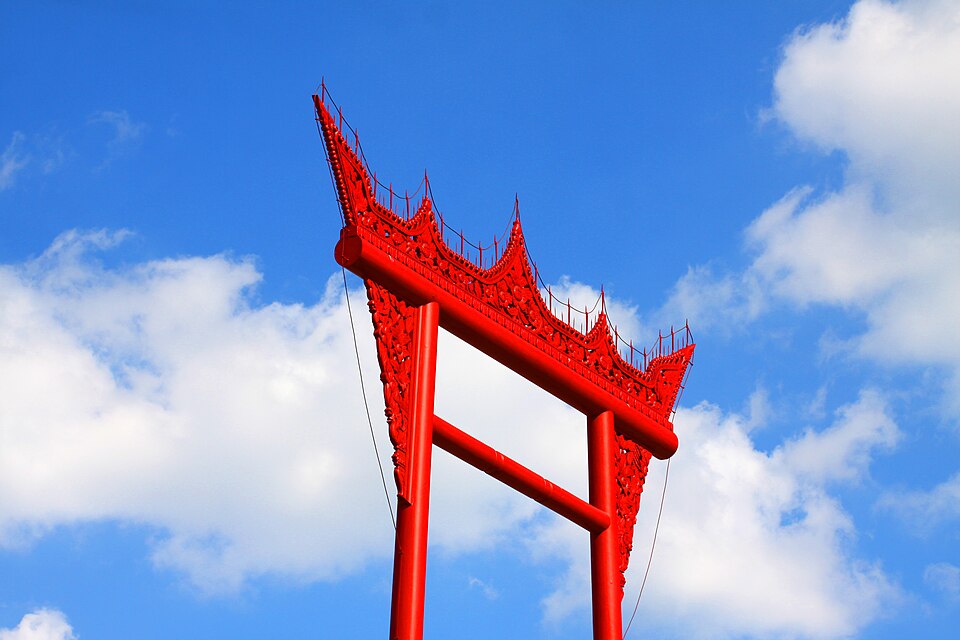
Allow fifteen minutes for the Giant Swing. It is one structure seen from open pavement, and once a visitor has walked the island's perimeter to find the angle that puts Wat Suthat behind the crossbar, there is nothing further to work through. The Giant Swing does not carry an hour on its own and was never meant to; it is the hinge between Wat Suthat on one side and the Devasathan shrine on the other, and the fifteen minutes disappear inside a longer walk through Phra Nakhon rather than standing alone in an itinerary. Visitors who arrive expecting a monument to enter will be finished sooner than that.
Checked 2026-08-25
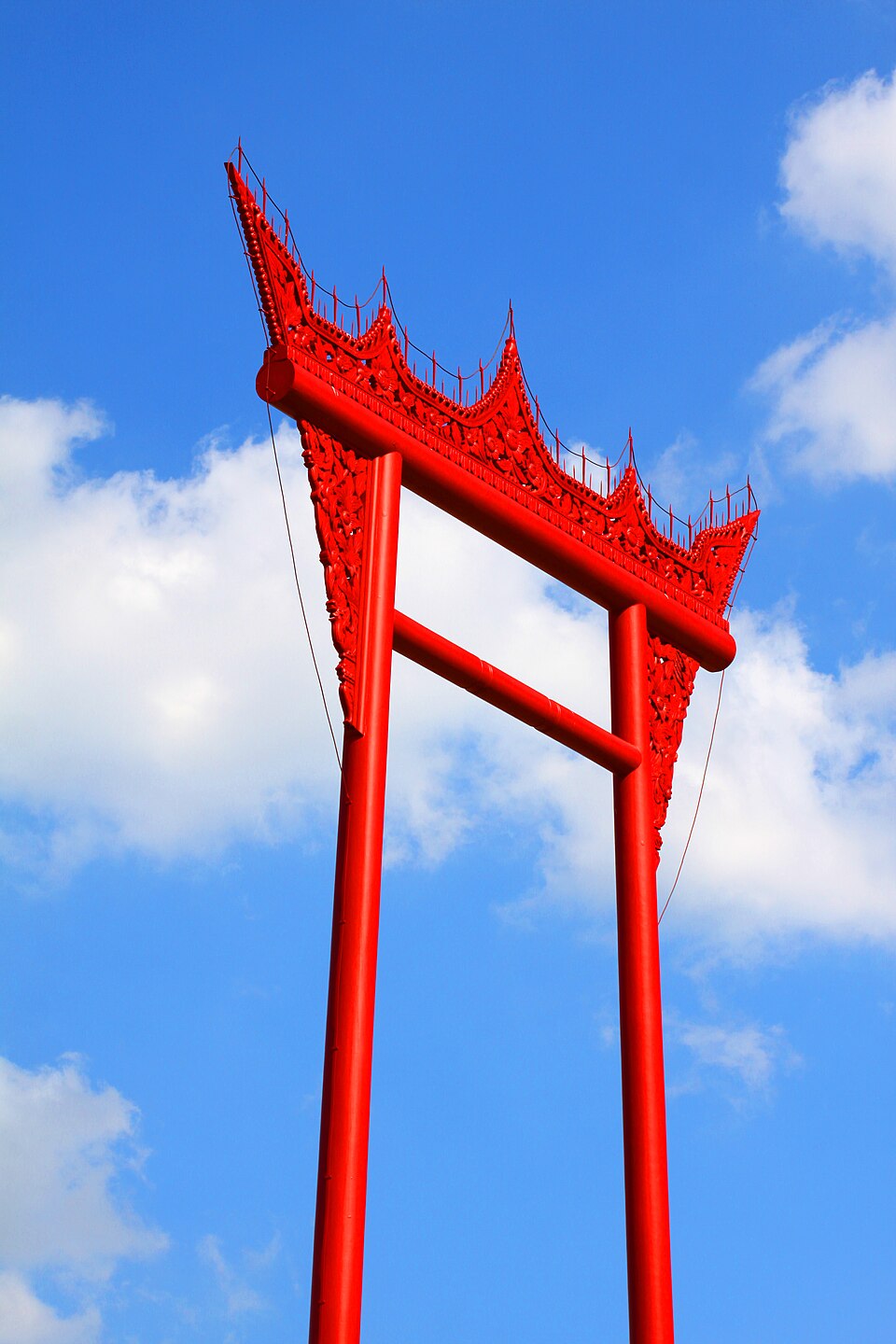
Early morning is the best hour at the Giant Swing, and the reason is shade rather than crowds. The island has no roof, no trees over the monument and nowhere to sit, so the middle of the day is spent squinting at a red frame in flat overhead light with traffic circling on both sides. Between roughly seven and nine in the morning the air is still tolerable, the light is low enough to pick out the carving on the crossbar, and the surrounding streets are quiet enough to cross without hurrying. Late afternoon is the alternative: the low sun warms the red timber and works well against Wat Suthat behind it. The Giant Swing is outdoors and unenclosed, so rain is the only weather that stops a visit outright, and Bangkok's rain rarely lasts long enough to matter for a fifteen-minute stop.
Checked 2026-08-25
There is no admission charge at the Giant Swing and no ticket office. The monument stands on public ground with open pavement on every side, and a visitor simply walks up to it. No opening hours and no admission price are recorded for the Giant Swing on this page, because no operator-published page carrying either could be found. What was checked on 25 August 2026: the Bangkok Metropolitan Administration web estate, the Giant Swing's Wikidata record and its Wikipedia article, none of which publishes hours or a fee for the monument. Two things follow. First, treat any price quoted for the Giant Swing elsewhere as belonging to something else. Second, Wat Suthat directly opposite is a separate site with its own gate and its own charge, which this page does not record and which should be confirmed at the temple itself; the swing and the temple are one photograph but they are not one ticket.
Checked 2026-08-25

The nearest rail to the Giant Swing is Sam Yot on the MRT Blue Line, which opened on 29 July 2019 between the Sam Yot intersection of Charoen Krung and Maha Chai Roads and the Unakan intersection, in Phra Nakhon District. The station's own description names the Giant Swing and Wat Suthat among the landmarks it serves. The walk is well under a kilometre on flat pavement and takes roughly ten minutes, which makes the Giant Swing one of the few old-city monuments reachable on the metro without a boat or a taxi. Arriving from the river instead means a Chao Phraya express boat pier and a longer walk east through Phra Nakhon's grid. Taxis and tuk-tuks can stop on the streets around the island, but the monument sits within a busy junction, so a driver will set down at the kerb rather than at the monument itself.
Checked 2026-08-25 · Source

The first thing to expect at the Giant Swing is disappointment of a specific kind: there is no swing. The seat and ropes are gone, the ceremony has not been performed since 1935, and visitors who picture a working ride find a bare frame. Knowing that in advance turns the stop from an anticlimax into what it is, a surviving piece of ritual architecture. The second is traffic. The monument occupies an island inside a working junction and vehicles pass on both sides, so crossing is done at the marked points and not diagonally, and children need holding. There is no shade, no seating and no water on the island itself. On conduct: the Giant Swing is a religious structure and a registered ancient monument, so climbing on the base or the supports is out, and the Devasathan shrine behind it is an active place of worship with the dress and behaviour expectations that implies. Wat Suthat opposite enforces covered shoulders and knees; a visitor planning both should dress for the temple, not for the street.
Checked 2026-08-25
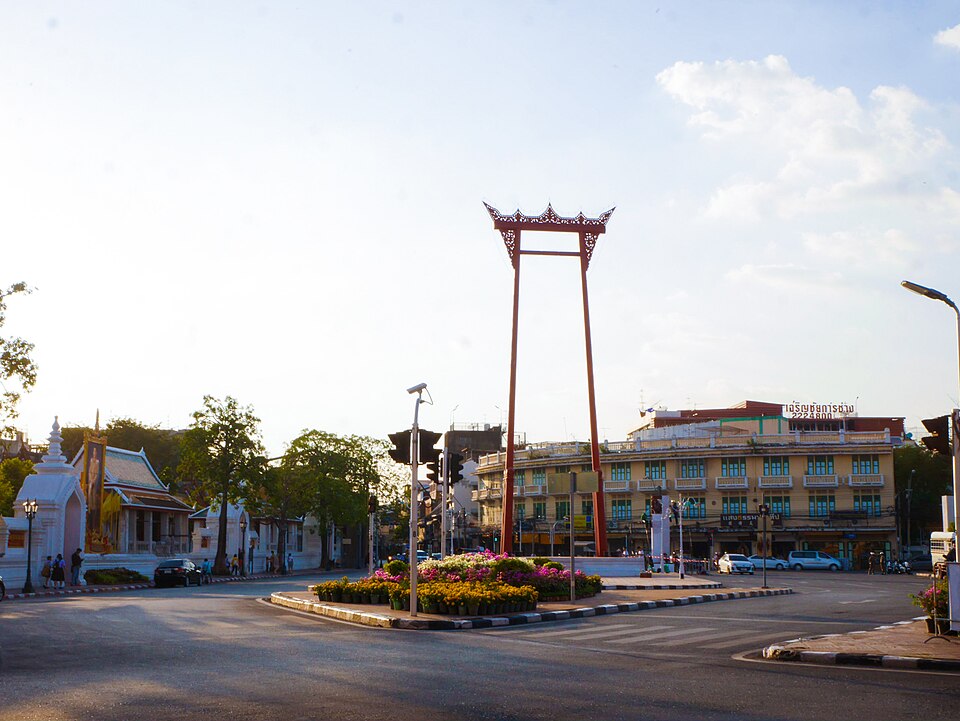
The Giant Swing is a silhouette subject, and the frame photographs best when something is put behind it. The standard composition sets the crossbar against the roofline of Wat Suthat, which means shooting from the far side of the island and stepping around until the two line up. Photography of the monument is unrestricted, since it stands in the open street. The two practical enemies are wires and vehicles: the junction carries overhead cabling and constant traffic, so a low angle that fills the frame with red timber and sky usually beats a wide one that includes the road. Overhead midday sun flattens the red paint and throws the carving on the crossbar into nothing, so morning or late afternoon is worth the effort. Inside Devasathan and inside Wat Suthat, photography rules are set by those sites and not by the street, so ask there rather than assuming the open-air freedom continues through the gate.
Checked 2026-08-25
No. The Giant Swing has no seat and no ropes, and the ceremony it was built for has not been performed since 1935, when it was stopped after repeated fatal accidents. What stands on the island today is the frame alone.
Nothing is charged and no ticket exists: the Giant Swing stands on public ground with open pavement on every side. No admission price or opening hours are recorded for it here, because no operator-published page carrying either could be found as of 25 August 2026.
The first swing was raised by King Rama I in 1784, but the timber is not that old. The structure was moved in 1920, renovated in 1959, and rebuilt from six teak trunks between April 2005 and December 2006, with the dedication presided over by King Bhumibol Adulyadej in September 2007. The replaced timbers are kept at the Bangkok National Museum.
Fifteen minutes. It is a single structure seen from the pavement, best treated as the link between Wat Suthat and the Devasathan shrine rather than as a stop with an hour of its own.
Sam Yot on the MRT Blue Line, which opened on 29 July 2019 in Phra Nakhon District and names the Giant Swing and Wat Suthat among the landmarks it serves. The walk is well under a kilometre on flat pavement.
They face each other and are photographed together, but they are separate sites. Wat Suthat has its own gate and its own admission charge, which is not recorded on this page and should be confirmed at the temple. The Giant Swing itself is open street.
Loading the interactive map…
The interactive map could not be loaded.
Last updated:
Source: OpenStreetMap contributors, Wikidata ·