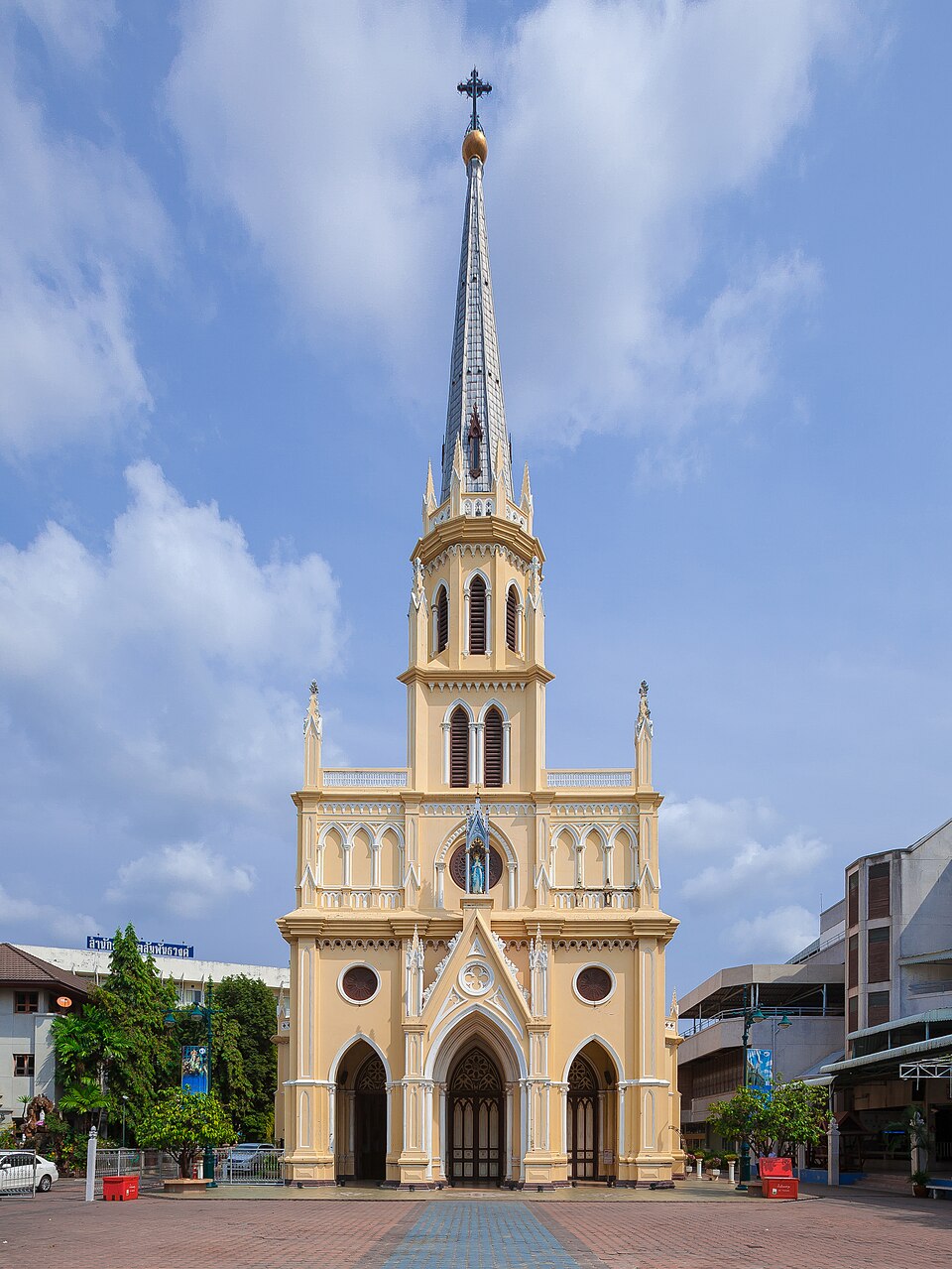
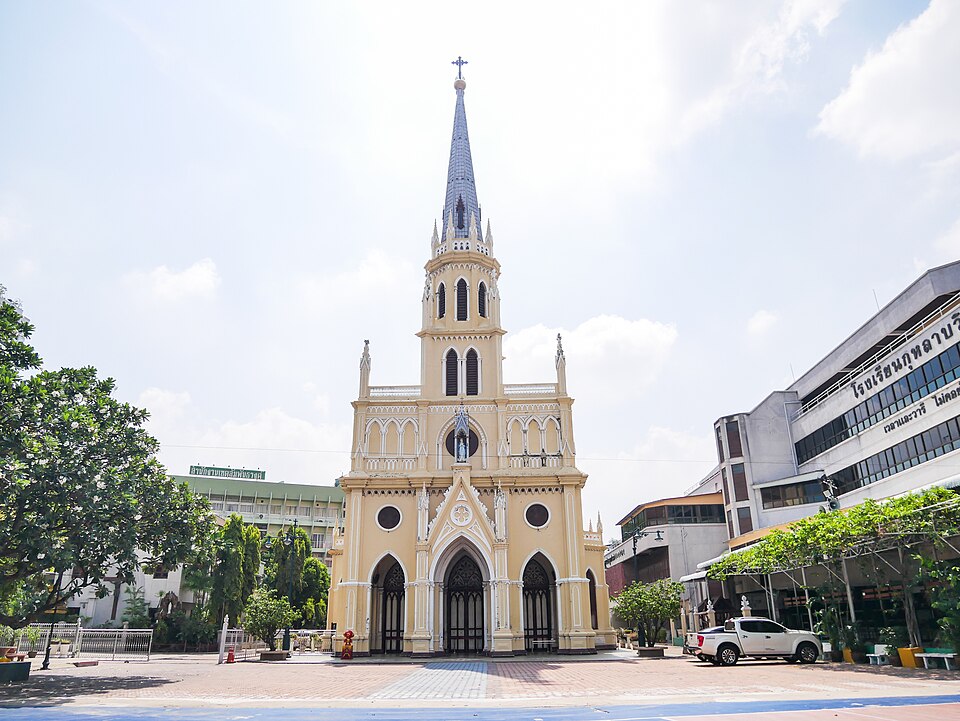
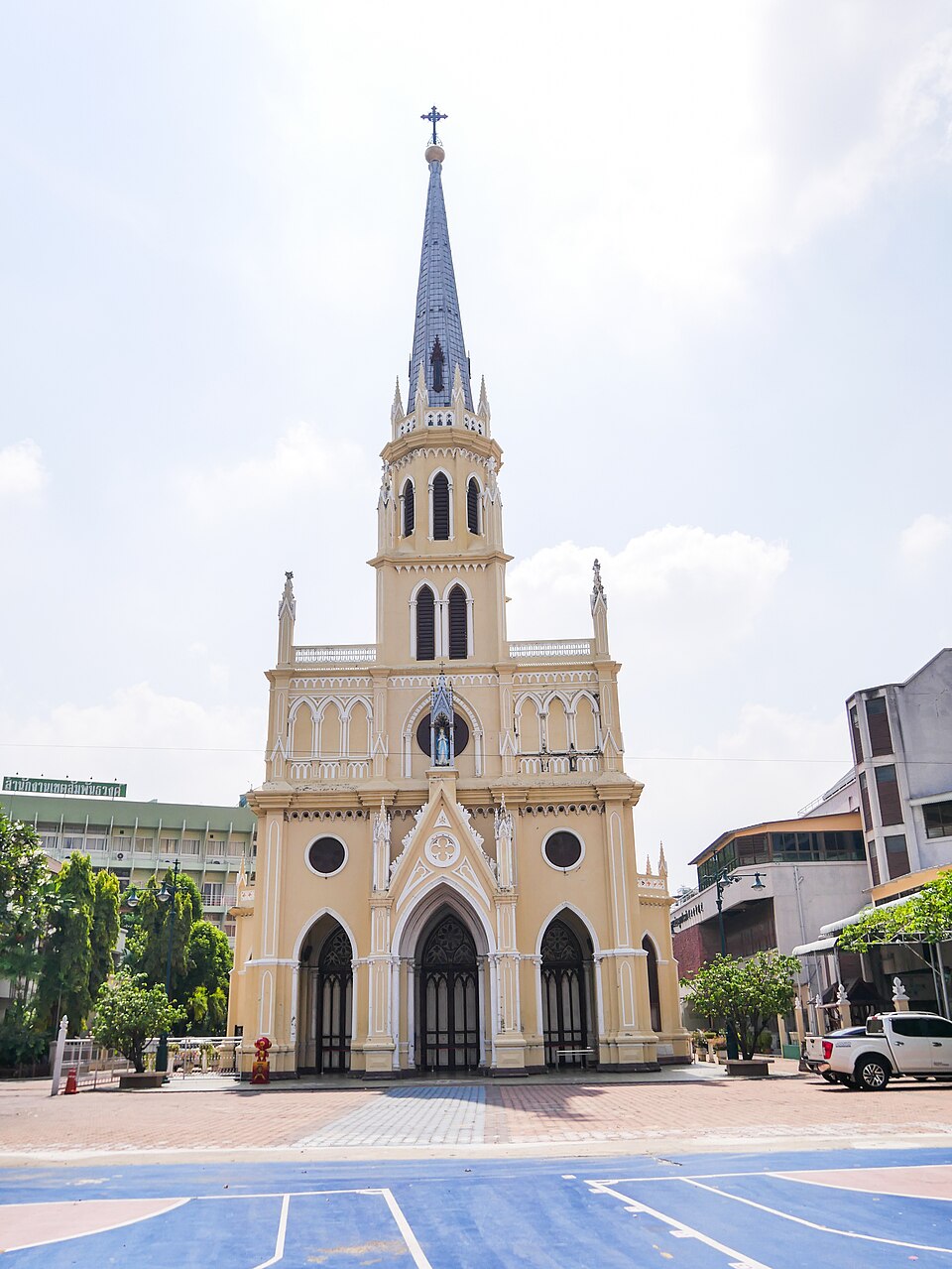
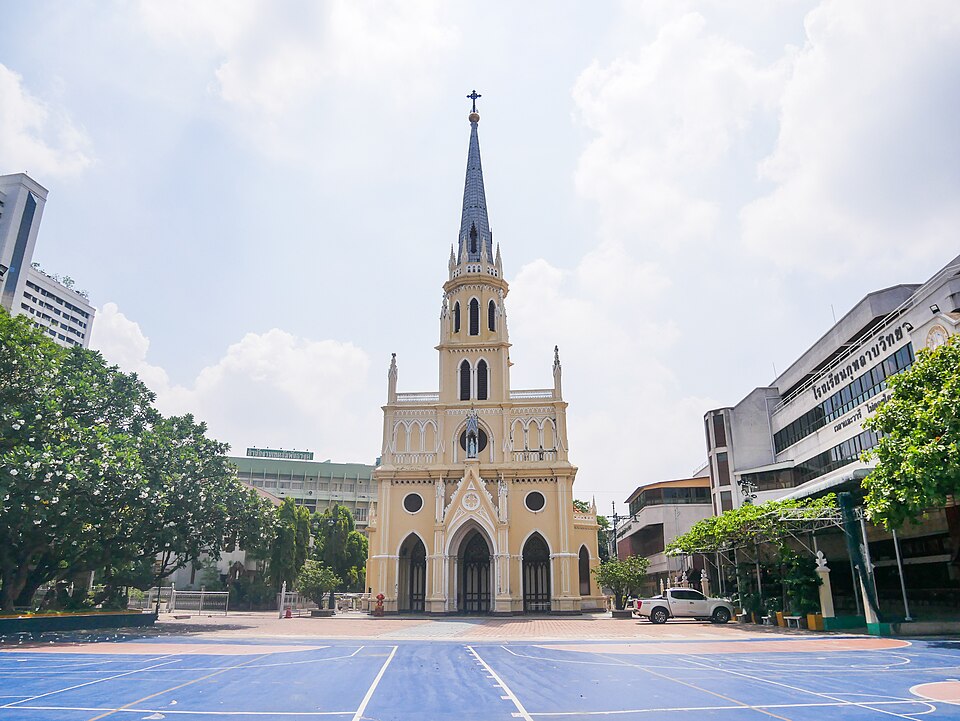
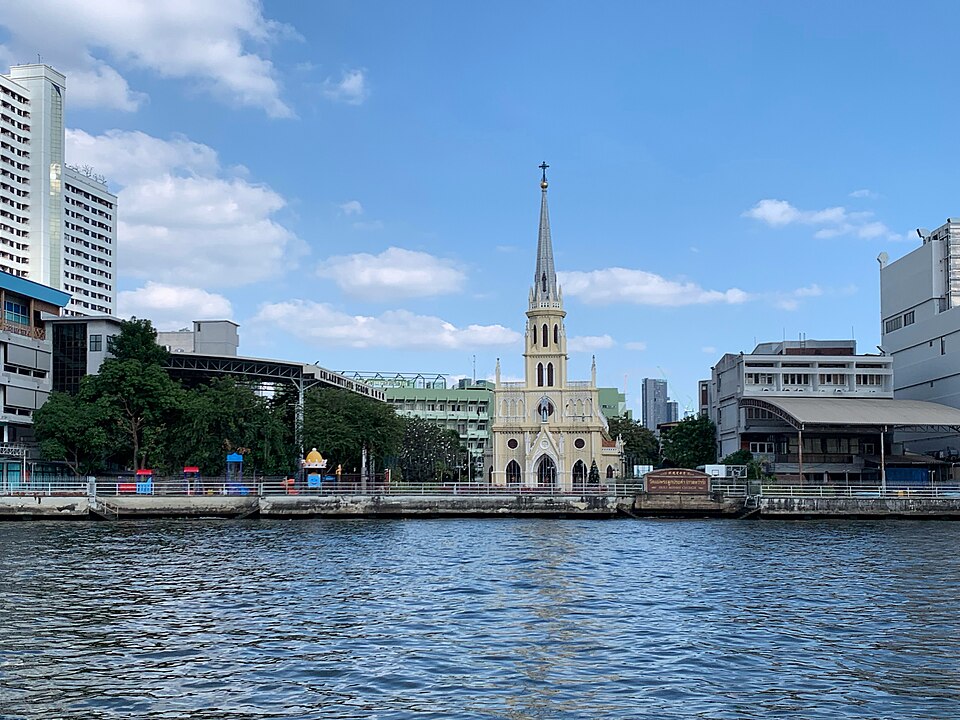
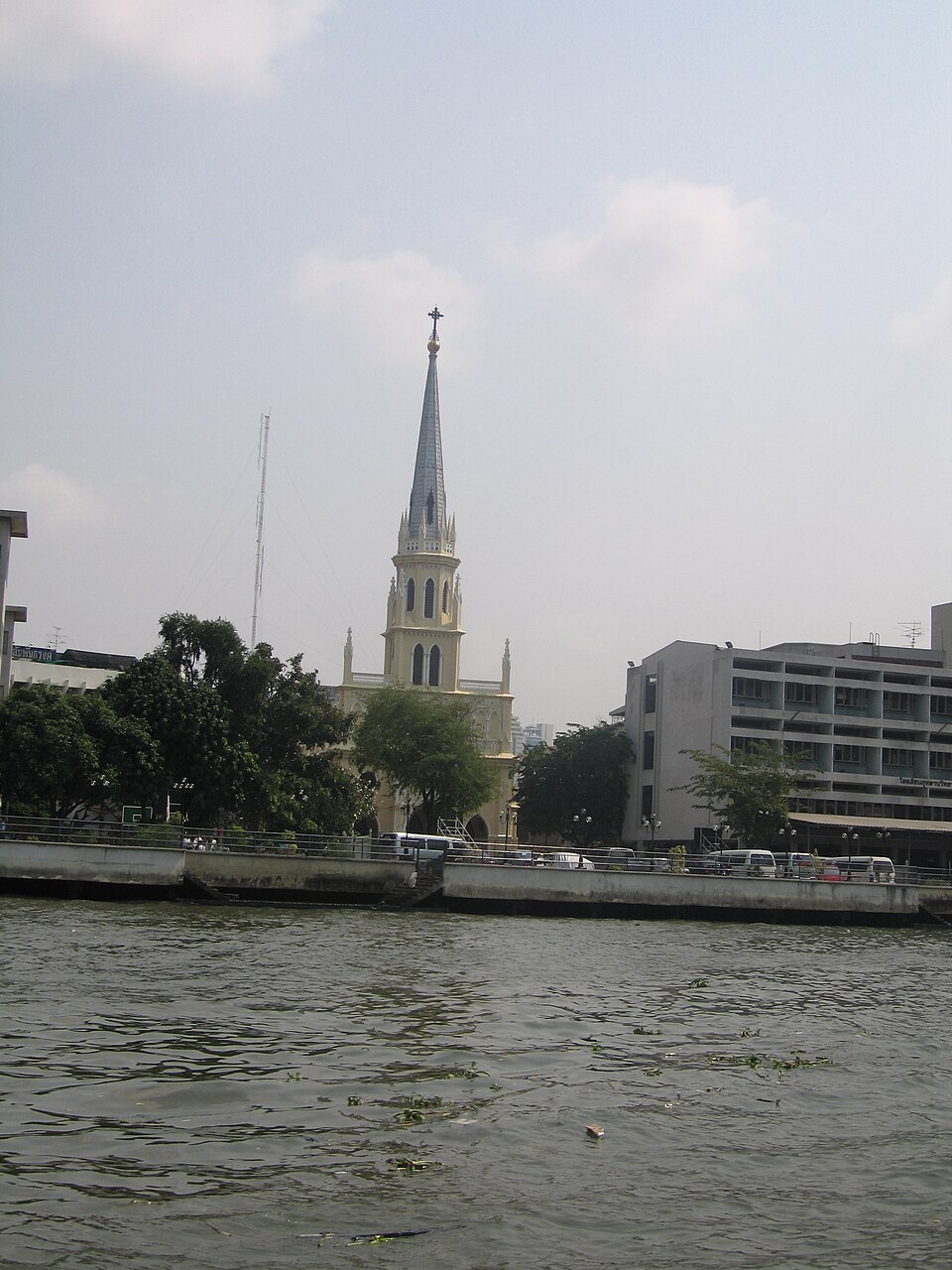
Holy Rosary Church, known in Thai as Wat Mae Phra Luk Prakham and to its Chinese congregation as Wat Kalawar, is the Catholic parish church of Talat Noi, standing on the Chao Phraya at Soi Wanit 2 off Yotha Road in Samphanthawong. The parish records that the present building is the third church on the plot: construction began in 1891 under Father Desalles and finished in 1897, at a cost of seventy-seven thousand baht. Its plan is a Latin cross 23.03 metres wide and 50.65 metres long, laid out east to west with the front turned down towards the river, and its detailing is Western Gothic — pointed windows, pinnacles above every pilaster, a balustrade running between them, and a bell tower rising over the entrance porch. The land was granted in 1786 to Portuguese Catholics who had come downriver from Ayutthaya, and the church has never stopped being a working parish; its name comes from a statue, not from a saint's dedication alone.
The interior of Holy Rosary Church is worth reading rather than merely looking at, because the parish has published what its inscriptions say. Chinese characters sit above each of the three entrance doors: the central one reads House of God, the left Morning Star, the right Gate of Heaven. On the arch above the altar the Chinese text asks Our Lady of the Rosary to intercede. Latin phrases run across the ceiling over the altar, and they are titles of the Virgin lifted from the Litany of Loreto — Turris Davidica, Sedes Sapientiae, Stella Matutina, Vas Honorabile, Rosa Mystica, Ianua Caeli, Vas Insigne Devotionis, Turris Eburnea. The nave is a single open hall crossed by a large Roman-arch opening that separates the sanctuary, with a gallery on paired columns above the entrance, cement floor tiles in the seating area and marble in the sanctuary. A large niche behind the altar holds the church's statue of the Virgin, with smaller niches to either side for Saint James and Saint Benedict, and further niches at the front of the nave for Saint Jerome and Saint Anne. The old carved wooden pulpit still stands on the left-hand side, no longer used since amplification made it unnecessary. The ceiling over the congregation carries stars in circles and a doubled letter M for the Virgin.
Allow thirty minutes at Holy Rosary Church. That is enough to walk the nave once, sit long enough to pick out the Latin titles on the ceiling and the Chinese characters over the doors, look at the two Ayutthaya-era statues, and step out to the riverside frontage. Visitors who read Thai and work through the parish's own account of the altar and the images can spend longer; visitors combining the church with the shophouse lanes of Talat Noi should treat it as one stop of thirty minutes inside a longer walk rather than as a destination of its own.
The building is a parish church first, so the reliable times to find it open are around Mass. The parish publishes its schedule as follows: Sunday Mass in Thai at 08.00 and 19.30, Sunday Mass in Chinese at 10.00, and Mass Monday to Saturday at 19.30. A daytime weekday visit therefore falls outside any scheduled service, and whether the doors are open then is not something the parish publishes. The quietest useful window is the late Sunday morning after the Chinese Mass has ended; the busiest day of the year is Good Friday, when the church's dead-Christ statue is carried in procession.
No admission charge is recorded for Holy Rosary Church, and none is claimed here. The parish website publishes a Mass timetable, the history of the church, and pages on the altar, the statues and the wall inscriptions, but it publishes no visitor fee, no ticket office and no visiting hours, and nothing on the site suggests that entry is charged for. The pages checked on 25 August 2026 were the parish timetable, history and architecture pages at rosary.catholic.or.th. A donation box inside a working parish church is a different thing from an admission fee, and this page records neither as a price.
Holy Rosary Church stands at Soi Wanit 2, Yotha Road, in the Talat Noi sub-district of Samphanthawong, with its front elevation facing the Chao Phraya to the west. The approach on foot is through Talat Noi itself, a grid of narrow lanes of Chinese metal-parts workshops between Yaowarat and the river, and the church appears suddenly at the end of a lane rather than announcing itself from a main road. Arriving by river and walking in from a nearby pier gives the building the frontal view it was designed for; arriving by rail means a walk of roughly ten to fifteen minutes east from Hua Lamphong. Taxis can reach Yotha Road, but the last stretch is walked.
This is an active parish, not a monument with an opening time, and the single most common disappointment is arriving to find the church locked outside Mass hours. Dress as for any church: covered shoulders and knees, hats off, phones silenced. If a Mass is under way, sit at the back or come back later rather than walking the aisles with a camera; the Chinese Mass on Sunday at 10.00 in particular fills the nave with a congregation who are there to pray. On Good Friday the procession draws a crowd that fills the lanes outside, which is either the reason to come or the reason to avoid the date. Talat Noi's lanes are shared with working workshops, welding and parked motorcycles, so watch your footing and do not photograph inside people's premises without asking.
The church was built to be seen from the water: its west front, with the gabled façade and the spire above the narthex, faces the Chao Phraya, so the façade takes direct light in the late afternoon and photographs flatly at midday. From a river ferry crossing towards Thonburi the whole west elevation reads at once, which no view from the lanes gives. Inside, the nave is lit by two tiers of windows — pointed below, circular above — down nine bays of wall, and the practical exposure problem is the gap between those windows and the shaded aisles; a handheld frame from the central aisle towards the sanctuary arch works better than pointing at a window. The gilded vine ornament and the star-and-monogram ceiling need a long lens rather than a wide one. Do not use flash, and do not photograph during Mass.
Checked 2026-08-25
Common questions
Why is Holy Rosary Church called Kalawar?
The name comes from a carved wooden statue of the dead Christ that Portuguese Catholics brought with them from Ayutthaya. Kalawar is the Thai rendering of Calvary, the hill where Christ was crucified, and the parish records that the image gave the first church on the site its popular name; Chinese parishioners still call the church Wat Kalawar rather than by its formal dedication to Our Lady of the Rosary.
How old is the statue of the Virgin inside the church?
The parish states that the statue of Our Lady of the Rosary was carried from Ayutthaya by Portuguese Catholics at the fall of the city, which makes it more than two hundred years old, and that nobody knows in what tradition, country or year it was made. The Virgin stands with the moon beneath her feet and the Christ Child on her left arm; a sceptre was later placed in her right hand, whose original attribute is unknown.
What are the Mass times at Holy Rosary Church?
The parish publishes Mass in Thai on Sunday at 08.00 and 19.30, Mass in Chinese on Sunday at 10.00, and Mass from Monday to Saturday at 19.30. These are the times the church is reliably open; the parish does not publish separate visiting hours for the building outside them.
What is carved on the altar?
The altar is marble, a solid rectangular block, and its front carries five virgin martyrs — Saint Lucy, Saint Agnes, Saint Philomena, Saint Cecilia and Saint Agatha. The parish explains that when the present church was completed in 1897 the altar stood against the tabernacle, and that it was moved forward to its current position at some point after the Second Vatican Council so that the priest could face the congregation.
How does this church differ from the other old churches on the river?
Holy Rosary was founded by the Portuguese group that refused the authority of the French mission after the fall of Ayutthaya in 1767 and worshipped for a time at Santa Cruz before receiving this land in 1786. Its congregation later became largely Chinese as the Portuguese families dispersed, which is why the doors and the sanctuary arch carry Chinese inscriptions and why a Chinese-language Mass is still said every Sunday.
Which saints will I see inside?
The parish lists the figures in the church as the Archangel Michael, Saint Nicholas, Saint James, Saint Therese of the Child Jesus, Saint Francis Xavier, Saint Anne, Saint Jerome, Saint Roch, Saint Anthony, the Archangel Raphael, Saint Joseph with the Christ Child, the Sacred Heart, the Virgin and Child, Saint Benedict, and two small angels holding shells of holy water at the entrance doors.
Nothing non-essential is set before you choose, in regions where consent is required. If you decline, ads still appear but they are non-personalised, and analytics is switched off entirely.
.jpg)
_%E0%B8%A7%E0%B8%B1%E0%B8%94%E0%B9%81%E0%B8%A1%E0%B9%88%E0%B8%9E%E0%B8%A3%E0%B8%B0%E0%B8%A5%E0%B8%B9%E0%B8%81%E0%B8%9B%E0%B8%A3%E0%B8%B0%E0%B8%84%E0%B8%B3_%E0%B9%80%E0%B8%82%E0%B8%95%E0%B8%AA%E0%B8%B1%E0%B8%A1%E0%B8%9E%E0%B8%B1%E0%B8%99%E0%B8%98%E0%B8%A7%E0%B8%87%E0%B8%A8%E0%B9%8C_%E0%B8%81%E0%B8%A3%E0%B8%B8%E0%B8%87%E0%B9%80%E0%B8%97%E0%B8%9E%E0%B8%A1%E0%B8%AB%E0%B8%B2%E0%B8%99%E0%B8%84%E0%B8%A3_(1).jpg)
_%E0%B8%A7%E0%B8%B1%E0%B8%94%E0%B9%81%E0%B8%A1%E0%B9%88%E0%B8%9E%E0%B8%A3%E0%B8%B0%E0%B8%A5%E0%B8%B9%E0%B8%81%E0%B8%9B%E0%B8%A3%E0%B8%B0%E0%B8%84%E0%B8%B3_%E0%B9%80%E0%B8%82%E0%B8%95%E0%B8%AA%E0%B8%B1%E0%B8%A1%E0%B8%9E%E0%B8%B1%E0%B8%99%E0%B8%98%E0%B8%A7%E0%B8%87%E0%B8%A8%E0%B9%8C_%E0%B8%81%E0%B8%A3%E0%B8%B8%E0%B8%87%E0%B9%80%E0%B8%97%E0%B8%9E%E0%B8%A1%E0%B8%AB%E0%B8%B2%E0%B8%99%E0%B8%84%E0%B8%A3_(2).jpg)
_%E0%B8%A7%E0%B8%B1%E0%B8%94%E0%B9%81%E0%B8%A1%E0%B9%88%E0%B8%9E%E0%B8%A3%E0%B8%B0%E0%B8%A5%E0%B8%B9%E0%B8%81%E0%B8%9B%E0%B8%A3%E0%B8%B0%E0%B8%84%E0%B8%B3_%E0%B9%80%E0%B8%82%E0%B8%95%E0%B8%AA%E0%B8%B1%E0%B8%A1%E0%B8%9E%E0%B8%B1%E0%B8%99%E0%B8%98%E0%B8%A7%E0%B8%87%E0%B8%A8%E0%B9%8C_%E0%B8%81%E0%B8%A3%E0%B8%B8%E0%B8%87%E0%B9%80%E0%B8%97%E0%B8%9E%E0%B8%A1%E0%B8%AB%E0%B8%B2%E0%B8%99%E0%B8%84%E0%B8%A3_(3).jpg)

