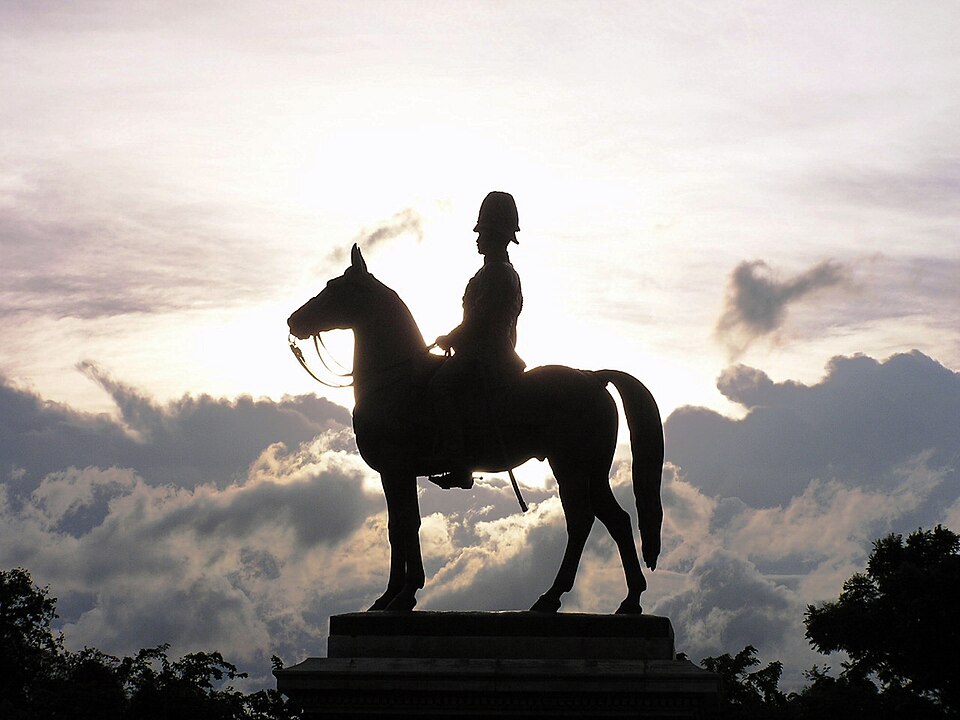
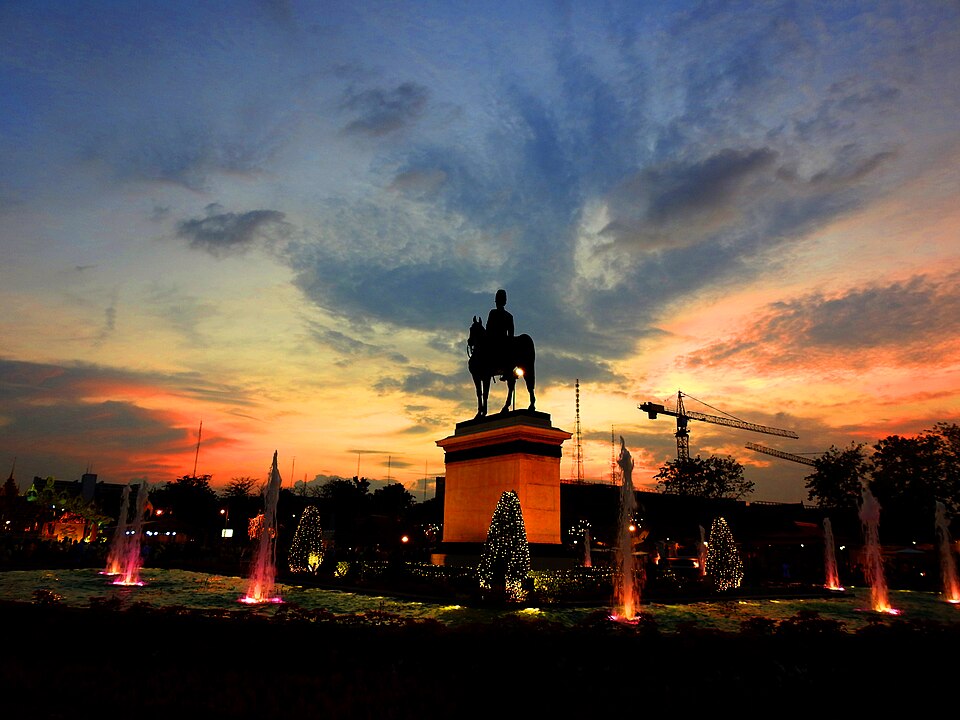
The equestrian statue of King Chulalongkorn stands at the centre of the Royal Plaza in Dusit, south of the Ananta Samakhom Throne Hall, and it is the monument Thai visitors mean when they speak of paying respects to Rama V. The bronze is five metres tall, weighs six tons and rests on a twenty-five-centimetre bronze base above a marble pedestal, and it shows the king in the uniform of a field marshal with the reins in his left hand and a baton in his right, facing southwest down Ratchadamnoen Avenue. It was made in Paris: two French metallurgists, Clovis-Edmond Masson and Georges Saulo, took charge of the work at the Susse Freres foundry, the casting was completed on 22 August 1907, and the statue was unveiled on 11 November 1908 to mark the fortieth anniversary of the king's accession, then the longest reign in Siamese history. Its funding is the part usually left out: the budget was about 200,000 baht, public donations reached around 1,200,000 baht, and King Vajiravudh used the surplus to found Chulalongkorn University.
There is no interior. What surrounds the statue is a piece of deliberate town planning: the Royal Plaza is roughly 500 metres long and 150 metres wide, laid in front of the Ananta Samakhom Throne Hall, which later served as Thailand's first parliament building. The plaza is where the People's Party staged the bloodless revolution of 24 June 1932 that ended the absolute monarchy, and for decades a bronze plaque set in the ground marked the spot; that plaque was removed in April 2017 and replaced with one that makes no mention of the revolution or of the constitution. The plaza has also carried rallies, parades and state ceremonies, and Chulalongkorn University students traditionally celebrated their graduation on it. So the ground around the statue holds two competing histories at once, the royal avenue Chulalongkorn built and the constitutional break staged against his successor, and reading the site means holding both.
Allow twenty-five minutes, and understand what that time now buys. This is a single outdoor monument at the head of a ceremonial avenue, so the looking takes ten minutes; the rest goes on walking the perimeter for the angles and on taking in the throne hall behind it. Because the plaza has been enclosed, a visitor should budget for viewing from the roadside rather than for standing at the pedestal, which shortens the visit rather than lengthening it. Twenty-five minutes is the figure to plan on. On 23 October the calculation is different: the memorial day draws crowds and wreaths and turns a quarter of an hour into a morning.
Early morning is the best light and the least traffic, because the statue faces southwest and the surrounding avenue carries vehicles all day. The date that matters is 23 October, Chulalongkorn Day, when institutions, government bodies and members of the public place memorial wreaths around the statue and Ratchadamnoen Avenue fills with people walking towards the plaza; it is the one day the monument is doing the job it was built for, and the one day it is genuinely crowded. Any visitor whose interest is the ceremony should come then and expect road closures. Any visitor whose interest is the bronze itself should come on any other morning. The cool season, when Bangkok's afternoon haze is thinner, gives the throne hall dome behind the statue a cleaner outline.
No admission is recorded for the equestrian statue and no ticket exists to buy: it is a public monument on a public avenue, not a ticketed site, and the fee is not stated because no operator charges one. What is worth checking before a visit is not price but access, since the plaza around the statue has been enclosed and the enclosure is not something a ticket resolves. Separately, the Ananta Samakhom Throne Hall behind the statue and the wider Dusit Palace grounds have their own arrangements and their own closures, and neither is covered by walking up to the monument. Confirm the current situation on the ground before building an itinerary around standing at the pedestal.
The statue stands in the Royal Plaza in Dusit district, in front of the Ananta Samakhom Throne Hall, at the head of the ceremonial avenue it faces down. The approach that makes sense of the monument is along Ratchadamnoen Avenue from the south, because the statue was placed facing southwest towards that avenue and the whole composition is built for that line of sight. Dusit is a government quarter of wide boulevards and long blocks, so the walk in from any drop-off point is longer than the map suggests and offers little shade. Anyone combining the monument with the throne hall, the surrounding Dusit Palace grounds or the riverside at Thewet should plan the order in advance rather than improvising between them.
The single thing to know before travelling here: as of 2022 the Royal Plaza was completely sealed off by a fence and incorporated into the Dusit Palace grounds, so the open square that older photographs and older guidebooks show is no longer walkable, and a visitor should expect to see the statue from outside a barrier rather than from beside it. Confirm the position before making a special trip. Beyond access, this is a royal monument and conduct around it is taken seriously in Thailand: dress neatly, do not climb on or lean against any part of the structure, do not pose irreverently, and do not treat wreaths or offerings as props. Thailand's lese-majeste law is enforced, and behaviour that would pass unnoticed at a European monument does not pass here. Traffic on the surrounding roads is fast and pedestrian crossings are far apart.
The statue faces southwest, which decides everything. Late afternoon light comes onto the king's face and the horse's flank; morning light puts the same face in shadow but gives a clean sky behind the throne hall dome, which is the better background of the two. With the plaza enclosed, the workable position is the roadside perimeter, so a short telephoto that compresses statue and dome into one frame does more here than a wide lens ever will. Shoot the silhouette against the dome rather than trying to include the whole plaza. On 23 October the picture is not the bronze at all but the wreaths banked around its base and the people carrying them, and that is a day for a normal lens and restraint about pointing it at mourners.
Checked 2026-08-25
Common questions
Who made the equestrian statue of King Chulalongkorn and when?
It was cast in Paris at the Susse Freres foundry, with two French metallurgists, Clovis-Edmond Masson and Georges Saulo, in charge of the work. The casting was completed on 22 August 1907 and the statue was unveiled on 11 November 1908, marking the fortieth anniversary of King Chulalongkorn's accession to the throne.
Can visitors walk up to the statue in the Royal Plaza?
Not as they once could. As of 2022 the Royal Plaza was completely sealed off by a fence and incorporated into the Dusit Palace grounds, which ended the open public access that the plaza had for a century. Anyone planning a visit should confirm the current arrangement before travelling, and should expect to view the statue from the perimeter rather than from the pedestal.
What happened to the money raised for the statue?
The budget for the monument was about 200,000 baht, but public donations came to roughly 1,200,000 baht, far more than the statue needed. King Vajiravudh used the surplus to establish Chulalongkorn University. The fundraising is therefore part of the monument's meaning: the same subscription produced both the bronze and the country's first university.
Is there an entrance fee for the equestrian statue?
No. The monument is a public statue on a ceremonial avenue and no admission fee is stated by any operator, because none is charged for looking at it. The Ananta Samakhom Throne Hall behind it and the wider Dusit Palace grounds are separate propositions with their own arrangements, and walking to the statue does not include them.
Why does 23 October matter at this statue?
23 October is Chulalongkorn Day, and the equestrian statue is where the country marks it. People, businesses and institutions place elaborate memorial wreaths around the monument, and crowds move along Ratchadamnoen Avenue towards the Royal Plaza through the morning. It is the busiest day of the year at the site and the only one on which the monument is in ceremonial use.
What is the plaque connected with this plaza?
A bronze plaque set into the ground of the Royal Plaza commemorated the People's Party revolution of 24 June 1932, which ended the absolute monarchy. It was removed in April 2017 and replaced by a plaque whose text emphasises the monarchy and mentions neither the revolution nor the constitution. The replacement is part of why the plaza is contested ground rather than a neutral setting.
Nothing non-essential is set before you choose, in regions where consent is required. If you decline, ads still appear but they are non-personalised, and analytics is switched off entirely.




_%E0%B8%9E%E0%B8%A3%E0%B8%B0%E0%B8%9A%E0%B8%A3%E0%B8%A1%E0%B8%A3%E0%B8%B9%E0%B8%9B%E0%B8%97%E0%B8%A3%E0%B8%87%E0%B8%A1%E0%B9%89%E0%B8%B2_01.jpg)
_%E0%B8%9E%E0%B8%A3%E0%B8%B0%E0%B8%9A%E0%B8%A3%E0%B8%A1%E0%B8%A3%E0%B8%B9%E0%B8%9B%E0%B8%97%E0%B8%A3%E0%B8%87%E0%B8%A1%E0%B9%89%E0%B8%B2_02.jpg)
_%E0%B8%9E%E0%B8%A3%E0%B8%B0%E0%B8%9A%E0%B8%A3%E0%B8%A1%E0%B8%A3%E0%B8%B9%E0%B8%9B%E0%B8%97%E0%B8%A3%E0%B8%87%E0%B8%A1%E0%B9%89%E0%B8%B2_03.jpg)
_%E0%B8%9E%E0%B8%A3%E0%B8%B0%E0%B8%9A%E0%B8%A3%E0%B8%A1%E0%B8%A3%E0%B8%B9%E0%B8%9B%E0%B8%97%E0%B8%A3%E0%B8%87%E0%B8%A1%E0%B9%89%E0%B8%B2_04.jpg)
_%E0%B8%9E%E0%B8%A3%E0%B8%B0%E0%B8%9A%E0%B8%A3%E0%B8%A1%E0%B8%A3%E0%B8%B9%E0%B8%9B%E0%B8%97%E0%B8%A3%E0%B8%87%E0%B8%A1%E0%B9%89%E0%B8%B2_05.jpg)