


2 min walk · Vračar
Vračar plateau
- Must see · Heritage site
- Nature site
Language · 1 published
Place of worship · Градска општина Врачар, Belgrade
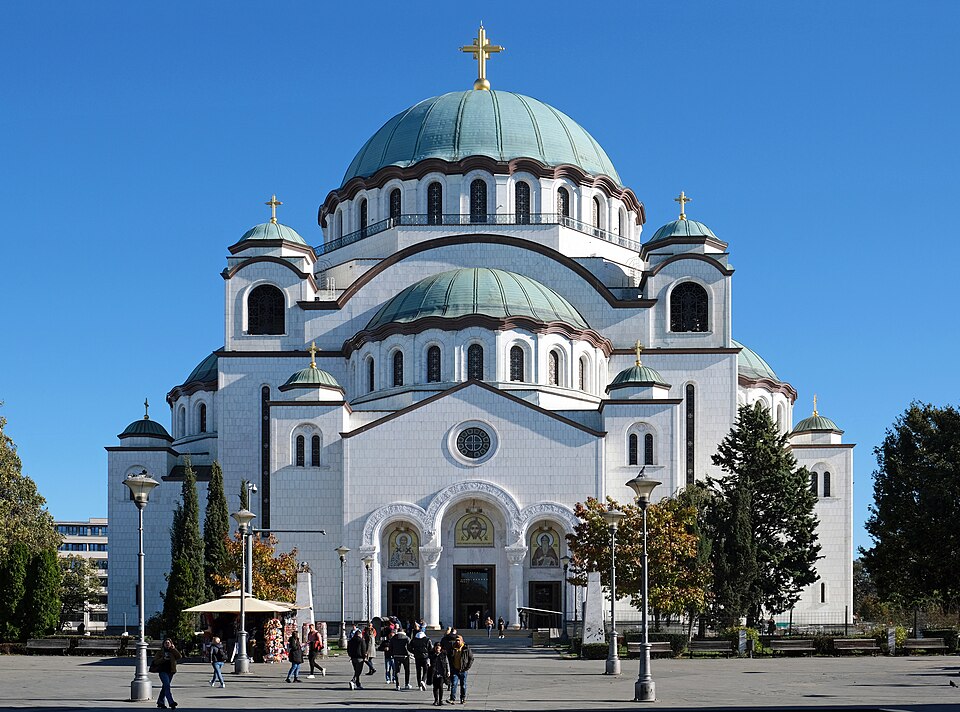
Храм Светог Саве
| Monday | 07:00 – 20:00 |
|---|---|
| Tuesday | 07:00 – 20:00 |
| Wednesday | 07:00 – 20:00 |
| Thursday | 07:00 – 20:00 |
| Friday | 07:00 – 20:00 |
| Saturday | 07:00 – 20:00 |
| Sunday | 07:00 – 20:00 |
Parsed from OpenStreetMap opening hours on 2026-08-25.
Read from the OpenStreetMap access tags; anything not listed has no tag recorded.
Set the group type to family in the planner and the day window contracts to about three quarters of a solo day.
The Church of Saint Sava stands where an Ottoman general burned a saint's bones, and it took eighty-five years to build.
On 27 April 1595 Sinan Pasha had the relics of Saint Sava brought from the Mileševa Monastery by military convoy and burned on this hill, in reprisal for a Serbian uprising.
The initiative to build here began in 1894, on the three-hundredth anniversary. Construction started on 15 September 1935, stopped in 1941 for the war and then for four decades of communist rule, and resumed on 12 August 1985.
The exterior was finished in 2004 and the interior mosaics in 2020. The whole cost about €100 million — €43 million from Serbia, €10 million from Russia and the rest from private donations.
Checked 2026-08-23 · Source
Fifteen thousand square metres of mosaic and about five million tesserae.
The interior was finished in 2020 and it is the largest Orthodox mosaic scheme completed in modern times. The dome mosaic is the piece that stops people at the door.
The building is 91 m east to west and 81 m north to south, 78.3 m high including the cross, with a dome 68.5 m externally and 30.5 m across inside. It holds up to 7,000 people on the ground floor with more space below.
The 4,000-tonne dome was assembled on the ground and lifted onto the arches over twenty days in June 1989 with hydraulic jacks, which remains one of the more remarkable pieces of engineering in the Balkans.
The crypt below is decorated in a different scheme and is a separate space.
Checked 2026-08-23 · Source
An hour, split between the church and the crypt.
The main space is one enormous room and the mosaic is what holds people in it — twenty minutes standing still is normal.
The crypt takes another twenty and is worth going down for; it is warmer, denser and more intimate than the church above and is frescoed rather than glazed.
The Vračar plateau outside, with the National Library of Serbia on one side and the Karađorđe monument on the other, takes fifteen minutes.
Checked 2026-08-23 · Source
Midday, when there is light in the dome.
The mosaic is gold-ground and the dome is 68.5 m up; it comes alive with sun through the drum windows and reads as brown at dusk.
It is a working church with services, and the space is large enough to absorb a congregation without a visit becoming intrusive — but the liturgy takes priority.
The building is heated and is a reasonable stop in winter, unlike most large Orthodox churches.
Checked 2026-08-23
Entry is free. The Church of Saint Sava is a working church and does not charge admission.
The crypt is also free.
Donations are collected and candles are sold, which is the customary arrangement rather than a ticket.
There is no tower access and no paid section.
Checked 2026-08-23 · Source

Vračar, on the plateau about twenty minutes' walk uphill from Republic Square.
Buses and trolleybuses run along the Kralja Milana and Bulevar oslobođenja to the plateau. The walk up from Slavija Square takes ten minutes.
There is no metro in Belgrade; trams, buses and trolleybuses run instead, and the old town is walkable end to end.
Checked 2026-08-23 · Source

It is a working Orthodox church: shoulders and knees covered, hats off for men, and heads covered by women in some circumstances. Services take priority over visiting.
The scale defeats photography and disappoints people expecting an ancient building — this is a twentieth and twenty-first century church, finished inside in 2020.
The crypt entrance is outside the main doors and around the building, which people miss.
Photography is generally permitted but not during services, and flash reaches nothing at 68 m anyway.
The plateau is open and unshaded.
Checked 2026-08-23 · Source

The dome interior is the photograph and it needs the exposure set for the gold rather than for the floor. A phone will make it grey.
From outside, the church is white marble and granite on an open plateau, which means it blows out at midday and reads best at either end of the day.
The best exterior angle is from the north-west corner of the plateau, where the dome and the belfries separate rather than stacking.
The crypt is dim, frescoed and low, and is a completely different photographic problem from the church above.
Checked 2026-08-23
Because Sinan Pasha had the relics of Saint Sava brought here and burned on 27 April 1595, in reprisal for a Serbian uprising.
The initiative began in 1894, construction started on 15 September 1935, stopped from 1941 to 1985, and the interior mosaics were finished in 2020.
91 m by 81 m, 78.3 m high including the cross, with a dome 30.5 m across inside. It holds up to 7,000 people on the ground floor.
It was assembled on the ground and lifted onto the arches over twenty days in June 1989 using hydraulic jacks. It weighs 4,000 tonnes.
Yes. It is a working church and charges no admission, and the crypt is free as well.
About 15,000 m², containing roughly five million tesserae. They were completed in 2020.
Loading the interactive map…
The interactive map could not be loaded.
Last updated:
Source: OpenStreetMap contributors, Wikidata ·