.jpg)
.jpeg)
.jpg)


1 min walk · Palilula
Church of the Holy Trinity
- High
- Place of worship
Language · 1 published
Place of worship · Градска општина Палилула, Belgrade
Црква Светог Марка
Read from the OpenStreetMap access tags; anything not listed has no tag recorded.
Set the group type to family in the planner and the day window contracts to about three quarters of a solo day.
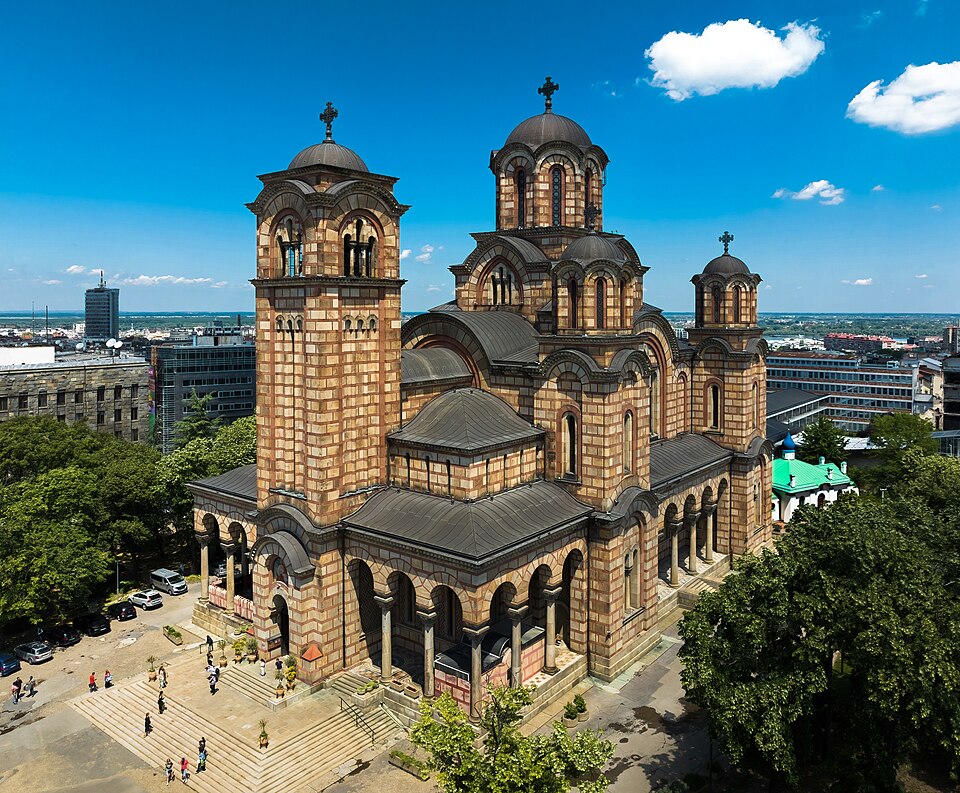
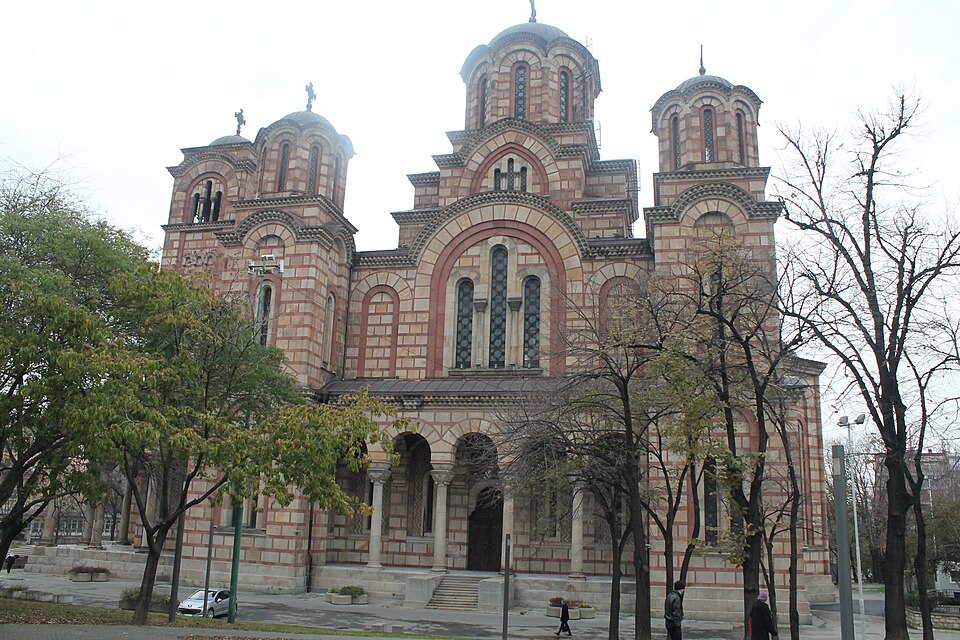
St. Mark's Church is a Serbian Orthodox church on Tašmajdan hill in central Belgrade, built between 1931 and 1940 to designs by the brothers Petar and Branko Krstić, both professors at the University of Belgrade Faculty of Architecture. It is modeled on the fourteenth-century Gračanica Monastery in Kosovo and belongs to the Serbo-Byzantine revival that shaped Belgrade's largest interwar churches. The foundation stone was laid on 8 May 1931, the exterior was finished in 1939 and the building was completed in 1940, though its interior decoration continued for decades afterward and is still unfinished today.
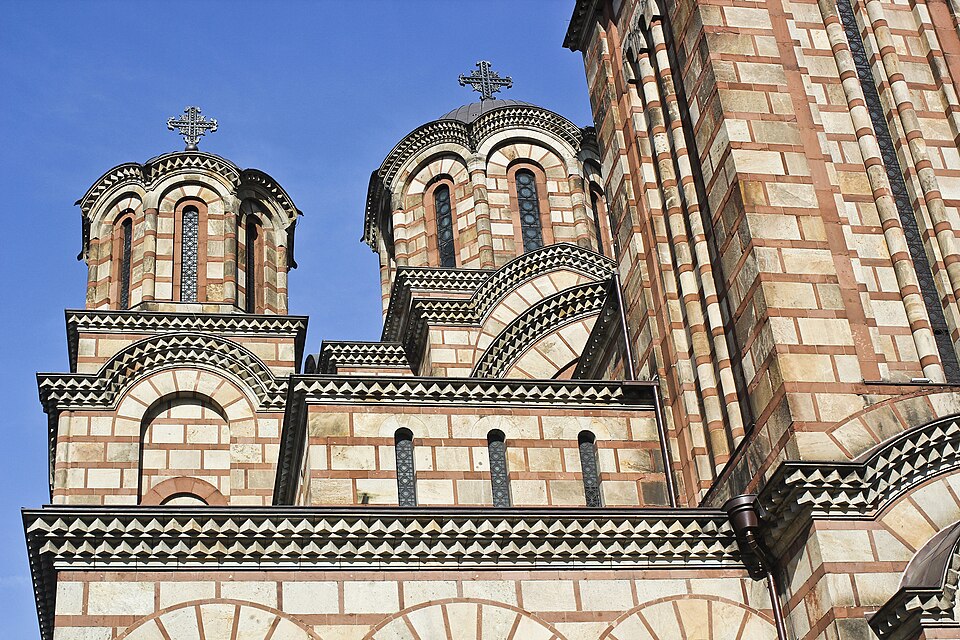
The exterior walls alternate two colors of natural stone, a signature of the Gračanica model, and the church rises to 60 meters excluding its cross, with a footprint 62 meters long and 45 meters wide. That makes it one of the largest church buildings in the Balkans, and its cascading domes are visible from most of central Belgrade.
Checked 2026-08-23 · Source
The naos holds up to 2,000 worshippers and the choir gallery can seat 150 musicians, spread across roughly 1,150 square meters of interior floor space. The church has three altars: the main altar, and two side altars dedicated to the medieval Serbian ruler Stefan Lazarević and to the Transfiguration.
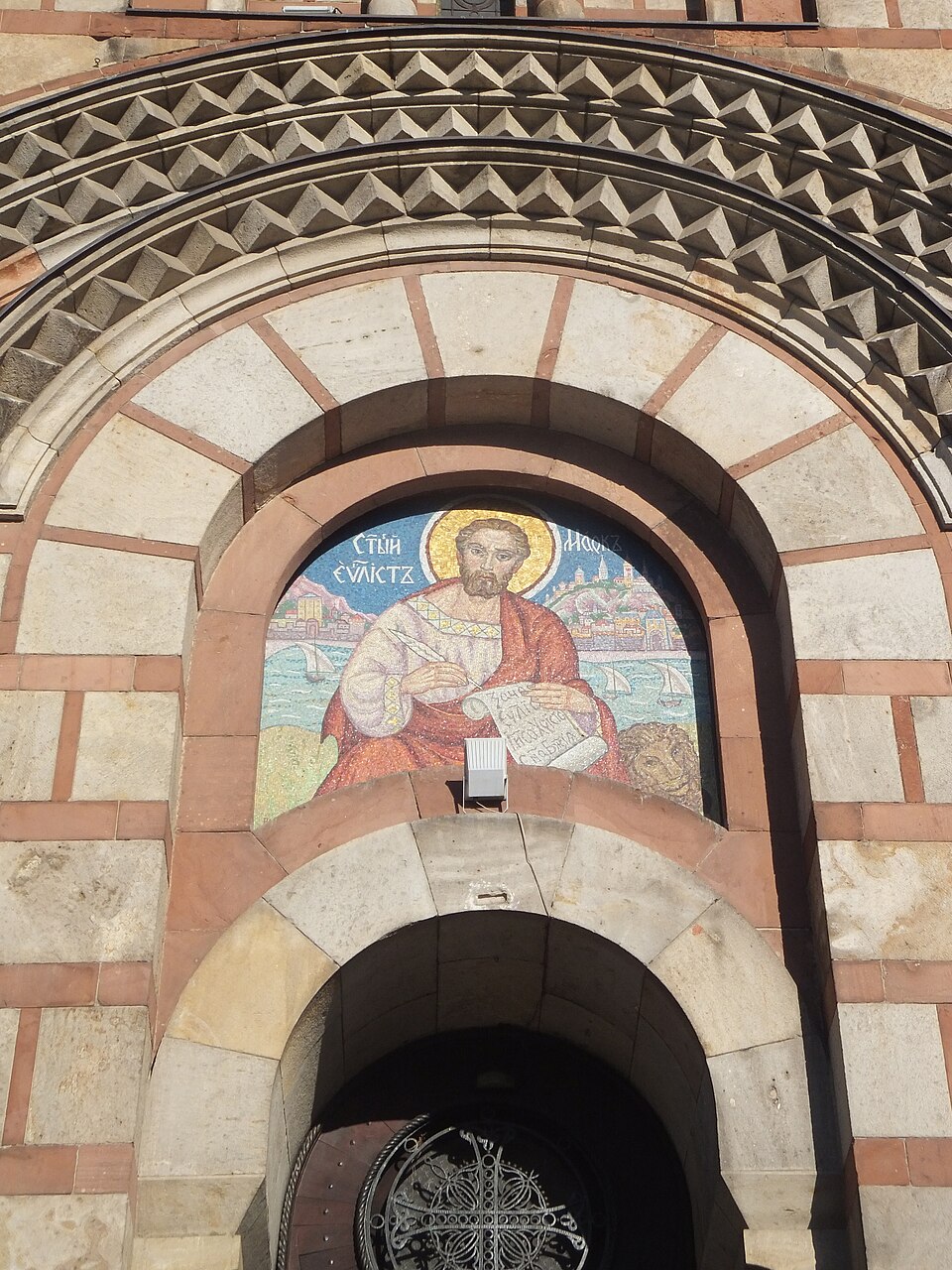
The marble iconostasis was installed in 1992 to a design by Zoran Petrović, its mosaic icons added between 1996 and 1998 by Đuro Radlović. Two large mosaics, both made from Venetian glass, followed much later: a 130-square-meter apse mosaic of the Mother of God completed in 2017, and a 100-square-meter ceiling mosaic of Christ Enthroned finished in 2022. Large stretches of wall remain bare plaster, since the fresco program that would normally cover a church of this scale has not been carried out.
St. Mark's holds the tomb of Emperor Stefan Dušan, the fourteenth-century ruler under whom medieval Serbia reached its greatest territorial extent; his remains were moved here in 1968. King Alexander I of Yugoslavia and Queen Draga are also buried in the church, along with Serbian Patriarch German.
Checked 2026-08-23 · Source
Twenty to thirty minutes covers the interior at a normal pace: the iconostasis, the two large mosaics and the royal and imperial tombs are the points worth stopping at. Visitors with a specific interest in Serbian church architecture or in the Nemanjić dynasty can extend that to 45 minutes by walking the full perimeter of the naos.
The church sits on Tašmajdan hill next to Tašmajdan Park, so it pairs naturally with a walk through the park or a stop at the nearby Church of St. Alexander Nevsky, roughly ten minutes away on foot, without needing to set aside a separate half-day.
Checked 2026-08-23 · Source
Mornings on weekdays are quietest, before tour groups working through central Belgrade's church circuit arrive. Sunday mornings carry an active liturgy with a full congregation, which is a valid way to see the building in use but is not the moment for a slow, photographic look at the mosaics.
The two large mosaics read best in daylight, since the interior lighting is dim by design and the Venetian glass depends on angled light to show its color range. Overcast winter afternoons leave the apse mosaic noticeably flatter than a bright morning does.
Checked 2026-08-23 · Source
Entry is free, as it is at every working Orthodox church in Belgrade; there is no admission booth and no combined ticket that covers St. Mark's alongside other sites in the city. Donation boxes near the entrance and the candle stand fund upkeep and are customary rather than mandatory.
Current details on whether specific chapels or the crypt area are roped off, and any seasonal changes to that access, are not published on the sources this page uses and are not reproduced here.
Checked 2026-08-23
The church stands on Tašmajdan hill on Bulevar kralja Aleksandra, a twelve-to-fifteen-minute walk east from Republic Square along Knez Mihailova and then the boulevard. Belgrade has no metro, so the practical alternative is any tram or trolleybus running along Bulevar kralja Aleksandra, with a stop at Tašmajdan directly opposite the church.
The site sits at the edge of Tašmajdan Park, next to Radio Television Serbia's building, which makes it an easy add-on to a walk that also takes in St. Alexander Nevsky Church a few streets to the west.
Checked 2026-08-23 · Source
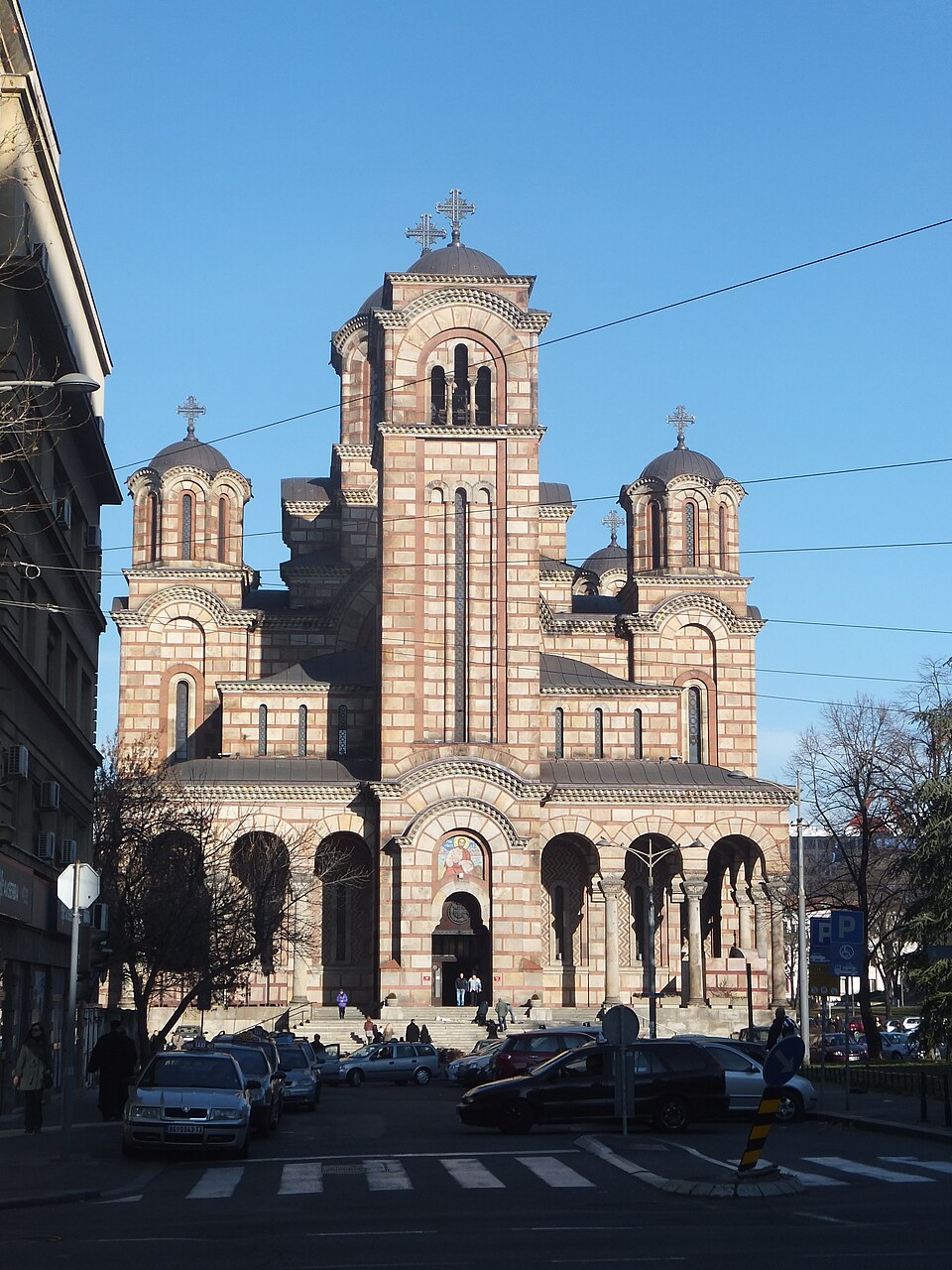
As an active Serbian Orthodox church, St. Mark's expects the same conduct as any working parish: shoulders and knees covered, hats off for men, and quiet during services. Entry may be restricted or the interior closed to sightseeing during liturgies, which run regularly on Sunday mornings and on feast days; a visit timed outside those hours avoids the conflict entirely.
The building is still an active construction and restoration site in places, since large interior surfaces remain undecorated decades after the exterior was finished — scaffolding or roped-off sections near ongoing work are not unusual and are not a sign the church is closed. There is no queue problem here comparable to Belgrade's more famous sites; crowding is rarely an issue outside of services.
Checked 2026-08-23 · Source
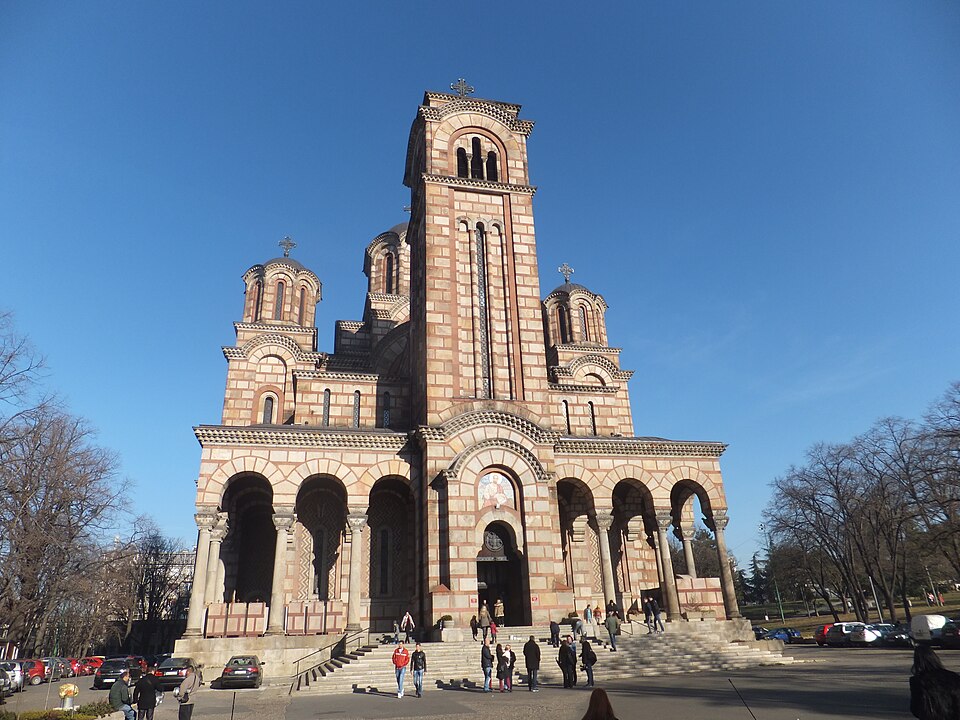
Photography without flash is normally tolerated in the naos outside of active services; flash and tripods disturb worship and are best avoided regardless of posted policy. The exterior stonework photographs well from the Tašmajdan Park side in the morning, when the sun is behind the photographer and picks out the two-tone stone banding.
Inside, the 2022 ceiling mosaic and the 2017 apse mosaic are the two subjects most worth the extra minute of framing, since both were built for exactly this kind of oblique, light-catching view and are recent enough that they are not yet as widely photographed as the older iconostasis.
Checked 2026-08-23 · Source
Construction ran from the laying of the foundation stone on 8 May 1931 to completion in 1940, though the interior decoration has continued in stages ever since and is still unfinished.
Brothers Petar and Branko Krstić, both professors at the University of Belgrade Faculty of Architecture, modeled it on the fourteenth-century Gračanica Monastery.
Emperor Stefan Dušan, whose remains were moved here in 1968, along with King Alexander I of Yugoslavia, Queen Draga, and Serbian Patriarch German.
The building is 62 meters long, 45 meters wide and 60 meters high excluding its cross, with an interior naos that seats up to 2,000 people and a choir gallery for 150 musicians.
No. The exterior was completed in 1939 and the structure in 1940, but large sections of the interior, including fresco painting, remain undecorated to this day.
Entry is free. Current details on donation-box practice or any area-specific restrictions are not published on the sources this page uses and are not reproduced here.
Loading the interactive map…
The interactive map could not be loaded.
Last updated:
Source: OpenStreetMap contributors, Wikidata ·