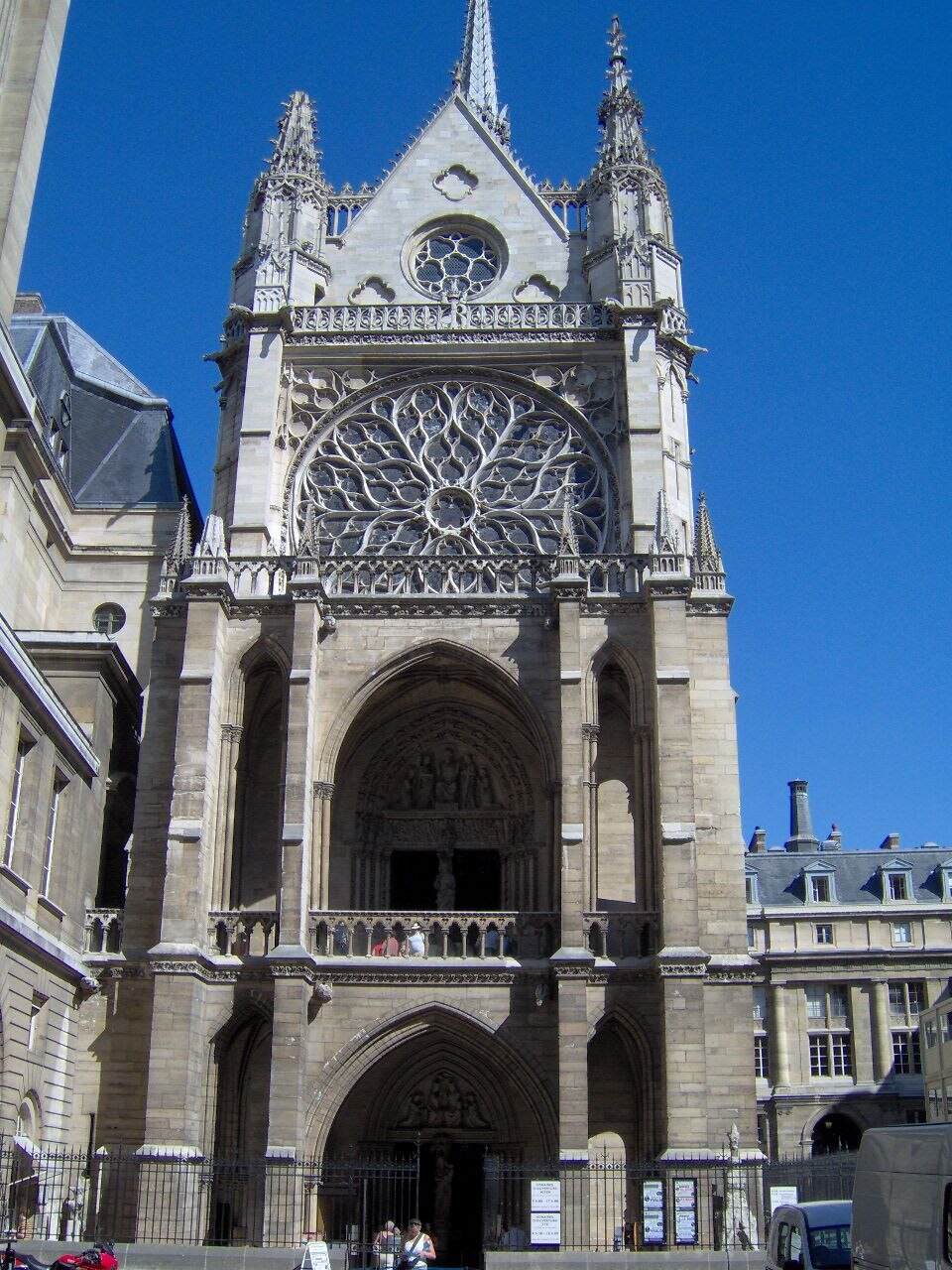
Sainte-Chapelle is a reliquary the size of a building, and the relic cost more than three times what the building did.
Louis IX bought the Crown of Thorns from Baldwin II, the Latin emperor at Constantinople, for 135,000 livres, paid to Venetian bankers. The Grande Châsse made to hold it cost another 100,000. The entire chapel, built and glazed, cost 40,000.
Construction began after 1238 and the chapel was consecrated on 26 April 1248. It is 36 m long, 17 m wide and 42.5 m high, which puts it among the major French Gothic buildings despite fitting inside a courtyard.
It is now a museum run by the Centre des monuments nationaux.
Two chapels stacked on each other, and 670 m² of thirteenth-century glass.
The lower chapel is dark, low and painted, and was for the palace staff. The upper chapel was for the king and the relics, and it is what people come for: fifteen windows of about 670 m² of stained glass, most of it installed between 1242 and 1248.
The rose window at the west end is later — late fifteenth century — nine metres across, with 89 panels of Apocalyptic scenes.
The Revolution destroyed the exterior sculpture and demolished the spire. The restoration began in 1840 under Félix Duban and Jean-Baptiste Lassus and took twenty-eight years.
Forty-five minutes inside, and most of it standing in the upper chapel.
There is one room and it is small. What takes the time is that the glass rewards being read rather than glanced at — the windows run in narrative order and the panels are the size of a hand at forty metres.
The lower chapel takes ten minutes and is where the queue is held.
The Conciergerie is in the same building complex and is another hour.
A bright morning. The glass is the entire point and it is lit from outside.
On an overcast day the upper chapel is dim and the colours do not carry; on a sunny one the floor and the walls take the colour of the windows. This is the rare Paris monument where the weather changes what you actually see.
The chapel is inside the Palais de Justice complex, which means airport-style security and a queue that forms outside on the pavement in all weather.
Evening concerts are held in the upper chapel and are a different and quieter way to see it.
Sainte-Chapelle is ticketed and a joint ticket with the Conciergerie is sold, the two being parts of the same medieval palace.
The figure shown on this page is the one currently published.
It is a national monument under the Centre des monuments nationaux and is covered by the Paris Museum Pass — but the pass does not skip the security queue, which is the queue that matters.
The security screening is the real queue. The chapel is inside a working courthouse and the screening is thorough; knives, tools and large bags will not pass and there is no left luggage.
The upper chapel is small and gets full. At peak times the experience is a slow shuffle round the walls rather than time spent looking.
Restoration scaffolding has covered individual windows at various times; there is no guarantee all fifteen are visible.
The stair between the chapels is a tight medieval spiral with no lift.
Photography without flash is permitted; tripods are not.
The upper chapel defeats phone cameras: the windows are brilliant and the stone between them is dark, and any automatic exposure picks one and loses the other. Expose for the glass and let the stone go black — that is closer to what the eye sees anyway.
The full sweep of fifteen windows needs a very wide lens from the west end, under the rose.
The rose window itself, nine metres across with 89 panels, is best in late afternoon when the sun is on the west front.
The lower chapel is painted, low and dim, and photographs as a blur without a support; tripods are not allowed.
Checked 2026-08-23
Common questions
What was Sainte-Chapelle built for?
To house Louis IX's Passion relics, above all the Crown of Thorns, which he bought from Baldwin II of Constantinople for 135,000 livres. The chapel itself cost 40,000.
How old is the glass?
Most of the fifteen windows were installed between 1242 and 1248 — around 670 m² of stained glass. The rose window at the west end is late fifteenth century.
When was it consecrated?
26 April 1248, after construction beginning some time after 1238.
How long does a visit take?
Forty-five minutes, most of it standing in the upper chapel. There is only one room worth the time and it is small.
Is it worth it on a cloudy day?
Less so. The glass is lit from outside, so a bright morning and an overcast afternoon are genuinely different visits.
Can I combine it with the Conciergerie?
Yes. A joint ticket is sold — the two are parts of the same medieval palace and are a few steps apart.
Nothing non-essential is set before you choose, in regions where consent is required. If you decline, ads still appear but they are non-personalised, and analytics is switched off entirely.