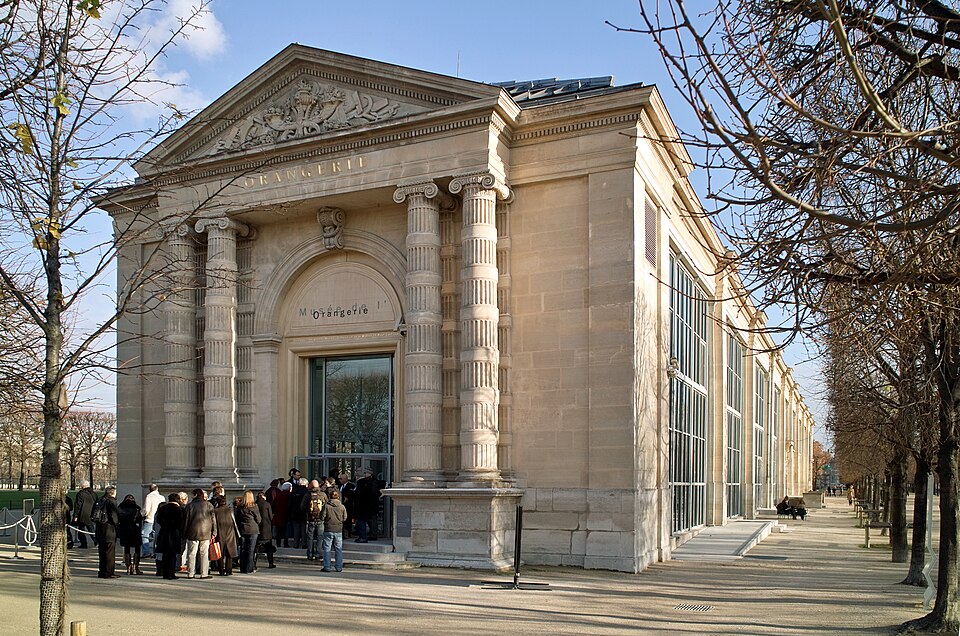
The Musee de l'Orangerie sits at the western end of the Tuileries Garden, in a building put up in 1852 under Napoleon III to overwinter the garden's orange trees, a purely functional greenhouse rather than a building meant to be seen. It became a museum after Claude Monet, then in his eighties, agreed in 1922 to give the state eight of his large Water Lilies canvases on condition that two purpose-built oval rooms held them, lit only by skylights he specified himself to keep the daylight even.
The rooms opened on 17 May 1927, a few months after Monet's death in December 1926, so he never saw the finished installation. The museum later added the Walter-Guillaume collection of Impressionist and early modern painting, assembled by the dealer Paul Guillaume and given to the state by his widow, Domenica Walter, in the 1960s and 1970s.
The building itself was renovated between 2000 and 2006 to restore the natural skylight Monet had specified, after decades in which additional exhibition space built above the oval rooms had blocked the original light source.
The two oval rooms hold Monet's Nymphaeas, eight panels each several metres wide, arranged to run continuously around the curved walls with no frame breaking one canvas from the next, so the water and reflections appear to wrap around the visitor rather than hang as separate pictures. Monet worked on the panels at his garden in Giverny for the last years of his life, in a studio he had specially built with a skylight for the purpose.
Below the oval rooms, the Walter-Guillaume collection holds Cezanne, Renoir, Matisse, Picasso, the Douanier Rousseau and Soutine, whose work Paul Guillaume championed early and in depth; the Soutine holdings in particular are among the largest gathered anywhere, and the collection also carries a small but significant group of Picasso's own early Cubist paintings.
Seventy-five minutes covers both oval rooms and the collection downstairs at an unhurried pace; the Water Lilies rooms alone are worth sitting in for at least fifteen minutes rather than walking straight through, since the panels reward a slow look from a fixed bench rather than a walking circuit.
Open 09:00 to 18:00 daily except Tuesday, checked against the museum's own site on 24 August 2026. Morning entry, close to opening, gives the oval rooms the best chance of being near-empty, since tour groups tend to arrive after 11:00 on their way through the Tuileries toward the Louvre.
Full admission is 12.50 EUR per person, checked on the museum's own site on 24 August 2026. A combined ticket with the Musee d'Orsay, which shares the same national-museum grouping, is sold separately for visitors doing both on the same trip and is generally cheaper than buying two full-price tickets; the exact validity window of that combined ticket was not confirmed during this check, so read the terms at purchase rather than assuming same-day use.
Concorde, on lines 1, 8 and 12, is the closest station, at the Tuileries end of Place de la Concorde. The museum sits inside the garden itself, so the walk in from the Concorde exit crosses open lawn rather than street, past the garden's own sculpture displays on the way.
The oval rooms are a fixed circuit with no seating inside them beyond a single central bench in each, so a quiet visit means timing around groups rather than avoiding them entirely. Bags above a small daypack size go through the same security check as the adjoining Tuileries entrances, and temporary exhibitions downstairs sometimes shrink the space given to the Walter-Guillaume collection. The building's small footprint also means it fills up fast relative to its size, so a queue can form at the entrance even when the wider Tuileries Garden outside looks uncrowded.
Photography without flash is allowed in the permanent collection, including the Water Lily rooms, which is unusual for a room this important and worth using: the panels read very differently in a wide shot than in the postcard crops most people have already seen. Flash and tripods are not permitted, and temporary exhibitions sometimes carry their own no-photography rule set by the lending institutions, so a sign at the entrance to a loan show should be checked rather than assumed to match the permanent collection's open policy.
Monet specified them himself in 1922 as the condition for donating eight large Water Lilies panels, and asked for skylight-only natural light and a continuous curved wall.
Did Monet see the finished rooms?
No. They opened on 17 May 1927, a few months after his death in December 1926.
What else is in the museum besides the Water Lilies?
The Walter-Guillaume collection: Cezanne, Renoir, Matisse, Picasso, the Douanier Rousseau and a large group of works by Soutine, on the level below the oval rooms.
What are the opening hours?
09:00 to 18:00 every day except Tuesday.
How much does admission cost?
12.50 EUR per person for full admission.
Is photography allowed?
Yes, without flash, in the permanent collection including the Water Lily rooms.
Nothing non-essential is set before you choose, in regions where consent is required. If you decline, ads still appear but they are non-personalised, and analytics is switched off entirely.




.jpg)
