


1 min walk · Paris 1er Arrondissement
La Nymphe
- Notable
- Art and culture venue
Language · 1 published
Historic monument · Paris 1er Arrondissement, Paris
Arc de Triomphe du Carrousel

Read from the OpenStreetMap access tags; anything not listed has no tag recorded.
Set the group type to family in the planner and the day window contracts to about three quarters of a solo day.
The Arc de triomphe du Carrousel stands in the Cour Napoleon, between the Louvre's wings and I. M. Pei's glass pyramid, and is one of the three structures poi_containments records as physically inside the Musee du Louvre complex, alongside the Louvre Palace itself and the pyramid, rather than as a separate rival monument competing with the museum for a visit.
Napoleon commissioned it in 1806 to celebrate the military victories of the year before, and the architects Charles Percier and Pierre Fontaine, who also designed much of the Louvre's Napoleonic-era interiors and went on to shape much of the Empire style across Paris, finished it in 1808 as the ceremonial entrance to the Tuileries Palace, which stood where the Tuileries Garden opens out today until it burned during the suppression of the Paris Commune in 1871 and was fully demolished in 1883, leaving the arch standing alone in open space where it once framed a gateway.
Checked 2026-08-24 · Source
There is no interior to visit; it is a freestanding triumphal arch, smaller and considerably older than the Arc de Triomphe at the top of the Champs-Elysees, which it predates by decades and is often confused with by first-time visitors reading only the name. Reliefs on its faces depict Napoleon's 1805 campaigns, including the surrender at Ulm and the entry into Munich and Vienna, and a bronze quadriga, four horses drawing a chariot led by a personification of Peace, tops it.
The original crowning group was the four bronze horses looted from Saint Mark's Basilica in Venice after Napoleon's 1797 Italian campaign; the allied powers forced their return to Venice in 1815 after his final defeat, and the current quadriga, added in 1828, is a nineteenth-century replacement cast to a related but distinct design rather than a copy of the Venetian originals.
Checked 2026-08-24 · Source
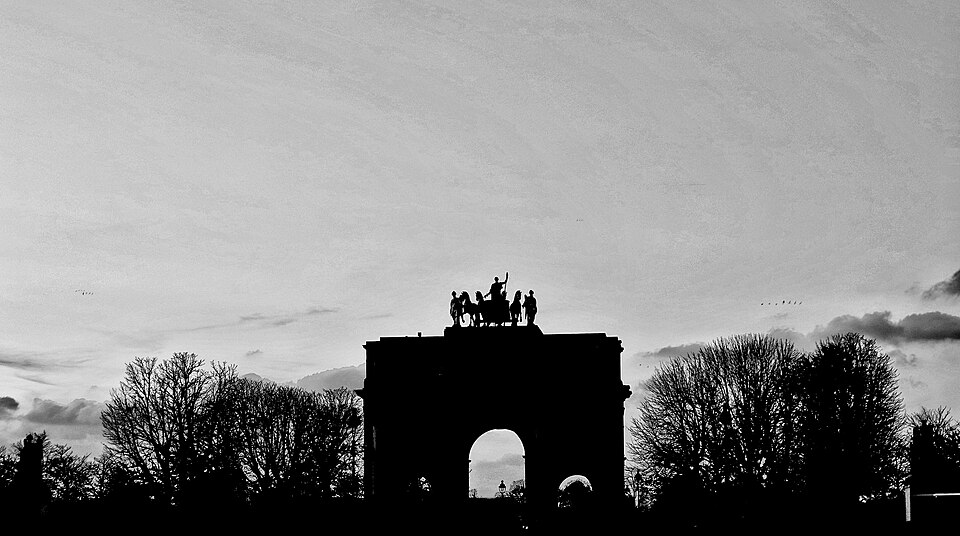
Fifteen minutes: it is seen and photographed rather than toured, most often as a stop while walking between the Louvre pyramid and the Tuileries Garden on the way to Concorde. There is no ticketed circuit or interior to extend the stop beyond a walk around the base and a look at the reliefs on each face.
Checked 2026-08-24 · Source

No fixed opening hours are recorded because it is an open-air monument standing in the Cour Napoleon; it is visible for as long as that courtyard itself is open, which follows the Louvre Museum's own opening pattern of 09:00 to 18:00 daily except Tuesday rather than a separate schedule of its own.
Checked 2026-08-24 · Source
Free to view; admission is not charged for the arch itself, checked against a reference source on 24 August 2026. It sits outside the ticketed part of the Louvre Museum, so no museum ticket is needed to see it, unlike the galleries inside the palace it stands beside, which makes it one of the few genuinely free stops directly in front of the pyramid.
Checked 2026-08-24 · Source

Palais-Royal - Musee du Louvre, on lines 1 and 7, is the closest station; the arch stands in the open courtyard between the pyramid and the Tuileries, reached on foot from any of the Louvre's usual entrances without needing a ticket or a security queue.
Checked 2026-08-24 · Source

Because it sits in the same courtyard as the pyramid, it draws the same dense crowds around the Louvre's main entrance rather than any hazard of its own; framing a clean photograph without other visitors in it is hardest at midday and easiest early morning before the museum's own queue has built up around the pyramid.
Checked 2026-08-24 · Source

Unrestricted outdoor photography at any time the courtyard is accessible. The classic shot lines the arch up with the pyramid behind it and the Champs-Elysees axis stretching beyond, best taken from ground level looking west in the late afternoon when the low sun lights the reliefs directly. The arch also lines up on the same historic axis as the Champs-Elysees arch and, further west, La Defense, a sightline that took over a century to complete and that guidebooks call the Axe Historique. Standing directly behind the arch and looking west through the pyramid, the Tuileries Garden, the Champs-Elysees arch and the Grande Arche de la Defense line up in a single continuous view on a clear day, a deliberate piece of urban planning stretched across more than a century of different regimes.
Checked 2026-08-24 · Source
No, that is a separate, much larger arch at Place Charles de Gaulle. This one is smaller and older, and stands inside the Louvre's Cour Napoleon.
It stands inside the Louvre complex alongside the Louvre Palace and the glass pyramid, but it is an outdoor monument rather than a ticketed part of the museum.
They were looted from Saint Mark's Basilica in Venice after Napoleon's 1797 campaign, mounted here in 1808, and returned to Venice in 1815 after his defeat; a replacement quadriga stands there now.
No, it is a free, open-air monument with no separate ticket.
The Tuileries Palace, which stood where the Tuileries Garden is today until it burned in 1871 and was demolished in 1883.
Loading the interactive map…
The interactive map could not be loaded.
Last updated:
Source: OpenStreetMap contributors, Wikidata ·