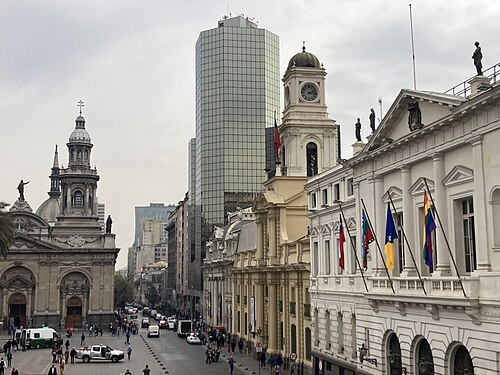
Plaza de Armas
Plaza de Armas de Santiago de Chile
Plaza de Armas is Santiago's principal historic square and the city's Kilometre Zero.
- Must see
- Historic monument
- Santiago
Language · 11 published
Country guide
Chile is a narrow strip between the Andes and the Pacific, the southernmost country in the world and the closest to Antarctica. Its 756,102 km² are arranged almost entirely along one north–south line, with Peru and Bolivia at the top and the Drake Passage at the bottom, so nearly every journey here is a journey up or down. The 2024 census counted 18.5 million people. Santiago is the capital and largest city. Chile also administers Pacific islands far offshore, among them Juan Fernández and Easter Island, which means two places under the same flag can sit an ocean apart.
Every city catalogued in this country so far, ranked by how much there is to see.
Photograph · Omnespsx (D•ES) · CC BY-SA 4.0
Ranked by importance — sitelinks, pageviews and heritage status, not editor preference.
100 places match
Category
Typical visit duration
Plaza de Armas de Santiago de Chile
Plaza de Armas is Santiago's principal historic square and the city's Kilometre Zero.
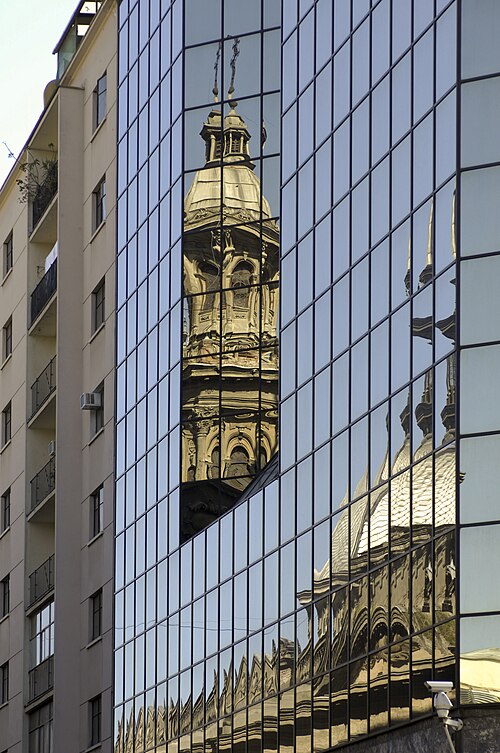
The Santiago Metropolitan Cathedral, known locally as Catedral Metropolitana de Santiago, stands as the principal Catholic cathedral of Chile's national capital. It occupies a commanding position on the west side of Plaza de Armas, the historic heart of Santiago.
Iglesia y Convento de San Francisco is a historic religious complex in central Santiago, comprising a church, convent, and museum under unified management. Founded by Franciscan missionaries, it stands among the oldest colonial-era structures in Chile's capital.
Museo de Santiago - Casa Colorada
Casa Colorada is a colonial-era house in central Santiago, Chile. Built in 1769, it is one of the oldest surviving structures in the city and serves as the Museo de Santiago Casa Colorada.
Patrimonio Mundial Ciudad minera de Sewell
Sewell is a UNESCO World Heritage mining town in the Andes mountains of central Chile. Established as a company town for copper extraction, it represents an exceptional example of early 20th century industrial urbanism at high altitude.
Palacio Museo de Bellas Artes
The Chilean National Museum of Fine Arts, locally known as Palacio Museo de Bellas Artes, stands as a principal cultural institution in Santiago. Located within the city's urban fabric, this landmark occupies a significant position in Chile's museum landscape.
Museo de Sitio y Parque por la Paz Villa Grimaldi
Casa Museo Isla Negra
Monumento a la Batalla de Chacabuco
Iglesia de San Francisco
Palacio Presidencial de Cerro Castillo
Patio 29 (Ejecutados Políticos)
Museo Astronómico Observatorio Manuel Foster
Plaza Sotomayor
Castillo Wulff
Espacio de Memoria Londres 38
Ascensor Artillería
Casa memoria José Domingo Cañas
Iglesia Carmen Bajo de San Rafael
Palacio Arzobispal de Santiago
Ascensor Polanco
Pontificia Universidad Católica de Chile
Castillo Brunet
Edificio Mundial
Casa Museo Vicente Huidobro
Museo de Bomberos de Santiago (MUBO)
Museo de Arte Contemporaneo
Museo Marítimo Nacional
Museo de Artes Decorativas Palacio Rioja
Templo Votivo de Maipú
Bodegas de la Viña Santa Carolina
Zona Típica Borde Costero de Cartagena
Palacio Carrasco
Casa de las Gárgolas
Casa de los Diez
Edificio de la Aduana
Monumento Histórico Hornos de Lonquén
Palacio Huneeus Valdés
Antiguo Teatro Carrera
Memorial Batalla Tres Acequias
Basílica de la Merced
Museo del Carmen
Museo de la Gran Minería del Cobre
Casa Museo Alberto Bachelet Martínez (Ex-Nido 20)
Basílica del Corazón de María
Iglesia de Santo Domingo
Catedral de Valparaíso
Bernardo O'Higgins
Arco Británico
Monumento a los Héroes de Iquique
Puerta Morandé 80
Paine, Un lugar para la memoria
Museo de Alhué
Iglesia de Nuestra Señora de la Divina Providencia
Museo CSD Colo Colo
Museo de Arte Sagrado
Memorial a Víctimas del Cuartel Simón Bolívar-DINA
Sitio Histórico Ex Escuela Normal Superior José Abelardo Núñez (JAN)
Fuente Alemana
Palacio Íñiguez
Memorial del Detenido Desaparecido y del Ejecutado Político
Gloria y Victoria
A la Victoria de Chacabuco
Source: OpenStreetMap contributors, Wikidata ·
A 10–16 day visit should pair Santiago with one major region, such as the Atacama, the Lake District or a Patagonian gateway. Chile’s length makes combining north and far south in a short itinerary transfer-heavy.
Chile’s consular service publishes the visa rules used for entry. Nationality, travel purpose and length of stay determine the requirement, and any application should be made through the official consular channel.
Santiago is the central international and domestic hub. Flights connect the desert, lake and Patagonian gateways, while long-distance buses cover mainland corridors and remote parks require a confirmed final transfer.
October through April is the broad operating window for many central and southern journeys. Atacama conditions, central-valley heat and Patagonian wind are distinct, so the least flexible regional leg should set the calendar.
Chile uses the Chilean peso (CLP). Current withdrawal costs and merchant acceptance are Not recorded; review the amount in pesos and any conversion offered before completing payment.
Chile uses 133 for police, 131 for ambulance and 132 for fire. Power is 220 V with Type C and L plugs, while nationwide tap-water guidance remains Not recorded.