
_-_(1986).JPG)
_-_1986.JPG)
_-1986-.JPG)
_-_1986_-.JPG)
_--_1986.JPG)
1 min walk
Königsplatz
- Must see · Heritage site
- Nature site
Language · 1 published
Museum · Munich
| Monday | Closed |
|---|---|
| Tuesday | 10:00 – 17:00 |
| Wednesday | 10:00 – 17:00 |
| Thursday | 10:00 – 20:00 |
| Friday | 10:00 – 17:00 |
| Saturday | 10:00 – 17:00 |
| Sunday | 10:00 – 17:00 |
Checked 2026-08-26 · Source
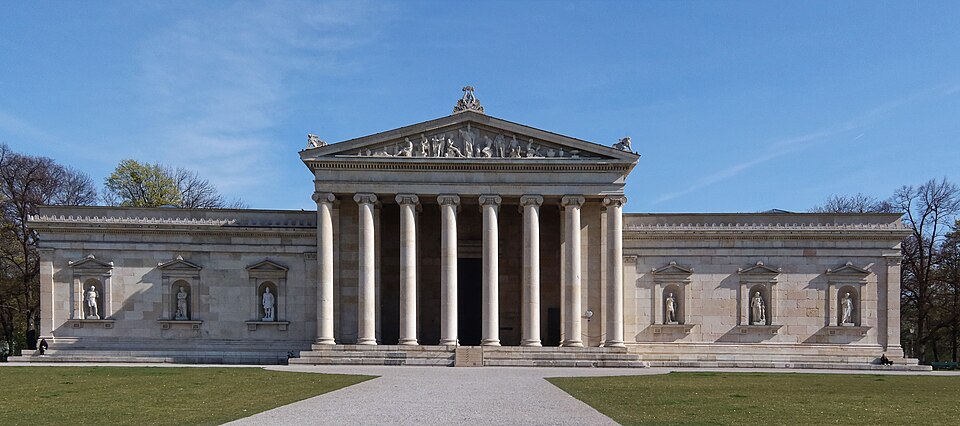
The Glyptothek occupies the north side of Königsplatz and is Munich's oldest public museum; its operator describes it as the only museum in the world devoted exclusively to ancient sculpture. The name is a manufactured nineteenth-century word, assembled from the Greek glyphein, to chisel, and theke, a store — a place where sculptures are kept. Ludwig I, King of Bavaria from 1825 to 1848, paid for the building and the collection out of his own pocket and instructed his Roman agent, Johann Martin von Wagner, to buy only works of outstanding beauty; most of what stands here was gathered between 1810 and 1820. Leo von Klenze built the house between 1816 and 1830, giving it a Greek temple front and vaulted interiors closer in spirit to Roman bath halls, fourteen of them ranged around a square courtyard. The museum shut at the outbreak of the Second World War, the sculptures went to monasteries for safekeeping, bombing in the summer of 1944 gutted the building, and it was left to decay for years afterwards. What reopened in 1972 is deliberately plain: slurried brick walls, blue-grey shell limestone floors and plinths, tall courtyard windows, and the figures pulled away from the walls to stand free in the middle of the rooms.
Checked 2026-08-26 · Source
The collection runs from the Archaic period of the sixth century BC through Greek Classicism of the fifth and fourth, Hellenism of the third to first, and on into the Roman Empire and Late Antiquity of the first to fifth centuries AD. The museum's own account names the pediment sculptures from the Temple of Aphaia on Aegina as its undisputed highlight: Ludwig bought them in 1812, Bertel Thorvaldsen supplemented them in Rome, they were installed in 1827 and restored after the war. Alongside temple and grave sculpture stands a long line of portraits — Homer and Plato, Alexander the Great, Augustus and Marcus Aurelius — so a walk through the halls is also a walk past faces the ancient world chose to remember. The children's media guide names the pieces most visitors come for and they make a serviceable checklist for adults too: the Kuros of Tenea, the Barberini Faun, the Athena of Aegina, the Augustus Bevilacqua and the Boy with the Goose. One work predates Ludwig entirely — the so-called Drunken Old Woman, a Roman copy of a Hellenistic original of around 200 BC, which came from the Wittelsbach electors' Antiquarium in the Residenz. The collection has grown since 1868 but remains, in the museum's own word, manageable.
Checked 2026-08-26 · Source

Ninety minutes is the honest figure for a first visit. Fourteen halls around one courtyard is a small museum by the standards of Munich's other collections, and the layout is a loop rather than a maze, so nobody spends time deciding where to go next. The museum does not publish a recommended visit length, but the running times of its own free media guide give a good frame: the Highlights tour covers thirteen works in about seventy minutes, the tour on the Greek view of humanity runs about sixty, and the portrait tour, Character heads, is offered in a sixty-minute and a hundred-and-fifty-minute version. The connoisseurs' tour covers ninety works and runs to roughly two hundred and seventy minutes of audio and video, which is a full afternoon and then some. Download the app before arriving rather than on the museum's wifi. Add half an hour if the café in the courtyard and Hall VIII is part of the plan, and add a further hour or so if the same day ticket is being used for the State Collections of Antiquities across the square, which most visitors do in one outing.
Checked 2026-08-26 · Source

The Glyptothek opens daily from 10:00 to 17:00, stays open until 20:00 on Thursdays, and closes on Mondays. There is no midday break. Thursday evening is the most comfortable slot: the late hours push the last two of the day well past the school-group window, and the halls are quietest after about 18:00. Sunday is the cheap day — admission drops to one euro per building — and is correspondingly busier. Beyond the weekly pattern, the museum publishes a list of unscheduled closures and it is worth reading before a trip is fixed. For 2026 the site lists the museum as closed on Tuesday 13 October, closed on 24 and 31 December, and open on 3 October, 1 November, and both 25 and 26 December. On two Thursdays, 17 September and 22 October, it closes at 17:00 instead of 20:00 and the evening tour is cancelled. On 17 October, the Long Night of Museums, the usual daytime opening is dropped entirely: the museum is closed from 10:00 to 17:00 and open instead from 18:00 to 01:00. Check the visitor information page again a few days before travelling, because that list is amended during the year.
Checked 2026-08-26 · Source
One ticket covers two museums: the day ticket admits the holder to both the Glyptothek and the State Collections of Antiquities on the far side of Königsplatz. The regular day ticket is six euros and the reduced ticket four. On Sundays there is a special admission price of one euro, charged per building rather than for the pair. Children and young people under eighteen are admitted free. An annual pass costs twenty euros, or fifteen reduced. The museum café is ticketed separately and cheaply — one euro for a day, two euros fifty for a year — so a coffee in the courtyard without a museum visit is possible. Tickets are sold at the museum ticket offices or online, and the museum warns plainly that online prices differ from the counter prices and that additional fees may apply; buying at the desk is the simpler option for a walk-up visit, and at these prices there is little queue risk. Further discounts and the full list of who enters free are set out in the general tariff conditions, published as a PDF on the visitor information page rather than summarised on it.
Checked 2026-08-26 · Source

No car is needed, and a car is the worse option. The Glyptothek sits on Königsplatz in the middle of Munich, a short distance from the main railway station, and the museum's own directions list three ways in: the U2 underground to Königsplatz, which puts a visitor on the square itself; tram 27 to Karolinenplatz, a few minutes' walk east; and the museum bus, line 100, which stops at Königsplatz and links the Kunstareal museums to the Hauptbahnhof and Ostbahnhof in one ride. That bus is the useful one if the Glyptothek is being combined with the Pinakotheken. Parking is paid and on-street in the adjacent roads, with no museum car park, so driving means hunting for a space in a dense inner-city district. The museum's event listing gives the address as Königsplatz 3; the administration's postal address, printed on the contact page, is Katharina-von-Bora-Straße 10, 80333 München, which is the same building approached from its western side. Step-free entry is at the northern royal entrance rather than up the main temple steps.
Checked 2026-08-26 · Source

The 17:00 close on every day except Thursday is the trap. It is early for a museum, and a visitor who eats lunch first and walks over at 15:30 will be moved along. Monday is a closed day, and the published list of unscheduled 2026 closures adds several more, including a Tuesday in October and two Thursdays that lose their evening hours. On accessibility the museum is specific and its two buildings differ sharply. The Glyptothek has barrier-free access at the northern royal entrance, all exhibition rooms are wheelchair accessible, and a lift from the café reaches the inner courtyard; an accessible toilet and lockers for luggage and coats sit beside the ticket office, and lightweight folding chairs can be borrowed. The State Collections of Antiquities, covered by the same ticket, is not wheelchair accessible at all — stairs at the main entrance and three exhibition levels inside — so do not plan the pair on the assumption that one ticket means one standard of access. Guide dogs and epilepsy alert dogs are admitted when identified. Blind visitors may touch the sculptures using gloves supplied at the cash desk, and the museum asks that this be booked in advance by phone or through its contact form.
Checked 2026-08-26 · Source

The light here is the whole point, and it is daylight. The 1972 reconstruction restored large windows onto the courtyard and set the sculptures free-standing in the middle of the halls, so a figure can be walked around and shot from any side — a luxury in a sculpture museum, where most collections press their marbles against a wall. On a clear day the courtyard light rakes across carved surfaces and reads the tool marks; on an overcast one it flattens to an even, forgiving wash that is easier for portraits and harder for drapery. Late morning and early afternoon give the strongest modelling. The Thursday evening opening is the exception worth planning for: after dusk the halls are lit artificially, the marble goes warmer and contrastier, and the rooms are close to empty, which matters because the halls are small and a wide shot fills quickly with other visitors. Bare brick and pale limestone will fool an automatic meter into underexposing white marble, so bias the exposure up. The museum's website does not publish a photography policy — no rule on tripods, flash or commercial use appears on its visitor pages — so ask at the ticket office rather than assume.
Checked 2026-08-26
The museum is open daily from 10:00 to 17:00, with an extended Thursday closing at 20:00, and it is closed on Mondays. There is no midday break. The operator also publishes a list of unscheduled closing days each year: for 2026 it names Tuesday 13 October, 24 December and 31 December as closed, and states that on 17 October, the Long Night of Museums, the museum is closed from 10:00 to 17:00 and open from 18:00 to 01:00 instead.
A regular day ticket is six euros and a reduced one four euros, and the same ticket admits the holder to both the Glyptothek and the State Collections of Antiquities opposite. On Sundays there is a special admission price of one euro, charged per building. Children and young people under eighteen enter free. An annual pass is twenty euros, or fifteen reduced. Online tickets are sold at different prices and may carry additional fees.
About ninety minutes covers the fourteen halls at a reasonable pace. The museum publishes no recommended duration, but the running times of its free media guide are a useful gauge: the Highlights tour takes roughly seventy minutes for thirteen works, and the connoisseurs' tour runs to about two hundred and seventy minutes across ninety works. Allow an extra hour if the day ticket is also being used for the State Collections of Antiquities across the square.
The museum lists the U2 underground station Königsplatz, tram 27 to the Karolinenplatz stop, and museum bus line 100 stopping at Königsplatz. All three put a visitor within a few minutes of the door, and line 100 connects the building to the Hauptbahnhof and the rest of the Kunstareal. Parking is paid and on-street in the neighbouring roads, so a car is unnecessary and inconvenient.
Yes. Barrier-free access is at the northern royal entrance, every exhibition room is wheelchair accessible, and a lift from the café reaches the inner courtyard. An accessible toilet and lockers are next to the ticket office, and lightweight folding chairs can be borrowed. The State Collections of Antiquities, covered by the same ticket, is not wheelchair accessible: stairs at the main entrance and three exhibition levels inside.
The pediment sculptures from the Temple of Aphaia on Aegina, bought by Ludwig I in 1812 and installed in 1827, are the works the museum itself calls its undisputed highlights. Beyond them, the pieces the museum's own guides single out are the Kuros of Tenea, the Barberini Faun, the Athena of Aegina, the Augustus Bevilacqua, the Boy with the Goose, and the Drunken Old Woman, a Roman copy of a Hellenistic original of around 200 BC.
Loading the interactive map…
The interactive map could not be loaded.
Last updated:
Source: OpenStreetMap contributors, Wikidata ·