

.jpg)
_(21755079366).jpg)
1 min walk · Paris 16e Arrondissement
La France
- Notable
- Art and culture venue
Language · 1 published
Museum · Paris 16e Arrondissement, Paris
| Monday | 12:00 – 22:00 |
|---|---|
| Tuesday | Closed |
| Wednesday | 12:00 – 22:00 |
| Thursday | 12:00 – 22:00 |
| Friday | 12:00 – 22:00 |
| Saturday | 12:00 – 22:00 |
| Sunday | 12:00 – 22:00 |
Checked 2026-08-24 · Source
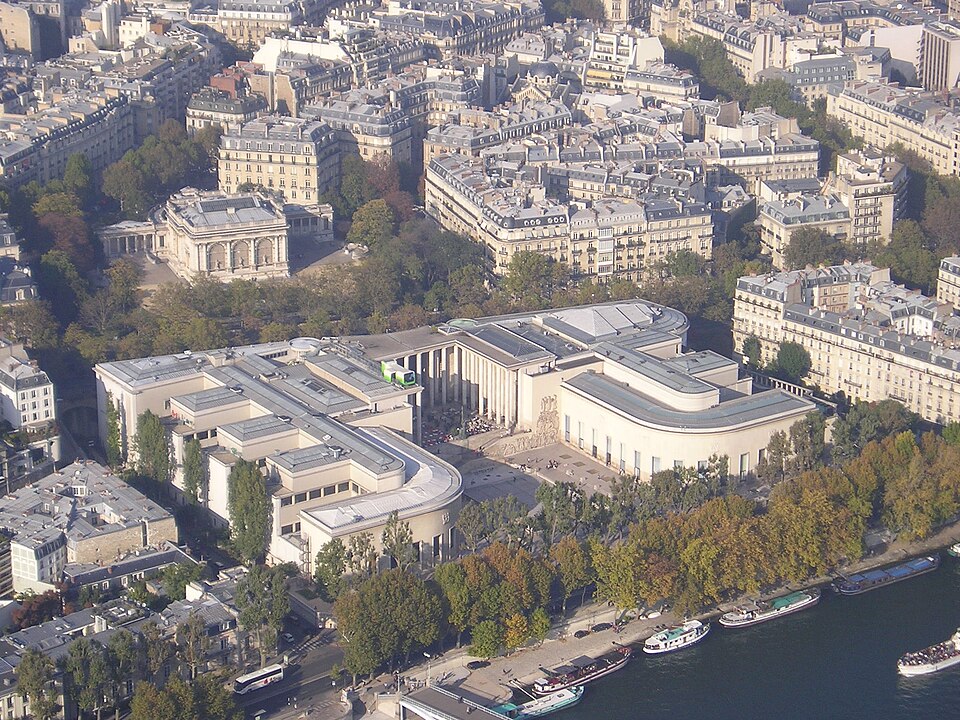
The Palais de Tokyo is Paris's largest centre for contemporary art, occupying the eastern wing of a building raised for the 1937 International Exposition by architects Jean-Claude Dondel, Andre Aubert, Paul Viard and Marcel Dastugue.
The building's west wing houses a separate institution, the Musee d'Art Moderne de la Ville de Paris, the city's own museum of modern art with its own permanent collection; the two share the address but operate as distinct museums with separate entrances and separate ticketing.
The Palais de Tokyo side reopened in its current, deliberately unfinished raw-concrete form in 2002 and expanded further in 2012, and it holds no permanent collection of its own — everything shown rotates through temporary exhibitions.
The building takes its name from the quai de Tokio, the old name for the stretch of riverbank it stands on before it was renamed avenue de New York and then avenue du President Wilson; the original 1937 name stuck to the building even after the streets around it changed twice.
Checked 2026-08-24 · Source
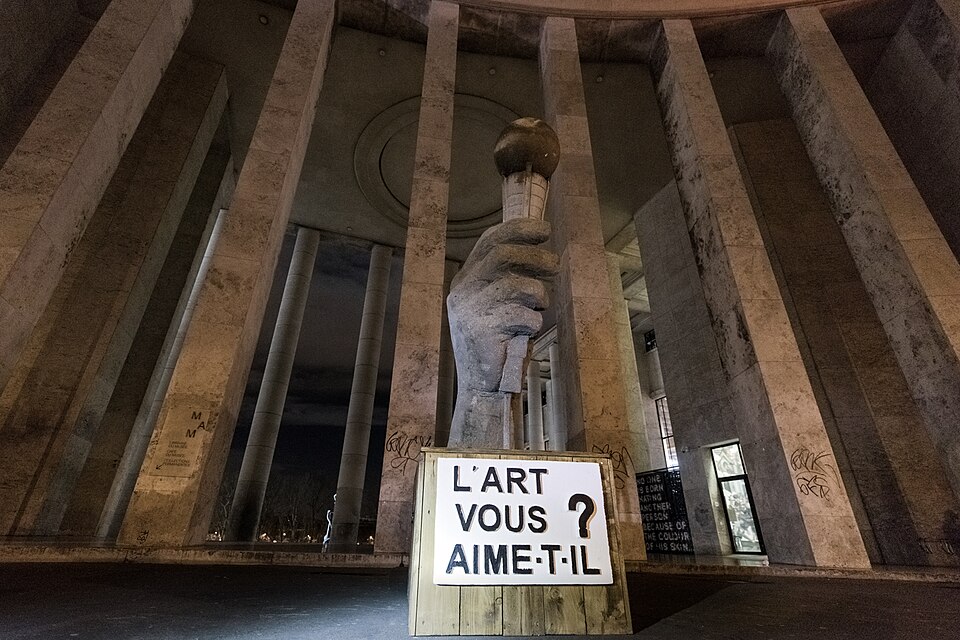
Roughly 13,000 square metres of exhibition space across raw, largely unrenovated concrete floors and stripped ceilings, a deliberate contrast to the polished white-cube galleries of most contemporary art institutions.
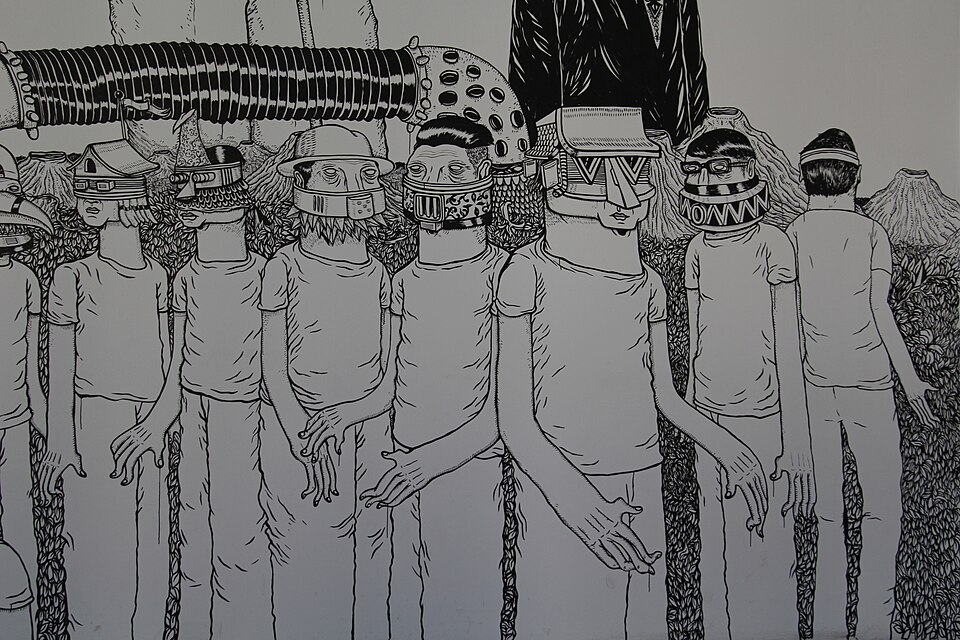
The programme is entirely temporary exhibitions — large-scale installations, solo and group shows, performance and moving-image work — that change several times a year, so there is no fixed circuit to describe; what is on display depends entirely on the current programme.
The building also holds a bookshop, restaurant and bar spaces that have made it as much a late-evening destination as a daytime museum stop, unusual for an art institution of its scale.
The 2012 extension by architects Anne Lacaton and Jean-Philippe Vassal opened up further basement levels that had sat unused since the 1937 building's construction, enlarging the exhibition area without changing the deliberately raw finish of the original 2002 renovation.
Checked 2026-08-24 · Source
One to two hours for the current exhibitions, depending on how much of the programme is open that season — the space's scale means a full show can run long.
Because there is no permanent collection to anchor a visit, checking what specific exhibitions are running before going is more useful here than at a collection-based museum. A visitor who arrives without checking risks finding only part of the 13,000 square metres open, since large installations sometimes take weeks to strike between shows.
Checked 2026-08-24
The Palais de Tokyo has historically kept some of the latest closing hours of any Paris museum, extending into the evening on several nights a week, which makes it one of the few art venues in the city that works well as an after-dinner stop rather than only a daytime one.
Exact current opening days and hours are not reproduced here, since the schedule has changed more than once; check the museum's own listing before planning an evening visit.
Checked 2026-08-24
Admission is paid, separately from the Musee d'Art Moderne next door, with the two institutions selling different tickets despite sharing a building.
Current prices are not reproduced here; check the Palais de Tokyo's own site before travelling. Reduced rates for under-26s and students have historically applied here as at most Paris contemporary art venues, but the exact current terms and any free-entry evening are not recorded and should be confirmed on the same listing.
Checked 2026-08-24
On avenue du President Wilson in the 16th arrondissement, on the Right Bank facing the Seine, close to the Trocadero and a short walk from the Musee du quai Branly on the opposite side of the river.
Metro line 9 stops at Iena, directly outside, or Alma-Marceau, a few minutes further along the avenue.
Checked 2026-08-24 · Source
This is not the Musee d'Art Moderne next door — the two share a building but not a ticket or an entrance, and arriving with the wrong one in mind is the most common confusion at this address.
Because the programme is entirely temporary shows, a specific work or installation seen in a photograph online may already have closed by the time of a visit.
Checked 2026-08-24

The raw concrete interior itself is often the most striking subject, independent of whatever exhibition is running — stripped ceilings, exposed structure and industrial stairwells give a texture few Paris museums share.
Photography rules vary by exhibition, since some installations restrict it for the artist's or lender's reasons; check the signage at each show rather than assuming a blanket policy.
Checked 2026-08-24
No — it shows only temporary exhibitions, unlike the Musee d'Art Moderne next door which does hold one.
No. They share a 1937 building but are separate institutions with separate entrances and tickets.
It was deliberately reopened in 2002 in raw concrete, left largely unrenovated, as a contrast to the polished galleries of most art museums.
It has historically kept later evening hours than most Paris museums on several nights a week; check its current listing for the exact schedule.
Iena on line 9, directly outside the building.
Architects Jean-Claude Dondel, Andre Aubert, Paul Viard and Marcel Dastugue, for the 1937 International Exposition.
Loading the interactive map…
The interactive map could not be loaded.
Last updated:
Source: OpenStreetMap contributors, Wikidata ·