
_-_DPLA_-_5286b657b01f0863eabf7c838ff55717.jpg)


1 min walk · Paris 16e Arrondissement
La France
- Notable
- Art and culture venue
Language · 1 published
Museum · Paris 16e Arrondissement, Paris
Musée d'Art Moderne de Paris
| Monday | Closed |
|---|---|
| Tuesday | 10:00 – 18:00 |
| Wednesday | 10:00 – 18:00 |
| Thursday | 10:00 – 21:30 |
| Friday | 10:00 – 18:00 |
| Saturday | 10:00 – 18:00 |
| Sunday | 10:00 – 18:00 |
Checked 2026-08-24 · Source
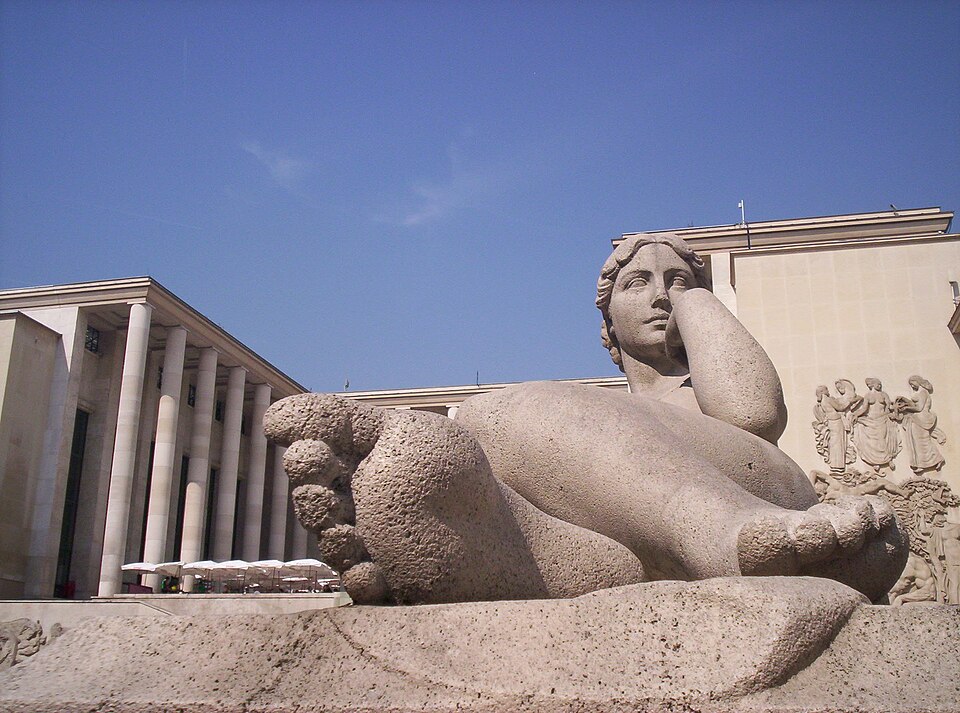
Musée d'Art Moderne de Paris is the city of Paris's own museum of modern art, occupying the east wing of the Palais de Tokyo on Avenue du Président Wilson. The building was constructed for the 1937 International Exposition and the museum opened inside it in 1961, taking over a space originally built to house exhibitions of contemporary art at the time of the fair itself. It belongs to the Paris Musées network, the group of city-run museums whose permanent collections carry free admission, distinguishing it from the national museums such as the Louvre or the Pompidou, which the French state rather than the city runs and which charge for their permanent collections.
The museum's own history includes a well-known theft: in May 2010 a burglar cut through a padlocked window grille overnight and removed five major paintings, including works by Matisse and Picasso, in an episode that made international news. A suspect was later convicted, but the paintings themselves were never recovered.
Checked 2026-08-24 · Source
The collection runs from Fauvism and Cubism through the School of Paris into contemporary work, and the rooms are arranged roughly chronologically so a walk through the building traces that whole span. Henri Matisse's La Danse inachevée, an unfinished mural triptych commissioned for a Merion, Pennsylvania collector and never delivered, fills a room of its own. Raoul Dufy's La Fée Électricité, painted for the 1937 Exposition to celebrate electricity's history, wraps a curved gallery and is among the largest paintings in the world at roughly 600 square metres, built from more than two hundred separate panels. Works by Amedeo Modigliani and Robert Delaunay also sit in the permanent rooms, alongside a rotating contemporary programme that keeps parts of the museum changing between visits even when the historic collection stays fixed.
Checked 2026-08-24 · Source

About ninety minutes to two hours for the permanent collection; a paid temporary exhibition, when one is running, adds another forty-five minutes to an hour, and the Dufy room alone is worth pausing in longer than its size might suggest, since the mural rewards a slow walk along its curve rather than a single glance from the doorway. Visitors on a tight schedule can see the highlights — the Matisse room and the Dufy mural — in as little as thirty minutes if they head straight there.
Checked 2026-08-24 · Source

Closed on Mondays. It runs noticeably quieter than the Pompidou or the Orsay, which cover similar periods with far larger crowds, which makes it one of the more comfortable major collections in Paris to see without a queue at the door, and a good option for an afternoon when the bigger national museums are visibly overcrowded.
Checked 2026-08-24 · Source
The permanent collection is free, funded by the city of Paris as part of the Paris Musées network, and no booking is required to walk in during opening hours. Temporary exhibitions are paid separately, each priced by the show it accompanies.
Checked 2026-08-24 · Source

Métro Iéna or Alma-Marceau, both on line 9, sit within a short walk, across the river from the Eiffel Tower area and a few minutes from the Trocadéro gardens. The Avenue du Président Wilson entrance is easy to walk past without noticing, since the museum's low, colonnaded facade reads more like a civic building than a gallery front from street level.
Checked 2026-08-24 · Source

The building's west wing houses Palais de Tokyo, a separate contemporary-art centre with its own paid programme and its own entrance — the two are easy to confuse from outside since they share one building from the 1937 Exposition and a similar name in casual conversation, so checking which entrance to use before arriving saves a walk around the block. Some galleries close in rotation for rehang, so a specific work is not guaranteed to be on view on every visit, and it is worth checking the current room list before making a special trip for one piece.
Checked 2026-08-24 · Source

The curved room holding Dufy's La Fée Électricité is the room most visitors photograph, since its scale is hard to convey any other way and a wide shot from the room's centre captures the sweep of the whole mural at once. Photography of the permanent collection is generally allowed without flash, in keeping with the free, city-run character of the museum, though any current loan exhibition may carry its own separate restriction.
Checked 2026-08-24 · Source
Yes, for the permanent collection; temporary exhibitions are ticketed separately.
They share one building from the 1937 Exposition, but Musée d'Art Moderne de Paris is the city's free permanent-collection museum in the east wing, while Palais de Tokyo is a separate paid contemporary-art centre in the west wing.
Monday.
Raoul Dufy's La Fée Électricité, a roughly 600-square-metre painted mural wrapping a curved gallery.
Around ninety minutes to two hours for the permanent collection alone.
Loading the interactive map…
The interactive map could not be loaded.
Last updated:
Source: OpenStreetMap contributors, Wikidata ·