


_-_Flickr_-_dalbera_(cropped).png)
1 min walk · Paris 16e Arrondissement
equestrian statue of George Washington
- High
- Historic monument
Language · 1 published
Museum · Paris 16e Arrondissement, Paris
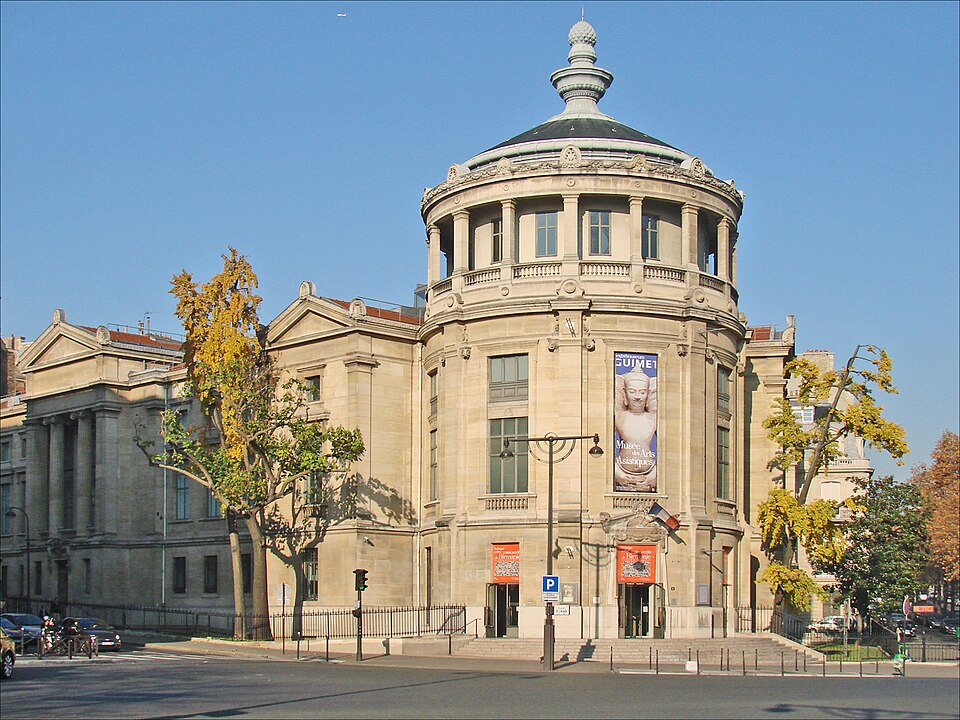
Musée Guimet
| Monday | 10:00 – 18:00 |
|---|---|
| Tuesday | Closed |
| Wednesday | 10:00 – 18:00 |
| Thursday | 10:00 – 18:00 |
| Friday | 10:00 – 18:00 |
| Saturday | 10:00 – 18:00 |
| Sunday | 10:00 – 18:00 |
Checked 2026-08-24 · Source
The Musee national des Arts asiatiques - Guimet holds the largest collection of Asian art outside Asia itself, spanning Afghanistan, Pakistan, India, Nepal, Tibet, China, Korea, Japan and Southeast Asia in one national museum.
It began as the private collection of the industrialist Emile Guimet, first opened in Lyon in 1879 and moved to its current building on place d'Iena in Paris in 1889. The state absorbed the collections of the former Musee Indochinois du Trocadero into it in the 1920s, which is why its Khmer holdings are so strong.
It became France's national museum of Asian art in 1945, when its Egyptian and Middle Eastern collections were transferred out to the Louvre in exchange for the Louvre's own Asian holdings coming in.
Emile Guimet built his original fortune in industrial chemicals and dyes in Lyon, and travelled through Egypt, Japan, China and India in the 1870s collecting religious art and artefacts specifically to found a museum of world religions, an unusual founding purpose that still shapes how the collection is organised by faith and region rather than purely by period.
Checked 2026-08-24 · Source
The Khmer collection is the museum's signature strength, with sandstone sculpture from Angkor and the wider Khmer empire forming one of the finest groups outside Cambodia itself, a legacy of French colonial-era archaeology in Indochina.
Beyond Cambodia, the galleries hold Gandharan Buddhist sculpture from ancient Afghanistan and Pakistan, Chinese bronzes, ceramics and Buddhist art across several dynasties, Japanese lacquerware and prints, and Nepalese and Tibetan Buddhist and Hindu religious art.
A short walk away, the museum's Hotel Heidelbach annex, the Galeries du Pantheon bouddhique, holds Emile Guimet's own Japanese and Chinese Buddhist statuary collection behind a small formal Japanese garden, a quieter counterpart to the main building.
A domed rotunda at the top of the main building holds part of the museum's historic library, a detail visitors focused on the ground-floor collections sometimes miss entirely on a first visit.
Checked 2026-08-24 · Source
Two hours for the main building's permanent galleries; add thirty minutes for the Pantheon bouddhique annex nearby, which is included on the same ticket.
The museum is large enough, and its regional collections distinct enough, that visitors focused on one region — Khmer sculpture, or Japanese art — can reasonably spend the whole visit there rather than covering all of Asia in one pass. Add a temporary exhibition, which the museum runs regularly alongside the permanent galleries, and a full visit can extend past three hours.
Checked 2026-08-24
Weekday mornings are the quietest slot; the Guimet sits slightly off the densest tourist routes around the Eiffel Tower and the Trocadero, so it rarely reaches the crowding of the Louvre or Orsay even in peak season.
The small Japanese garden at the Pantheon bouddhique annex is worth timing for a clear day, since it is an open-air courtyard rather than an indoor space.
Checked 2026-08-24
Admission is paid for the permanent collection, with the Pantheon bouddhique annex included on the same ticket, and free entry for under-18s in line with French national museums.
Current prices are not reproduced here; check the museum's own site before travelling. As at most French national museums, a free-entry day exists for some visitor categories on certain dates, but the exact current rule is not recorded and should be confirmed on the operator's own listing.
Checked 2026-08-24

On place d'Iena in the 16th arrondissement, close to the Trocadero and a short walk from the Palais de Tokyo and the Musee du quai Branly on the opposite bank.
Metro line 9 stops directly at Iena, right outside the museum's front steps.
Checked 2026-08-24 · Source

The Pantheon bouddhique annex is a separate building a short walk from the main museum, not a room inside it — visitors who do not know this sometimes miss it entirely despite it being included on the same ticket.
Some Khmer and Gandharan stone pieces are displayed with minimal barriers; the museum asks visitors to keep a clear distance rather than lean in for a closer look.
Checked 2026-08-24

The Pantheon bouddhique's small Japanese garden, seen through the annex's windows or from its courtyard, is the most distinctive photograph the site offers and one few visitors to the main building know to look for.
Inside the main galleries, photography without flash is generally permitted, as at most French national museums, but rules can vary for specific loaned pieces — signage at each case states the exception.
Checked 2026-08-24
Khmer sculpture from Angkor and the wider Khmer empire, one of the finest groups outside Cambodia itself.
The industrialist Emile Guimet, whose private collection first opened in Lyon in 1879 before moving to Paris in 1889.
A separate annex building near the main museum, holding Emile Guimet's own Japanese and Chinese Buddhist statuary behind a small Japanese garden, included on the same ticket.
In 1945, when its Egyptian and Middle Eastern holdings moved to the Louvre in exchange for the Louvre's Asian collections.
Iena on line 9, right outside the museum.
Under-18s enter free, in line with French national museums generally.
Loading the interactive map…
The interactive map could not be loaded.
Last updated:
Source: OpenStreetMap contributors, Wikidata ·