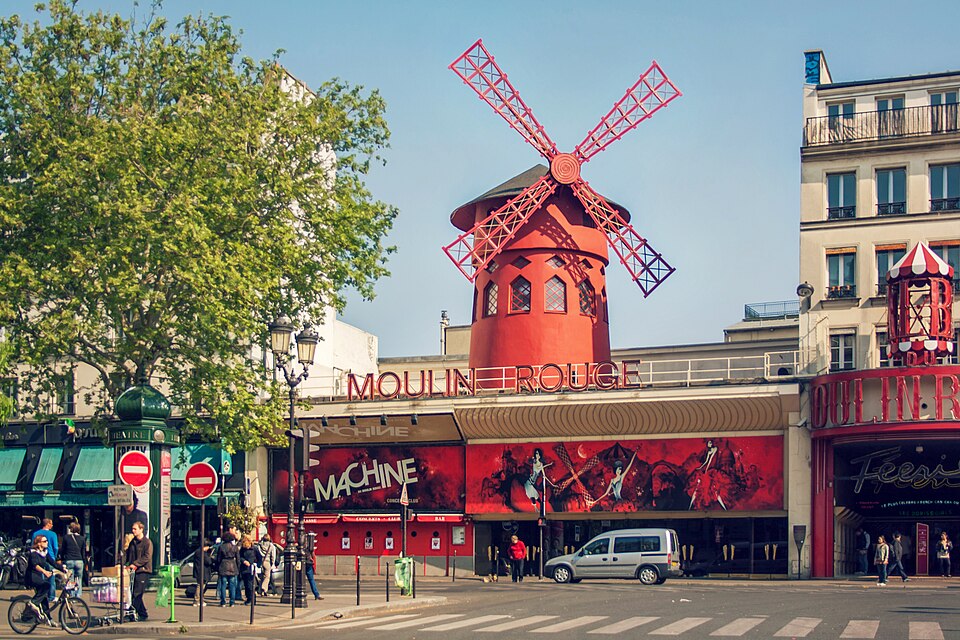
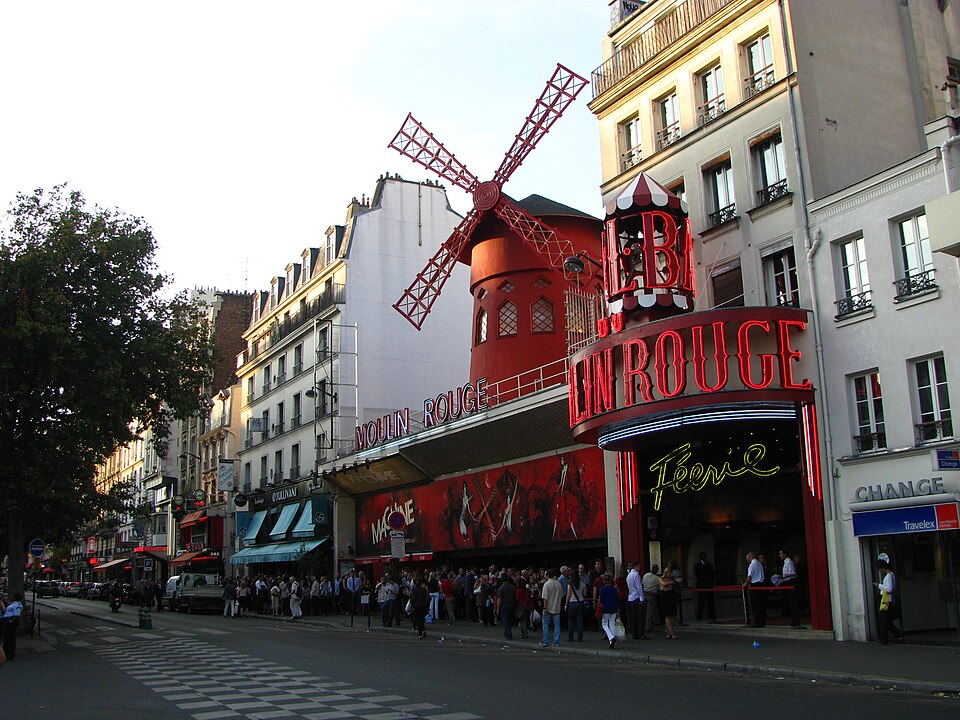
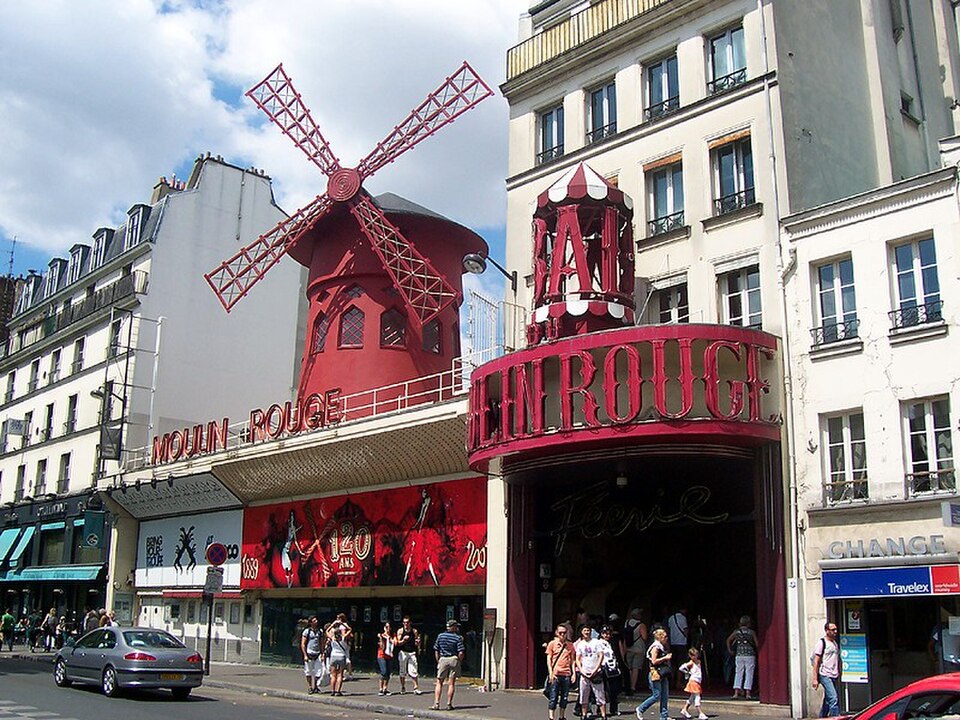
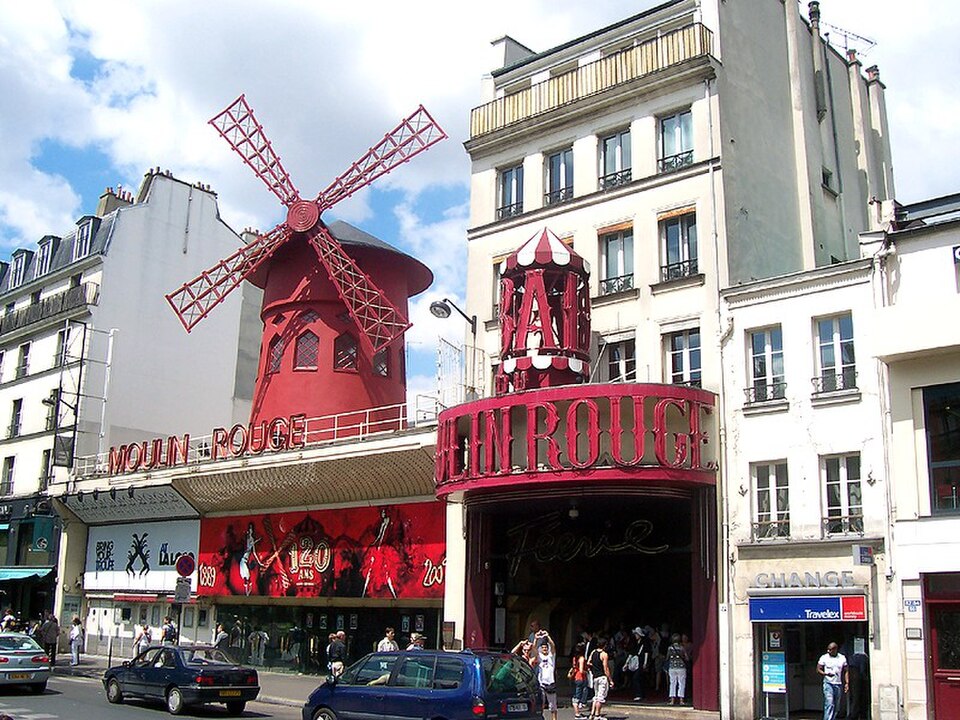
A red windmill on a Pigalle façade marks the cabaret that turned the French cancan into a Paris export.
Joseph Oller and Charles Zidler opened the Moulin Rouge on 6 October 1889, at the foot of Montmartre, the same year the Eiffel Tower went up across the city for the World's Fair. The cancan, already danced in working-class Montmartre halls, became the venue's signature act and the reason it drew a wealthy, mixed audience into a neighbourhood otherwise known for cheaper entertainment.
Henri de Toulouse-Lautrec, a regular in the audience through the 1890s, painted and lithographed the venue and its performers — La Goulue among them — in images that are now more widely recognised than almost any photograph of the building itself.
A dinner-and-cabaret theatre built around a single revue, currently titled Féerie, running with a live orchestra, elaborate costume, and the cancan line at its centre.
The original 1889 interior burned down in a fire in 1915; the venue rebuilt and has operated continuously on the same site since, updating its shows across the decades while keeping the format of a seated dinner or champagne show built around themed numbers. The red-windmill sign on the façade, rebuilt and re-lit many times over, remains the venue's identifying image.
The revue format has stayed consistent even as the specific show has changed names over the decades: a sequence of themed numbers built around costume, choreography and the cancan finale, staged for an audience seated at tables rather than in conventional theatre rows. Live musicians accompany the whole performance rather than a recorded score.
Around two hours for a show, longer if the seating includes a dinner service beforehand rather than a drinks-only slot before the performance starts.
Shows run on a fixed schedule rather than free entry, so the time commitment is set by the booking rather than by how long a visitor wants to stay — arriving and leaving mid-performance is not really an option once seated.
Whichever of the fixed evening performances is booked — the venue does not run daytime shows or open for casual browsing.
Booking ahead matters more than choosing a particular night: seats fill for both the earlier and later evening slots, and a same-day walk-up is far less reliable than reserving in advance, especially in the busier tourist months.
Entry is by booked show only. Current ticket rates are not published on the sources this page uses and are not reproduced here.
The venue sells several seating tiers — champagne-only, dinner-and-show, and higher seating categories closer to the stage — through its own official booking system, which is the source to check before travelling rather than a resale or aggregator site.
Boulevard de Clichy in Pigalle, at the southern foot of the Montmartre hill, in the 18th arrondissement.
Blanche, on Métro line 2, sits directly outside the venue, and Pigalle station, on lines 2 and 12, is a short walk east along the same boulevard, close enough to combine with a wider evening out in the district.
The surrounding Pigalle streets carry the area's long-standing red-light-district reputation, which is worth being aware of walking to and from a late-evening show, though the venue and the immediate boulevard are well lit and busy with tourist traffic.
Shows run on a strict schedule and seating is assigned, so arriving after the doors close for a performance means missing it rather than joining late. Photography and filming during the performance itself are generally restricted, in keeping with most cabaret theatres.
Dress expectations lean smart rather than casual, especially for the higher seating and dinner categories, and the venue asks guests to arrive with enough margin before the stated start time to be seated and served before the performance begins.
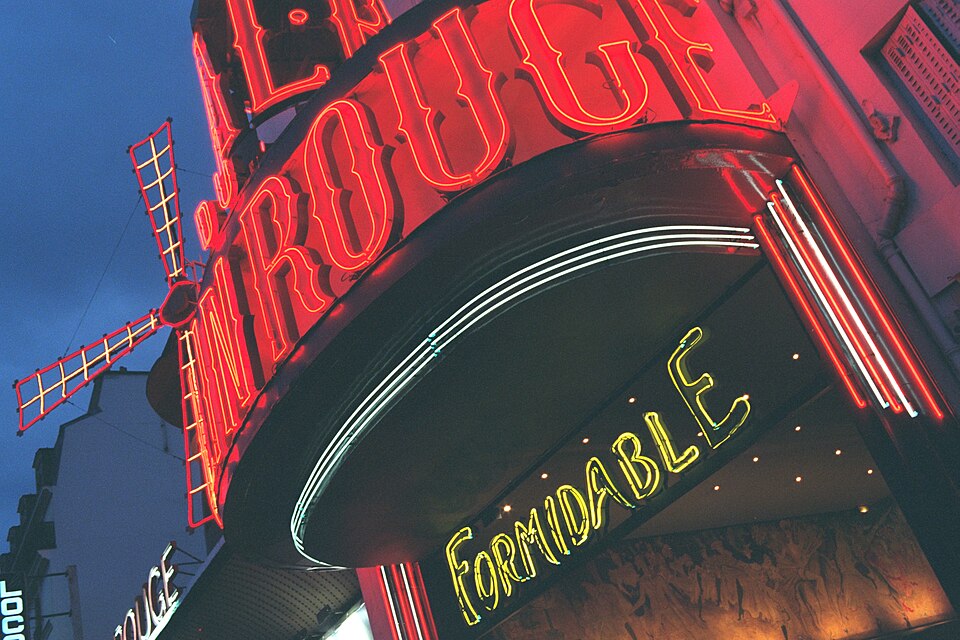
The illuminated red windmill on the façade, shot from across Boulevard de Clichy after dark, is the image the venue is known for and the one visitors line up to take before a show.
Inside, photography during the performance is generally restricted, so the façade and the entrance are the reliable subjects rather than the show itself. The windmill's red neon reads best in the half-light just after sunset, before full darkness flattens the surrounding street into shadow.
On 6 October 1889, in Pigalle at the foot of Montmartre, the same year the Eiffel Tower was completed.
What time do the shows run?
Performances run in the evening; the current schedule lists an 8pm show through to 11:30pm daily on the operator's own site.
Is this the original 1889 building?
The site is the same, but the original interior burned down in a 1915 fire; the venue rebuilt and has operated continuously since.
What show is currently on?
Féerie, the venue's long-running revue built around live orchestra, costume and the cancan.
Why is the cancan associated with this venue?
The dance was already performed in Montmartre's working-class dance halls before 1889; the Moulin Rouge made it its signature act and the reason for its wider fame.
Nothing non-essential is set before you choose, in regions where consent is required. If you decline, ads still appear but they are non-personalised, and analytics is switched off entirely.

.jpg)


