


1 min walk · Paris 4e Arrondissement
Bastille
- Must see
- Historic monument
Language · 1 published
Historic monument · Paris 11e Arrondissement, Paris
Colonne de Juillet
Closed today, Wednesday. Next open Saturday at 14:30 — the planner will not place a stop here on a Wednesday.
Plan around it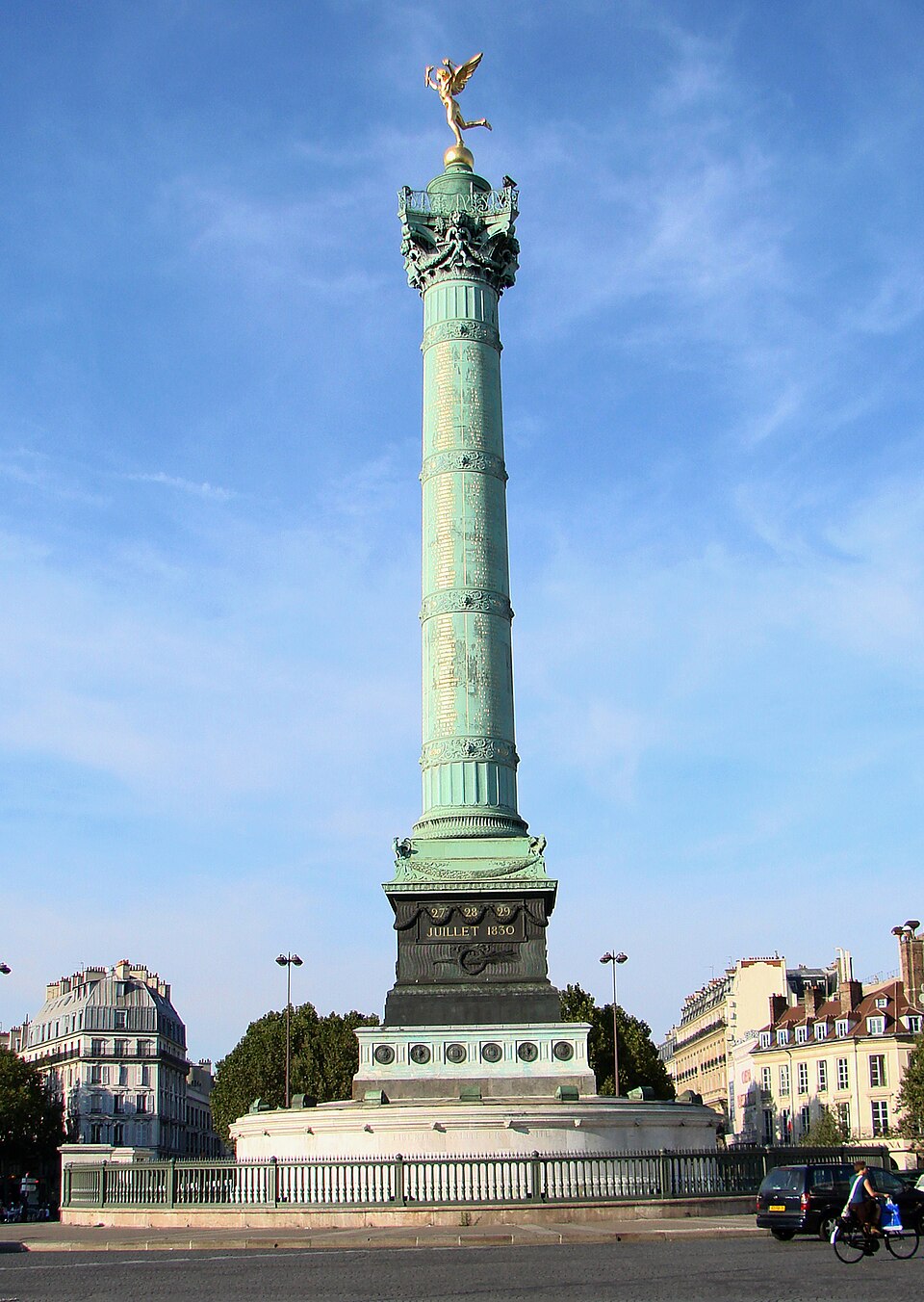
| Monday | Closed |
|---|---|
| Tuesday | Closed |
| Wednesday | Closed |
| Thursday | Closed |
| Friday | Closed |
| Saturday | 14:30 – 16:30 |
| Sunday | 14:30 – 16:30 |
Checked 2026-08-24 · Source
Read from the OpenStreetMap access tags; anything not listed has no tag recorded.
Set the group type to family in the planner and the day window contracts to about three quarters of a solo day.
The Colonne de Juillet stands at the centre of Place de la Bastille and commemorates the July Revolution of 1830 — the Trois Glorieuses, three days of fighting on 27-29 July that drove King Charles X from the throne.
The architect Jean-Antoine Alavoine designed it and began construction in 1835; he died in 1834 before it was finished — before construction started under the design, in fact, since the commission dates from 1833 — and Joseph-Louis Duc completed the work, with the column inaugurated on 28 July 1840, the revolution's tenth anniversary.
It rises to about 47 m and stands on the site of the old Bastille fortress, demolished in 1789-90, and over a section of the old Saint-Martin canal basin that once ran through the square. The base holds a crypt containing the remains of Parisians killed in the 1830 revolution, later joined by victims of the 1848 revolution as well.
Checked 2026-08-24 · Source
A hollow bronze shaft around a spiral staircase of 238 steps climbs to a viewing platform below the statue, a route that is not open to the public on an ordinary day and is not part of this page's guidance to expect.
At the top stands the gilded bronze Genie de la Liberte — the Spirit of Liberty — a winged figure by the sculptor Augustin Dumont, one foot resting on a globe, holding a torch and a broken chain.
The crypt at the base holds the remains of victims of the 1830 and 1848 revolutions, sealed inside the monument rather than on public display.
The bronze shaft itself is cast in sections rather than a single pour, and its surface carries the names of those killed in the July fighting, inscribed in gilt lettering that circles the column near its base — a detail most visitors passing the roundabout by car never get close enough to read.
Checked 2026-08-24 · Source
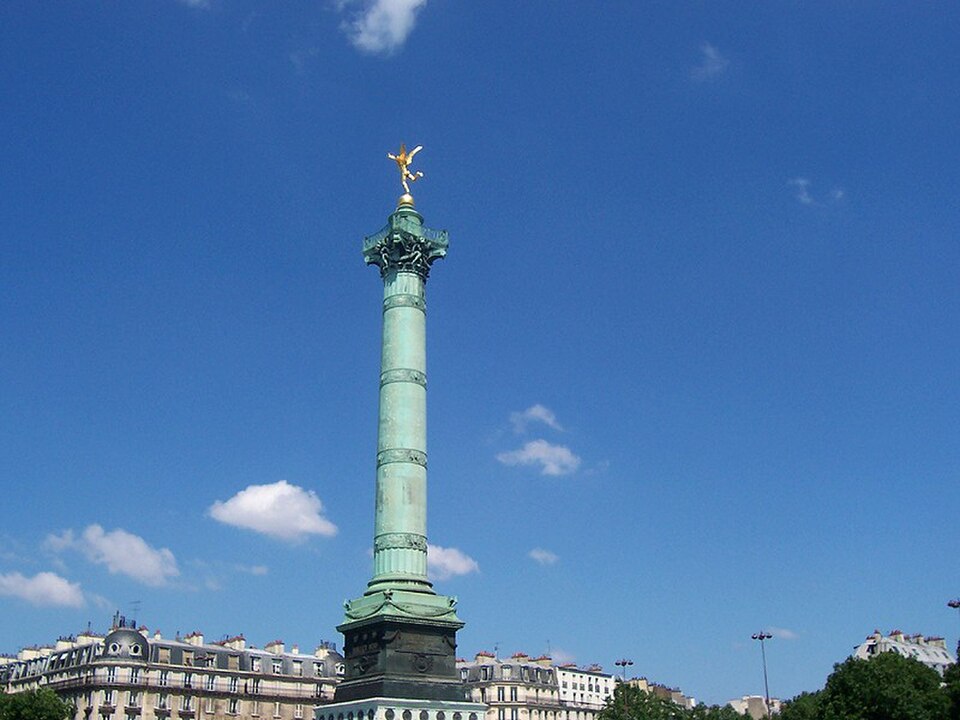
Ten to fifteen minutes to walk around the base and take in the column against the traffic circling Place de la Bastille, which is what most visitors do since the interior stairs are not generally open.
The square itself, with the Opera Bastille on its east side and the Bassin de l'Arsenal marina to the south, is worth a longer loop if the column is being combined with a walk rather than treated as a single stop.
Checked 2026-08-24 · Source
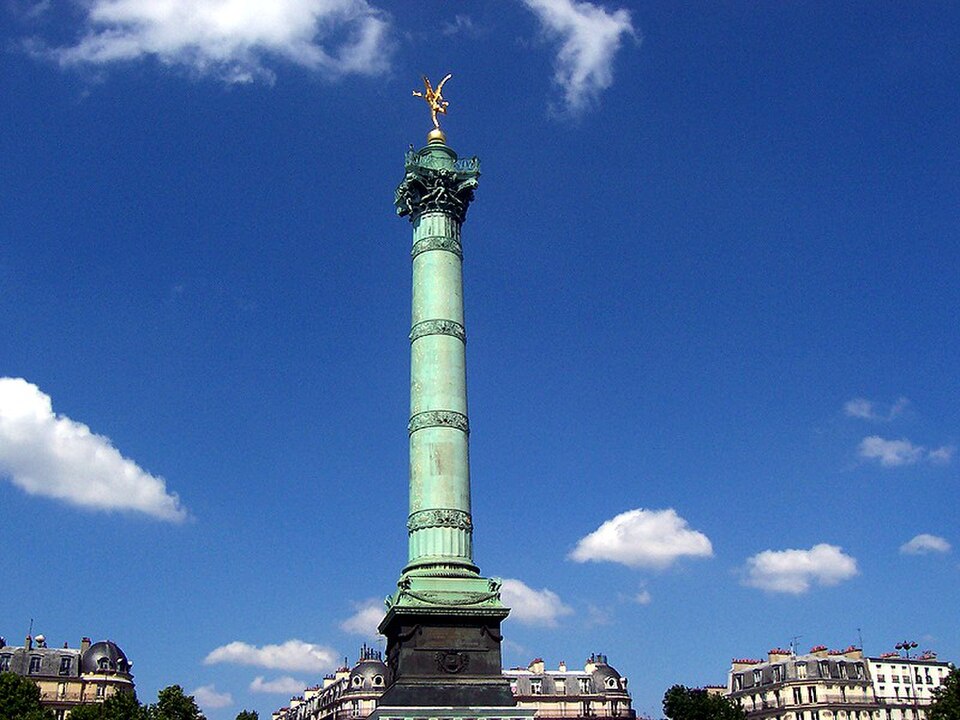
Any time of day — it is an open-air monument in the middle of a public square with no gate. Evening brings the best light on the gilded statue, which catches the low sun over the rooftops to the west.
The square is at its busiest and most symbolic on 14 July, Bastille Day, when the column is the visual anchor for the surrounding celebrations, and it is also a regular gathering point for political demonstrations because of what the site represents.
Checked 2026-08-24 · Source
No ticket and no door for viewing the column from the square. The interior staircase to the viewing platform is not part of a regular public offer; access, when it happens at all, is tied to occasional heritage open days rather than a standing admission the public can buy.
Checked 2026-08-24 · Source
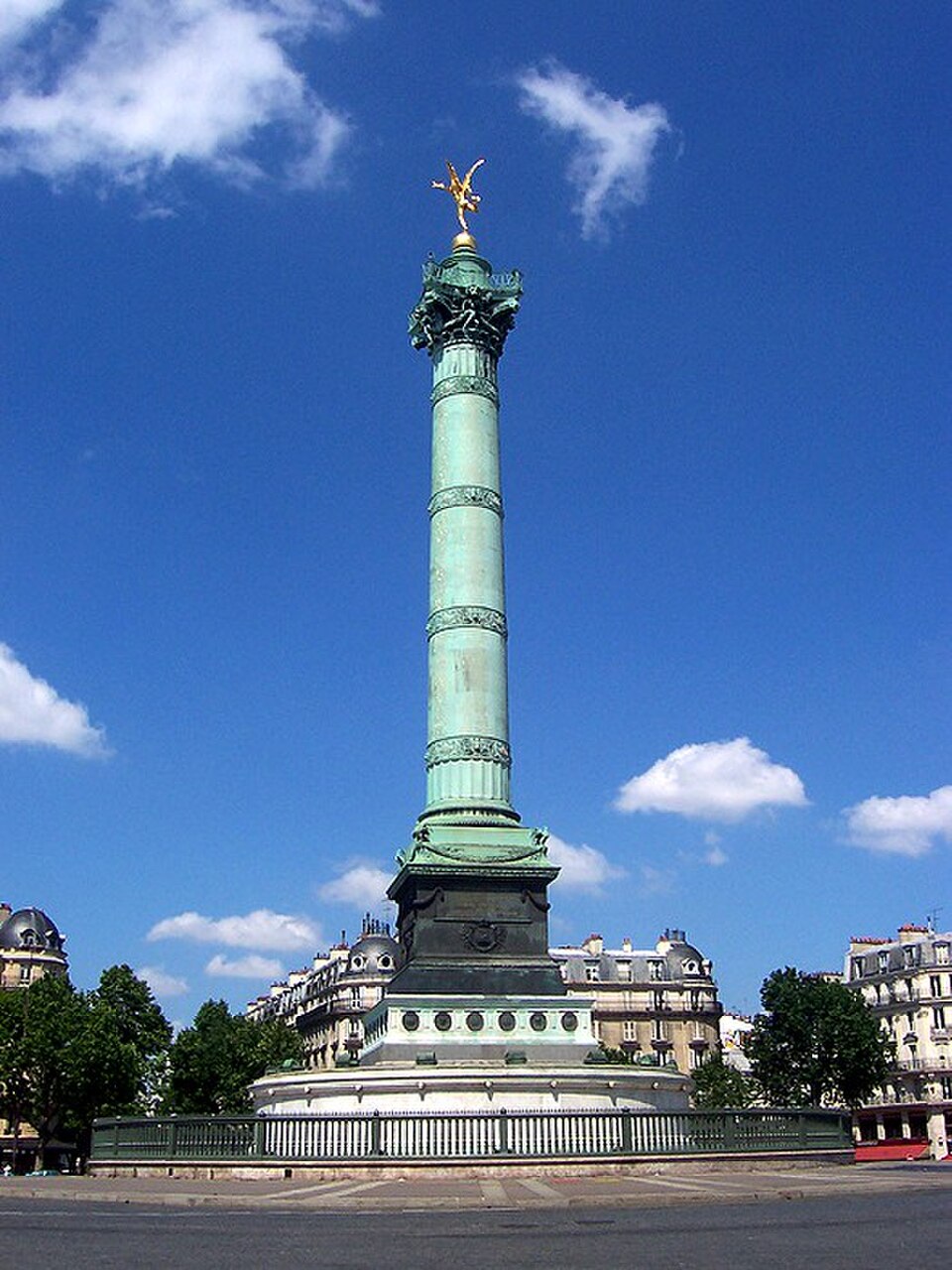
Bastille station sits directly beneath the square, served by Metro lines 1, 5 and 8, with several exits opening straight onto the roundabout around the column.
Place de la Bastille also marks the start of the Bassin de l'Arsenal and the canal walk south towards the Seine, and the boulevard Richard-Lenoir promenade north towards Canal Saint-Martin.
Checked 2026-08-24 · Source
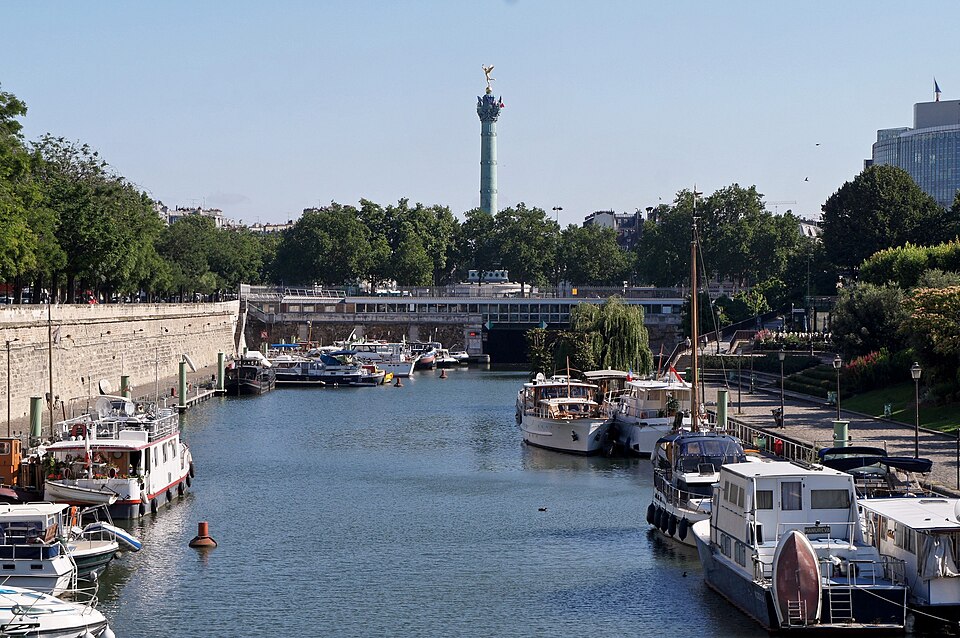
Place de la Bastille is one of the busiest traffic roundabouts in Paris, with several boulevards converging on it — reaching the column on foot means using the marked crossings rather than cutting across the roadway.
The square's revolutionary history keeps it in active use for demonstrations and political gatherings, which can close roads or restrict access around the column with little notice.
Checked 2026-08-24 · Source
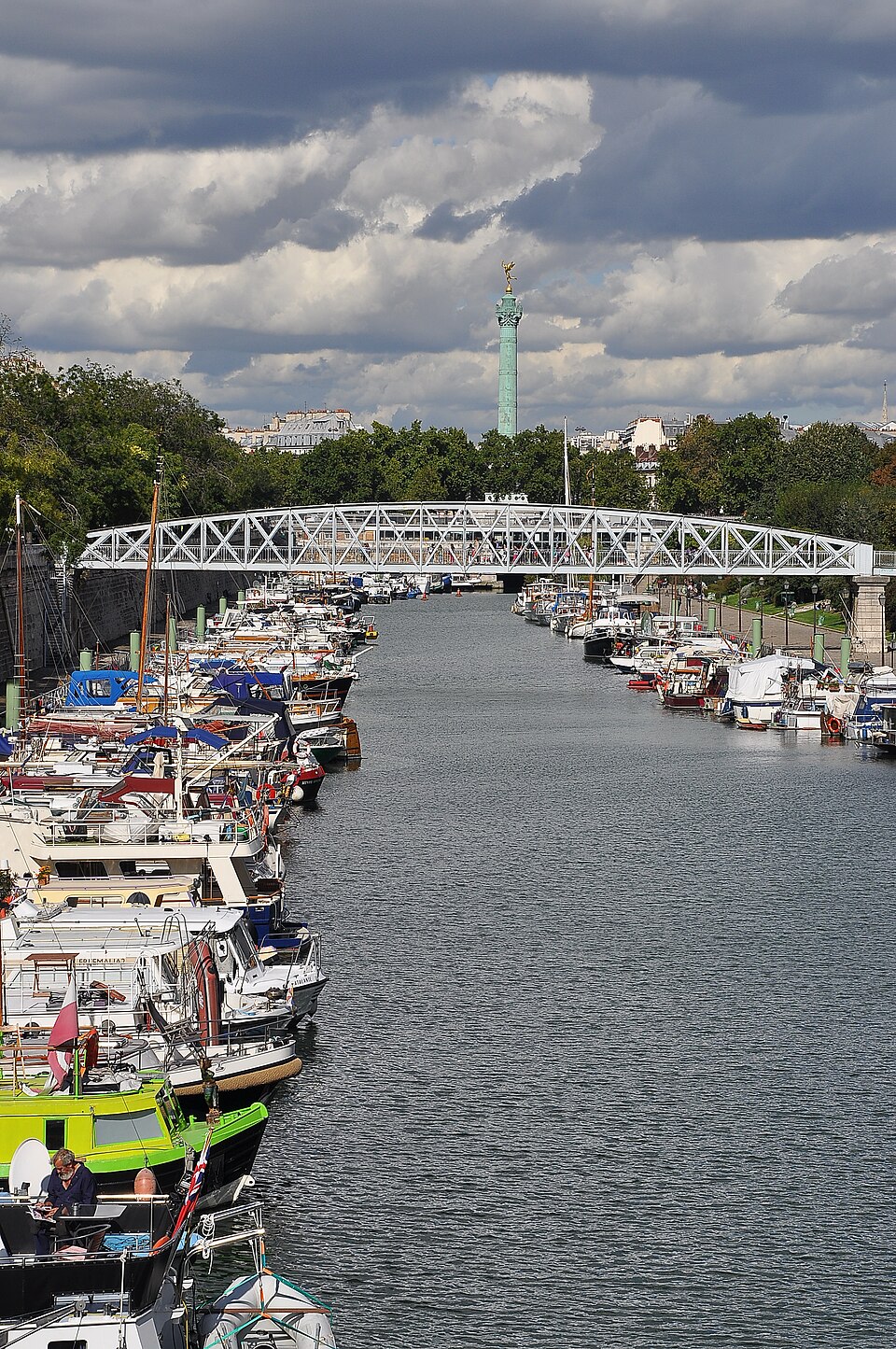
The gilded Genie de la Liberte catches evening light well above the surrounding rooftops, and a long lens from across the square isolates the statue against the sky.
For the whole column with its base, the widest unobstructed view is from the Bassin de l'Arsenal side to the south, where the water gives a clear foreground and, at the right angle, a reflection.
Checked 2026-08-24 · Source
The July Revolution of 1830 — the Trois Glorieuses, three days of fighting on 27-29 July that removed King Charles X from the throne.
About 47 m, topped by the gilded bronze Genie de la Liberte, a winged figure by the sculptor Augustin Dumont.
Commissioned in 1833, designed by Jean-Antoine Alavoine, and completed by Joseph-Louis Duc after Alavoine's death; it was inaugurated on 28 July 1840, the revolution's tenth anniversary.
Not on a regular basis. The interior staircase to the viewing platform is not part of a standing public offer.
A crypt holding the remains of Parisians killed in the 1830 revolution, later joined by victims of the 1848 revolution.
The Bastille fortress, demolished in 1789-90 after it was stormed at the start of the French Revolution.
Loading the interactive map…
The interactive map could not be loaded.
Last updated:
Source: OpenStreetMap contributors, Wikidata ·