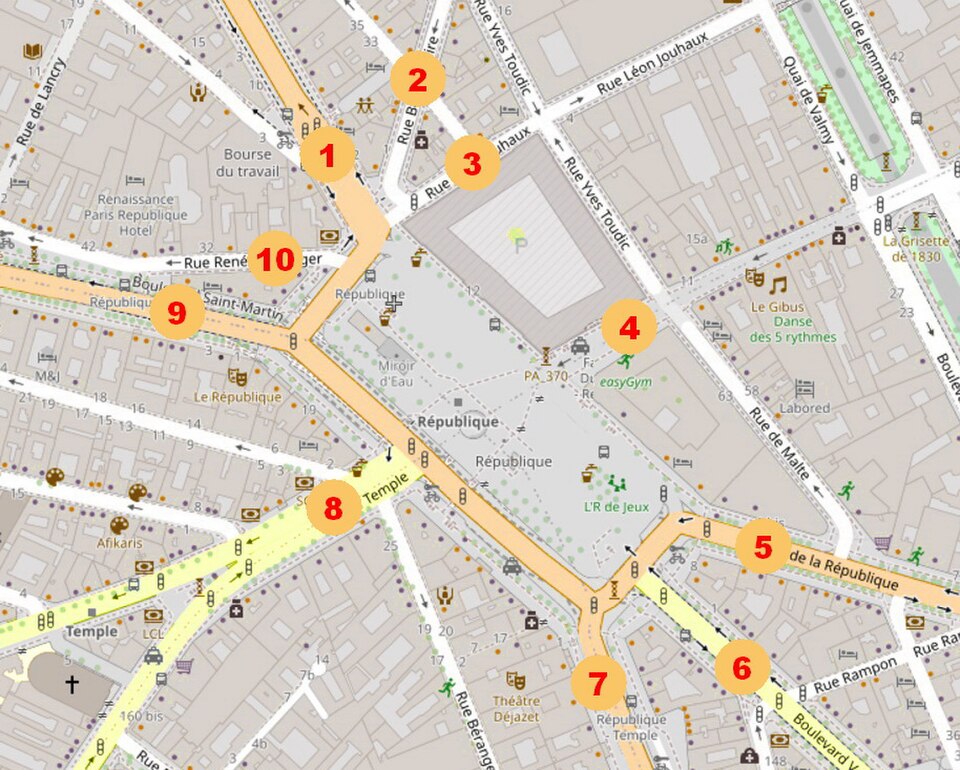
Place de la Republique is a large public square straddling the 3rd, 10th and 11th arrondissements, at a junction where several of Paris's grand boulevards meet, and it functions today primarily as a civic gathering space rather than a sightseeing stop with a building or interior to visit.
It was laid out under Haussmann's renovation of Paris and originally named Place du Chateau-d'Eau, after a water tower once standing here; it took its current name and its centrepiece statue in the 1880s, under the Third Republic.
The square has been the customary starting or ending point for major political demonstrations and marches in Paris since the 19th century, and that role, not its architecture, is why it appears in the news as often as it does.
The Statue de la Republique dominates the square: a 9.5-metre bronze allegorical figure of Marianne holding an olive branch, standing on a stone pedestal ringed by three seated bronze figures representing Liberty, Equality and Fraternity, and reliefs depicting scenes from French republican history. It was designed by the brothers Leopold and Charles Morice and unveiled in 1883.
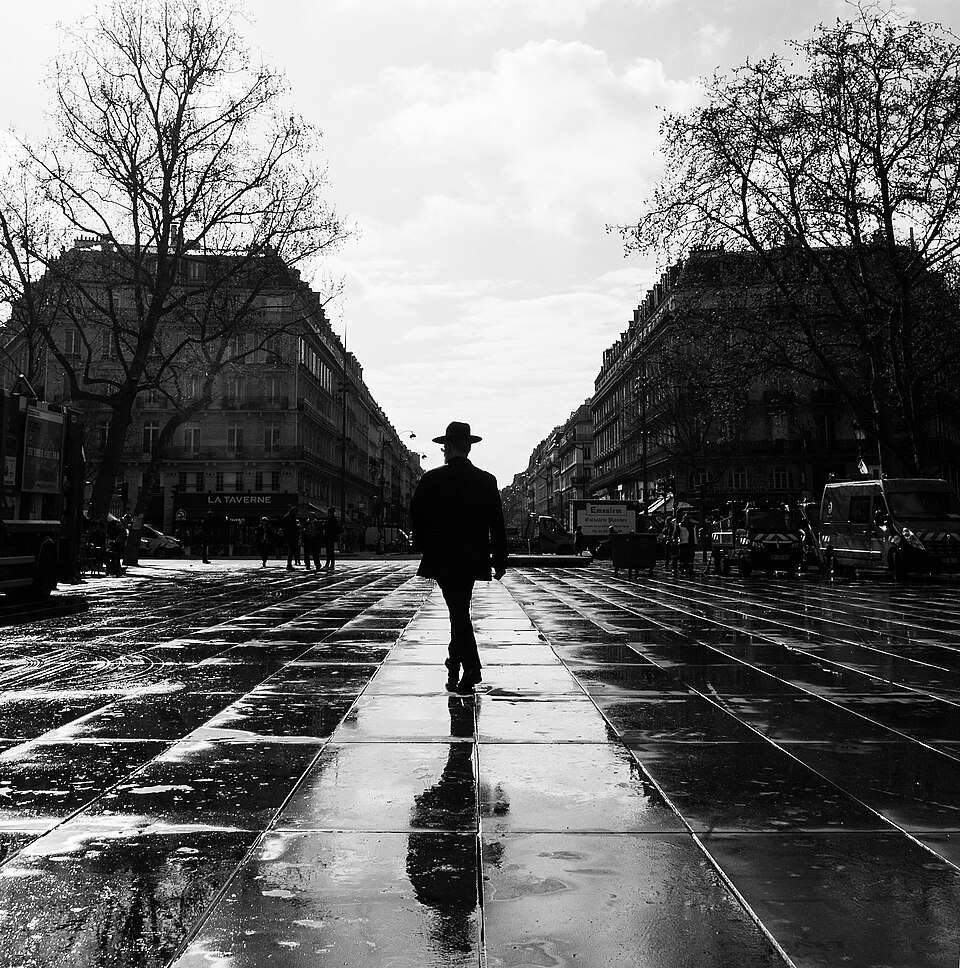
The wider square is a large paved, largely car-free plaza rather than a garden — its 2010-2013 renovation by the TVK architecture agency with Martha Schwartz Partners removed most of the through-traffic and added fountains, seating and a large open pavement area around the statue, deliberately built for crowds rather than for quiet strolling.
A base of the statue's pedestal was, until the 2010s renovation, a traffic island crossed mainly by cars; the redesign turned roughly two-thirds of the surrounding roadway into pedestrian space, which is why the square today reads as one continuous plaza rather than a monument marooned in the middle of a traffic circle, unlike several of the other grand-boulevard squares nearby.
Fifteen to twenty minutes covers the statue and a walk around the plaza; there is no interior or ticketed attraction to extend the stop with. Most visitors pass through it as a stop between the Marais and the Canal Saint-Martin rather than as a destination on its own.
A closer read of the pedestal's reliefs, which depict scenes from French republican history, adds another ten minutes for a visitor who wants to identify each scene rather than take in the statue as a single silhouette from a distance.
The square is calmest on weekday mornings; afternoons and weekends bring skaters, buskers and families using the open pavement space around the fountains.
Because the square is used for demonstrations, it is worth checking the news before visiting on a day a major march is scheduled to start or end here — the square can be closed to ordinary foot traffic, heavily policed, or simply very crowded on those occasions.
Free. It is an open public square with no ticketed attraction, no gate and no opening hours, and no charge applies at any time of day to walk the plaza or view the statue up close, whether alone or as part of a larger gathering passing through on a march day.
Metro lines 3, 5, 8, 9 and 11 all stop at Republique, making it one of the better-connected interchange stations in Paris and an easy stop to fold into a route between other neighbourhoods rather than a destination requiring a dedicated trip.
The square is also a natural walking link between the Marais to the south-west and the Canal Saint-Martin to the north-east, both roughly ten minutes on foot, which is how most visitors reach it rather than as a dedicated metro trip on its own.
Political demonstrations regularly start or converge here; when one is scheduled, expect a heavy police presence, temporary barriers and possible station or road closures, and check local news rather than arriving unaware.
As a large, open transit hub, the square attracts the pickpocketing and petting-scam activity typical of any major Paris interchange — normal city vigilance applies rather than any risk specific to the monument itself.
Skateboarders and rollerbladers use the open pavement around the statue in numbers, particularly in the afternoon and evening, and the space is shared rather than reserved for pedestrians, so a walk across the plaza sometimes means giving way to a moving skater rather than a clear straight line to the statue.
The statue reads best from directly in front, framed against the open sky of the plaza rather than against the surrounding buildings, and works well lit at night when the fountains and statue floodlighting are on.
A wide shot taking in the full plaza and one of the converging boulevards captures the square's scale better than a close statue portrait, since the size of the open pavement is the feature that distinguishes this square from a smaller Paris place.
Marianne, the personification of the French Republic, holding an olive branch, with three seated bronze figures at her base representing Liberty, Equality and Fraternity.
When was the square renovated?
Between 2010 and 2013, when the TVK agency and Martha Schwartz Partners removed most through-traffic and added the fountains and open pavement seen today.
Why is Place de la Republique often in the news?
It has been the customary start or end point for major political demonstrations and marches in Paris since the 19th century.
What was the square called before?
Place du Chateau-d'Eau, after a water tower that once stood on the site, before it was renamed under the Third Republic in the 1880s.
Is there an entrance fee?
No, it is a free, open public square with no gate or ticketed attraction.
What metro lines stop here?
Lines 3, 5, 8, 9 and 11 all serve Republique station, one of the busier interchanges in the city.
Nothing non-essential is set before you choose, in regions where consent is required. If you decline, ads still appear but they are non-personalised, and analytics is switched off entirely.



.jpg)
.jpg)
.jpeg)
