


3 min walk · Paris 16e Arrondissement
square du Tchad
- High
- Nature site
Language · 1 published
Historic monument · Paris 16e Arrondissement, Paris
Jardin des serres d’Auteuil
| Monday | 08:00 – 20:00 |
|---|---|
| Tuesday | 08:00 – 20:00 |
| Wednesday | 08:00 – 20:00 |
| Thursday | 08:00 – 20:00 |
| Friday | 08:00 – 20:00 |
| Saturday | 09:00 – 20:00 |
| Sunday | 09:00 – 20:00 |
Checked 2026-08-24 · Source
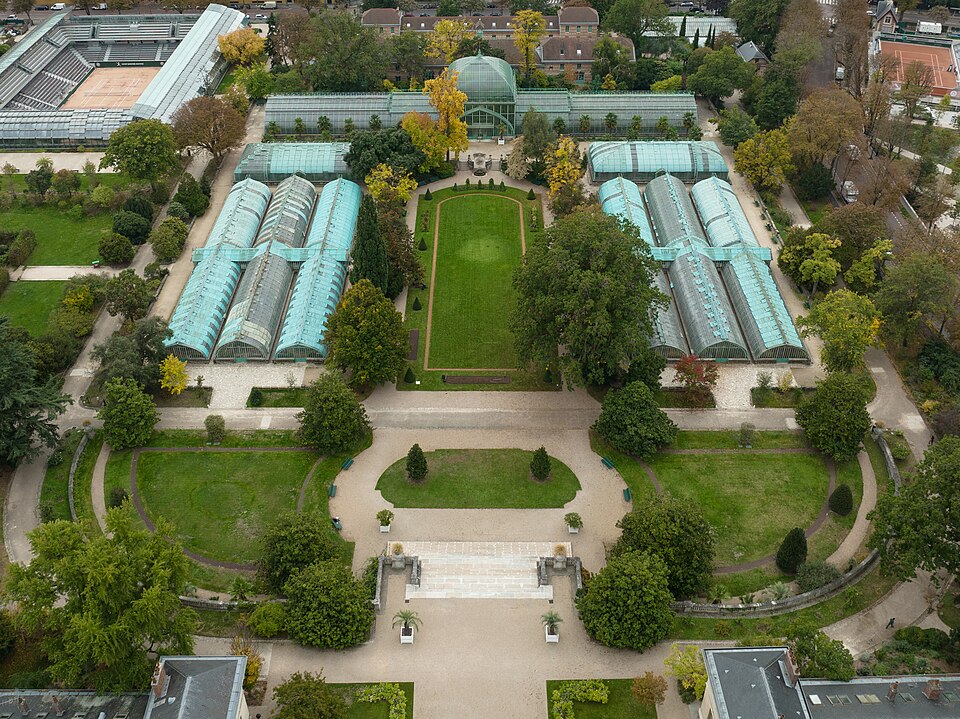
The Jardin des serres d'Auteuil is a municipal botanical garden built around a set of glasshouses, on the western edge of Paris beside the Bois de Boulogne. The city built it in 1898 to the design of Jean-Camille Formige, the architect responsible for several of Paris's park structures of that era, to grow the flowers and plants used across the city's parks and public squares.
It is a working production garden as much as a public one: propagation greenhouses behind the ornamental glasshouses still supply plants for Paris's municipal beds.
Part of its historic footprint was ceded in the 2010s to expand the neighbouring Roland-Garros tennis stadium, a change contested by heritage and environmental groups before the new Simonne-Mathieu court was built on land partly reclaimed as garden in compensation.
The Auteuil greenhouses sit at the edge of the Bois de Boulogne, itself laid out by Baron Haussmann's engineer Adolphe Alphand in the 1850s and 1860s as one of the great public parks of the Second Empire, which is why the surrounding streets and the park boundary share the same period of development.
Checked 2026-08-24 · Source
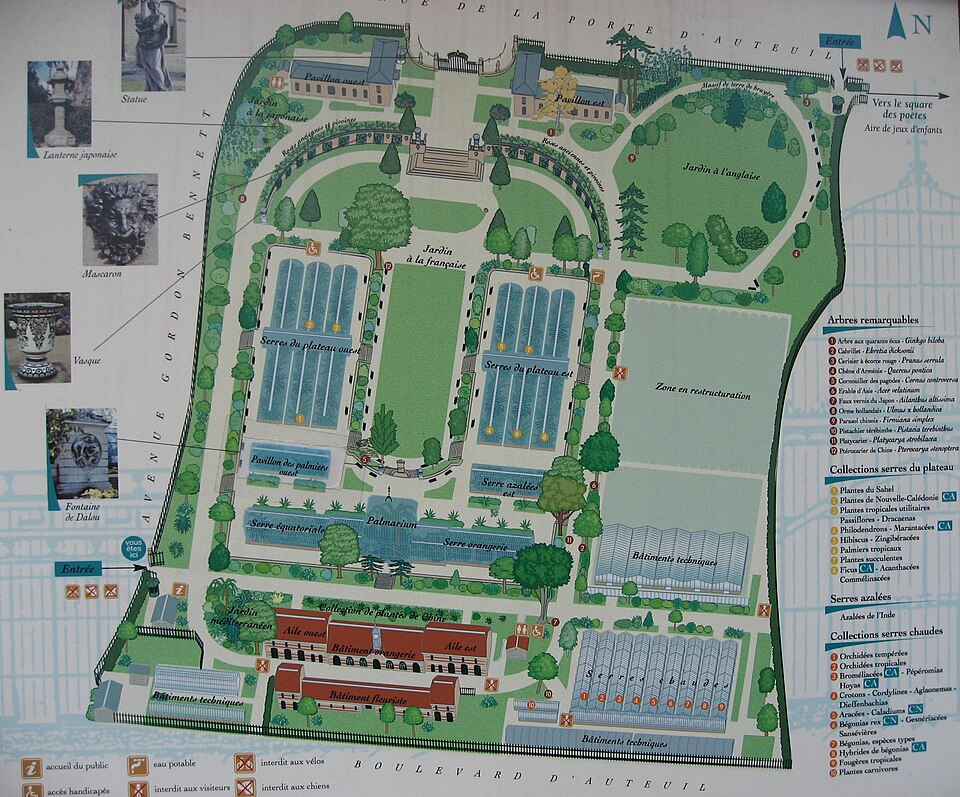
A grande serre, or great glasshouse, at the centre holds tropical and subtropical plants under an iron-and-glass roof, flanked by smaller greenhouses for palms, ferns and orchids.
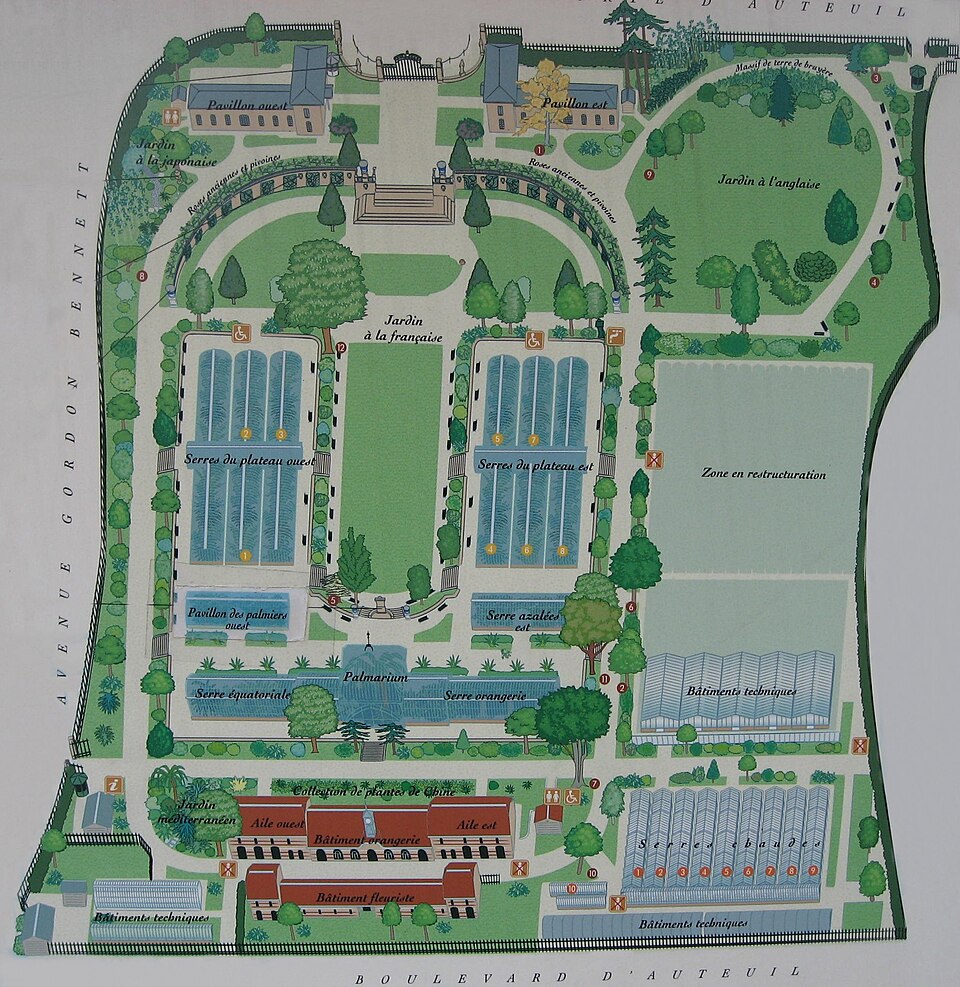
Outside the glasshouses, the garden is laid out in distinct themed sections: a formal French parterre near the entrance, a rose garden, and an English-style landscaped area with ponds and winding paths. The Auteuil greenhouses also hold a notable orchid collection, shown seasonally in the smaller glasshouses.
The Simonne-Mathieu tennis court, opened in 2019 within the garden's grounds, is itself glasshouse-shaped and set among four planted gardens themed on different climate zones, a deliberate echo of the greenhouses next door.
A separate rock garden and a small Japanese-inspired area sit further along the paths, both maintained by the same municipal nursery that supplies bedding plants to squares across Paris, which is the garden's original working purpose and still part of what it does today.
Checked 2026-08-24 · Source

Forty-five minutes to an hour for the glasshouses and the main garden paths; longer for anyone lingering in the orchid displays or the rose garden in season.
It pairs naturally with a longer walk into the adjoining Bois de Boulogne, which the garden borders directly on its western side. Visitors arriving by the Porte d'Auteuil metro stop can walk straight from the platform into the garden's main entrance in a couple of minutes, which makes even a short stop between trains worthwhile.
Checked 2026-08-24
The rose garden peaks in late spring and early summer; the glasshouses are worth visiting in any season precisely because they hold their own climate regardless of the weather outside, which makes this one of the better wet-weather or winter garden visits in western Paris.
Weekday mornings are quietest — it is a residential-neighbourhood garden well off the main tourist route, so crowding is rarely an issue even in peak season.
Checked 2026-08-24
Free. The Jardin des serres d'Auteuil is run by the city of Paris as a public municipal garden, with no admission charge for the garden or the glasshouses.
This covers the grande serre and the smaller display greenhouses as well as the outdoor parterre and rose garden; nothing on the site requires a separate ticket, which sets it apart from many botanical greenhouses elsewhere in Europe that charge for the glasshouse portion alone.
Checked 2026-08-24
In the 16th arrondissement, on the western edge of Paris directly beside the Bois de Boulogne and next to the Roland-Garros tennis stadium.
Metro line 10 terminates at Porte d'Auteuil, a short walk from the main entrance on boulevard d'Auteuil. Michel-Ange-Auteuil on lines 9 and 10 is a slightly longer walk from the opposite side.
Checked 2026-08-24 · Source
During the French Open in late May and early June, the neighbouring Roland-Garros stadium fills the surrounding streets and Metro station with crowds, and some garden paths bordering the tennis courts can see access restricted for tournament security.
The glasshouses are kept warm and humid year-round, which is comfortable briefly but worth knowing before layering up for a winter visit.
Checked 2026-08-24
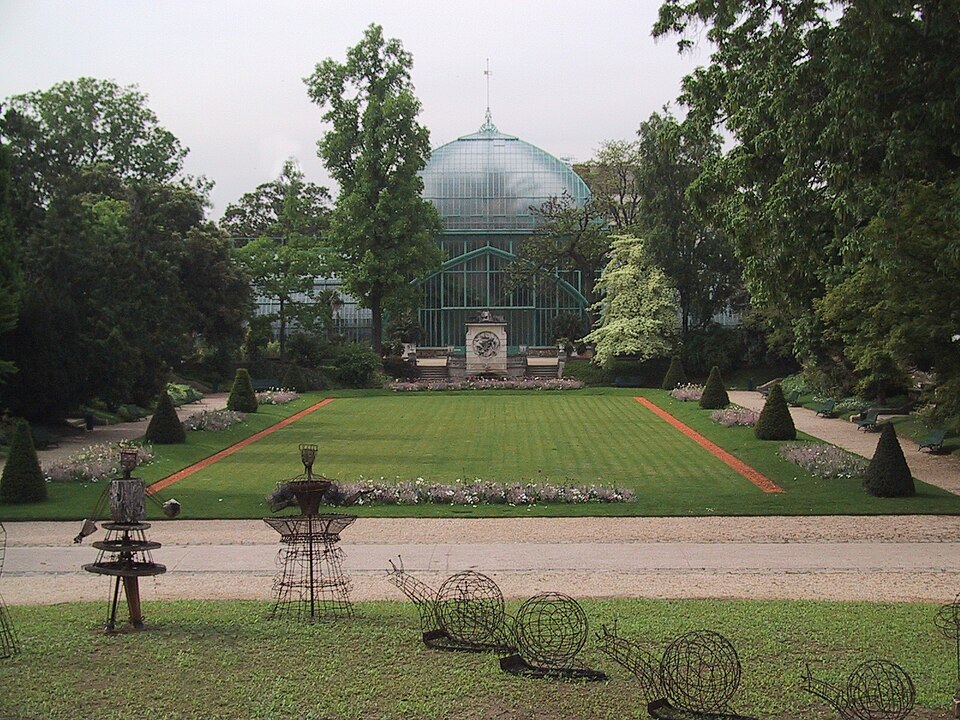
The great glasshouse's iron-and-glass structure photographs well from the formal parterre in front of it, where the symmetry of the beds leads the eye straight to the building.
Inside, the palm house's tall canopy against the glass roof is the strongest single shot; a wide lens handles the height better than a standard one in the confined aisles.
Checked 2026-08-24
The city of Paris in 1898, to a design by architect Jean-Camille Formige, originally to grow plants for the city's own parks and squares.
Yes, it is a public municipal garden with no admission charge.
Part of the garden's historic footprint was ceded in the 2010s to expand the neighbouring stadium, and the new Simonne-Mathieu court was built partly on land returned to the garden in compensation.
Yes — the glasshouses hold their own indoor climate regardless of the weather outside.
Porte d'Auteuil on line 10, a short walk from the main entrance.
Late spring and early summer, in step with the roses' natural bloom.
Loading the interactive map…
The interactive map could not be loaded.
Last updated:
Source: OpenStreetMap contributors, Wikidata ·