

1 min walk
Shinsekai
- Must see
- Historic monument
Language · 1 published
Viewpoint · Osaka
通天閣
| Monday | 09:00 – 21:45 |
|---|---|
| Tuesday | 09:00 – 21:45 |
| Wednesday | 09:00 – 21:45 |
| Thursday | 09:00 – 21:45 |
| Friday | 09:00 – 21:45 |
| Saturday | 09:00 – 21:45 |
| Sunday | 09:00 – 21:45 |
Checked 2026-08-26 · Source
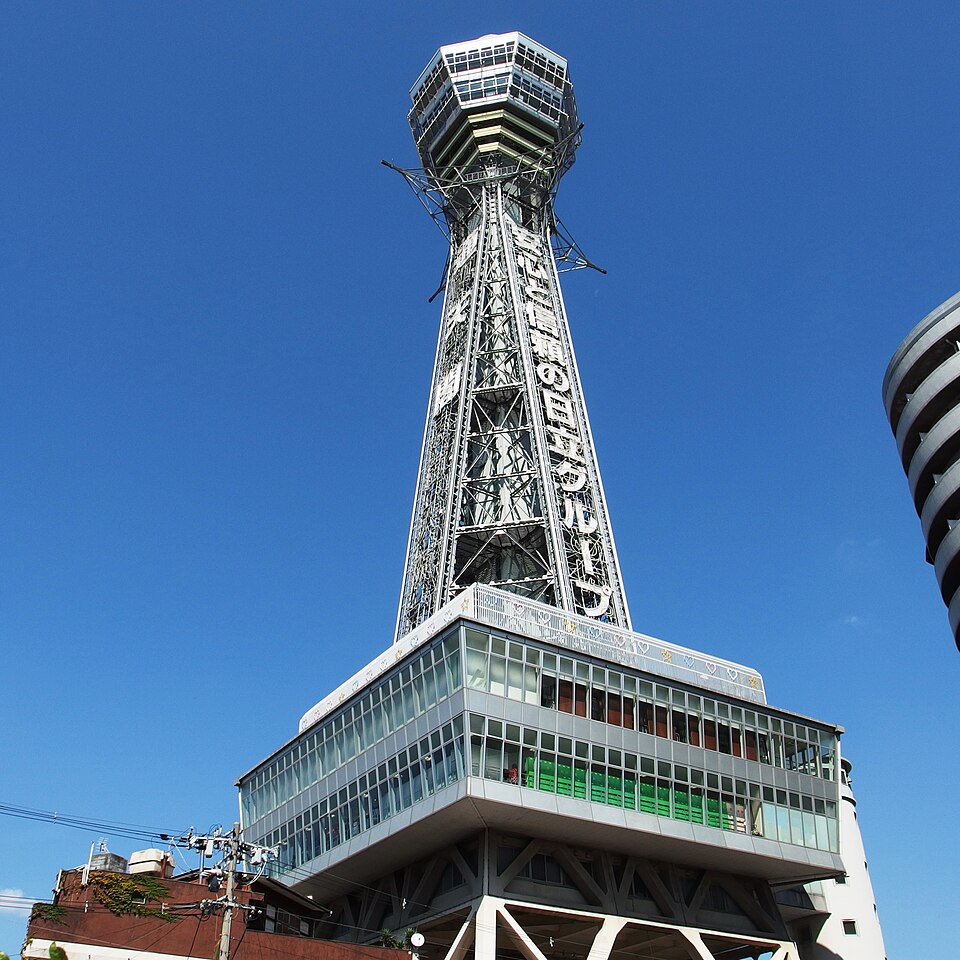
Tsutenkaku is an observation tower in Shinsekai, in Osaka's Naniwa ward, and it is the second tower to stand on the spot. The first went up in 1912, a 64-metre hybrid of the Eiffel Tower and the Arc de Triomphe, joined to the Luna Park amusement grounds beside it by an aerial cable car; at the time it was the second tallest structure in Asia. Fire damaged it badly in 1943 and it was not repaired. The frame was taken down and the steel went into the war effort. After the war residents pressed for a replacement, a private company, Tsutenkaku Kanko Co., Ltd., was formed to build one, and Tachu Naito, the engineer behind most of Japan's early towers, designed the eight-sided structure that opened in 1956. It stands 108 metres, and the same company still owns and runs it from an office at the foot of the tower. It has also sold the advertising on it since 1957, when Hitachi became the sponsor; the lighting that wraps the shaft, neon at first and LED now, changes colour every two months. The lamps at the very top are a weather beacon, their colour combination announcing the following day's forecast. The view from the decks is not a high one by modern standards. What it gives instead is a close, legible look down into one of Osaka's oldest and least polished districts.
Checked 2026-08-26 · Source
The tower is read from the top down, and the operator numbers its floors by their height above ground. The highest point a visitor reaches is the open-air Tenbo Paradise at 94.5 metres, an 8.5-metre-wide circular walkway with nothing between the railing and the city, reached by stairs from the deck below. Attached to it at 92.5 metres is TIP THE TSUTENKAKU, a 5.4-metre jetty 1.5 metres wide whose outer end is a 12-square-metre glass floor. Below that, at 87.5 metres, is the Golden Observation Deck, gilded in answer to Hideyoshi's golden tea room and holding the shrine of the third-generation Billiken, the grinning good-luck figure the tower is known for. At 84 metres the Light Observation Deck turns over to mirror balls and coloured lighting after dark. Lower down the tower does other things entirely: the Top Floor at 22 metres holds a diorama and photographs of Shinsekai as it looked a century ago along with the tower's cafe; the Under Floor at 18 metres has the Jan-Jan Town displays and a Kinnikuman archive corner; the ground floor carries a reproduction of the original tower's painted ceiling; and the basement, Waku Waku Land, is a row of antenna shops run by Morinaga, Glico and Nissin.
Checked 2026-08-26 · Source
Allow about an hour for the tower itself, and treat that as the working figure rather than a published one, because the operator does not state a suggested visit length anywhere on its site. The hour covers the queue at the first-floor ticket centre, the lift up, both indoor decks, the climb to the open-air deck and the walk back down through the Top Floor, the Under Floor and the basement shops, which is the route the building funnels everyone along. Half of that hour is circulation, not viewing; the decks themselves are small and a slow circuit of each takes ten minutes.
Two things stretch it. The timed-entry system removes most of the uncertainty from the arrival queue but does not remove the lift queue at the top of the day or the wait for the stairs to the outdoor deck when the weather is good. And the two paid attractions are not part of the hour: the Tower Slider adds a wait plus a locker stop for a ten-second descent, and Dive and Walk is booked and boarded at a separate building down the street, so budgeting under an hour for that alone would be optimistic. A visitor doing the decks, the slider and the shops should think in terms of two hours.
Checked 2026-08-26
The tower keeps one set of hours all week. The general observation deck and the open-air deck both run 9:00 to 21:45, with the last admission to the general deck at 21:15 and the last entry to the open-air deck at 21:35. The shops close earlier: the second-floor official shop and the basement Waku Waku Land at 21:30, the third-floor select shop at 19:30. The operator publishes no weekly closing day, and it says that any change of hours or unscheduled closure is announced on the tower's official X account, which is the thing to check on the morning of a visit.
Late afternoon into evening is when the tower does something the daytime cannot: the fourth-floor deck switches to its lighting show, the tower's own LED skin comes on, and Shinsekai below turns into a field of signs. That is also when the operator warns that tickets can sell out, so an evening visit is the one that wants a reservation made early in the day. The open-air deck is the part the weather governs, and a clear, still evening is worth planning the day around.
Checked 2026-08-26 · Source
Admission to the decks is 1,500 yen for adults, meaning anyone 15 or over, and 800 yen for children aged 5 to 14. That single price is a set: the operator sells the general deck and the open-air Tenbo Paradise only together, so there is no cheaper indoor-only ticket. Holders of a disability certificate pay 1,300 and 700 yen respectively on showing the booklet at the ticket counter, a copy being acceptable, and one accompanying person is charged at the same reduced rate while a second and any further companions pay the full fare. Group rates of 1,400 and 700 yen are published but group reservations are currently suspended, and the discounted fares are not available online, so anyone using one must buy at the on-site ticket centre.
Every ticket carries a reserved entry time. The operator recommends buying the advance online ticket, warns that same-day buyers may wait, and asks holders of the Osaka Amazing Pass and similar passes to reserve an entry time at the counter on arrival. Tickets are not refunded or reissued, and there is no re-entry once a visitor has left. The Tower Slider and Dive and Walk are charged separately from admission.
Checked 2026-08-26 · Source
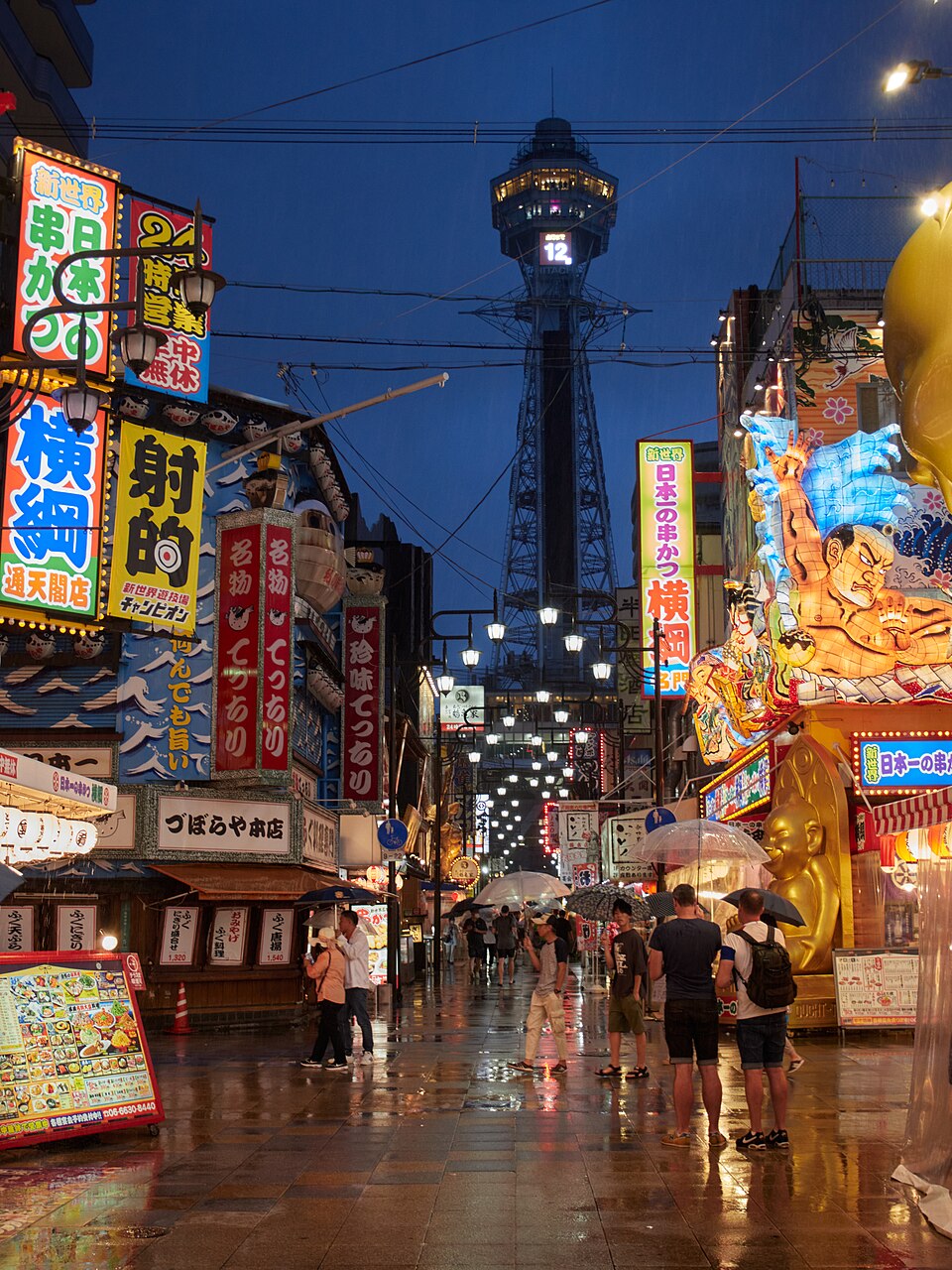
Tsutenkaku stands at 1-18-6 Ebisu-higashi in Naniwa ward, and it is a short walk from four different railways. The closest are Ebisucho on the Osaka Metro Sakaisuji line, three minutes from exit 3, and Ebisucho on the Hankai tram line, also three minutes. Dobutsuen-mae on the Midosuji line is six minutes from exit 1, and JR Shin-Imamiya is six minutes from the east exit, which the station signs label the Tsutenkaku exit. Nankai's Shin-Imamiya station is ten minutes from the west exit. Any of them puts a visitor into Shinsekai on foot, which is the right way to arrive: the tower reads best from the end of one of the covered shopping streets that aim at it.
Do not drive. The operator states plainly that it has no car park and no coach parking and directs drivers to paid car parks in the neighbourhood. For anyone who still arrives by road, the site names the Hanshin Expressway Route 1 Loop exits: Yuhigaoka about five minutes away and Namba about six, with Ebisucho the nearest entrance for leaving, at three minutes.
Checked 2026-08-26 · Source
The open-air deck is the part of the visit that can be taken away. The operator states that it closes without notice in rain, strong wind or dense fog, and since the ticket is sold only as a set there is no separate refund for losing it. It is also reached by stairs, and the operator asks visitors who are unsteady on their feet or using a wheelchair not to go up, for safety. Bags may be restricted at the entrance, food, drink, smoking and anything flammable are barred, and tripods and monopods are not allowed.
The house rules apply throughout the building and a few of them surprise people. Photography that occupies a spot, tripod work in particular, is prohibited, as is bringing a pet — assistance dogs excepted, with their handbook and certification checked where necessary. The two paid attractions have their own limits, and they are hard limits: the Tower Slider takes riders aged 7 to 65 who are at least 120 centimetres tall and under 120 kilograms, with an adult accompanying anyone aged 7 to 12, while Dive and Walk takes ages 9 to 65 at 130 centimetres and above.
Checked 2026-08-26 · Source
The tower is a better subject than a viewpoint, and the pictures worth planning for are taken from the street. The classic frame is from the middle of one of the covered shopping streets that aim at the tower, where the shaft sits squarely between the shopfronts and the hanging signs give it a foreground; the same shot works from the open crossings on either side, with the older Shinsekai frontages filling the lower half. Both want either flat overcast light or the twenty minutes after sunset, when the tower's LED skin is lit and the sky still holds colour. Full darkness flattens the tower into a bright outline and loses the street around it.
From the decks, the glass on the indoor floors reflects badly, so shoot with the lens against it and the lighting behind you switched out of frame. The Golden Deck's gilding throws a strong colour cast that no white balance preset handles well; shoot raw if the camera allows it. On the open-air deck a phone is the practical tool, because tripods and monopods are barred and the walkway is narrow enough that stopping in it blocks the circuit. The glass floor of TIP THE TSUTENKAKU photographs best looking straight down with the shoes in frame for scale.
Checked 2026-08-26
The general observation deck and the open-air deck are both open 9:00 to 21:45 every day. The last admission to the general deck is 21:15 and the last entry to the open-air deck is 21:35. The operator publishes no weekly closing day, and states that any change of hours or temporary closure is announced on the tower's official X account. The shops close earlier: the second-floor shop and the basement Waku Waku Land at 21:30, the third-floor select shop at 19:30.
Admission is 1,500 yen for adults, meaning 15 and over, and 800 yen for children aged 5 to 14. The operator sells the general deck and the open-air Tenbo Paradise only as a set, so that one price covers both and there is no indoor-only ticket. Holders of a disability certificate pay 1,300 and 700 yen, with one companion at the same rate; those fares are only sold at the on-site ticket centre, not online.
Every ticket carries a reserved entry time, so a time slot has to be taken one way or another. The operator recommends buying the advance online ticket, warns that same-day buyers may have to wait, and notes that tickets can sell out from late afternoon onwards. Holders of the Osaka Amazing Pass and similar passes reserve their entry time at the counter on the day. Tickets are not refunded or reissued, and there is no re-entry after leaving.
No. The operator states that it has no parking for cars or coaches and directs drivers to paid car parks in the surrounding streets. A car is not needed: Ebisucho station on the Osaka Metro Sakaisuji line is three minutes away on foot from exit 3, the Hankai tram stop of the same name is also three minutes, and both Dobutsuen-mae on the Midosuji line and JR Shin-Imamiya are six minutes.
The operator states that Tenbo Paradise closes without notice in rain, strong wind or dense fog. Because admission is sold only as a general deck and open-air deck set, there is no separate refund when it shuts, so a visitor who has come specifically for it should check the forecast and the tower's official X account first. The deck is also reached by stairs, and the operator asks wheelchair users and anyone unsteady on their feet not to go up.
No, both are charged on top of deck admission. The Tower Slider costs 1,100 yen for those aged 15 to 65 and 600 yen for children aged 7 to 14, runs 9:30 to 20:30 with last reception at 20:00, and is sold at the first-floor ticket centre. Dive and Walk costs 3,000 yen for ages 15 to 65 and 2,000 yen for ages 9 to 14, with a Walk-only option at 1,500 and 1,000 yen, and is booked at the separate Tsutenkaku SATELLITE building.
Loading the interactive map…
The interactive map could not be loaded.
Last updated:
Source: OpenStreetMap contributors, Wikidata ·