
.jpg)

.jpg)
.jpg)
16 min walk
Universal Studios Japan
- Must see
- Entertainment venue
Language · 1 published
Family attraction · Osaka
海遊館
| Monday | 10:30 – 20:00 |
|---|---|
| Tuesday | 10:30 – 20:00 |
| Wednesday | 10:30 – 20:00 |
| Thursday | 10:30 – 20:00 |
| Friday | 10:30 – 20:00 |
| Saturday | 09:30 – 20:00 |
| Sunday | 09:30 – 20:00 |
Checked 2026-08-26 · Source
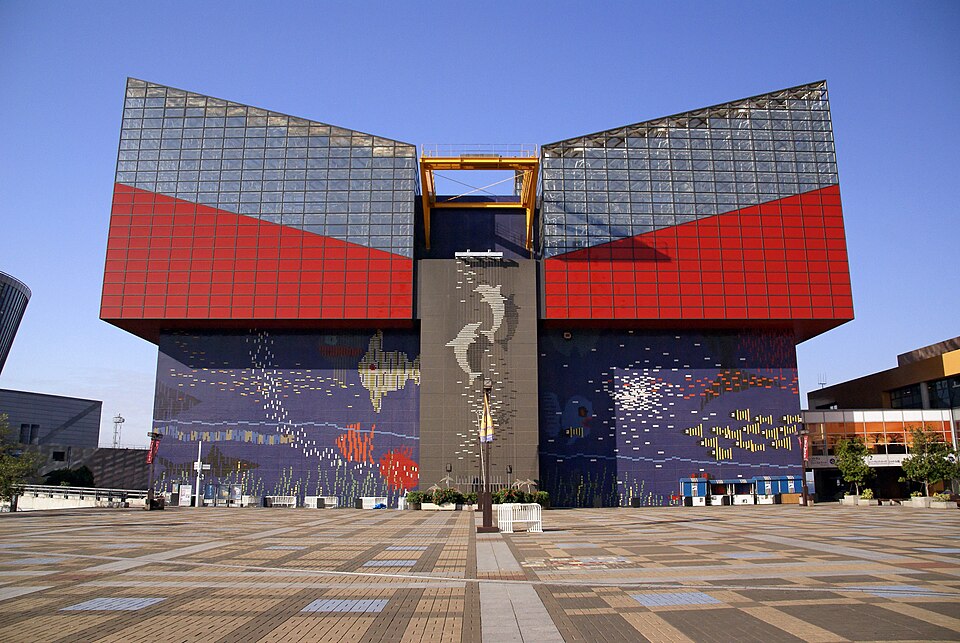
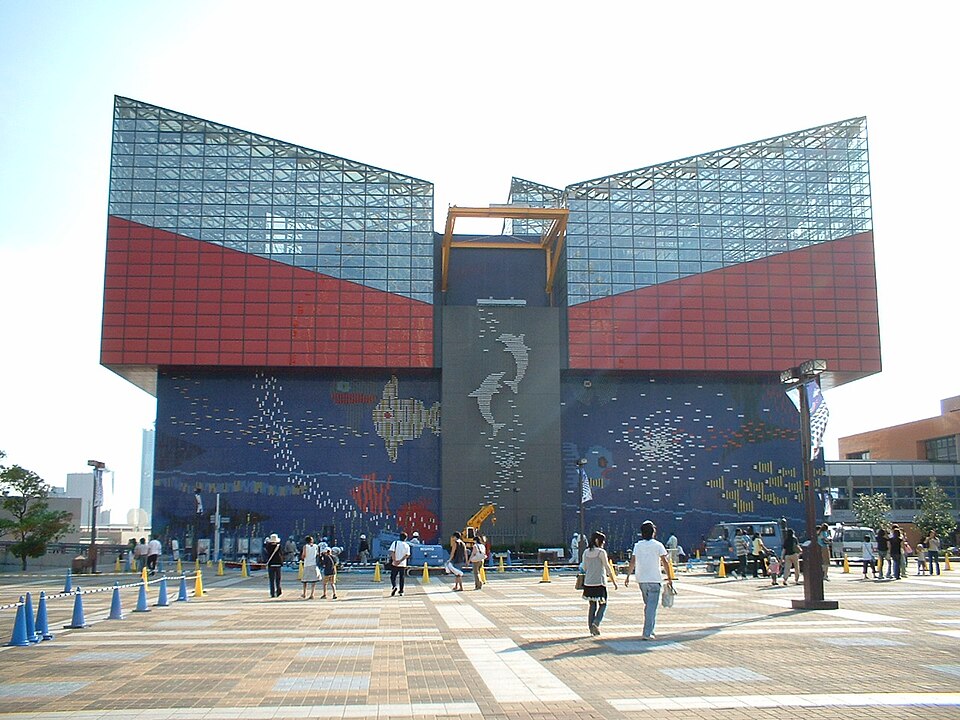
Kaiyukan stands on the Tempozan waterfront in Minato-ku, on the north shore of Osaka Bay, and it is built around one idea rather than a collection of tanks. The exhibition theme is the Ring of Fire, the belt of active volcanoes that encircles the Pacific, and each tank recreates the environment of a region that belt produced: the Aleutian Islands, Monterey Bay, the Gulf of Panama, the Ecuadorian rainforest, Antarctica, the Tasman Sea, the Great Barrier Reef. The aquarium states that it holds about 30,000 creatures from roughly 620 species, and the centre of the building is the Pacific Ocean tank, where whale sharks swim. The route matters as much as the contents. A visitor rides to the top of the building and then walks down a ramp that wraps around the central tanks, so the same body of water is met at the surface, then at mid depth, then at the floor, and the animals at each level are different ones. Kaiyukan describes the circuit as one-way with a single exit, which is why nobody gets lost in it and also why doubling back is awkward. The whole thing is indoors, which makes it one of the few Osaka sights a wet forecast does not spoil.
Checked 2026-08-26 · Source
The circuit opens at the Aqua Gate, a tunnel of blue water with tropical fish overhead, then climbs to the Japan Forest on the eighth floor, an otter stream under falling water. From there the ramp descends past the Aleutian Islands, Monterey Bay with its sea lions, the Gulf of Panama with coatis working the bank, the Ecuadorian rainforest where pirarucu hang in the shallows, the Antarctic penguin colony and the Tasman Sea, home to Pacific white-sided dolphins. The Great Barrier Reef tank leads into the Pacific Ocean tank, the largest in the building, with whale sharks, spinetail devil rays and schooling mackerel. Below it come the Seto Inland Sea, a seasonal tank restocked through the year, the Chilean rocky coast with its sardine shoal, the Cook Strait, and the Japan Deep, which recreates the lightless water below 200 metres. The last stretch is the jellyfish gallery, staged as a dark galaxy, then the Arctic and the Falkland Islands in the entrance building. Two areas need checking before a visit: Kaiyukan lists the Aleutian Islands tank as closed for renovation, and says the Antarctica tank cannot be seen between 16 January and 20 February 2026 while its enclosure is improved, with those dates subject to change. Cafe R.O.F. sits on the fourth floor behind the Japan Deep tank.
Checked 2026-08-26 · Source

Kaiyukan publishes a figure of its own: it tells group organisers that one circuit of the building takes 90 to 120 minutes. That is the number to plan against, and it is an honest one, because the route is fixed and one-way and there is little scope to shorten it beyond walking faster. Two hours is the sensible allowance for a first visit, and this guide records 120 minutes. Ninety minutes is achievable by someone who does not queue for the front row at the Pacific Ocean tank and does not stop for a feeding. Longer than two hours usually means one of three things: a feeding watched from two different floors, the jellyfish gallery treated as a place to sit rather than pass through, or small children setting their own pace. Time outside the aquarium has to be added separately. Buying tickets, the walk from Osakako Station and the restaurants and shops of Tempozan Marketplace turn a two-hour aquarium into a comfortable half day at the harbour. One constraint bounds the end of a visit rather than its length: last admission is one hour before closing, so an arrival timed too close to the doors shutting loses the walk, not the queue.
Checked 2026-08-26 · Source
Kaiyukan does not run one timetable. Opening and closing times are set date by date and published on a calendar on the aquarium's own site. Across the calendar for August to October 2026, weekday openings ran from 10:30 as late as 08:00 on the busiest summer dates, closing usually at 20:00 and occasionally at 21:00. This guide records the pattern that recurs most often, 10:30 on weekdays and 09:30 at weekends with a 20:00 close, but the exact date should be checked before travelling because an earlier opening is common in August. Last admission is one hour before closing. There is no weekly closing day; the published maintenance closure is 13 and 14 January 2027.
The aquarium's own crowd advice is that weekdays are quieter than weekends, with one exception it names itself: school parties fill weekday mornings from early February to early March, from mid-April to the end of May outside Golden Week, and from October to early December, and it suggests the afternoon on those dates. Evening is the other answer. The Kaiyukan Night Aquarium runs daily from 17:00, when the lighting changes and the animals behave differently, and a late entry misses the school groups entirely.
Checked 2026-08-26 · Source
Kaiyukan uses dynamic pricing: the adult ticket costs a different amount depending on the date, and the price for every date is published on the ticket calendar. Across August to October 2026 the adult price fell into four bands, 2,800, 2,900, 3,200 and 3,500 yen, with 2,800 yen the commonest and the higher bands attached to public holidays and peak weeks. Children aged 7 to 15 pay 1,400 to 1,800 yen on the same bands, children aged 3 to 6 pay 700 to 900 yen, and children aged 2 and under enter free. Adult means high school age or 16 and over. This guide records 2,800 yen, the lowest and most frequent adult band, so budget above it for a holiday date.
The aquarium sells an e-ticket for a chosen date and entry time and recommends buying in advance, since a same-day ticket does not guarantee entry at the hour a visitor wants. Holders of a Japanese disability certificate and one carer are admitted at half price on presentation of the original document. Set tickets that combine admission with the Santa Maria cruise, the Captain Line shuttle boat or the Legoland Discovery Center are sold alongside the plain ticket.
Checked 2026-08-26 · Source
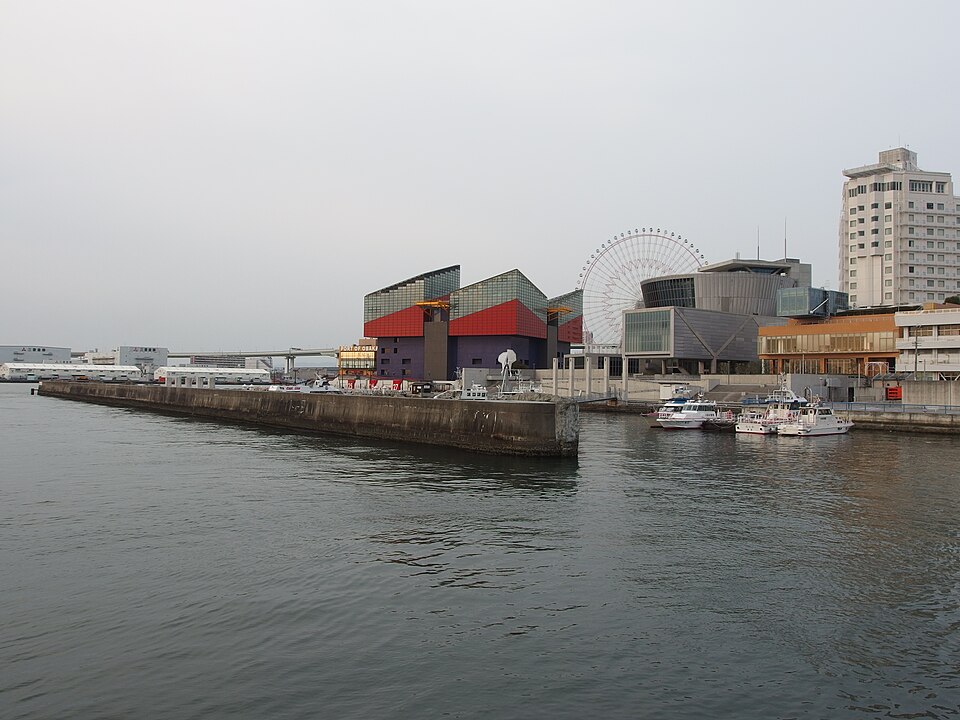
No car is needed. The address is 1-1-10 Kaigandori, Minato-ku, and the aquarium is about a five-minute walk from Exit 1 of Osakako Station on the Osaka Metro Chuo Line. Leave by Exit 1 or 2, follow the signs for Tempozan Marketplace, and walk towards the Ferris wheel, which is visible from the street. From Umeda the trip is a Midosuji Line ride and a change onto the Chuo Line. Buses stop nearby as well: Osaka City Bus route 88 from Osaka Station and route 60 from Namba stop at Tempozan Harbor Village, Nankai Bus stops at Kaiyukan (Tenpozan), and the Kansai Airport limousine bus stops at Tempozan (Kaiyukan). From the Universal Studios side of the harbour, the Captain Line shuttle boat lands at the Kaiyukan West Pier.
Drivers leave the Hanshin Expressway Bayshore Line at the Tempozan exit. The Tempozan car park beneath the aquarium and the marketplace holds about 1,000 cars, opens 08:00 to 23:00 with exit until midnight, and restricts vehicles to 2.00 metres in height and 5.00 metres in length. Parking costs 200 yen per 30 minutes to a 2,000 yen maximum on weekdays, and 250 yen per 30 minutes to 2,500 yen at weekends and on public holidays.
Checked 2026-08-26 · Source
Luggage is the rule most likely to catch a traveller out. Kaiyukan does not admit suitcases, carts, or any bag whose three sides add up to more than 120 centimetres or whose longest side exceeds 70 centimetres, and it asks visitors to leave them at a hotel or in a coin locker before arriving. Lockers stand near the aquarium entrance, by Kaiyukan Hall and the museum shop, in Tempozan Marketplace and under the Ferris wheel; the Hall and shop lockers can be used without an aquarium ticket. Open cups and tumblers are refused, while a bottle with a lid that will not spill is allowed.
Eating inside the aquarium is not permitted except at Cafe R.O.F. on the fourth floor, alcohol may not be brought in at all, and smoking, e-cigarettes included, is banned throughout.
Two warnings come from the aquarium itself. The corner where the Pacific Ocean tank first appears, just past the Great Barrier Reef, is where most people stop; the same tank is visible repeatedly further down, so walking on costs nothing. And because most of the route is a slope rather than a staircase, it is easy to lose track of position: the signs underfoot give the distance still to go to the exit.
Checked 2026-08-26 · Source
Photography is allowed and the building is generous with it, but the acrylic is thick, up to 30 centimetres on the Pacific Ocean tank with a sample panel displayed on the fourth floor, so expect some softness and a blue-green cast, and hold the lens against the panel to kill reflections. Flash is where the rules bite. Kaiyukan prohibits flash and photography lights that dazzle the animals or other visitors, and bans flash outright, all day, at the seasonal exhibit tank and the ringed seal tank. Tripods and selfie sticks are not permitted, although a tripod may be used as a monopod, and anything emitting a constant light is refused.
That leaves a high ISO and a fast lens as the working answer, and patience as the rest of it. Standing in front of a tank for a long stretch is explicitly discouraged, as is live streaming that blocks other people's view, so compose quickly and step back out of the flow. The descending ramp is the real advantage here: one tank can be shot from the surface, from mid-water and from the floor, and a whale shark reads very differently looked down on than looked up at.
Checked 2026-08-26 · Source
Kaiyukan states that one circuit of the building takes 90 to 120 minutes. The route is one-way with a single exit, so the length is fixed rather than a matter of choice. Allow two hours for a first visit, more if a feeding time is watched from more than one floor or small children are setting the pace.
Hours are set date by date and published on the aquarium's own calendar. The pattern that recurs most often is 10:30 to 20:00 on weekdays and 09:30 to 20:00 at weekends, but dates in August open as early as 08:00 and some close at 21:00, so the specific date should be checked. Last admission is one hour before closing. There is no weekly closing day; the published maintenance closure is 13 and 14 January 2027.
Pricing is dynamic. Across August to October 2026 the published adult price was 2,800, 2,900, 3,200 or 3,500 yen depending on the date, with 2,800 yen the commonest. Children aged 7 to 15 pay 1,400 to 1,800 yen, children aged 3 to 6 pay 700 to 900 yen, and children aged 2 and under are free. A Japanese disability certificate holder and one carer are admitted at half price.
No car is needed. The aquarium is about five minutes on foot from Exit 1 of Osakako Station on the Osaka Metro Chuo Line, and city buses, the Kansai Airport limousine bus and the Captain Line shuttle boat all stop at Tempozan. Drivers use the Tempozan exit of the Hanshin Expressway Bayshore Line; the car park holds about 1,000 cars, opens 08:00 to 23:00, and costs up to 2,000 yen on a weekday and 2,500 yen at weekends.
Yes, with limits. Flash and photography lights that dazzle the animals or other visitors are prohibited, and flash is banned all day at the seasonal exhibit tank and the ringed seal tank. Tripods and selfie sticks are not allowed, though a tripod may be used as a monopod. Occupying the space in front of a tank for a long time, and live streaming that blocks other visitors, are both discouraged.
The aquarium says weekdays are generally quieter than weekends, but names three periods when school parties fill weekday mornings: early February to early March, mid-April to the end of May outside Golden Week, and October to early December. On those dates it recommends the afternoon. The Night Aquarium runs daily from 17:00 and is the other way to avoid the groups.
Loading the interactive map…
The interactive map could not be loaded.
Last updated:
Source: OpenStreetMap contributors, Wikidata ·