
.jpg)
.jpg)
.jpg)


9 min walk
Temple of Olympian Zeus
- Must see · Heritage site
- Historic monument
Language · 1 published
Historic monument · Athens
Παναθηναϊκό Στάδιο
| Monday | 08:00 – 19:00 |
|---|---|
| Tuesday | 08:00 – 19:00 |
| Wednesday | 08:00 – 19:00 |
| Thursday | 08:00 – 19:00 |
| Friday | 08:00 – 19:00 |
| Saturday | 08:00 – 19:00 |
| Sunday | 08:00 – 19:00 |
Also recorded: 08:00 – 17:00
Checked 2026-08-26 · Source
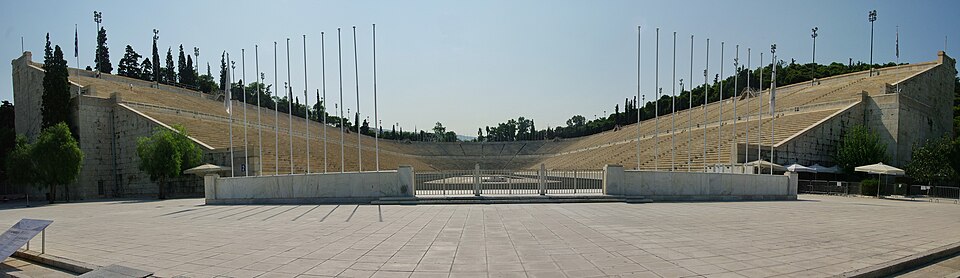
The Panathenaic Stadium is a horseshoe of white Pentelic marble sunk into the hollow between the hills of Ardittos and Agra, about a kilometre south-east of Syntagma Square. Athenians call it the Kallimarmaro, the beautiful marble, and the name describes the building better than the official one does. An earthen stadium was cut into this hollow by the orator and politician Lycurgus for the games of the Great Panathenaea; the operator's own pages date that work twice, around 330 BC on the ancient-stadium page and 339 BC on the Ardittos page, and both readings are reproduced here rather than averaged. The rectangular earth banks lasted until the second century AD, when the wealthy sophist Herod Atticus paid to rebuild the whole thing in marble between 140 and 143 AD, giving it the horseshoe shape, the propylon and a capacity of fifty thousand. Christianity ended the games, the marble was quarried away for other buildings, and by the eighteenth century the stadium was a grassed-over depression that European travellers came to sketch. What stands today is a reconstruction of the Roman stadium, and it is the only large stadium in the world built entirely of marble.
Checked 2026-08-26 · Source
One ticket covers the whole site, and the whole site is smaller than its reputation suggests. A visitor walks in through the courtyard, onto the running track, and then up the marble tiers as far as they care to climb. The vaulted passage under the eastern bank, the tunnel athletes once used to enter, is open and walkable. The podium at the head of the track is there to be stood on and photographed. Inside the stadium building is the Stadium Museum, whose permanent exhibition is titled Memories from Olympic Games: Posters and Torches from 1896 till today, and which the ticket also admits you to. Every full and reduced ticket includes an automatic audio guide device handed over at the entrance; the tour runs about thirty minutes and is available in eleven languages including English, French, Spanish, Italian, Russian, Chinese, Korean and Japanese. A canteen sits to the right of the entrance and there are two gift shops, one in the courtyard which needs no ticket and one in the museum area which does. Restrooms are charged separately.
Checked 2026-08-26 · Source
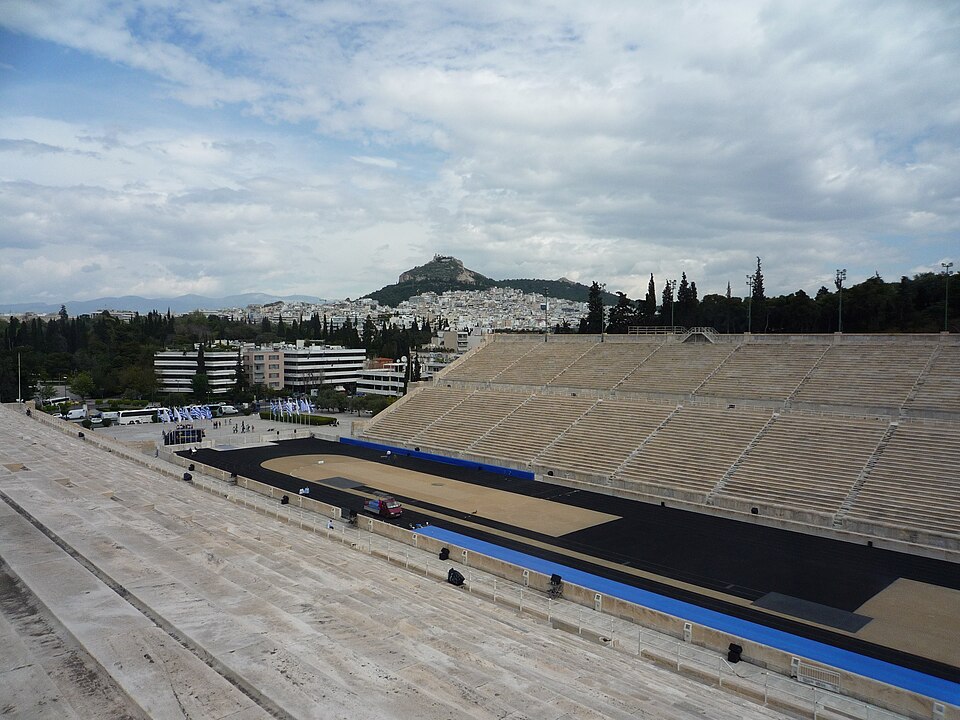
Allow an hour. The Hellenic Olympic Committee publishes no suggested visit length anywhere on the stadium's own site, so this figure is judgement rather than a recorded fact: it is built from the thirty minutes the operator states for the audio tour, plus the climb to the upper tiers and back, plus the museum. Ninety minutes is the right allowance for anyone who wants to sit at the top for a while or read every museum caption, and forty minutes is enough for someone who only wants to stand on the track, photograph the podium and leave. The single variable that most affects the number is the climb. The marble tiers are steep and there is no lift to them, so a slow ascent to the highest rows and a careful descent can absorb twenty minutes on its own. Groups using the audio guide are handled at a rate the operator gives as one hundred people every fifty minutes, which is a useful indication that the intended pace through the site is unhurried rather than quick. The stadium sits well as a one-hour block between the Zappeion and the National Garden.
Checked 2026-08-26
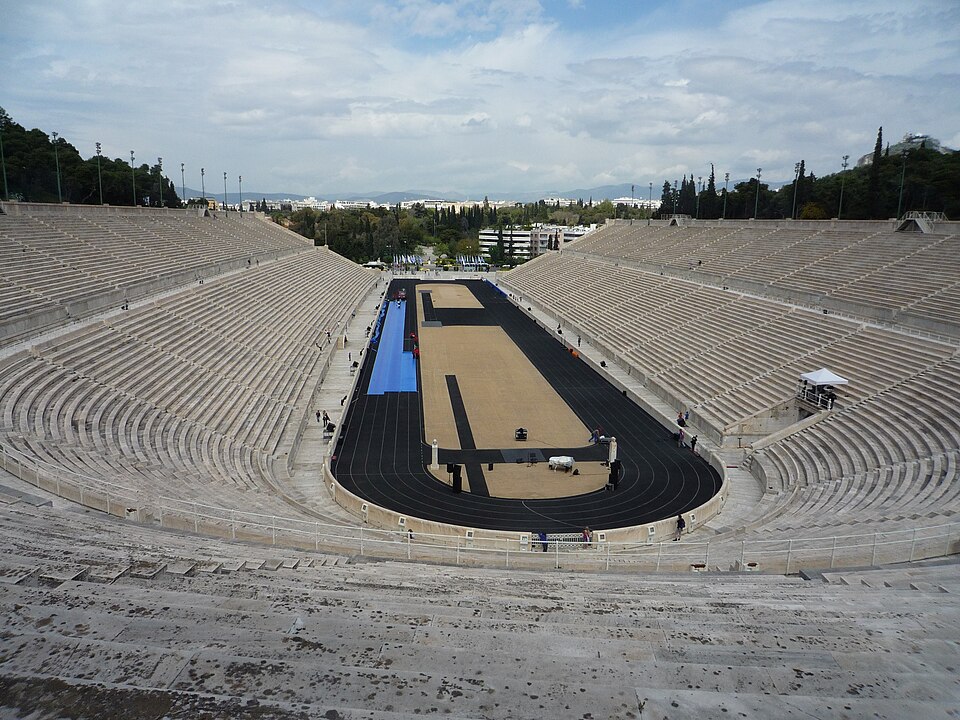
The stadium is open every day, and its hours change with the season: 08:00 to 19:00 from March to October, and 08:00 to 17:00 from November to February, with last entry at closing time in both bands. No weekly closing day is published. The operator's own advice for summer is to come in the morning or the late afternoon, when the temperature is lower, and that advice should be taken literally. The site is a marble bowl with no shade in it at all, the tiers face inward, and a July or August midday on the upper rows is punishing. The 08:00 opening is unusually early for an Athens sight and is the single best thing about the place logistically: arriving at opening gives an empty track, cool marble and low eastern light, and leaves the rest of the morning free. In winter the operator warns that the steps can be slippery, which is worth remembering because the descent is the harder direction. Anything scheduled at the stadium, a concert or the marathon finish, changes the hours, and those changes are announced on the operator's site rather than anywhere else.
Checked 2026-08-26 · Source
General admission is €12.00 per person and reduced admission is €6.00 for students on presentation of a student identity card. These prices took effect on 1 October 2025 by decision of the Executive Committee of the Hellenic Olympic Committee. Children up to the age of six enter free, as do disabled visitors and one accompanying person, and teachers and pupils escorting educational visits from Greek primary and secondary schools. Anyone claiming free or reduced entry has to show the documentation at the stadium ticket office; it cannot be arranged in advance. Tickets are sold only at the Panathenaic Stadium ticket desk, in cash or by bank card, and there is no online sale for individual visitors — electronic deposit is available to travel agents only. A ticket is valid on the day it is issued and no longer; the moment you leave the stadium it is spent, so there is no going out for coffee and coming back. Purchases cannot be cancelled or refunded. The admission price includes the audio guide and the museum. The restrooms are not included: using them costs €1.50 per person and the exact amount is required.
Checked 2026-08-26 · Source
No car is needed and none is wanted. The stadium stands on Vasileos Konstantinou Avenue, across from the statue of the Discobolus of Myron, and the operator publishes no visitor car park — the only parking it names is for bicycles, at the stadium entrance. What it does publish is that the site is about a thousand metres from three metro stations: Syntagma and Evangelismos on line M3 and Akropoli on line M2. Any of the three is a walk of twelve to fifteen minutes, and the walk from Syntagma through the National Garden and past the Zappeion is the pleasant one, shaded most of the way. City buses 2, 4, 10, 11, 90, 209 and 550 stop at the stop named Stadium, as do trolley lines 2, 4, 10 and 11; tram line 6 stops at Zappeio, a few minutes further on foot. Both the track and the stoa are accessible to visitors with physical disabilities. The museum is reached by stairs only and has no lift, which is the one part of the site step-free access does not reach.
Checked 2026-08-26 · Source
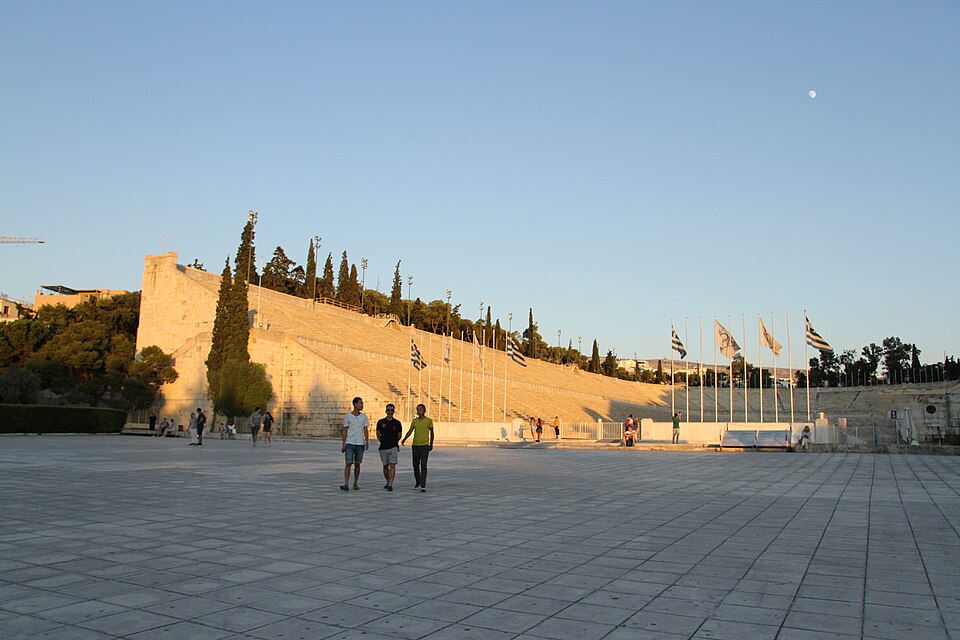
Two sets of works are running at the stadium as of late August 2026 and both affect what a visitor can do. The running track has been closed to visitors since 26 June 2026 and the operator's notice gives 31 August 2026 as the end of the resurfacing, so a visit before September may not include walking on the track — check the site's news page before going rather than assuming. Separately, cleaning and conservation of the marble began on 10 August 2026 at the sphendone, the curved end, and is expected to finish there by 10 September; the work then moves around the rest of the stadium and is expected to run through 2026, so scaffolding or working teams somewhere on the marble are likely. Beyond the works: this is an archaeological site and the rules are enforced. No smoking, no food, and no drink other than water. Pets are not admitted except guide dogs. Bicycles, roller skates and any other wheeled vehicle are refused, though prams are fine. There is no visitor WiFi. Bring water and sunscreen in summer; the operator says so itself.
Checked 2026-08-26 · Source
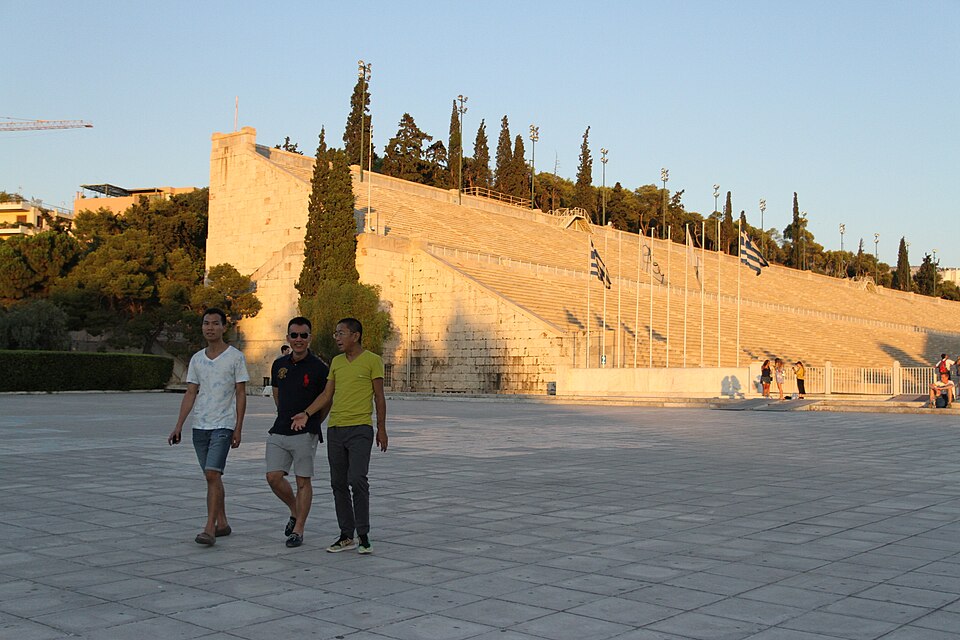
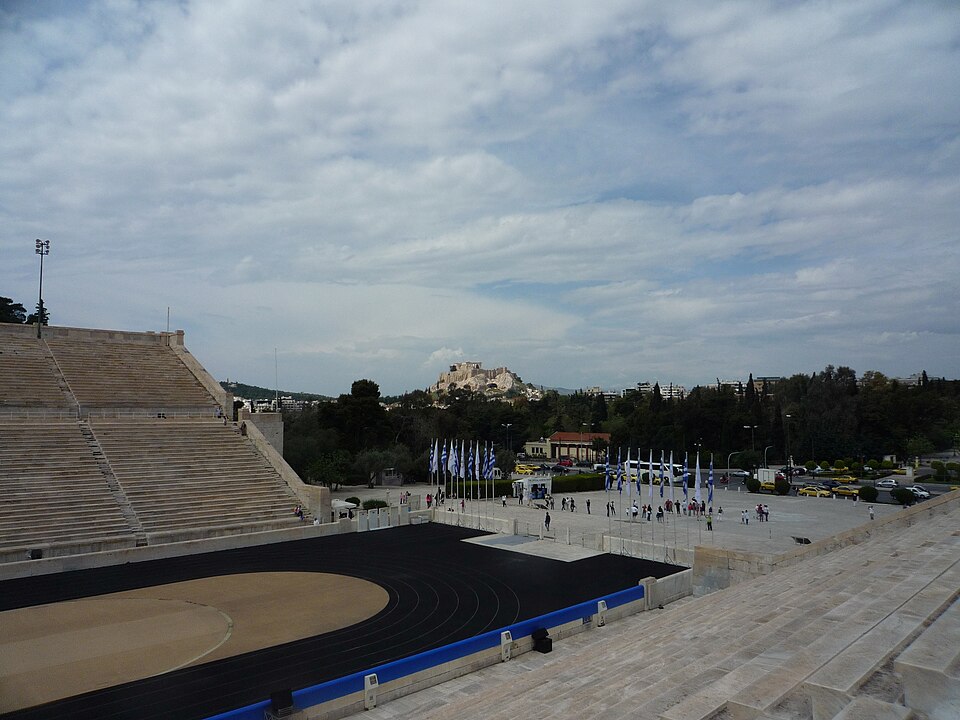
Amateur photography and filming are allowed in every area of the stadium, and the operator names two shots specifically. The first is from the upper bleachers of Section 21, which looks out over the rim of the bowl to the Acropolis and the Parthenon, the Zappeion, the National Garden and Lycabettus Hill; it is the reason to make the climb even in heat. The second is on the podium at the head of the track, with the marble tiers behind. The light is the thing to plan around. The bowl opens to the north-west, so early morning puts the sun behind the eastern bank and leaves the tiers evenly lit and the marble cool white rather than blown out; midday flattens everything and makes the white unmanageable; late afternoon warms the western tiers and the Acropolis view from Section 21. Restrictions are on publication rather than on taking. Publishing images of the stadium or its interiors commercially is prohibited, professional photographers need approval in advance, and using Olympic symbols or references in the resulting material is not permitted.
Checked 2026-08-26 · Source
General admission is €12.00 per person and reduced admission is €6.00 for students showing a student identity card, prices set by the Hellenic Olympic Committee and in force since 1 October 2025. Children up to the age of six, disabled visitors with one companion, and teachers and pupils on Greek school educational visits enter free on showing documentation at the ticket office. The price includes the audio guide and the Stadium Museum. Using the restrooms is extra, at €1.50 per person, exact amount required.
The stadium opens daily at 08:00. It closes at 19:00 from March to October and at 17:00 from November to February, with last entry at closing time in both seasons. The operator publishes no weekly closing day and no midday break. Hours do change for events held at the stadium, such as concerts or the finish of the Athens Marathon, and the operator states that any such change is announced on its own website, so check there before a visit that depends on a particular hour.
No. The operator states that a ticket for the Panathenaic Stadium can only be purchased at the stadium's own ticket office, paying in cash or by bank card; electronic deposit exists only for travel agents. Free and reduced tickets are likewise issued only at the ticket office, against the documentation that entitles you to them. A ticket is valid only on the day it is issued, cannot be cancelled or refunded, and stops working the moment you leave the stadium, so there is no re-entry on the same ticket.
Normally yes, but not right now. The operator allows jogging on the track every day from 07:30 to 09:00, with a ticket and a signed acceptance of the terms of use, except on days reserved for a major event, and outside those hours visitors may run on the track at their own risk without disturbing others. However, the operator's notice of 25 June 2026 closed the track to visitors from 26 June 2026 until 31 August 2026 for resurfacing works, so a visit before September should not count on reaching it.
About an hour is right for most visitors. The operator publishes no suggested visit length, so that is judgement rather than a recorded figure: it is the thirty minutes the operator gives for the audio tour, plus the museum, plus the climb up the marble tiers and back down. Ninety minutes suits anyone who wants to sit at the top or read the museum in full, and forty minutes is enough to walk in, see the bowl, photograph the podium and leave.
No car is needed, and the operator publishes no visitor car park — only bicycle parking at the entrance. The stadium is about a thousand metres from the Syntagma, Evangelismos and Akropoli metro stations, a twelve to fifteen minute walk, and city buses 2, 4, 10, 11, 90, 209 and 550 and trolleys 2, 4, 10 and 11 stop at the stop named Stadium. Tram line 6 stops at Zappeio. The track and the stoa are accessible to visitors with physical disabilities; the museum is reached by stairs only and has no lift.
Loading the interactive map…
The interactive map could not be loaded.
Last updated:
Source: OpenStreetMap contributors, Wikidata ·