

_(5054897427).jpg)
_(5054895733).jpg)
.jpg)
.jpg)
2 min walk
Arch of Hadrian
- Must see · Heritage site
- Historic monument
Language · 1 published
Historic monument · Athens
Ναός του Ολυμπίου Διός
| Monday | 08:00 – 20:00 |
|---|---|
| Tuesday | 08:00 – 20:00 |
| Wednesday | 08:00 – 20:00 |
| Thursday | 08:00 – 20:00 |
| Friday | 08:00 – 20:00 |
| Saturday | 08:00 – 20:00 |
| Sunday | 08:00 – 20:00 |
Checked 2026-08-26 · Source
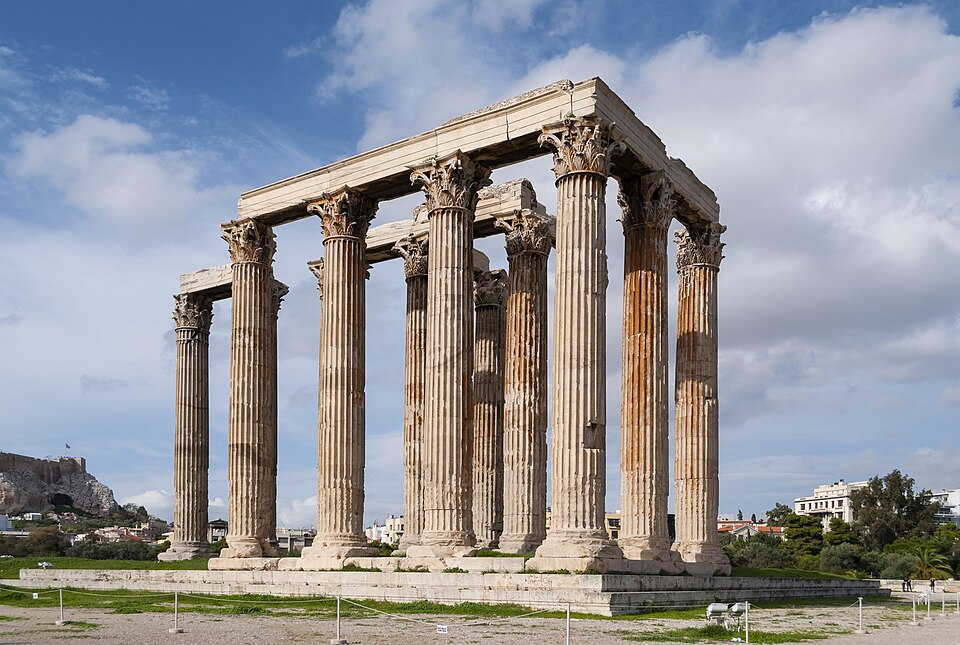
The Temple of Olympian Zeus stands inside the archaeological site of the Olympieion, the sanctuary of Olympian Zeus that occupied the low ground between the Acropolis and the hill of Ardittos, on the banks of the Ilissos. Building began around 515 BC under the sons of Peisistratos; Aristotle read the project as a tyrant's device for keeping the ruled busy and poor. It then stood unfinished for roughly four centuries. Antiochus IV Epiphanes restarted it in 174 BC and abandoned it again, and the emperor Hadrian finally completed it in AD 131-132, a feat Philostratus called a great contest with time. Hadrian's temple was Corinthian, built of Pentelic marble, 107.89 metres long and 41.11 metres wide, with two rows of twenty columns down each long side and three rows of eight across each end: 104 columns in the peristyle, each shaft 16.89 metres tall and 1.92 metres across at the base. Ruin set in around the fifth century AD. One column was burned for lime in 1759 on the order of the voivode Tzistarakis, to build the mosque on what is now Monastiraki Square. Fifteen columns stand today, and a sixteenth lies where a storm dropped it in 1852.
Checked 2026-08-26 · Source
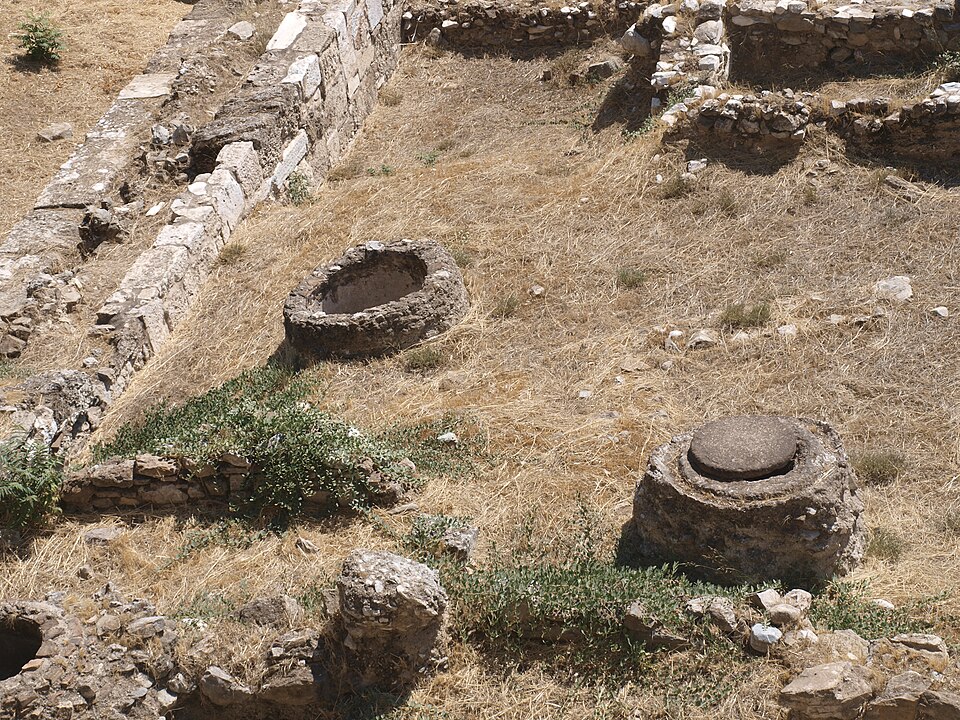
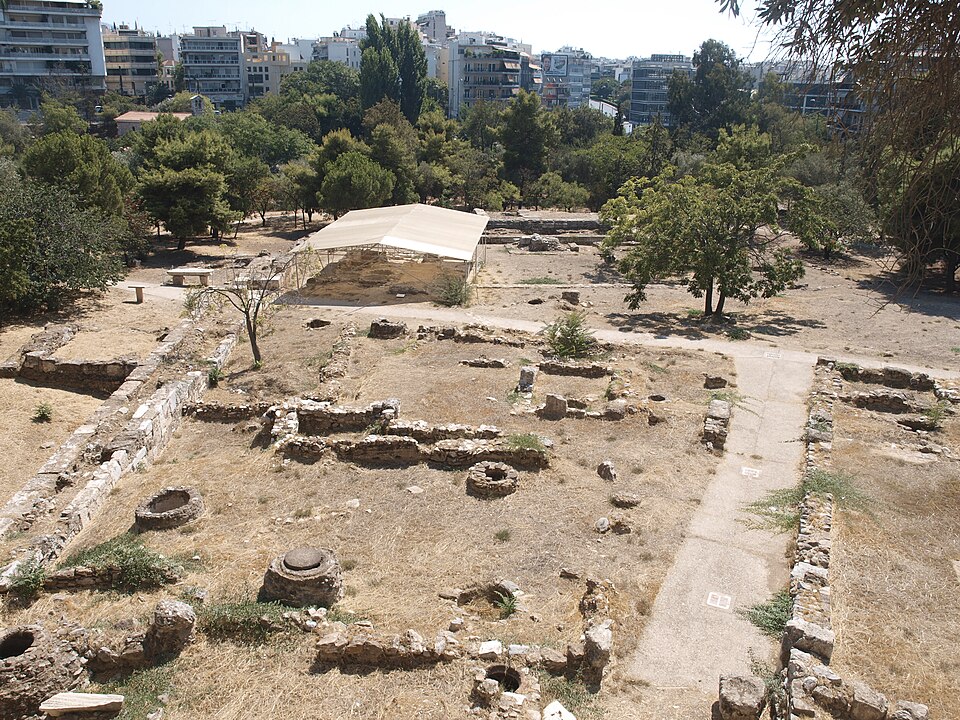
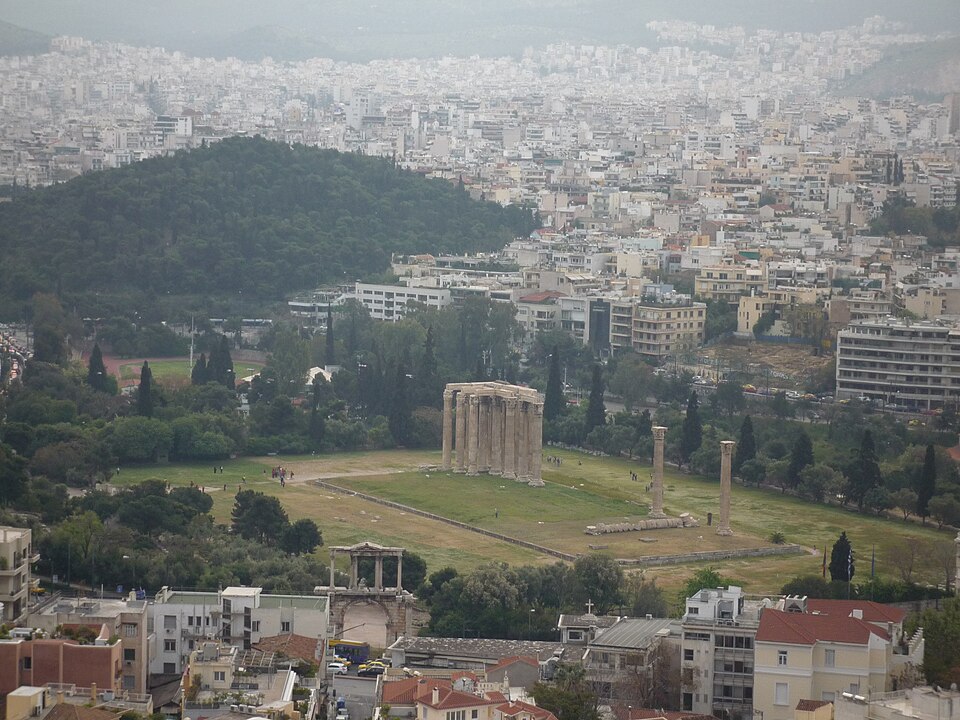
The fenced ground is larger than the temple, covering about fifteen acres bounded by Vasilissis Olgas Avenue to the north, Amalias Avenue to the west, Athanasiou Diakou Street to the south and the tennis club to the east. Besides the columns, the enclosure holds Roman baths, Classical houses, a basilica of the fifth century AD and a stretch of the city's fortification wall. The older cult buildings are here too: the Doric peripteral temple of Apollo Delphinios of about 500 BC and, beside it, the Delphinion Court with its wide courtyard and chambers on the north side; the gates of the Themistoclean Wall of 479-478 BC; the temple of Panhellenic Zeus of AD 131-132; and the small peripteral temple of Kronos and Rea of about 150 BC. Most of this survives as foundation courses at ankle height, legible from the path rather than enterable. Hadrian's Arch sits just outside the fence, on the far side of Vasilissis Olgas Avenue. There is a shop and there are toilets by the entrance. The operator has installed nineteen marble plaques carrying QR codes across the site, feeding a digital guide application that a ticket now includes.
Checked 2026-08-26 · Source

Allow forty-five minutes. The operator publishes no suggested visit length for the Olympieion, so that figure is this guide's judgement rather than a number read off the Ministry's page, and it follows from the shape of the place. This is one open field with nothing to go inside: the columns are seen from the path, from three or four angles, and the rest of the enclosure is foundation courses read at ankle height. Twenty minutes covers the temple platform and the standing group properly. The remaining twenty-five take in the Apollo Delphinios foundations, the Delphinion Court, the wall gates and the Roman baths at the pace those deserve, which is slow but not long. A visitor who only wants the columns can be in and out in twenty minutes and will not have missed much. Entry is by timed slot, so the clock starts at a moment chosen in advance rather than on arrival. Hadrian's Arch, immediately outside the fence, costs nothing and adds five minutes. The Acropolis is a seven-minute walk away, which makes the Olympieion a natural short stop before or after a much longer one, not a destination that fills a morning on its own.
Checked 2026-08-26
The site opens at 08:00 every day of the year and its closing time moves with the season. From 1 April to 31 August it closes at 20:00; from 1 to 15 September at 19:30; from 16 to 30 September at 19:00; from 1 to 15 October at 18:30; from 16 to 31 October at 18:00; and from 1 November to 31 March at 15:00. There is no weekly closing day and no midday break. The operator's visitor page gives last admission as twenty minutes before closing, and its ticket store says the same; the older Ministry page for the site instead prints 19:30 as the summer last entrance, so the two do not agree and the safer assumption is the earlier one. The site closes entirely on 1 January, 25 March, 1 May, Easter Sunday, and 25 and 26 December. Within the day, the constraint is shade: the enclosure is open ground with almost none of it, and the columns stand in full sun. In summer that argues for the first hour after opening or the last two before the 20:00 close. In winter the 15:00 closing removes the late afternoon altogether, and the low sun through the middle of the day is the best light on offer.
Checked 2026-08-26 · Source
Admission is 20 euros full and 10 euros reduced, charged per person, and the reduced rate is half the full one. The ticket covers the Olympieion archaeological site and admits the holder once, on the date and time chosen; entry is by timed slot. Tickets are sold at the ticket office on Vasilissis Olgas Avenue and online through the Ministry's own e-ticketing service at tickets.hh.gr, which is the operator's store rather than a reseller. Bought online, a ticket may be changed up to two hours before the booked entry, twice at most, and is not refundable. Anyone using a reduced or free ticket has to show identification or supporting documentation at the gate. Access to the digital guide application is included in the price. Admission is free on 6 March, 18 April, 18 May, the last weekend of September and 28 October, and also on the first and third Sunday of every month between 1 November and 31 March. Whether a combined ticket covering the Olympieion together with other central Athens sites is currently sold could not be established from the operator's own pages, which list only the single-site full and reduced prices, so budget for the 20 euros unless a package is found at the counter.
Checked 2026-08-26 · Source
The only way in is the gate house on Vasilissis Olgas Avenue, postcode 10557, on the north edge of the enclosure. No car is needed and none is wanted: this is central Athens, the operator publishes no visitor parking, and every approach it lists is on foot or on public transport. The nearest station is Acropolis on metro Line 2, seven minutes' walk away, which is also the station for the Acropolis itself and makes the two an easy pair. Tram line T6 stops at Leoforos Vouliagmenis. Bus lines 040, 230 and A2 serve the area, as do trolleybus lines 1, 2, 4, 5, 11 and 15. Walking in from Syntagma down Amalias Avenue takes about fifteen minutes and passes Hadrian's Arch, which stands on the far side of Vasilissis Olgas Avenue just outside the fence, so the arch is seen before the gate is reached. Note that Vasilissis Olgas Avenue is being redeveloped by the Municipality of Athens. Work in front of the entrance has been going on in stages since August 2025 and the operator states it does not obstruct access, but the pavement approach changes as the project moves.
Checked 2026-08-26 · Source
Two parts of the wider site are not available. The Parilissia Sanctuaries, the group along the Ilissos that was joined to the Olympieion during the unification of the Athens archaeological sites, cannot be visited at present. The ground around Hadrian's Gate is closed to the public for the Vasilissis Olgas Avenue redevelopment, so a visitor should expect to see the arch from the street rather than from beside it. Inside the fence, the Ministry's operating rules prohibit eating and drinking, smoking, littering, touching anything, and taking or moving any object; large luggage is refused at the gate. Visitors are asked to keep to the marked routes and to follow the guards' instructions, and the Ministry specifically recommends footwear suitable for walking on an archaeological site, which is fair warning that the surfaces are gravel and broken stone rather than paving. The winter closing time of 15:00 catches people out more than any other detail here, and last admission is twenty minutes before that. On accessibility, the operator states the site is wheelchair accessible over most of its area through the Vasilissis Olgas entrance, recommends that a companion come along, and provides accessible toilets; tactile site plans and Braille brochures in Greek and English are held at the ticket office.
Checked 2026-08-26 · Source
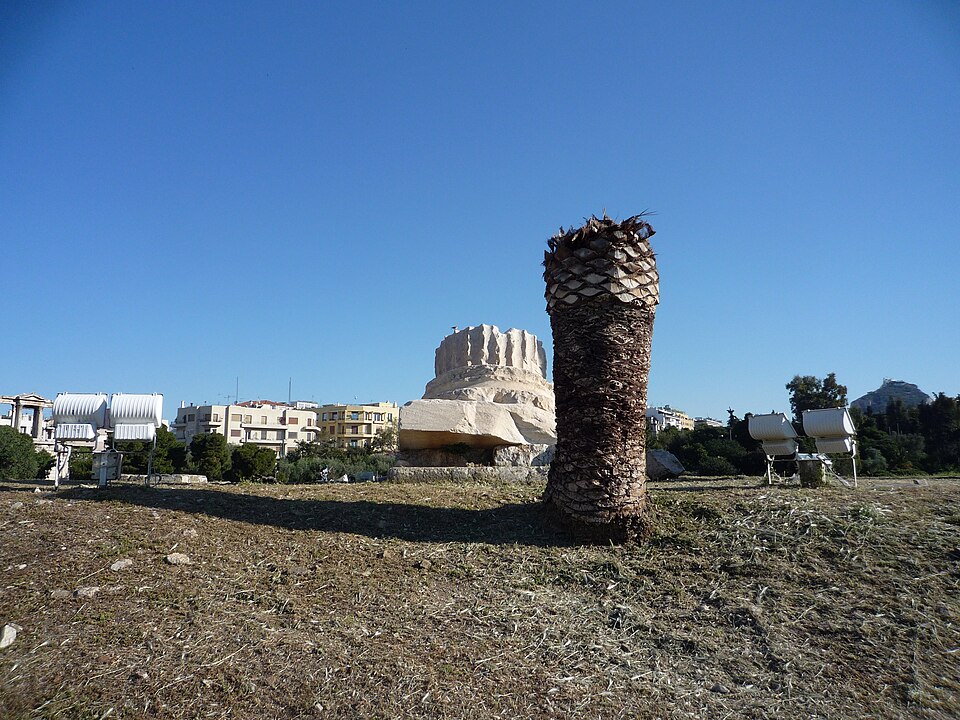
The operator's ticket terms forbid professional photo shoots and filming; ordinary personal photography is what the site expects, and the QR plaques exist to be read rather than kept out of frame. The subject organises itself into two groups. Thirteen columns stand together at the east end of the temple and three more to the west, one of which fell in 1852 and lies broken into drums on the ground, which is the single most photographed object here and the only one that shows how the shafts were built. At 16.89 metres a shaft will not fit in a normal lens from close in, so either step back towards the perimeter path or accept the base-up angle and use it. The Acropolis rises to the north-west and can be brought behind the columns from the western side of the platform. Light matters more than position: the stone is Pentelic marble and goes flat and white under a high sun, so early morning or the last hour before the summer 20:00 close is when it takes colour. Between November and March the 15:00 closing puts the golden hour outside opening times entirely, and the fence line on Vasilissis Olgas Avenue is then the only way to shoot the columns late.
Checked 2026-08-26
Full admission is 20 euros and the reduced rate is 10 euros, charged per person, and the ticket admits the holder once at a booked date and time. It is sold at the ticket office on Vasilissis Olgas Avenue and online through the Ministry's own service at tickets.hh.gr. Access to the digital guide application is included. Admission is free on 6 March, 18 April, 18 May, the last weekend of September, 28 October, and the first and third Sunday of each month from 1 November to 31 March. Reduced and free tickets require identification at the gate.
It opens at 08:00 every day and closes on a seasonal schedule: 20:00 from 1 April to 31 August, 19:30 from 1 to 15 September, 19:00 from 16 to 30 September, 18:30 from 1 to 15 October, 18:00 from 16 to 31 October, and 15:00 from 1 November to 31 March. There is no midday break. Last admission is twenty minutes before closing according to the operator's visitor page and its ticket store, though an older Ministry page prints 19:30 for the summer last entrance, so arriving before the earlier of the two is the safe course.
No. The Olympieion has no weekly closing day and is open daily throughout the year. It closes only on fixed public holidays: 1 January, 25 March, 1 May, Easter Sunday, 25 December and 26 December. Two caveats are worth carrying separately. The Parilissia Sanctuaries, the group of sites along the Ilissos that belongs to the same archaeological area, cannot be visited at present, and the ground around Hadrian's Gate is closed to the public while Vasilissis Olgas Avenue is being redeveloped, so the arch is currently seen from the street rather than from close beside it.
Forty-five minutes is a fair allowance, and that is this guide's judgement rather than a figure the operator publishes; the Ministry gives no suggested visit length for this site. The reasoning is simple: there is nothing to go inside. Twenty minutes covers the temple platform and the standing columns, and another twenty-five takes in the Apollo Delphinios foundations, the Delphinion Court, the Themistoclean wall gates and the Roman baths at a slow pace. A visitor who wants only the columns can be finished in twenty minutes. Entry is by timed slot, so the visit begins at a moment chosen in advance.
No car is needed and the operator publishes no visitor parking. The only entrance is the gate house on Vasilissis Olgas Avenue, postcode 10557. Acropolis station on metro Line 2 is seven minutes' walk away. Tram line T6 stops at Leoforos Vouliagmenis. Bus lines 040, 230 and A2 serve the area, along with trolleybus lines 1, 2, 4, 5, 11 and 15. Walking down Amalias Avenue from Syntagma takes about fifteen minutes and passes Hadrian's Arch. Roadworks on Vasilissis Olgas Avenue have been under way in stages since August 2025 without, the operator states, obstructing access.
Largely, yes. The operator states that the archaeological site is wheelchair accessible over most of its area through the main entrance on Vasilissis Olgas Avenue, and recommends that a companion assist. Toilets for visitors with disabilities are provided on site. Tactile site plans and brochures in Braille, in Greek and in English, are available at the ticket office for visitors who are blind or partially sighted. The surfaces across the enclosure are gravel and broken stone rather than paving, which is why the Ministry recommends footwear suitable for walking and why the companion recommendation is worth taking seriously.
Loading the interactive map…
The interactive map could not be loaded.
Last updated:
Source: OpenStreetMap contributors, Wikidata ·