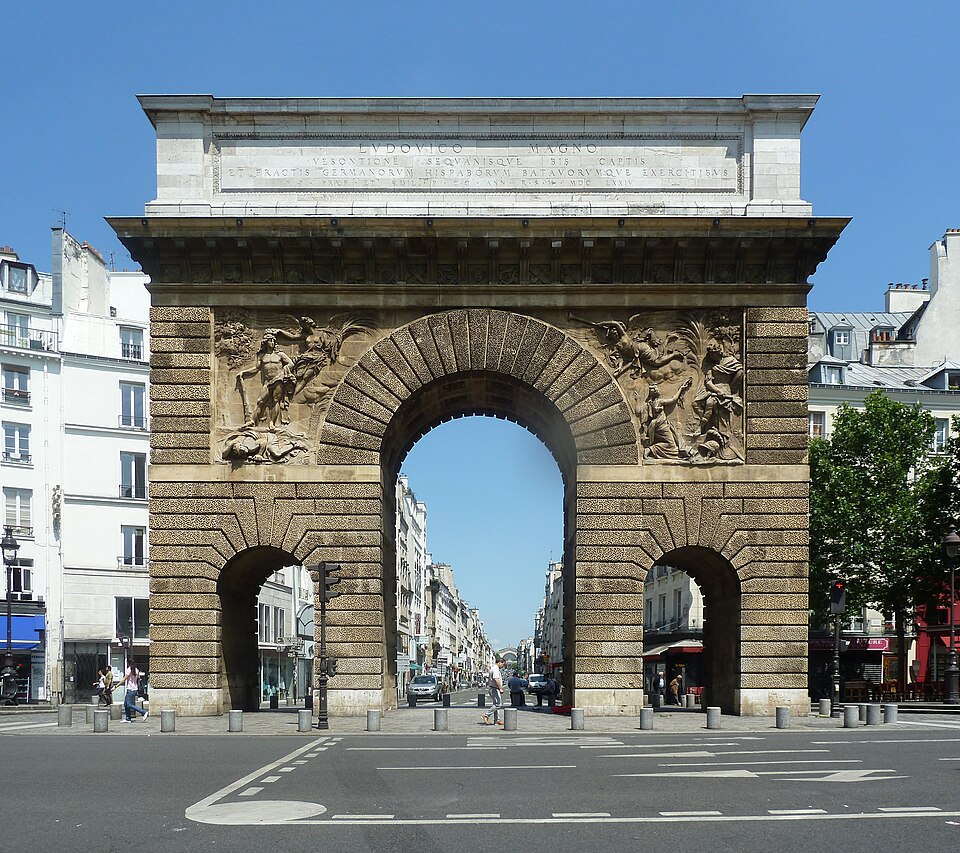
Porte Saint-Martin is a triumphal arch built in 1674 at the order of Louis XIV to celebrate his military victories on the Rhine and in Franche-Comte, standing at what was then a gate in the walls of Paris built under Charles V.
Architect Pierre Bullet, a student of Francois Blondel who designed the nearby Porte Saint-Denis two years earlier, replaced the old medieval gate with the present arch. It was restored in 1988 and stands 18 metres high, built in limestone and marble in a heavily rusticated style.
It sits at the junction of four streets — the Rue Saint-Martin from the south, the Rue du Faubourg Saint-Martin from the north, and the Grands Boulevards, Boulevard Saint-Martin to the east and Boulevard Saint-Denis to the west — making it a traffic island rather than a gate anyone still passes through with any formality.
Louis XIV commissioned both this arch and the Porte Saint-Denis in the same short burst of building, within two years of each other, to mark the same run of campaigns; the pair still frame the same stretch of Grands Boulevards today, one gate replacing the medieval Porte Saint-Martin in the wall built under Charles V, the other replacing its Saint-Denis counterpart.
Four bas-relief panels fill recesses on each face of the arch, each commemorating a specific 1673-74 campaign: on the north side, Pierre Le Gros the Elder's Capture of Limbourg and Gaspard Marsy's Defeat of the Germans, showing Louis XIV as Mars pushing back a German eagle; on the south side, Etienne le Hongre's Breaking of the Triple Alliance, with Louis XIV as a partly nude Hercules, and Martin van den Bogaert's Capture of Besancon, with Louis XIV as Fame receiving keys from a personification of the city.
There is no interior open to visitors; the arch is a solid monument to be viewed from the street, not entered or climbed.
The arch replaced a medieval gate built under Charles V in the fourteenth century, part of a defensive wall that no longer survives anywhere near this junction; the arch itself is the only trace left of that fortification line on this stretch of the Grands Boulevards, which is why it stands isolated on a traffic island rather than attached to any surviving wall.
Ten to fifteen minutes to walk around the arch and read the four bas-reliefs at street level; it pairs naturally with the Porte Saint-Denis, a five-minute walk west along the same boulevard.
Both arches together, with the walk between them along the Grands Boulevards, make a thirty-minute stop rather than a destination on their own.
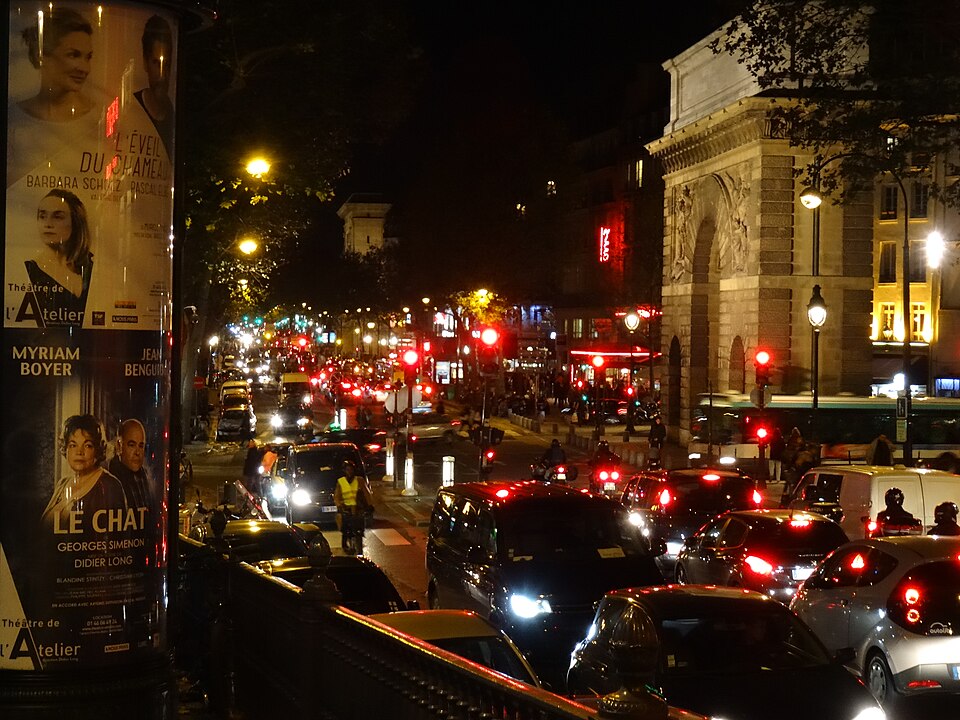
Any time of day works, since there is no interior and no opening hours to plan around; the arch is lit at night and reads differently after dark against the boulevard's traffic and shopfronts.
Daytime gives the clearest view of the carved bas-reliefs; the surrounding boulevard is busiest with shoppers and commuters in the late afternoon.
At the junction of the Grands Boulevards and Rue Saint-Martin, on the border of the 10th arrondissement.
Strasbourg-Saint-Denis station, lines 4, 8 and 9, sits directly beneath the junction and is the closest stop, with an exit that surfaces within sight of the arch itself, no further walk needed to find it.
The arch sits on a busy traffic island at a major boulevard junction; crossing to it and around it means using the marked pedestrian crossings rather than cutting across the road directly.
There is no interior to visit and nothing to queue for — a visitor expecting a ticketed monument the way the Arc de Triomphe is ticketed will find only an exterior view here.
A straight-on shot down Rue Saint-Martin toward the arch, with the boulevard's shopfronts framing it either side, is the standard composition and works at any time of day.
The bas-reliefs reward a closer approach and a slightly angled shot in the low side light of morning or late afternoon, when the deep carving casts the strongest shadow.
Louis XIV ordered it in 1674 to celebrate his military victories on the Rhine and in Franche-Comte; architect Pierre Bullet designed it.
Can you go inside the arch?
No. It has no interior open to visitors and cannot be climbed; it is viewed from the street.
How tall is it?
18 metres, built in limestone and marble.
Is it near Porte Saint-Denis?
Yes, a five-minute walk west along the same boulevard, built two years earlier by Francois Blondel, whose student Pierre Bullet designed the Saint-Martin gate.
What is the nearest metro station?
Strasbourg-Saint-Denis, on lines 4, 8 and 9, directly beneath the junction.
Nothing non-essential is set before you choose, in regions where consent is required. If you decline, ads still appear but they are non-personalised, and analytics is switched off entirely.




.jpg)
