Porte Saint-Denis is a triumphal arch built in 1672 on the orders of the city of Paris to honour Louis XIV's military victories on the Rhine, in particular the crossing of the Rhine earlier that year during the Franco-Dutch War.
The architect Francois Blondel designed it to replace a gate in the old city walls that had stood roughly on the same spot, part of the fortifications built under Charles V and later Louis XIII, which were being demolished as Paris expanded north beyond its medieval limits.
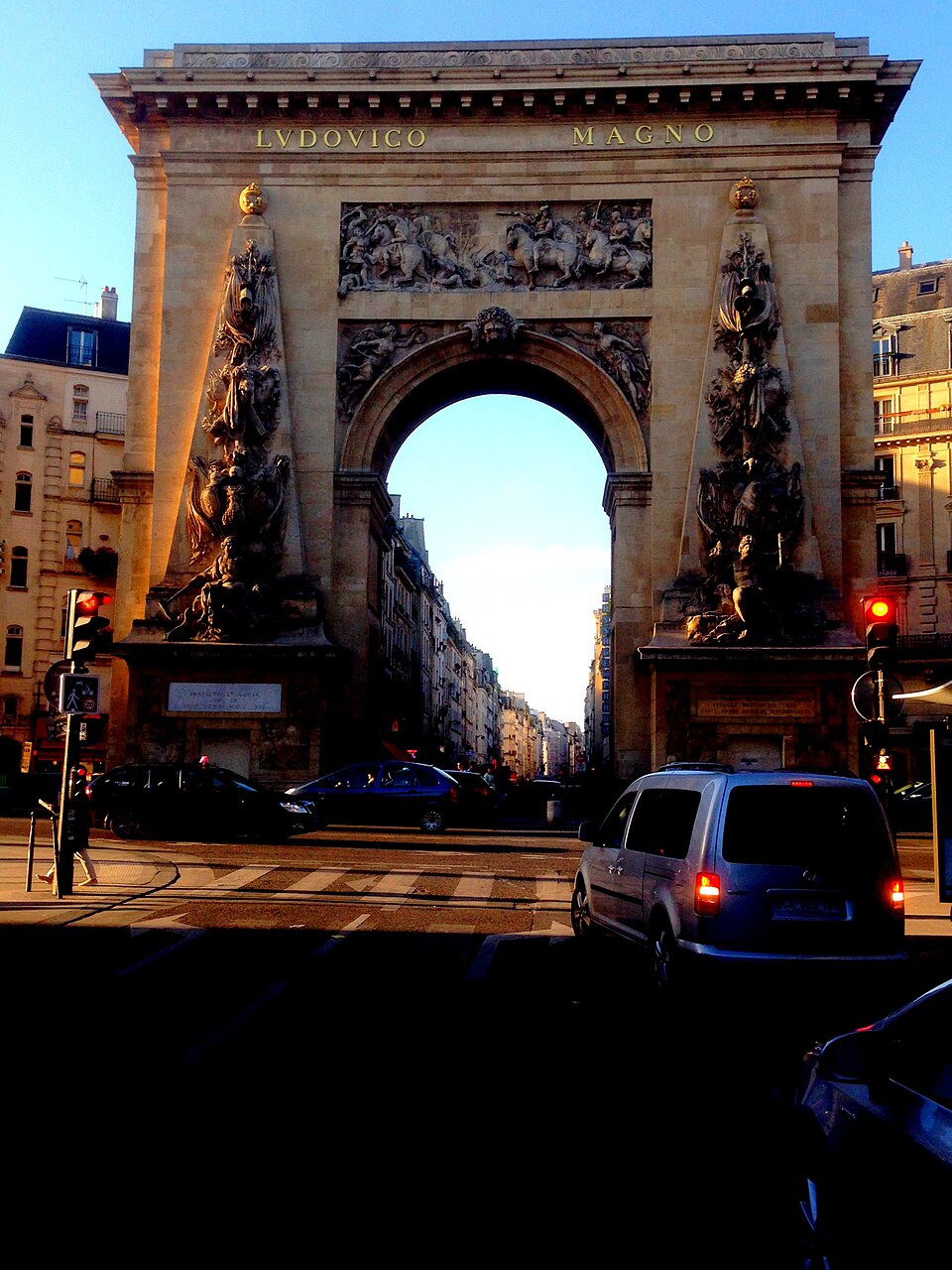
It rises to roughly 24 m and stands in the middle of Boulevard Saint-Denis, at the point where the boulevard crosses the old north-south axis of Rue Saint-Denis, one of the oldest streets in Paris.
The arch is solid stone throughout — there is no interior to enter and no staircase, unlike some of the city's other monuments.
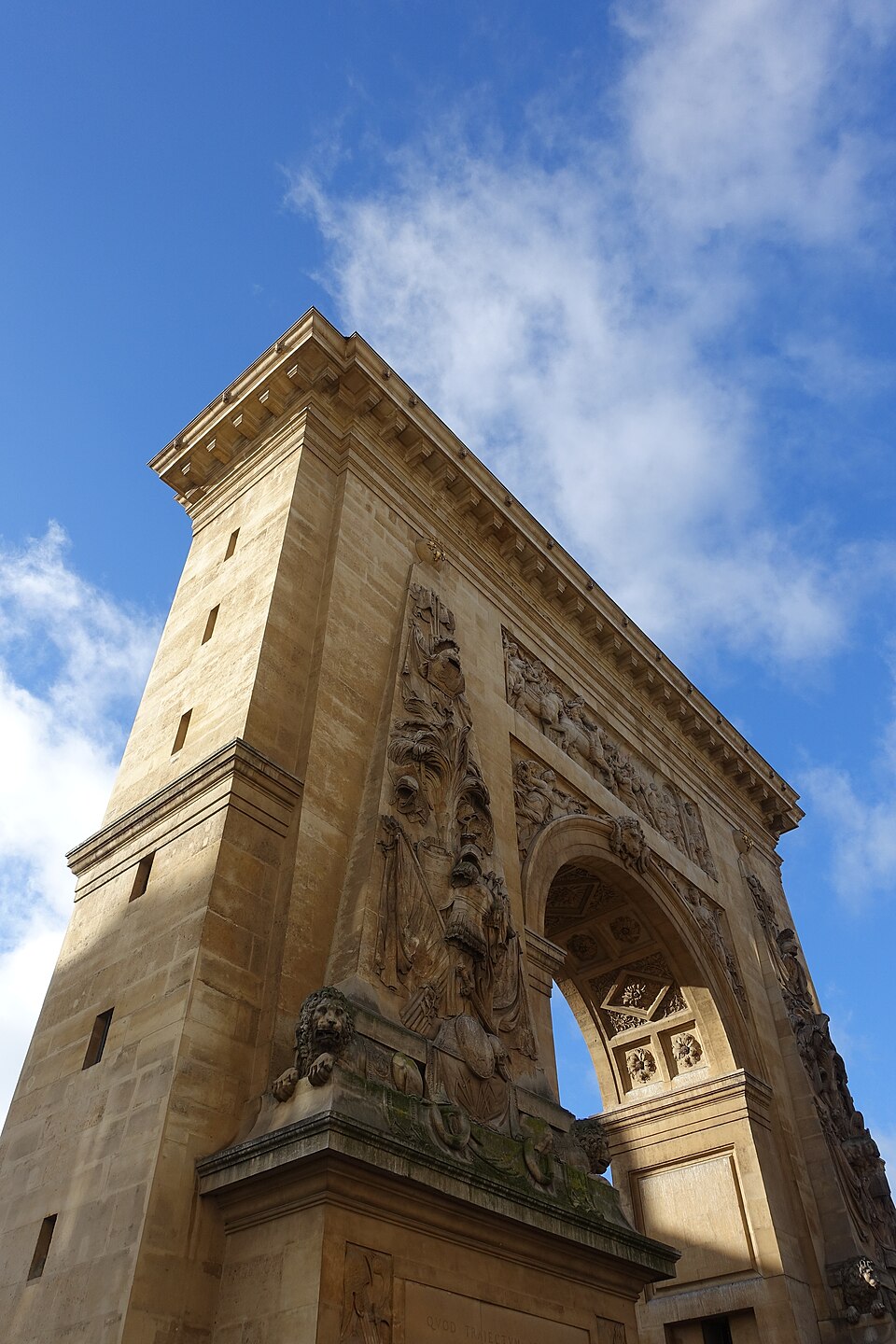
Its faces carry relief sculpture by several sculptors working under Blondel's direction, including scenes read as allegories of the Rhine crossing and the capture of Maastricht in 1673, with Louis XIV represented in classical guise rather than portraiture, the standard convention for royal monuments of the period.
Obelisk-shaped side elements and trophies of arms carved in relief complete the decoration, all original 17th-century stonework rather than later restoration replacement.
The arch replaced medieval fortification on this exact spot, and it was built as a freestanding monument rather than as a working gate — there was never a door to close, which sets it apart from the city gates it succeeded and marks the point where 17th-century Paris moved from fortified boundary to open commemorative architecture.
A few minutes to take in the arch itself. It sits well on a longer walk along the Grands Boulevards, paired with Porte Saint-Martin, a smaller triumphal arch of the same period about 500 m to the east on the same boulevard.
Neither arch has an interior visit to extend the stop — both are street monuments seen from outside.
Any time of day, since it is a freestanding monument in the open street with no gate or hours. It is floodlit after dark, which gives a different read on the relief carving than daylight does.
Traffic and pedestrian activity on Boulevard Saint-Denis run heaviest in the evening, when the surrounding stretch of the Grands Boulevards is at its busiest.
No ticket and no door. Porte Saint-Denis is a public monument standing in the middle of a traffic junction, visible and approachable at any time at no cost.
It carries no operator, no visitor centre and no gift shop — a difference from the ticketed monuments elsewhere in the city, and the arch is maintained by the city of Paris as street furniture rather than run as an attraction with an admission of any kind.
Strasbourg-Saint-Denis station, served by Metro lines 4, 8 and 9, sits directly beneath the arch, with exits opening onto the junction of Boulevard Saint-Denis, Boulevard de Bonne Nouvelle and Rue du Faubourg Saint-Denis.
The arch marks a natural point to break a walk along the Grands Boulevards or to turn south into Rue Saint-Denis towards Les Halles and the Centre Pompidou.
The arch sits on a traffic island at a busy junction — several boulevards and Rue Saint-Denis converge here, and reaching the base means using the marked pedestrian crossings rather than stepping directly off a pavement.
The relief carving is at height and faces both the boulevard and the smaller side streets, so a full look at the sculpture means walking around the base rather than viewing it from a single position.
The surrounding stretch of Rue du Faubourg Saint-Denis and Rue Saint-Denis is dense and commercial by day and busy with pedestrian traffic well into the evening, which is ordinary for the neighbourhood rather than specific to the monument, but it means the arch is rarely seen without traffic and people moving through the shot.
The straight run of Boulevard Saint-Denis gives a symmetrical view straight through the arch from either direction, the classic framing for this monument.
Floodlighting after dark picks out the relief carving in a way flat daylight does not, and the wide boulevard gives enough distance to fit the whole arch in frame without a wide-angle lens.
Nothing non-essential is set before you choose, in regions where consent is required. If you decline, ads still appear but they are non-personalised, and analytics is switched off entirely.




_-_2023-06-14_-_2.jpg)

.jpg)

_-_estampe_-_Casse_fr.es,_%C3%A0_Saint-Gaudens_-_btv1b53015420k.jpg)
.jpg)