Parc Montsouris is a 15.5-hectare public park in the 14th arrondissement, opened in 1878 as part of Napoleon III and Baron Haussmann's programme of large landscaped parks for Paris.
It was designed by Jean-Charles Alphand, the engineer behind the Bois de Boulogne, the Bois de Vincennes and the Parc des Buttes-Chaumont, in the English landscape style: curved paths, an artificial lake and grassy slopes rather than the formal geometric layout of a garden like the Tuileries.
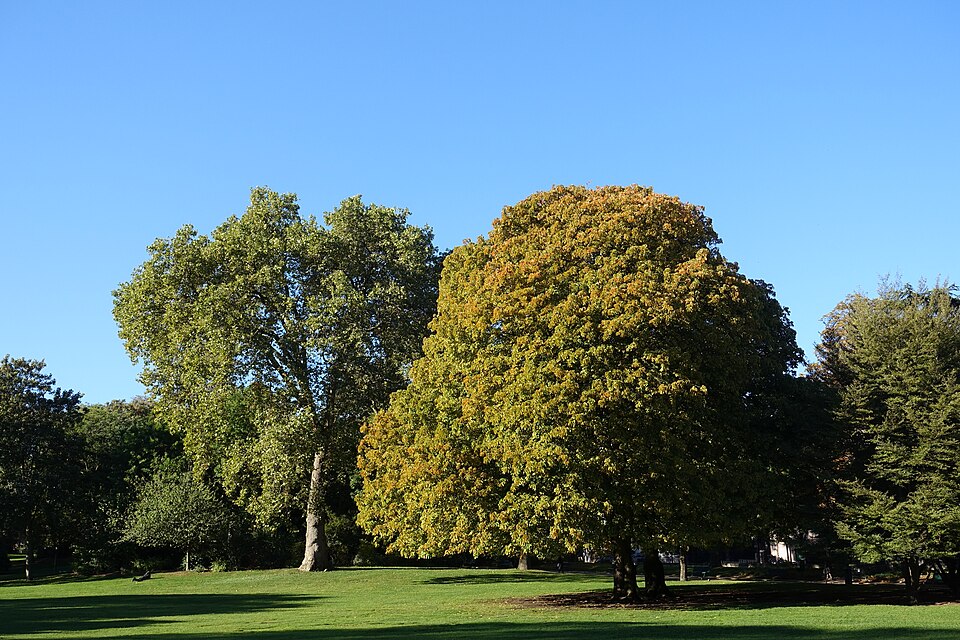
A lake at the centre of the park, an artificial waterfall, sloping lawns open for picnicking, and a scattering of mature trees including a well-known cedar of Lebanon are the park's core features.
The Paris Observatory's official meteorological station for the city sits inside the park, and its readings are the reference series used for Paris temperature records. A statue of the astronomer and mathematician Urbain Le Verrier, who predicted the existence of Neptune from orbital calculations, stands near the observatory building.
A well-known local story holds that the park's lake famously drained overnight on the day it opened in 1878, after the engineers misjudged the surrounding clay and gypsum ground -- the same unstable subsoil that had earlier swallowed a railway tunnel nearby -- and had to be relined before it would hold water.
An hour covers a full walking loop of the park's paths and the lakeside; longer if picnicking on the lawns or sitting out an afternoon.
The park works well paired with the Cite Internationale Universitaire de Paris, the student residence campus across boulevard Jourdan, whose varied national pavilion architecture is a short walk from the park's southern edge.
A full circuit of the park's outer path, rather than only the lakeside loop, adds another twenty minutes and takes in the sloped lawns on the northern side that the lakeside route bypasses.
Spring and early summer bring the fullest tree canopy and the busiest lawns on warm weekend afternoons; a weekday morning gives the quietest walk around the lake.
Not recorded: any seasonal gate-hour change beyond the general daily opening and closing times posted at the park's entrances, which shift slightly with the season in the pattern common to Paris city parks.
There is no ticket and no door: Parc Montsouris is a free public park, open daily within its posted gate hours, which run roughly from early morning to sunset or a little after, varying by season.
Not recorded: a precise current gate-hour table sourced to the operator; the posted times at the entrances are the reliable reference on the day.
RER B stops at Cite Universitaire directly across boulevard Jourdan from the park's southern side, making this one of the easiest large Paris parks to reach by train.
Tramway T3a also stops at Cite Universitaire, and Metro Line 4's terminus at Porte d'Orleans is a short walk from the park's western edge.
The park's several gated entrances are spread around its perimeter along boulevard Jourdan, rue Gazan and rue Nansouty, so approaching from the correct side of the park saves a walk around the perimeter fencing.
The lake's edges are unfenced in most places, which matters with small children running on the sloped lawns above it.
Cyclists share the park's paths with pedestrians at busy times, and the paths curve rather than run straight, which limits sightlines at bends. As with any large Paris park, valuables left unattended on a picnic blanket are a known risk on a busy weekend.
The RER B line runs in a tunnel directly beneath part of the park, a legacy of the unstable ground that also drained the lake on opening day, though nothing of it is visible from the surface today.
The lake with its small waterfall and the wooded slope behind it is the park's most photographed corner, especially in the low light of early morning or evening.
The cedar of Lebanon and the open lawns give a wide, uncluttered foreground for a skyline-free shot, unusual for central Paris; the observatory building adds a distinct landmark for anyone shooting toward the park's northern side.
Autumn colour on the deciduous trees around the lake, from mid-October, gives a warmer palette than the same view in high summer.
A shot along the water toward the small waterfall works best from the eastern bank in mid-morning, with the sun behind the photographer rather than into the lens.
Jean-Charles Alphand, the engineer who also laid out the Bois de Boulogne, the Bois de Vincennes and the Parc des Buttes-Chaumont for Napoleon III's park programme.
Is Parc Montsouris free to enter?
Yes. It is an open public park with no ticket, open daily within its posted gate hours.
What is inside Parc Montsouris besides the lawns?
A lake with an artificial waterfall, mature trees including a cedar of Lebanon, and the Paris Observatory's official meteorological station for the city.
How is Parc Montsouris reached by train?
RER B stops at Cite Universitaire directly across the boulevard from the park's southern side; tramway T3a stops there too.
What is the statue near the observatory in Parc Montsouris?
A statue of Urbain Le Verrier, the astronomer who predicted Neptune's existence from orbital calculations before it was observed.
Nothing non-essential is set before you choose, in regions where consent is required. If you decline, ads still appear but they are non-personalised, and analytics is switched off entirely.



.jpg)


