
_et_la_rue_de_Bretagne,_vues_de_la_rue_de_Picardie,_la_nuit,_en_1907._3%C3%A8me_ar,_D.3559(4).jpg)
.jpg)
.jpg)
.jpg)

2 min walk · Paris 3e Arrondissement
Ruya Grodnicki née Hedzberg
- High
- Historic monument
Language · 1 published
Market · Paris 3e Arrondissement, Paris
Marché couvert des Enfants Rouges
| Monday | Closed |
|---|---|
| Tuesday | 08:30 – 20:30 |
| Wednesday | 08:30 – 20:30 |
| Thursday | 08:30 – 21:30 |
| Friday | 08:30 – 20:30 |
| Saturday | 08:30 – 20:30 |
| Sunday | 08:30 – 17:00 |
Also recorded: 08:30 – 20:30
Parsed from OpenStreetMap opening hours on 2026-08-25.
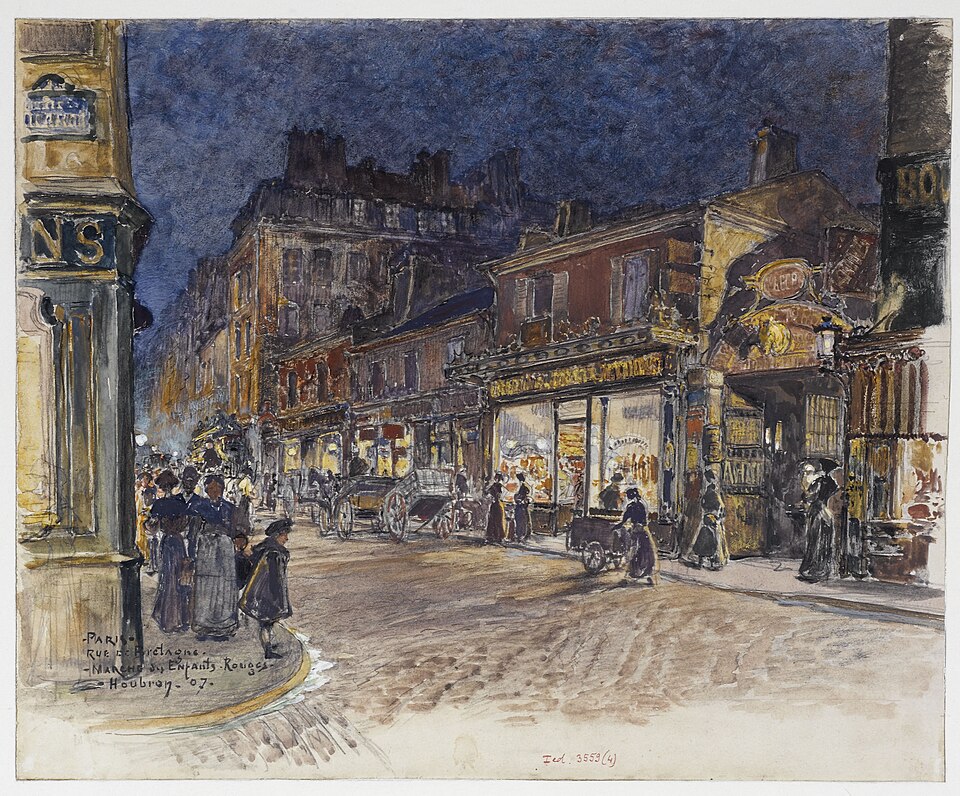
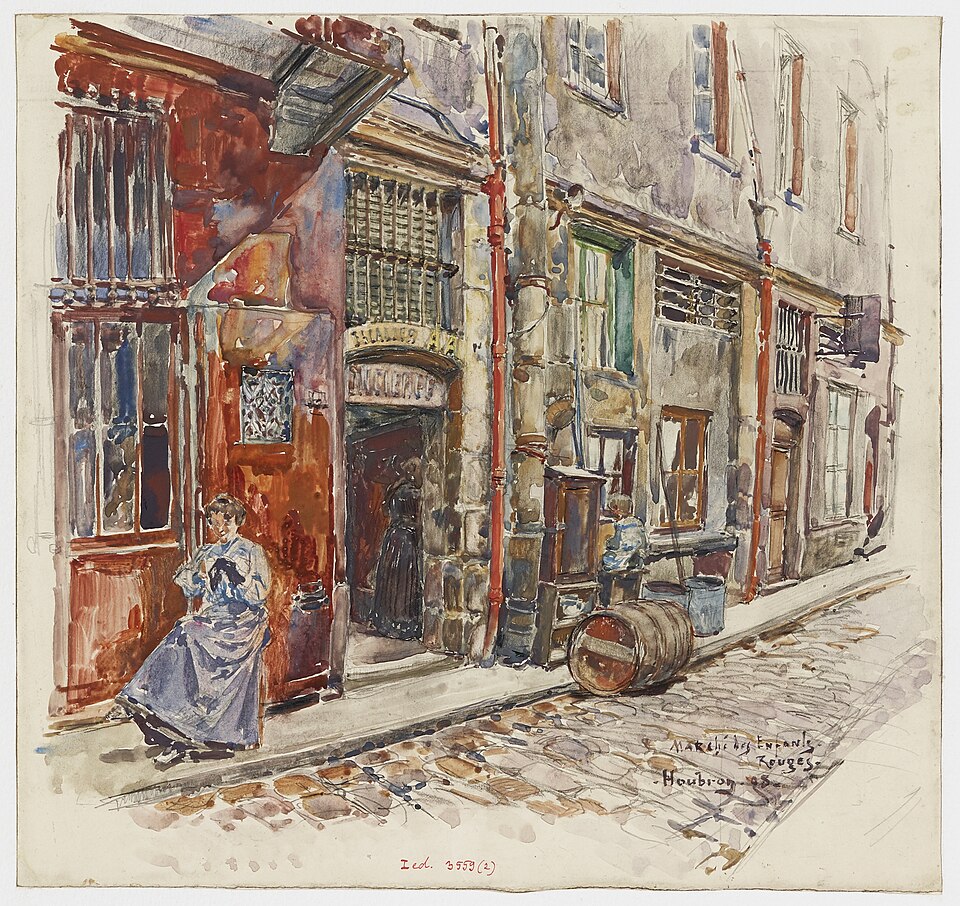
Marché des Enfants Rouges, at 39 rue de Bretagne in the Marais, is the oldest covered market still operating in Paris, tracing back to a walled market built for the neighbourhood in the early seventeenth century under Louis XIII, when the Marais was being newly developed as a district of townhouses for the nobility and needed a supply market to match. Its name comes not from the market itself but from a nearby orphanage, the Hospice des Enfants-Rouges, whose children wore red clothing — the colour associated with Christian charity at the time — and whose presence in the district gave the market its lasting nickname rather than any official name it was given at founding.
The market closed for a period in the twentieth century and faced threat of permanent closure more than once as the surrounding area changed, before a public campaign and a change of operator kept it running and modernised its stalls into the mixed produce-and-food-court format seen today, a survival story shared by several of the older Paris covered markets that lost customers to supermarkets in the later twentieth century.
Checked 2026-08-24 · Source
A covered hall of small stalls mixes a working produce and flower market with a wide range of ready-to-eat food counters — Moroccan, Japanese, Lebanese, Italian, Antillean and traditional French among them — arranged around shared communal tables at the centre. It functions as much as a lunch destination today as a grocery market, and the mix of stalls has shifted over the market's long life as the surrounding Marais neighbourhood itself has changed, from a working-class quarter to one of the most visited parts of the Right Bank.
Checked 2026-08-24 · Source
Thirty to sixty minutes for a browse; longer for a sit-down lunch at the communal tables, where a wait for a seat is common at peak lunch hour, and regulars often circle the stalls once before deciding where to eat. A quick take-away visit can be as short as ten minutes for anyone who already knows which stall they want, while a leisurely lunch with a second stop for something sweet can easily run past an hour.
Checked 2026-08-24 · Source

Midday through early afternoon is when the food stalls are fullest and the market is liveliest, with most counters winding down again by mid-afternoon and the produce and flower stalls keeping steadier hours across the rest of the day. Most Paris covered markets close one day a week; which day this one observes is not confirmed on the sources this page uses.
Checked 2026-08-24 · Source
Free to enter and browse — it is a market, not a ticketed attraction. Food and produce are paid for individually at each stall, and prices vary stall to stall rather than being set market-wide, in the same way prices vary between independent restaurants rather than following one posted menu.
Checked 2026-08-24 · Source
In the Marais, a short walk from Métro Filles du Calvaire (line 8) or Métro Temple (line 3), on rue de Bretagne in the northern part of the district, itself one of the streets known locally for its concentration of small independent shops and cafés.
Checked 2026-08-24 · Source

The communal tables mean sharing seating with strangers at busy lunch hours, which is part of the market's character rather than a flaw, and arriving with a group larger than the tables comfortably seat can mean splitting up. Some of the smaller stalls prefer cash over card, so carrying a little cash avoids a wasted trip to a nearby cash machine mid-visit. Weekend lunchtime is the most crowded window, with a real chance of no free seats, so a weekday visit is the more comfortable option for a sit-down meal. Once a plate is bought at one stall it is generally understood to be eaten at the shared tables rather than carried away without buying, out of courtesy to the vendors keeping the seating area usable for everyone.
Checked 2026-08-24 · Source

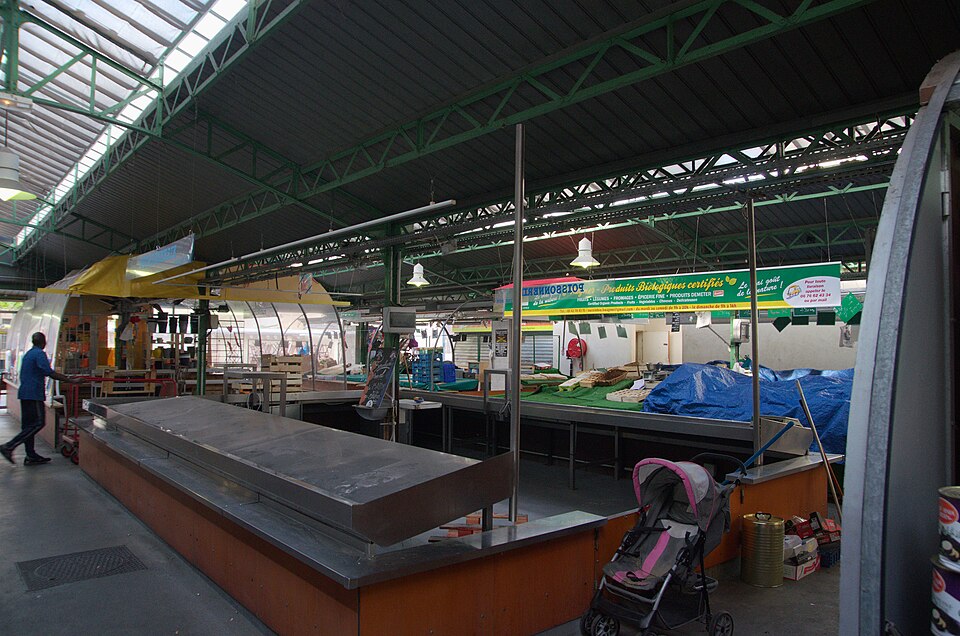
The covered timber roof structure over the rows of stalls is the market's own architectural feature worth a photograph, distinct from the newer glass-and-steel covered markets built elsewhere in Paris in the nineteenth century, and the produce stalls near the rue de Bretagne entrance make for a colourful frame earlier in the day before the lunch crowd fills the aisles. A courteous approach photographs a vendor's stall rather than identifiable customers eating.
Checked 2026-08-24 · Source
It traces back to a walled market built in the early seventeenth century, under Louis XIII, making it the oldest covered market still running in Paris.
After a nearby orphanage whose children wore red clothing; the market took the nickname from the neighbourhood, not the other way round.
No, browsing the market is free; only what is bought is paid for.
Both — a working produce and flower market alongside a wide range of ready-to-eat food stalls with shared seating.
Midday to early afternoon, when the food stalls are fullest — arriving earlier in that window improves the odds of a seat.
Filles du Calvaire on line 8, or Temple on line 3, both a short walk away.
Loading the interactive map…
The interactive map could not be loaded.
Last updated:
Source: OpenStreetMap contributors, Wikidata ·