
.jpg)


.jpg)
2 min walk
Museum of Copenhagen
- Must see · Heritage site
- Museum
Language · 1 published
Museum · Copenhagen
Nationalmuseet
| Monday | 10:00 – 17:00 |
|---|---|
| Tuesday | 10:00 – 17:00 |
| Wednesday | 10:00 – 17:00 |
| Thursday | 10:00 – 17:00 |
| Friday | 10:00 – 17:00 |
| Saturday | 10:00 – 17:00 |
| Sunday | 10:00 – 17:00 |
Checked 2026-08-26 · Source
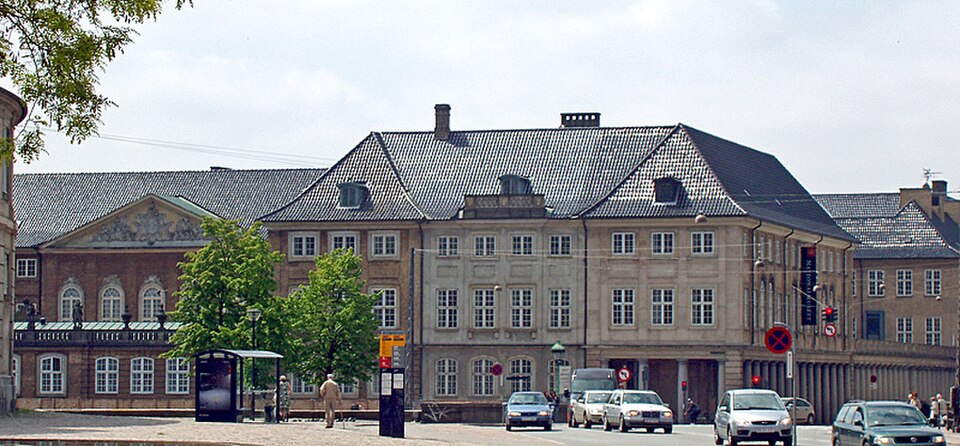
Nationalmuseet is Denmark's national museum of cultural history, and it occupies a building that was a private house, then a royal residence, then a courthouse, before it was ever a museum. The core of it is the Prince's Mansion, Prinsens Palæ, on the block between Ny Vestergade, Stormgade, Vester Voldgade and Frederiksholms Kanal. A merchant named Gysbert Wigand Michelbecker built the first house on the site in 1684; Frederick IV bought it in 1725 and turned it into a residence for the crown prince, and Niels Eigtved rebuilt it completely in 1743 and 1744 into one of the earliest Rococo buildings in Copenhagen. After the fire that destroyed the first Christiansborg in 1794 the Supreme Court of Denmark worked here, and its administration stayed until 1864. The 1849 constitution transferred the mansion to the Danish state, which made it a home for the national collections, and the Museum of Nordic Antiquities that grew into the National Museum opened in it in 1892. What a visitor walks through today is mostly the later expansion: Mogens Clemmensen and Arne Nystrøm added a four-winged block behind the mansion between 1929 and 1938, along with the Stormgade colonnade of thirty-eight Bornholm granite columns, and Gehrdt Bornebusch glazed over an interior courtyard in 1992.
Checked 2026-08-26 · Source
The collection is stacked over four levels and the museum publishes the floor list, which is the fastest way to plan a route. The ground floor holds the Children's Museum, Danish Prehistory and The Hunt for Danish History. The first floor holds Danish Middle Ages and Renaissance, The King's Curiosities, Voices from the Colonies, The Power of Amulets, The Prophecy of the Viking Sorceress, and The Arctic. The second floor holds the Ethnographic Treasuries, Toys, Stories of Denmark 1660-2000, the money exhibition KA-CHING! and Land Unknown. The third floor holds Classical, Egyptian and Near Eastern Antiquities. Note one change the museum flags on that same page: Peoples of the Earth was to close on 13 April 2026, with Room 151 and its Eckhout paintings staying open, and The Arctic unaffected; the exhibition still appears in the published list, so check it on the day rather than build an afternoon around it. Of roughly two million artefacts in the museum's care, about forty-two thousand are on display. The named objects most people come for sit in Danish Prehistory: the Sun Chariot, the Egtved Girl, the Gundestrup Cauldron, the Golden Horns and Ragnhild's rune stone.
Checked 2026-08-26 · Source
Allow three hours. The museum publishes no suggested visit length of its own, so that figure is this guide's judgement, and it comes from the shape of the building rather than from a number on the site. Four levels of galleries against a 10.00 to 17.00 day means the longest visit physically available is seven hours, and the museum starts closing the exhibitions at 16.45, with the Children's Museum shutting at 16.30 and the main entrance at 17.00. Three hours is enough for Danish Prehistory properly, the Middle Ages and Renaissance rooms, and one of the ethnographic or Arctic floors. It is not enough for all four levels, and nobody should try. A visitor with ninety minutes should take the ground floor alone and treat the rest as a return trip, which is cheaper than it sounds: the admission ticket is valid for a year from the date of purchase, and it works as a day ticket, so stepping outside for air and coming back in on the same ticket is explicitly allowed. A family with small children should assume the Children's Museum absorbs an hour on its own and plan the adult route around what is left.
Checked 2026-08-26
The museum answers this itself, and its answer is more useful than a general rule. It says visitor numbers are fewest on weekdays, especially Mondays and Fridays; in the late afternoon, because school classes arrive near opening time and are usually gone after lunch; on sunny days, particularly the first warm days of spring and early summer, when Copenhagen empties itself into the parks; and outside school holidays. It also says the pattern varies with the weather and the calendar, so this is a tendency rather than a promise. Two constraints cut across that advice. The Monday recommendation only holds from April to October, because from November to March the museum is closed on Mondays. And the late-afternoon recommendation runs into the closing sequence: arriving after 16.00 buys forty-five minutes of galleries, not an hour. The practical sweet spot for a quiet visit is a weekday in the April-to-October season, entering around 13.30, once the school groups have left and with three hours still in front of you. The museum is closed on 24, 25 and 31 December.
Checked 2026-08-26 · Source
An adult ticket is 150 DKK at the museum's ticket desk and 135 DKK bought online, a ten per cent discount for booking ahead. Anyone under 18 is free, and the museum's own wording is that children are free up to and including the year they turn 18. A group of ten or more pays 135 DKK a head. There is no senior discount and no student discount; the museum states this plainly, and it also states that it has no free-admission days. Admission is free on presentation of a valid press card, a valid ODM, ICOM or ICOMOS card, and free for one companion on presentation of a valid companion card, shown at the ticket counter on arrival. School classes and state-funded institutions visiting on their own are free. One ticket admits one person, it covers all the exhibitions including the Children's Museum, and it is valid for a year from purchase. An annual pass is 285 DKK for one person and 495 DKK for two, and the museum says it pays for itself on a second visit; a same-day upgrade credits the ticket price, but only at the museum, not online. Payment is by Mastercard, VISA or MobilePay. The shop and Café Daisy can be visited without a ticket.
Checked 2026-08-26 · Source

The visitor entrance is Ny Vestergade 10, 1471 Copenhagen K. Do not use Frederiksholms Kanal 12, which the museum publishes as its address for parcels, not for people. The museum does not name a station or a bus route on its own site; it says the museum is easy to reach by bus, train or Metro and points visitors at the Rejseplanen journey planner, which is the honest answer in a city where three modes converge on the same few hundred metres. Measured on OpenStreetMap, the building sits about 370 metres in a straight line from Rådhuspladsen, about 385 metres from Gammel Strand, about 640 metres from Copenhagen Central Station and just under a kilometre from Kongens Nytorv, so almost any central arrival ends in a walk of five to ten minutes. No car is needed and there is no museum car park. The museum names two commercial garages nearby instead: BLOX Parking at Vester Voldgade 129 and Q-Park Industriens Hus at H. C. Andersens Boulevard 18. Both are paid, and neither is worth the money for a visitor already staying in central Copenhagen.
Checked 2026-08-26 · Source
Two published statements about the Monday closure do not agree, and a winter visitor should plan around the stricter one. The information page says simply that the museum is closed on Mondays from November to March; the opening-hours page says the same but adds an exception for week 7 and for Easter. Neither page is an aggregator and both are the museum's own, so treat Monday in winter as closed and check the site the week before if a Monday is the only day available. Second, the bag rule catches people arriving with luggage: backpacks and larger bags are not allowed in the exhibitions at all. Free lockable lockers are provided, and umbrellas go in the stands or the lockers. Third, prams. Your own pram or stroller may not go into the exhibitions either; the museum lends a lock, the pram stays just inside the entrance, and you take one of the museum's strollers, with a carrycot allowed inside it for a baby too small to sit up. Dogs are not admitted unless they are service dogs. Finally, the museum's telephone hours are narrow, Tuesday to Friday 10.00 to 12.00 only, so a question that needs a human is better sent by email.
Checked 2026-08-26 · Source
The rules here are unusually relaxed and the museum states them without hedging: it is glad for visitors to photograph and film, provided the pictures are for private use, the camera is a standard one used without a tripod, and the flash is a regular flash. Flash being permitted at all separates this museum from most collections of comparable age, though it is worth not using it anyway on the darker prehistory cases, where the reflection off the glass costs more than the extra light gains. Tripods are out, the objects must not be damaged in any way, other visitors must not be disturbed, and staff instructions override everything else, so a sign or a word from a host on the floor is the rule that applies in that room. The museum asks for social posts to be tagged with its own handle. Photography for commercial use needs prior approval from the Head of Visitor Services and must be arranged before the visit rather than negotiated at the door. In practice the strongest pictures are the big single objects rather than the rooms: the Sun Chariot, the Gundestrup Cauldron and the rune stones all reward standing still and bracing the camera against a case edge.
Checked 2026-08-26 · Source
No. An adult ticket is 150 DKK at the ticket desk, or 135 DKK bought online, which is a ten per cent discount for booking ahead. Anyone under 18 is free, up to and including the year they turn 18, and a group of ten or more pays 135 DKK a head. The museum states that it has no free-admission days and that it offers neither a senior nor a student discount. Admission is free on presentation of a valid press card, an ODM, ICOM or ICOMOS card, or for one companion holding a valid companion card. The shop and Café Daisy can be entered without a ticket.
It depends on the season. From April to October the museum is open every day of the week, 10.00 to 17.00. From November to March it is closed on Mondays and open Tuesday to Sunday, 10.00 to 17.00. The museum's two pages differ slightly on the detail: the information page states the winter Monday closure without qualification, while the opening-hours page adds that week 7 and Easter are exceptions. A winter visitor should plan for closed and confirm on the museum's site if a Monday is unavoidable. The museum is also closed on 24, 25 and 31 December.
Three hours is a sensible allowance. The museum publishes no suggested visit length, so that is this guide's judgement rather than a figure read off its site. There are four levels of galleries and about forty-two thousand objects on display, against a day that runs 10.00 to 17.00 with the exhibitions starting to close at 16.45 and the Children's Museum at 16.30. Three hours covers Danish Prehistory, the Middle Ages and Renaissance rooms and one further floor at a proper pace. Because the ticket is valid for a year and works as a day ticket, splitting the collection over two visits is a real option rather than a consolation.
Neither. Backpacks and larger bags are not allowed in the exhibitions, and the museum provides free lockable lockers for them; umbrellas go into the umbrella stands or the same lockers. Your own pram or stroller may not be taken into the exhibitions either. The museum lends a lock so the pram can be left just inside the entrance, and provides its own strollers to use during the visit; a carrycot or baby nest can be placed in the museum stroller if the baby is too small to sit up. Dogs are not admitted, with the exception of service dogs.
No. The originals were stolen and melted down in 1802, and what the museum displays are copies. That is worth knowing before standing in front of them, because the objects around them in Danish Prehistory are the real thing: the Sun Chariot, the Gundestrup Cauldron, the Egtved Girl's coffin and the Holmegaard bow are all originals. The horns are shown anyway because their story, including a chance find in a field in 1639 and their nineteenth-century career as national symbols, is part of what the exhibition sets out to tell.
No, and a car is a liability rather than a help. The entrance is at Ny Vestergade 10 in the middle of Copenhagen, roughly 370 metres from Rådhuspladsen, 385 metres from Gammel Strand and 640 metres from Copenhagen Central Station measured in a straight line on OpenStreetMap, so most central arrivals end in a five to ten minute walk. The museum names no station or bus route of its own, saying only that bus, train and Metro all reach it easily and pointing visitors at the Rejseplanen journey planner. There is no museum car park; the museum names two paid commercial garages nearby, BLOX Parking on Vester Voldgade and Q-Park Industriens Hus on H. C. Andersens Boulevard.
Loading the interactive map…
The interactive map could not be loaded.
Last updated:
Source: OpenStreetMap contributors, Wikidata ·