.jpg)
.jpg)


2 min walk · Royal Borough of Kensington and Chelsea
Natural History Museum
- Must see
- Museum
Language · 1 published
Museum · Royal Borough of Kensington and Chelsea, London
| Monday | 10:00 – 18:00 |
|---|---|
| Tuesday | 10:00 – 18:00 |
| Wednesday | 10:00 – 18:00 |
| Thursday | 10:00 – 18:00 |
| Friday | 10:00 – 18:00 |
| Saturday | 10:00 – 18:00 |
| Sunday | 10:00 – 18:00 |
Parsed from OpenStreetMap opening hours on 2026-08-25.
Read from the OpenStreetMap access tags; anything not listed has no tag recorded.
Set the group type to family in the planner and the day window contracts to about three quarters of a solo day.
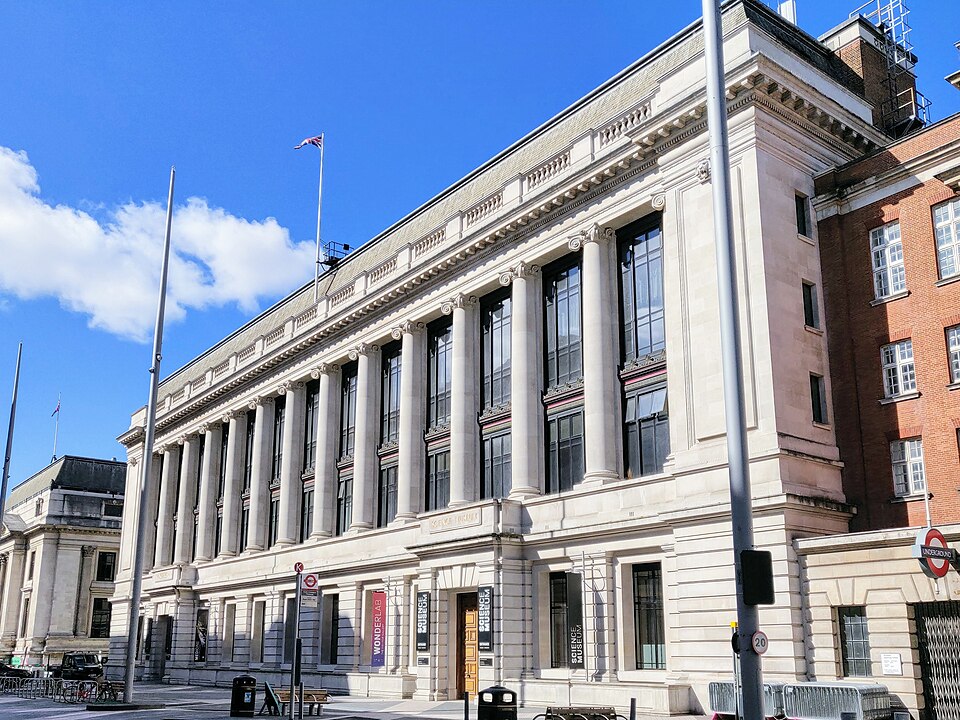
The Science Museum on Exhibition Road in South Kensington is Britain's national museum of science, technology, engineering and medicine, founded in 1857 and independent since 26 June 1909. It grew out of the same body as the Victoria and Albert Museum next door: the South Kensington Museum held art and science together until the science collections were renamed in 1885, given their own director in 1893 and finally separated when construction of the present building began in 1914. Its holdings came from the Royal Society of Arts collection, surplus from the Great Exhibition, and the Patent Office Museum, whose contents transferred in 1883 and supplied several of the objects that still anchor the galleries. Like the other publicly funded national museums in the United Kingdom it does not charge for admission, though visitors are asked to donate if they can and temporary exhibitions may carry a fee. What distinguishes it from a science centre is that the objects are real and singular — the actual Apollo 10 command module, the actual oldest surviving steam locomotive — and what distinguishes it from a conventional museum is the number of galleries built to be operated by hand. It is one of five museums in the Science Museum Group.
Checked 2026-08-26 · Source
The route through the main building starts in the Energy Hall, where the beam engines include the oldest surviving one built by James Watt, alongside a reconstruction of Watt's garret workshop assembled from more than 8,300 objects removed from a room that had been sealed since his death in 1819. Exploring Space and Making the Modern World follow at ground level: the Apollo 10 command module Charlie Brown, which orbited the Moon 31 times in 1969, Puffing Billy as the oldest surviving steam locomotive, Francis Crick's original double helix model, and a V-2 rocket whose curator describes plainly the slave labour that built it. Stephenson's Rocket left this gallery in 2019 for the National Railway Museum in York. Above, Medicine: The Wellcome Galleries opened on 16 November 2019 across the whole first floor with more than 3,000 exhibits; the second floor holds the Clockmakers' Museum, the world's oldest collection of clocks and watches, and Mathematics: The Winton Gallery by Zaha Hadid Architects, reached past a working Babbage Difference Engine No. 2 completed in 1991. Information Age, opened in October 2014, traces six communication networks. Wonderlab: The Equinor Gallery on Level 3 is the hands-on gallery, staffed by Explainers who run live experiments, and the Flight gallery of 1963 holds Alcock and Brown's transatlantic Vickers Vimy of 1919 and a cut-away Boeing 747. The Wellcome Wing adds Power Up, with over 150 playable consoles, Who Am I?, the Energy Revolution gallery and an IMAX cinema with a screen 24.3 by 16.8 metres.
Checked 2026-08-26 · Source

Allow two and a half hours, the duration recorded on this page. That covers the Energy Hall, Making the Modern World, one upper-floor gallery and either Wonderlab or Flight, which is about as much as a single visit sustains before the exhibits stop registering. Families should plan differently: Wonderlab and Power Up are timed, staffed, hands-on spaces where children settle in and do not want to move, so a family visit built around one of them plus the Energy Hall is more successful than a sweep of the building. The IMAX cinema and the ticketed temporary exhibitions are separate commitments on top of the figure above. The museum sits between the Natural History Museum and the V&A on the same street, and an attempt at two of the three in one day works only if each is given a firm two hours and a hard stop.
Checked 2026-08-26

The Science Museum is a school-trip destination in a city full of them, and the pattern that follows is predictable: term-time mornings from mid-morning onwards belong to organised groups, and the hands-on galleries feel it first. Late afternoon on a term-time weekday is the calmest window, and the middle of the school holidays is the busiest. Weather matters here more than at most museums, because South Kensington's three free museums share a catchment and a wet Saturday sends everybody indoors at once. This guide records no opening hours for the Science Museum: the operator's own website refused every automated request made on 26 August 2026, and hours are a fact this project takes from the operator or not at all. OpenStreetMap records the museum as open daily from 10:00 to 18:00, which is offered here as an unverified indication rather than as a source. Confirm the day's hours on the museum's own site before travelling.
Checked 2026-08-26
No admission price is recorded for the Science Museum on this page, because no operator page could be read. Requests to sciencemuseum.org.uk, including www.sciencemuseum.org.uk, its /visit-science-museum page and sciencemuseumgroup.org.uk, returned HTTP 405 or timed out on 26 August 2026, to both a plain fetch and a browser user-agent, and this project does not take a price, an opening hour or a closure day from an aggregator. What can be said with a source is the policy rather than the price: like other publicly funded national museums in the United Kingdom the Science Museum does not charge visitors for admission, asks for a donation from those able to give one, and may charge for temporary exhibitions. The IMAX cinema and special exhibitions are separately ticketed. Anyone planning a visit around a paid exhibition or a cinema showing should confirm the price and availability on the museum's own booking pages, which were unreachable from here but are reachable from an ordinary browser.
Checked 2026-08-26 · Source

The Science Museum's entrance is on Exhibition Road in South Kensington, on the same street as the Natural History Museum and around the corner from the Victoria and Albert Museum's Exhibition Road entrance. South Kensington Underground station, on the District, Circle and Piccadilly lines, is the nearest and is connected to the museum quarter by a pedestrian subway that avoids the weather and most of the traffic; Gloucester Road is the alternative on foot. Exhibition Road itself is a shared-surface street without a conventional kerb between the station and the museums, so pedestrians, cyclists and cars occupy the same space and children need holding onto. Buses on Cromwell Road and Kensington Gore serve the area. Driving into South Kensington means the Congestion Charge and almost no parking, and the museum's own accessibility, cloakroom and parking arrangements should be confirmed on its website, which could not be read for this guide.
Checked 2026-08-26
The two things that undo a Science Museum visit are scale and scheduling. The building runs from Exhibition Road through to Queen's Gate across the main building and the Wellcome Wing, and the Wellcome Wing is reached by walking through the Energy Hall, Exploring Space and Making the Modern World at ground level, so a visitor heading straight for Power Up crosses half the museum first. Wonderlab and the IMAX are the parts most likely to be full or ticketed by the time an unplanned visitor reaches them. Free entry also means no booking discipline: the entrance can hold a substantial queue on a wet weekend even though nobody is paying. Because the operator's website could not be read for this guide, three things in particular should be checked directly before travelling — the day's opening hours, whether any gallery is closed, and whether the exhibition or cinema showing you want requires a ticket. Gallery closures for redevelopment are frequent at a museum of this age.
Checked 2026-08-26
No photography policy is recorded here, because the museum's own pages could not be read; assume that individual exhibitions post their own rules at the door and follow those. On the pictures themselves: the Energy Hall is the best-lit space in the building, a tall top-lit room where the beam engines read as clean silhouettes against the glazing and where a phone camera does as well as anything. Making the Modern World is the opposite problem — dark, dramatic and object-lit, with reflective cases that defeat flash, so bracing against a rail beats raising the ISO. Exploring Space is a corridor of rockets shot best from floor level looking up. The Wellcome Wing's blue-lit galleries throw a strong colour cast that automatic white balance corrects into something grey and wrong, and leaving it uncorrected is the more honest picture. Outside, the Exhibition Road frontage faces west and takes late-afternoon light.
Checked 2026-08-26
Yes. Like other publicly funded national museums in the United Kingdom the Science Museum does not charge for admission, although visitors are asked to donate if they are able. Temporary exhibitions and the IMAX cinema may carry a separate charge.
This guide records none. Every automated request to the museum's own website on 26 August 2026 was refused or timed out, and hours are taken from the operator or not at all. OpenStreetMap records daily 10:00 to 18:00, unverified. Check the museum's site before travelling.
Allow about two and a half hours, which covers the Energy Hall, Making the Modern World, one upper-floor gallery and either Wonderlab or Flight. A family visit built around Wonderlab or Power Up will fill that time in two galleries rather than four.
The strongest claim belongs to the Apollo 10 command module Charlie Brown, which orbited the Moon 31 times in 1969 and is displayed in Making the Modern World. Puffing Billy, the oldest surviving steam locomotive, and the oldest surviving James Watt beam engine are in the same league.
The Association of Leading Visitor Attractions recorded 2,640,417 visits to the Science Museum in 2025, seven per cent down on the previous year and tenth in the United Kingdom. Wikipedia gives a different 2025 figure, 2,817,852; the two sources disagree and both are printed here rather than reconciled.
No. Rocket was displayed in Making the Modern World but has been on permanent display at the National Railway Museum in York since 2019, following a short tour of the United Kingdom.
Loading the interactive map…
The interactive map could not be loaded.
Last updated:
Source: OpenStreetMap contributors, Wikidata ·