
.jpg)


.jpg)

2 min walk · Royal Borough of Kensington and Chelsea
Science Museum
- Must see
- Museum
Language · 1 published
Museum · Royal Borough of Kensington and Chelsea, London

| Monday | 10:00 – 17:50 |
|---|---|
| Tuesday | 10:00 – 17:50 |
| Wednesday | 10:00 – 17:50 |
| Thursday | 10:00 – 17:50 |
| Friday | 10:00 – 17:50 |
| Saturday | 10:00 – 17:50 |
| Sunday | 10:00 – 17:50 |
Checked 2026-08-26 · Source
Read from the OpenStreetMap access tags; anything not listed has no tag recorded.
Set the group type to family in the planner and the day window contracts to about three quarters of a solo day.
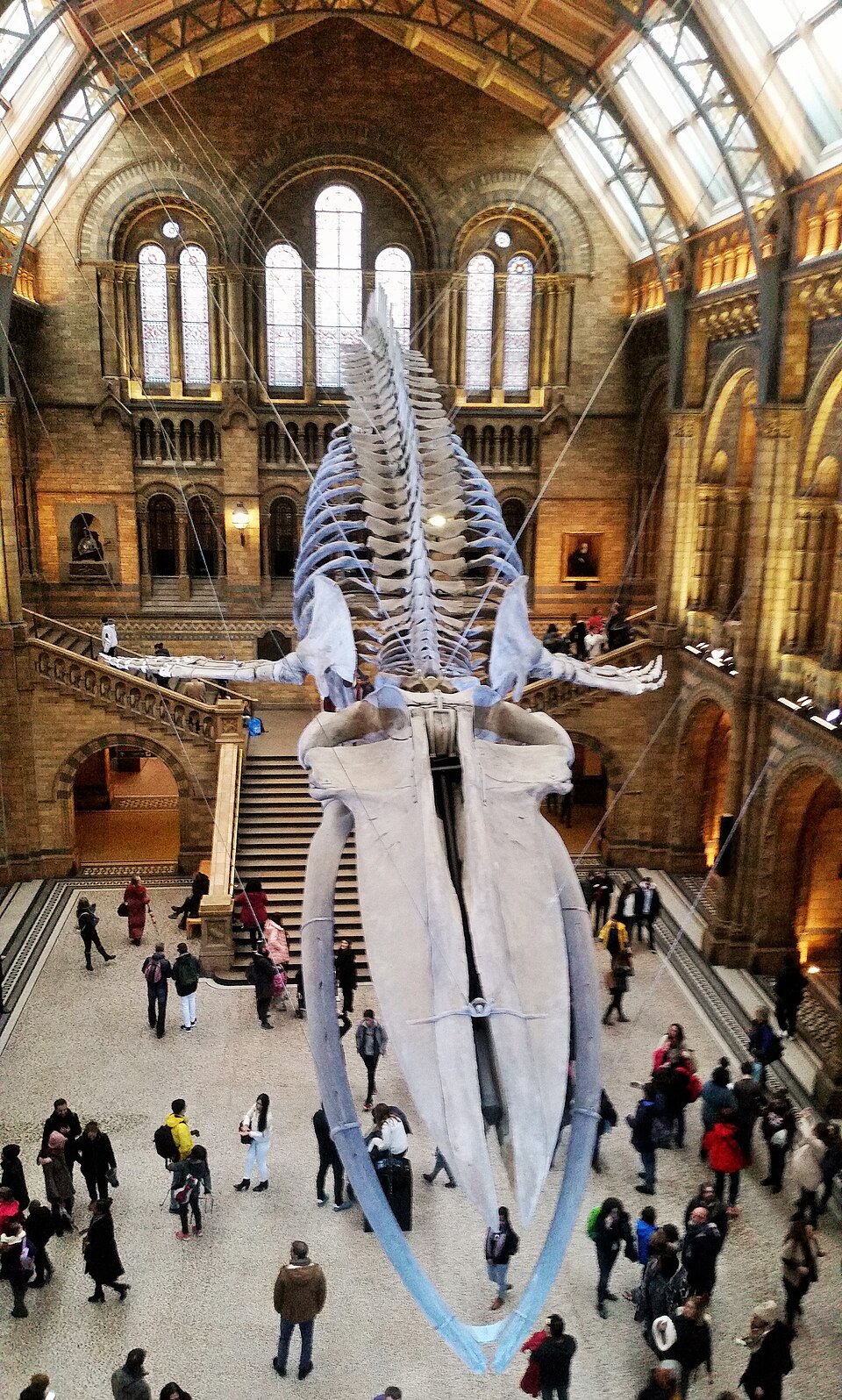
The Natural History Museum in South Kensington holds around 80 million specimens across botany, entomology, mineralogy, palaeontology and zoology, and it holds them in a building that is itself one of the exhibits. Alfred Waterhouse designed it in a Romanesque manner; construction began in 1873 and the new museum opened on 18 April 1881, with the move from the old British Museum site continuing until 1883. The facade and the interiors are faced in architectural terracotta modelled with plants and animals, so the cataloguing begins before a visitor is through the door. Hintze Hall, the cathedral-like central space under those terracotta arches, is dominated by Hope, a blue whale skeleton suspended from the ceiling since 2017; Hope is a 128-year-old skeleton from a whale that stranded on sandbanks at the mouth of Wexford Harbour, Ireland, in March 1891, and it replaced Dippy, the Diplodocus cast that had held the hall since arriving in 1905. The collections include Charles Darwin's own specimens and the Archaeopteryx fossil, and the Darwin Centre's second phase, a cocoon-shaped building by C. F. Møller Architects completed in 2009, houses the dry collections and Archie, a giant squid specimen 8.62 metres long. It is free to enter and it is the most visited attraction in the United Kingdom, with 7,116,929 visits recorded in 2025.
Checked 2026-08-26 · Source
Past Hintze Hall the museum divides into themed galleries, and the museum's own map is organised around them rather than around floors. The Dinosaurs Gallery, where visitors meet the roaring Tyrannosaurus and walk among fossils, and the earthquake simulator are the two things the museum itself points families towards first. Earth Hall carries visitors up through a sculpted globe into the geology displays, with a Stegosaurus at its foot and, on the Earth Hall Mezzanine, a dinosaur newly recognised as a species by science and given permanent residence there. Lasting Impressions holds fossil evidence of long-ago events, Fossils from Britain traces the record through mud, silt and sand with preserved shark teeth and fakes to spot, and the Fossil Marine Reptiles gallery covers what was happening in the oceans while dinosaurs held the land. The Mammals Hall and Mammals gallery run from polar bears to pygmy shrews, the Birds gallery holds an extinct dodo, a historical hummingbird cabinet and a Victorian avian anatomy display, and the Fishes, Amphibians and Reptiles and Marine Invertebrates galleries cover the water. Outside, the gardens hold Fern, standing among tree ferns and cycads.
Checked 2026-08-26 · Source

Allow two and a half hours at the Natural History Museum, which is the duration this guide records. That is enough for Hintze Hall and Hope, the Dinosaurs Gallery with its queue, Earth Hall and the earthquake simulator, and one further gallery chosen rather than stumbled into. Families with young children should plan the same 150 minutes but expect to spend most of it in two galleries rather than five. A visitor interested in the building and the whale alone can do it properly in 45 minutes. Nobody sees 80 million specimens; the museum is planned as a set of routes and the honest approach is to pick two or three galleries in advance and let the rest go.
Checked 2026-08-26

The museum is open daily from 10:00 to 17:50, with last entry at 17:30. It is closed on 24, 25 and 26 December, and the South Kensington site will also be closed on Friday 9 October 2026 while the museum hosts a charity gala. The museum states that it can get busy during weekends and school holidays and that visitors may have to queue to enter at those times, which makes a weekday morning in term time the materially better visit — the same galleries, without the entrance queue and without a wait to see the dinosaurs. The Wildlife Photographer of the Year exhibition and other ticketed shows run on their own dates and are the usual reason for a visit timed to the calendar rather than the week.
Checked 2026-08-26 · Source
The galleries are free to explore, and this guide records no admission charge because the museum makes none. A free entry ticket can be booked in advance, and the museum recommends it as the way to guarantee entry: members and ticket holders can skip the queues that build at weekends and during school holidays, while a visitor arriving without either joins the door queue. Some exhibitions and events are ticketed separately and charged; membership includes free entry to all paid exhibitions along with queue priority and discounts. Nothing needs to be paid to see Hintze Hall, Hope, the Dinosaurs Gallery, Earth Hall or the gardens.
Checked 2026-08-26 · Source
The museum stands in South Kensington with its main entrance on Cromwell Road, and a second entrance on Exhibition Road serving the Earth Galleries. The nearest Underground station is South Kensington, which is connected to the museum by a pedestrian tunnel — worth knowing in bad weather, because it delivers visitors to the Exhibition Road side without crossing a road. The Exhibition Road entrance is also the one that puts a visitor straight into Earth Hall rather than into Hintze Hall, which changes the shape of a visit: entering from Cromwell Road gives the whale first, entering from Exhibition Road gives the geology first. The Victoria and Albert Museum and the Science Museum are immediate neighbours on the same two streets.
Checked 2026-08-26 · Source
The queue is the thing to plan around. The museum states that it can get busy during weekends and school holidays and that visitors may have to queue to enter, and that members and ticket holders can skip those queues; booking a free entry ticket in advance is what turns a 30-minute wait outside into a walk-in. The second trap is the calendar: the South Kensington site is closed on Friday 9 October 2026 for a charity gala and on 24, 25 and 26 December, and a visitor who has travelled for it will find the doors shut. The third is last entry, which is 17:30 for a 17:50 close, meaning a 17:15 arrival buys perhaps 25 usable minutes. The fourth is gallery closures: individual galleries close for work and the museum publishes the current list on its map page, so a visit built around one specific gallery should be checked first.
Checked 2026-08-26 · Source
No general visitor photography rule was found on the museum pages read for this guide, so none is stated here; signage at the entrance to a ticketed exhibition is the authority for that exhibition. The subject is Hintze Hall. The hall is lit from above through the terracotta arcades and takes daylight best in the middle of the day, and the shot everyone attempts — Hope's skeleton diving from the ceiling — needs to be taken from the first-floor balconies rather than the floor, because from below the ribs collapse into each other. The staircase at the far end of the hall gives the whale and the arches in one frame. The Dinosaurs Gallery is dim and crowded and defeats most phone cameras; the terracotta animals on the exterior, in low afternoon light on Cromwell Road, are the easiest photographs in the building and the ones nobody takes.
Checked 2026-08-26
Yes. The galleries are free to explore. A free entry ticket can be booked in advance to guarantee entry, and members and ticket holders can skip the queues that build at weekends and during school holidays. Some exhibitions and events are ticketed separately.
The museum is open daily from 10:00 to 17:50, with last entry at 17:30. It is closed on 24, 25 and 26 December, and the South Kensington site is also closed on Friday 9 October 2026 for a charity gala.
It is Hope, a blue whale skeleton hung in Hintze Hall since 2017. The skeleton is 128 years old and comes from a whale that stranded on sandbanks at the mouth of Wexford Harbour, Ireland, in March 1891. It replaced Dippy, the Diplodocus cast that had stood in the hall since 1905.
Booking is not compulsory, but the museum recommends a free entry ticket as the way to guarantee entry, because weekends and school holidays can produce a queue at the door. Members and ticket holders skip that queue.
The main entrance is on Cromwell Road and leads into Hintze Hall and the whale. The Exhibition Road entrance serves the Earth Galleries and is reached from South Kensington Underground station through a pedestrian tunnel, which avoids crossing a road in bad weather.
The Association of Leading Visitor Attractions recorded 7,116,929 visits to the Natural History Museum at South Kensington in 2025, ranking it first among UK attractions and 13 per cent up on the previous year.
Loading the interactive map…
The interactive map could not be loaded.
Last updated:
Source: OpenStreetMap contributors, Wikidata ·