


18 min walk · London Borough of Hounslow
Carville Hall Park South
- Nature site
Language · 1 published
Historic monument · London Borough of Richmond upon Thames, London
Royal Botanic Gardens, Kew
| Monday | 10:00 – 19:00 |
|---|---|
| Tuesday | 10:00 – 19:00 |
| Wednesday | 10:00 – 19:00 |
| Thursday | 10:00 – 19:00 |
| Friday | 10:00 – 19:00 |
| Saturday | 10:00 – 20:00 |
| Sunday | 10:00 – 20:00 |
Checked 2026-08-26 · Source
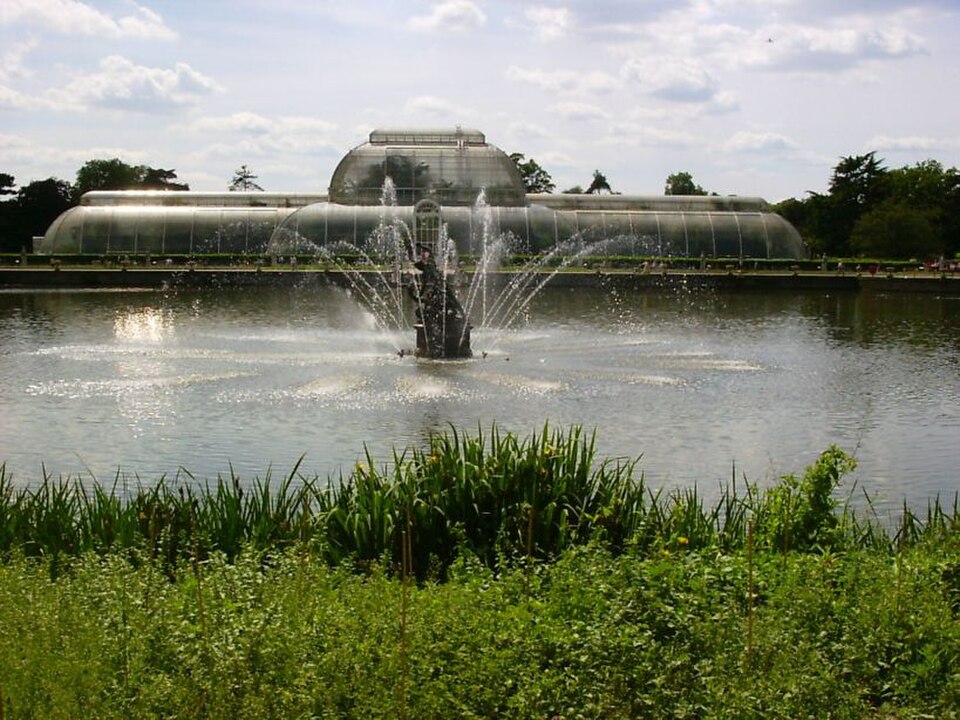
The Royal Botanic Gardens at Kew is a working scientific institution on 320 acres beside the Thames in south-west London, with more than 50,000 living plants and a UNESCO World Heritage inscription granted in July 2003. It is not a park with labels. Kew is a non-departmental public body sponsored by the Department for Environment, Food and Rural Affairs; its herbarium holds over 8.5 million preserved plant and fungal specimens, its library more than 750,000 volumes, and its illustrations collection more than 175,000 prints and drawings, all of it used for taxonomy and conservation research rather than display. The gardens formally began in 1759 out of the royal estates at Kew and Richmond, and the landscape still carries their furniture: William Chambers's Great Pagoda of 1761, the Dutch House that George III bought in 1781 and that is now Kew Palace, and five trees planted in 1762 that survive as the Five Lions. What a visitor comes for is the glasshouses — the Palm House and the Temperate House above all — and the sheer scale of the grounds, which is also the thing most people underestimate. Kew has had its own police force, the Kew Constabulary, since 1845.
Checked 2026-08-26 · Source
The Palm House, built by the architect Decimus Burton and the ironmaker Richard Turner between 1844 and 1848, was the first large-scale structural use of wrought iron and is described as the most important surviving Victorian glass and iron structure in the world; every pane in it is hand-blown, and it holds a compressed tropical rainforest that fogs a camera lens within seconds. Kew announced in 2025 that the Palm House will close in 2027 for a five-year renovation. The Temperate House is twice its size and is the largest Victorian glasshouse in existence, reopened in May 2018 after a five-year, £41 million restoration. Beyond the glass, the Treetop Walkway of 2008 carries visitors 200 metres through the canopy 18 metres above a woodland glade on a perforated metal deck that flexes underfoot and sways in wind; its steel supports were designed to rust to a tree-like colour. The Hive, Wolfgang Buttress's 17-metre aluminium lattice of 2016, stands in a wildflower meadow and translates the activity of a real colony into light and sound. The Lake Crossing of 2006 by John Pawson and Buro Happold is a double curve of black granite between bronze posts. Kew Palace, the Great Pagoda and Queen Charlotte's Cottage are run within the gardens by Historic Royal Palaces.
Checked 2026-08-26 · Source

Allow three and a half hours, the duration recorded on this page, and understand that it is a walking figure rather than a looking one. Three hundred and twenty acres means the distance between the Elizabeth Gate and the Pagoda at the far southern end is a genuine hike, and a visitor who lands at the wrong gate can lose forty minutes simply reaching the glasshouses. Three and a half hours covers the Palm House, the Temperate House, the Treetop Walkway and one of the galleries at an unhurried pace with a stop for lunch. Half a day is not excessive and a full day is easy to fill. If time is short, the cheaper after-4pm ticket is a real option, but many attractions close before the gardens do — the glasshouses shut at 5pm and the galleries at 5.30pm — so a late entry buys grounds, not buildings. Families with a Children's Garden visit in mind should treat that as its own hour.
Checked 2026-08-26
Kew's hours are seasonal and the operator publishes the calendar in bands. From 1 May to 31 August 2026 the gardens open 10am to 7pm Monday to Friday, last entry 6pm, and 10am to 8pm at weekends and on bank holidays, last entry 7pm. From 1 to 30 September it is daily 10am to 7pm, last entry 6pm, with a late 11am opening on 13 September for the Richmond Runfest. From 1 to 24 October, daily 10am to 6pm, last entry 5pm. Members can enter from 8am at the Victoria and Brentford gates. Attractions keep shorter hours than the grounds: the glasshouses run 10am to 5pm, the Treetop Walkway to 6pm with last entry at 5.45pm, and the Shirley Sherwood and Marianne North galleries to 5.30pm. The Historic Royal Palaces attractions inside the gardens — Kew Palace, the Great Pagoda and Queen Charlotte's Cottage — close from Monday 28 September until spring 2027. Season matters more here than time of day: this is a botanic garden, and spring blossom, high-summer roses and autumn colour are three different places.
Checked 2026-08-26 · Source

Kew prices by season and rewards booking online. The peak adult ticket from 2 September to 31 October 2026 is £25 online, or £27.50 with the voluntary donation that lets Kew claim Gift Aid; at the gate it is £28, or £31 with donation. £25 is the price recorded on this page. Off-peak, from 1 November to 31 January, the adult ticket falls to £17 online and £20 at the gate. Under the government's Great British Summer Savings initiative, from 25 June to 1 September 2026 the adult ticket was £21.85 online and £24.50 at the gate. A child aged 4 to 15 pays £2 online from 2 September and children under 4 are free; a young person aged 16 to 29 or a student pays £10 online at peak; concessions for disabled visitors and over-65s are £23 online at peak; visitors on Universal Credit or Pension Credit pay £1 and may buy up to four guest tickets. Residents of Richmond, Kingston-upon-Thames, Hammersmith, Fulham, Wandsworth and Hounslow pay the concession rate on proof of address. An after-4pm adult ticket is £10 online at peak, available until 30 September. Members enter free. Parking at the Brentford Gate car park costs £10 a day and is separate from admission.
Checked 2026-08-26 · Source
Kew has four gates and choosing the right one saves a mile of walking. Victoria Gate, TW9 3JR, is the pedestrian entrance closest to Kew Gardens Underground station, 500 metres away on the District line's Richmond branch and the Mildmay line in Zone 3 — note that the westbound platform has no level access, and the workaround is to continue one stop to Richmond and come back to the eastbound side. Elizabeth Gate, TW9 3AE, is nearest Kew Bridge station, 800 metres, served by South Western Railway from Waterloo via Vauxhall and Clapham Junction, and is the gate for river cruise arrivals and coach drop-off. Brentford Gate, TW9 3AF, has the car park. Lion Gate, TW9 2DF, is closest to Richmond station, a 15-minute walk. Bus 65 stops near Elizabeth, Victoria and Lion gates and runs between Ealing Broadway and Richmond; route 110 serves Kew Gardens station and Elizabeth Gate; 237 and 267 stop at Kew Bridge. Kew is outside the Congestion Charge zone but inside the ULEZ, parking is first come first served, and the car park entrance closes 30 minutes after the gardens do.
Checked 2026-08-26 · Source
Kew's rules are stricter than a public park's because the collection is the point. Bicycles, tricycles, roller skates, skateboards, micro-scooters and balance bikes must be left at the gates; ball games and sports, jogging included, are not allowed anywhere, in order to protect the lawns. Smoking and vaping are prohibited throughout the gardens and inside every building. Drones and other remotely controlled aircraft are banned, as are balloons, radios, musical instruments, barbecues and picnic furniture — picnics themselves are welcome on grass. Plants may not be taken out and plants may not be brought in, since unassessed material can carry pathogens. Bags may be searched at the gates or at individual venues, and the prohibited list includes professional camera equipment without a valid permit. Assistance dogs are welcome; other pets are not. There are no lockers or baggage storage anywhere in the gardens. Children aged 16 and under must be accompanied by an adult at all times, and there are deep bodies of water on site. Check the planned closures page before travelling: individual attractions shut for maintenance without much notice.
Checked 2026-08-26 · Source
Personal photography is normal at Kew; professional camera equipment without a valid permit is on the operator's prohibited items list, and drones are banned outright, so anything that looks like a commercial shoot needs arranging in advance. The practical difficulty inside the Palm House is condensation — a cold lens carried into that heat fogs immediately and takes several minutes to clear, so the trick is to go in, do a lap without shooting, then start. The Temperate House is the easier glasshouse to photograph: bigger, drier, and lit from all sides through the largest surviving Victorian glass roof in the world. Outside, the Treetop Walkway deck flexes and sways in the wind, which ruins long exposures and rewards a fast shutter. Kew's east–west spread means the light runs the length of the Broad Walk at both ends of the day, and autumn colour in the arboretum peaks weeks later than most London parks because the collection is deliberately diverse.
Checked 2026-08-26 · Source
The peak adult ticket from 2 September to 31 October 2026 is £25 online or £28 at the gate, and £27.50 or £31 with the voluntary Gift Aid donation. Off-peak from 1 November to 31 January it is £17 online. A child aged 4 to 15 pays £2 online from 2 September, and under-fours are free.
They change by season. From 1 May to 31 August 2026 Kew opens 10am to 7pm Monday to Friday, last entry 6pm, and 10am to 8pm at weekends and bank holidays, last entry 7pm. From 1 to 30 September it is daily 10am to 7pm, and from 1 to 24 October daily 10am to 6pm.
Victoria Gate, TW9 3JR, is 500 metres from Kew Gardens Underground station; Elizabeth Gate, TW9 3AE, is 800 metres from Kew Bridge rail station and takes coaches and river arrivals; Brentford Gate, TW9 3AF, has the car park; Lion Gate, TW9 2DF, is a 15-minute walk from Richmond station.
Allow about three and a half hours. That covers the Palm House, the Temperate House, the Treetop Walkway and a gallery at an unhurried pace with a stop for lunch. The site is 320 acres, so a good deal of that time is spent walking.
No. Bicycles, tricycles, roller skates, skateboards, micro-scooters and balance bikes must be left at the gates, and powered wheelchairs are the exception. There are bicycle racks at all four gates, inside the gates at Elizabeth and Victoria.
Kew announced in 2025 that the Palm House would close in 2027 for a five-year renovation. It is open at the time of writing, but the closure is worth checking against Kew's planned closures page before making a trip specifically to see it.
Loading the interactive map…
The interactive map could not be loaded.
Last updated:
Source: OpenStreetMap contributors, Wikidata ·