.jpg)

.jpg)

4 min walk · London Borough of Richmond upon Thames
Hampton Court Maze
- Nature site
Language · 1 published
Historic monument · London Borough of Richmond upon Thames, London
Read from the OpenStreetMap access tags; anything not listed has no tag recorded.
Set the group type to family in the planner and the day window contracts to about three quarters of a solo day.
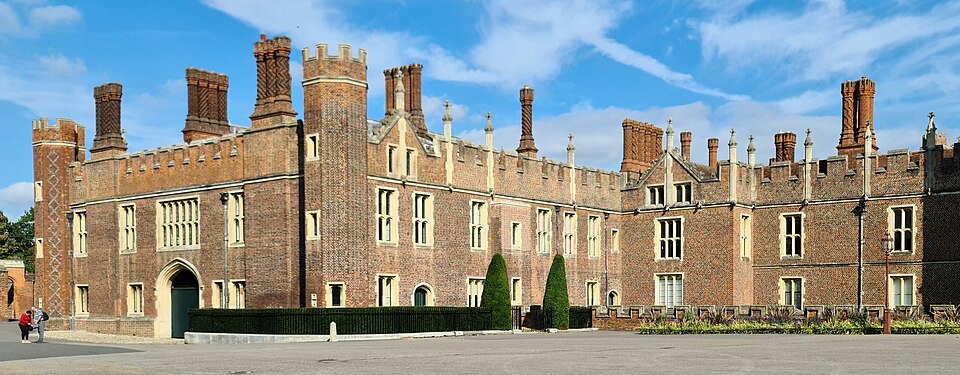
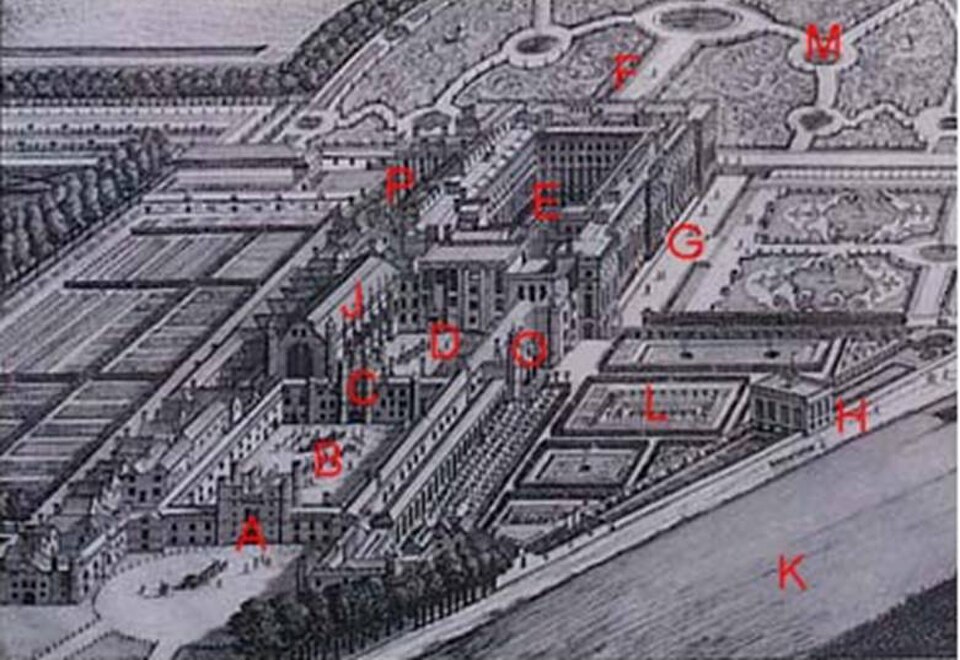
Hampton Court Palace is a Tudor and Baroque royal palace on the Thames 12 miles (19 kilometres) southwest and upstream of central London, in the London Borough of Richmond upon Thames. Cardinal Thomas Wolsey leased the site in 1514 and spent 200,000 crowns building over seven years, raising the Base Court and Clock Court with his own lodgings, before his fall in 1529 handed the palace to Henry VIII. The king enlarged it within six months and kept building: the kitchens were quadrupled in 1529 to feed a court of a thousand, the Great Hall went up between 1532 and 1535, and the astronomical clock was installed in 1540. A century and a half later William III and Mary II commissioned Christopher Wren to rebuild the whole thing, and between 1689 and 1694 he destroyed much of the Tudor palace before the work stopped unfinished. The result is the building's defining oddity: one palace in two architectures, domestic Tudor brick on one side and Baroque state apartments on the other, meeting in the middle. George II was the last monarch to live there, and it opened to the public in 1838.
Checked 2026-08-26 · Source
The palace is walked as a set of separate routes rather than a single circuit, and the two halves are the point. On the Tudor side are the Great Hall of 1532–35 — the last medieval great hall built for the English monarchy, with a hammerbeam roof — the Chapel Royal, whose timber and plaster ceiling has been called the most important and magnificent in Britain, and the enormous kitchens Henry VIII quadrupled in 1529. Above the gate into Clock Court is the astronomical clock of 1540, which shows the time, the phase of the moon, the date, and the hour of high water at London Bridge, a genuinely useful reading for a court that travelled by river. On the Wren side are the Baroque state apartments built for William III and Mary II, and the Cumberland Suite of 1737. The palace holds 542 works from the Royal Collection. Outside are the gardens: the Privy Garden, replanted in 1992 in period style with clipped hollies and yews on a geometric path system; the Great Vine, which by 1968 had a trunk 81 inches thick and a length of 100 feet (30 m) and still crops annually; and the maze.
Checked 2026-08-26 · Source
Allow three and a half hours for Hampton Court Palace, and treat that as the minimum for seeing both halves of the building and the gardens rather than a comfortable figure. The palace is not one route: the Tudor kitchens, the Great Hall and Chapel Royal, the Baroque state apartments and the gardens are separate walks, and each takes 30 to 50 minutes at a reading pace. The maze alone takes about 20 minutes to solve to its centre, and longer coming back out. A visitor arriving at midday who wants the interiors and the Privy Garden and the vine and the maze will not do it in two hours and will be rushed in three. Add the travel time honestly as well: this is a day out on the far southwest edge of London, not an afternoon stop, and the round trip from central London is most of another two hours on top. A full day is the right way to plan it.
Checked 2026-08-26
Hampton Court Palace received 782,780 visits in 2025 according to ALVA's published table, an 11 per cent rise on the previous year, which places it 49th among UK attractions and makes it far quieter underfoot than the central London headline sights. That is the argument for going: a Tudor palace of this scale with under a million visitors a year is not a crowded building on an ordinary weekday. Weekday mornings outside the English school holidays are the quietest. The gardens are the seasonal variable rather than the palace — the Privy Garden and the wider grounds are at their best from late spring through summer, and the Great Vine crops in the late summer. The Home Park hosts the Hampton Court Palace Festival and the Hampton Court Garden Festival, which draw large numbers to the site on their dates. Because the operator's own visiting pages could not be read for this entry, opening times and seasonal closures were not established and must be checked at hrp.org.uk before travelling.
Checked 2026-08-26 · Source
No admission price and no opening hours are recorded for Hampton Court Palace, because the operator's own site could not be read. Hampton Court Palace is run by Historic Royal Palaces, and the pages that carry its prices and opening times were requested on 26 August 2026 at https://www.hrp.org.uk/hampton-court-palace/, https://www.hrp.org.uk/hampton-court-palace/visit/ and https://www.hrp.org.uk/hampton-court-palace/prices-and-opening-times/. All three returned HTTP 403 Forbidden, to a plain request and again to a request carrying a standard desktop browser user agent. No aggregator, resale site or third-party listing was substituted, because the operator's own figures are the only ones worth recording for a ticketed palace whose prices change annually and which sells timed entry. What is known from the operator by other means is only that the palace is ticketed rather than free — ALVA's 2025 table classifies it as a charging attraction. Visitors must read the price and the opening times at hrp.org.uk directly before travelling, and should expect the palace and the gardens to be sold on separate or combined tickets.
Checked 2026-08-26

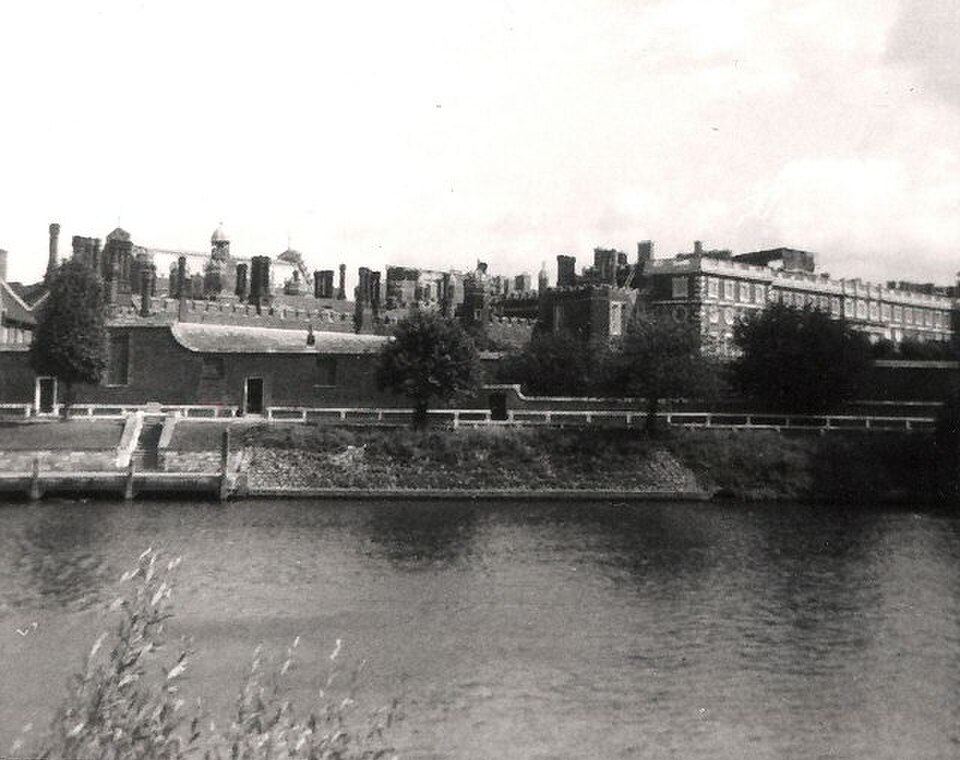
Hampton Court sits on the Thames 12 miles (19 kilometres) southwest and upstream of central London, and the railway is the obvious way to it: Hampton Court railway station opened in February 1849 and stands across the bridge from the palace gates, a walk of a few minutes. That station is the end of a branch from London Waterloo, which makes the journey a single train from the same terminus that serves the South Bank. The other approach is the historical one — the palace was reached by boat from London for centuries, and river services still run up the Thames in the summer season, a slow and expensive way to arrive that is worth doing once for the view of the west front from the water. Driving is possible and the palace is outside the Congestion Charge zone, unlike almost every other sight in this batch, but a train from Waterloo removes the parking question entirely. Because the operator's pages could not be read, no parking charges or opening times for the car park are recorded here.
Checked 2026-08-26 · Source
The first thing to watch for is the one this page cannot answer: the opening hours and the ticket price were not obtainable, because Historic Royal Palaces returned 403 Forbidden to every request made on 26 August 2026. A visitor who travels 12 miles southwest on the strength of a remembered price or a remembered closing time is taking a real risk, and hrp.org.uk should be read on the day of booking. Beyond that: the palace is two buildings in one and the routes through them are separate, so it is easy to walk the Baroque state apartments and leave without ever seeing the Tudor kitchens, which are the more memorable half. The gardens are large and the Great Vine and the maze are some distance from the state rooms, so a visitor short of time will lose them. The maze takes about 20 minutes to reach the centre and is not a two-minute diversion. And the site is a long way out — the last train back to Waterloo matters here in a way it does not at any central London sight.
Checked 2026-08-26
The two architectures are the picture, and the trick is to photograph them separately rather than trying to get both. The Tudor west front and the great gatehouse into Base Court read best in the morning, when the low sun rakes across the brickwork and the chimneys and the dark red goes warm; flat midday light turns the same façade into a plan drawing. The Wren east front and the Privy Garden are an afternoon and evening subject, because they face the other way and the Baroque stonework wants side light to show its depth. The astronomical clock of 1540 above the Clock Court gate needs a long lens from across the court to be read properly; from directly beneath it is unphotographable. Interiors are dark, as Tudor interiors are, and the Great Hall's hammerbeam roof is the hardest thing on the site to capture — brace against a wall rather than raising the sensitivity, and photograph the roof from the far end of the hall rather than the middle. Photography rules inside were not established, because the operator's pages could not be read.
Checked 2026-08-26
No price is recorded here. Hampton Court Palace is run by Historic Royal Palaces and its pricing pages at hrp.org.uk returned HTTP 403 Forbidden to every request made on 26 August 2026, so no admission figure could be read from the operator. The price must be checked at hrp.org.uk directly. No aggregator figure was substituted.
No opening hours are recorded here, for the same reason as the price: the operator's pages at hrp.org.uk could not be read on 26 August 2026, returning HTTP 403 Forbidden. Hours must be confirmed at hrp.org.uk before travelling, particularly for a site 12 miles from central London.
Allow three and a half hours on site as a minimum for both halves of the palace and the gardens, and plan the day around a round trip of roughly two hours on top from central London. Treat it as a full day out rather than an afternoon.
Because it is. Wolsey and Henry VIII built a Tudor palace between 1514 and the 1540s, and William III and Mary II then commissioned Christopher Wren to replace it, whose work between 1689 and 1694 destroyed much of the Tudor fabric before stopping unfinished in 1694. The surviving palace is domestic Tudor on one side and Baroque on the other.
The maze was planted between 1689 and 1695, covers about one third of an acre, and is the oldest surviving hedge maze in Britain. It was originally hornbeam, later replaced by yew, and takes roughly 20 minutes to reach the centre.
By train from London Waterloo to Hampton Court railway station, which opened in February 1849 and stands across the bridge from the palace, a walk of a few minutes. River boats also run upstream from London in the summer season, which is how the palace was reached historically.
Loading the interactive map…
The interactive map could not be loaded.
Last updated:
Source: OpenStreetMap contributors, Wikidata ·