Historic monument · City of Westminster, London
Hyde Park
Photograph

Opening hours
| Monday | 05:00 – 24:00 |
|---|---|
| Tuesday | 05:00 – 24:00 |
| Wednesday | 05:00 – 24:00 |
| Thursday | 05:00 – 24:00 |
| Friday | 05:00 – 24:00 |
| Saturday | 05:00 – 24:00 |
| Sunday | 05:00 – 24:00 |
Checked 2026-08-26 · Source
Access and facilities
- Step-free access · Available
Read from the OpenStreetMap access tags; anything not listed has no tag recorded.
Set the group type to family in the planner and the day window contracts to about three quarters of a solo day.
- Today
- Open today, 05:00 – 24:00
- Visit duration
- 1 hr 30 min
- Accessibility
- Step-free
- Price
- Not recorded
- Standing
- Must see
- Rank
- Rank 17 of 18,182
What it is
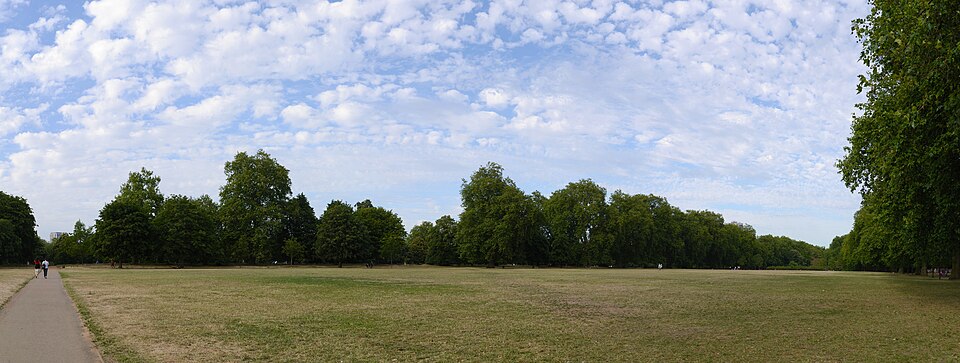
Hyde Park is a 350-acre (140-hectare) royal park in the City of Westminster, the largest of the four central London parks and the one that runs west from Marble Arch and Hyde Park Corner to the Serpentine and the boundary with Kensington Gardens. Henry VIII took the land from Westminster Abbey in 1536 and used it as a hunting ground; it stayed private until Charles I opened it to the public in 1637, which makes it one of the oldest deliberately public open spaces in the city. Its present shape is largely Queen Caroline's: in the 1720s and 1730s she annexed nearly 300 acres to form Kensington Gardens and dammed the Westbourne to create the Serpentine, and the park has changed remarkably little since. Together with Kensington Gardens the two form a continuous 253 hectares (625 acres). Hyde Park is not a monument with a gate and a ticket. It is a working piece of London that happens to contain Speakers' Corner, a lido, a rose garden, a bandstand and several dozen memorials.
Checked 2026-08-26 · Source
What's inside
The Serpentine cuts the park diagonally and organises everything else. On and around it are the lakeside paths, waterfront cafés, the Serpentine Lido — opened in 1930 and still swum in through the summer — and boating. Speakers' Corner sits at the northeast tip near Marble Arch, established as a place of open speech and debate since 1872, on ground where the Tyburn gallows stood until 1783. The monuments are the park's quiet inventory and the Royal Parks lists them with dates: Westmacott's Achilles of 1822, Decimus Burton's Apsley Gate of 1826–29, the Boy and Dolphin fountain of 1862, the bandstand of 1869, Countess Feodora Gleichen's Huntress fountain of 1906, Adrian Jones's Cavalry Memorial and Jacob Epstein's Hudson Memorial Bird Sanctuary both of 1924, Epstein's Pan of 1961, Huxley-Jones's Joy of Life of 1963, the Norwegian War Memorial of 1978, the Holocaust Memorial of 1983, the Queen Elizabeth Gate of 1993, the Diana, Princess of Wales Memorial Fountain of 2004, and the 7 July Memorial of 2009 by Carmody Groarke and Arup. There are also sports pitches for football, tennis and padel, a rose garden, and Rotten Row.
Checked 2026-08-26 · Source


How long to spend
Allow 90 minutes for Hyde Park and treat that as a walk rather than a visit. Ninety minutes is enough to cross the park on the diagonal, take the length of the Serpentine, stop at the Diana Memorial Fountain and reach Speakers' Corner or Hyde Park Corner at the far end — which is the shape most first-time visitors want, because it links two Underground stations and puts the park between them rather than requiring a return. Half an hour is enough only for a single set piece: the fountain, or the rose garden, or a coffee by the water. A half-day is easily spent if the Lido, boating, or the memorial trail across the north of the park is added, and the park absorbs a whole summer afternoon without any difficulty at all. There is no route that has to be walked and nothing that closes at a fixed hour, so the duration is set entirely by how far the visitor intends to go.
Checked 2026-08-26
Season and crowds
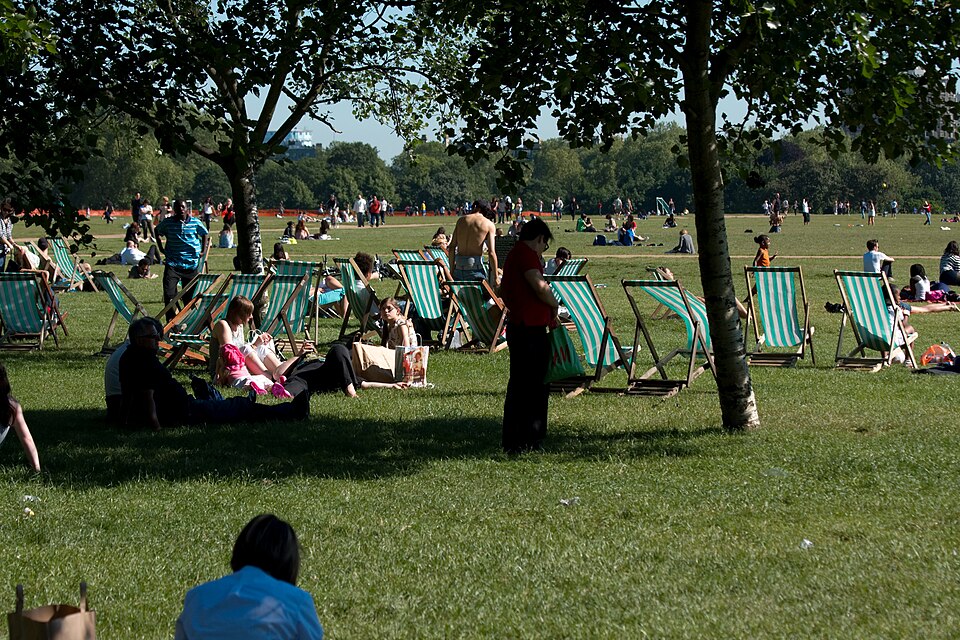
The Royal Parks gives the pedestrian gates as 5am to midnight, every day of the year, which makes Hyde Park one of the few major London sights available before breakfast and after dinner. Early morning is the park at its best: the Serpentine is still, the swimmers are in the Lido, and the paths belong to runners and horses rather than crowds. Late afternoon into dusk is the other good window, particularly in summer when the light comes low down the length of the water. May and June give the rose garden; autumn gives the avenues. The park is at its busiest and least park-like in two specific windows — the Winter Wonderland Christmas event, which has run since 2007 and has grown into one of the largest Christmas events in Europe, and the British Summer Time concert season, when a large part of the south of the park is fenced off for the festival site. Both are worth going to on purpose and worth avoiding by accident.
Checked 2026-08-26 · Source


Tickets
No admission is recorded for Hyde Park. The Royal Parks pages for the park print no entry charge of any kind, and the only charges listed anywhere on them are incidental: the public toilets cost 20p and take contactless cards and mobile wallets but no longer accept cash, car parking costs 70p per 15 minutes on weekdays and 50p on Sundays between 8.30am and 6.30pm, and motorcycle parking is free with a four-hour limit. Individual activities inside the park — the Serpentine Lido, boating, the tennis and padel courts — are run as separate concessions and are charged separately by their operators; those prices were not read from an operator page for this entry and are not recorded here. Large gatherings are the one thing that needs permission rather than money: the Royal Parks states that informal picnics are welcome for groups of fewer than 100 people, and that groups above 100 require an event application.
Checked 2026-08-26 · Source

.jpg)
Getting there
Five Underground stations sit on the edges of Hyde Park, which is the practical reason to walk across it rather than around it. Hyde Park Corner and Knightsbridge serve the southeast and south on the Piccadilly line; Marble Arch and Lancaster Gate serve the northeast and north on the Central line, with Queensway at the northwest corner beyond Kensington Gardens. Bayswater and High Street Kensington are also close. The grand entrance is at Hyde Park Corner, where Decimus Burton laid out a screen of fluted Ionic columns with three carriage archways in 1825, with the Wellington Arch opening nearby in 1828 — arriving through it is a considerably better introduction than slipping in from a side gate. Cycling is allowed only on designated routes such as Serpentine Road and the Broad Walk, signage marks where it is not, and pedestrians have priority throughout. Driving in is possible but pointless; the car parks charge by the quarter-hour and the park is bounded by some of London's slowest roads.
Checked 2026-08-26 · Source
What to watch out for
Hyde Park is safe and open, and the things to watch for are rules rather than hazards. Barbecues are not allowed anywhere in the park. Dogs may generally be off lead provided the owner keeps them under control, but there are exceptions, including the Rose Garden and the areas around the Serpentine, and the Royal Parks publishes a separate dogs policy that governs the rest. Cycling off the designated routes is prohibited and the routes are signed. Groups of 100 or more need an event application rather than turning up. Toilets charge 20p and are contactless-only, so a visitor carrying only cash cannot use them. Two seasonal warnings matter more than any of these: during Winter Wonderland and the British Summer Time concert season substantial parts of the park are fenced into ticketed event sites, so paths that exist on the map are closed on the ground, and a visitor who has planned a crossing may find it blocked. Check the Royal Parks site for the dates before relying on a route.
Checked 2026-08-26 · Source

Photography
Hyde Park photographs as water and trees rather than as landmarks, and the Serpentine is the subject. The best hour is the first one after the gates open at 5am in summer, when the lake is glass, mist sits on the surface and the Serpentine Bridge reads clean against an empty sky; the same view at midday is a busy municipal lake. In the other direction, late light down the length of the water from the eastern end gives the bridge in silhouette. The Diana, Princess of Wales Memorial Fountain of 2004 is a low granite ring rather than a vertical fountain and only works photographed close and from above the rim, not from a distance. Epstein's Pan and his Hudson Memorial reward a long lens and patience with the light through the trees. Rotten Row in the early morning gives the one shot that is genuinely particular to this park: horses on sand in central London, with traffic audible and invisible behind the hedge.
Checked 2026-08-26
Common questions
What time does Hyde Park open and close?
The Royal Parks gives the pedestrian gates as 5am to midnight. Those hours apply throughout the year.
Is there an entry charge for Hyde Park?
The Royal Parks pages for Hyde Park print no admission charge. The only charges listed are 20p for the public toilets, which are contactless-only, and car parking at 70p per 15 minutes on weekdays and 50p on Sundays between 8.30am and 6.30pm.
How big is Hyde Park?
Hyde Park covers 350 acres, which is 140 hectares. Taken together with the adjoining Kensington Gardens the two make 253 hectares, or 625 acres.
Can dogs run off the lead in Hyde Park?
Generally yes, provided the owner keeps the dog under control, but there are exceptions including the Rose Garden and the areas around the Serpentine. The Royal Parks publishes a separate dogs policy covering the remaining restrictions.
Why is Speakers' Corner in Hyde Park?
Speakers' Corner sits at the northeast of the park, near the site of the Tyburn gallows which closed in 1783. It has been established as a place of free speech and debate since 1872 and has been used by suffragettes as well as figures including Karl Marx and Vladimir Lenin.
Can Hyde Park and Kensington Gardens be walked together?
Yes. The two adjoin without a boundary wall and are usually walked as one, which is how they were laid out — Kensington Gardens was annexed from Hyde Park by Queen Caroline in the 1720s and 1730s. Walking both end to end is a half-day rather than an hour.
Where it is
Loading the interactive map…
The interactive map could not be loaded.
Nearby
In City of Westminster
Same category
Fit it into a plan
External links
Last updated:
Source: OpenStreetMap contributors, Wikidata ·