


.jpg)
.jpg)
.jpg)
29 min walk
Zabeel Palace
- Must see
- Historic monument
Language · 1 published
Museum · Dubai
متحف المستقبل
| Monday | 10:00 – 19:00 |
|---|---|
| Tuesday | 10:00 – 19:00 |
| Wednesday | 10:00 – 19:00 |
| Thursday | 10:00 – 19:00 |
| Friday | 10:00 – 19:00 |
| Saturday | 10:00 – 19:00 |
| Sunday | 10:00 – 19:00 |
Checked 2026-08-26 · Source
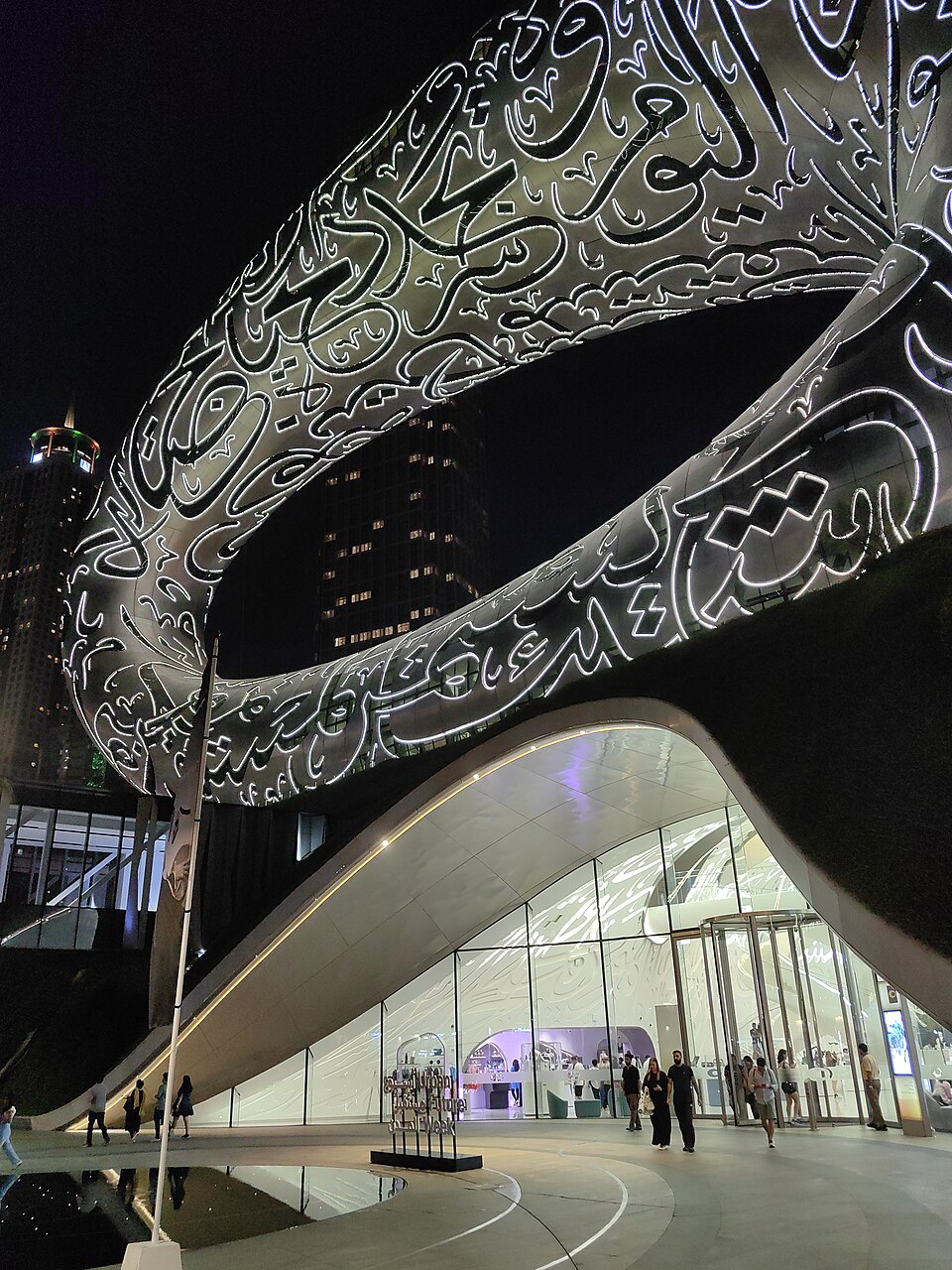
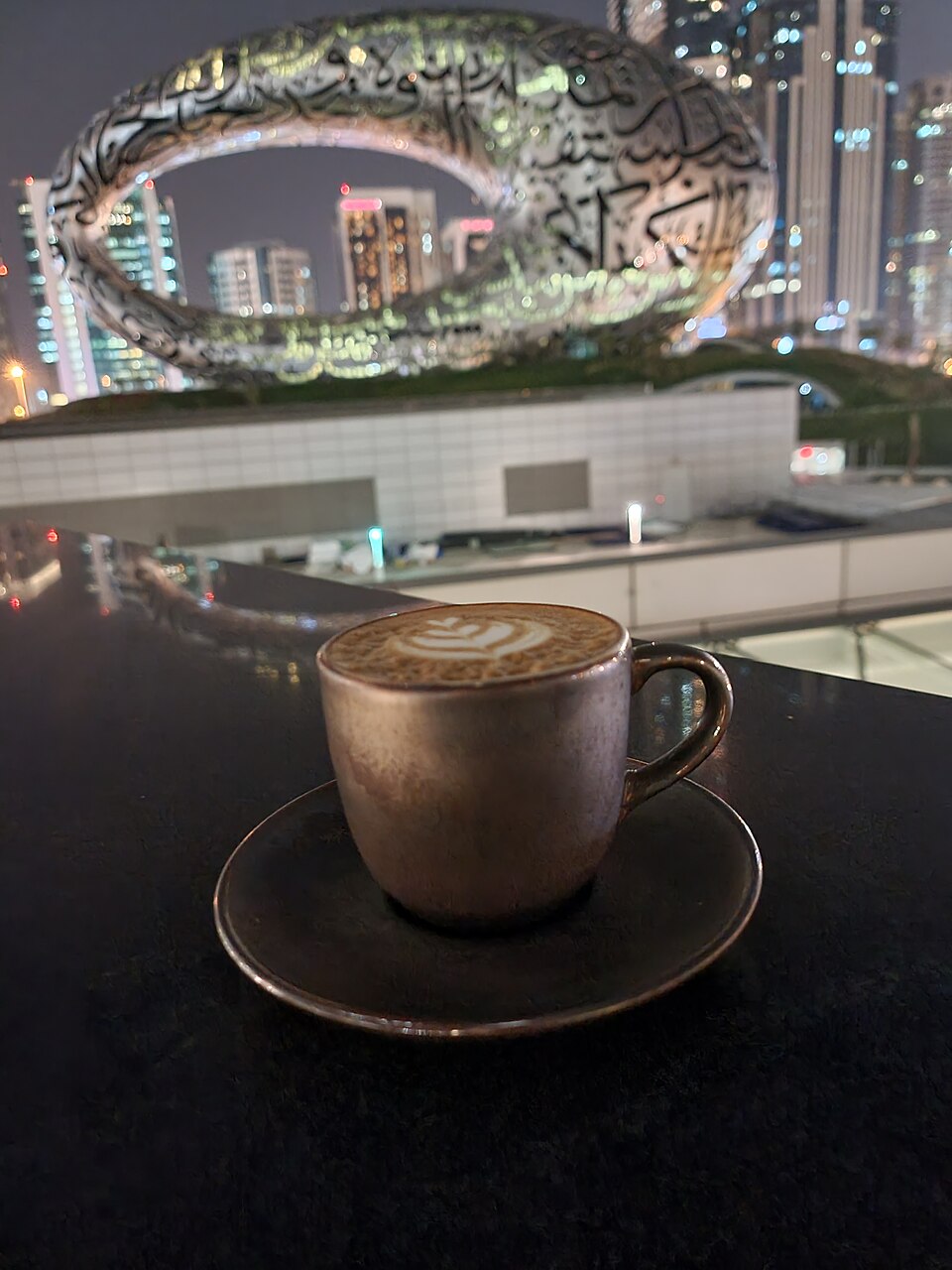
The Museum of the Future is a steel torus standing on a planted green mound beside Jumeirah Emirates Towers on Sheikh Zayed Road, with an oval void cut through its centre. The operator reads the form as a statement rather than a shape: the ring stands for humanity, the mound for the earth, and the void for the unknown future. The building is 77 metres tall and occupies an overall area of 30,548 square metres. Its skin is stainless steel, 1,024 separately shaped panels produced by a robot-assisted process and covering 17,600 square metres in total, and every one of those panels is cut through by Arabic script. The text is a set of sayings by Sheikh Mohammed bin Rashid Al Maktoum, rendered in the calligraphy of Mattar bin Lahej, and the letterforms themselves are the windows, so the daylight reaching the interior arrives already shaped into writing. Killa Design drew the building and Buro Happold engineered it. The museum is an initiative of the Dubai Future Foundation, and it says openly that what waits inside is not a collection of objects behind velvet ropes. It is a sequence of built environments closer to immersive theatre than to a gallery, each floor staged as a habitable set from a projected future.
Checked 2026-08-26 · Source
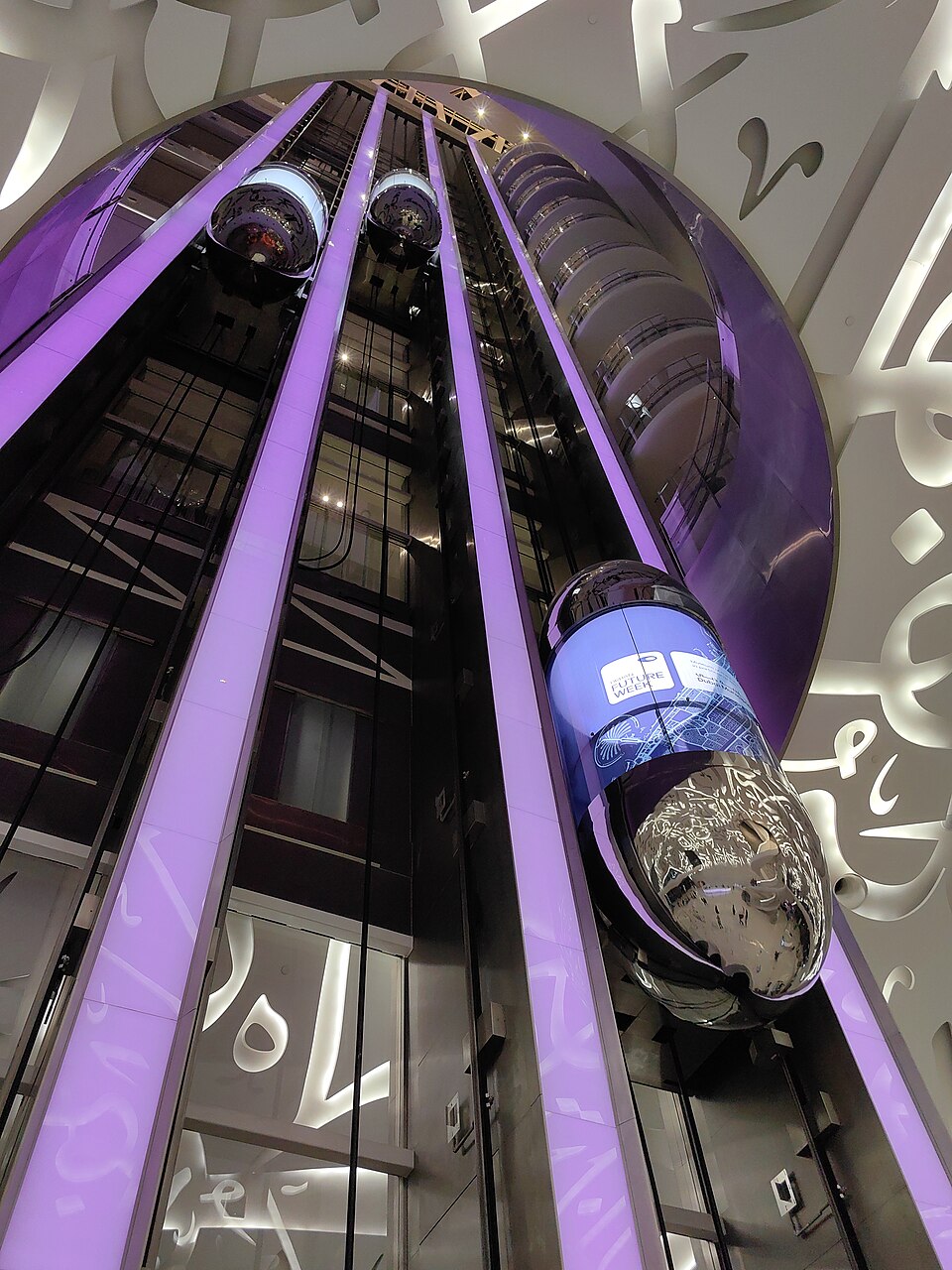
Five floors carry exhibitions, numbered one to five, above a ground-floor lobby. Floor 7 is an event space and floor P3 an auditorium; both are hired out rather than open to visitors. The route is self-guided but fixed, walked in sequence rather than wandered, and museum ambassadors are posted along the whole journey to answer questions instead of leading tours. OSS Hope places you on a space station 600 kilometres above the earth, looking down on a moon reimagined as a renewable-energy source and meeting the community of Pioneers who live and work there. HEAL Institute is a mixed-reality recreation of the Amazon rainforest paired with a DNA library of thousands of species that visitors can explore, collect from and add to. Al Waha is the wellness floor, a deliberate retreat from digital life built around movement, meditation and water beneath a dome of light. Tomorrow Today shows near-future technologies from working innovators and partners, and is rebuilt over time as those collaborations change. Level 1 is Future Heroes, a children's floor that is deliberately screen-free, organised around Imagine, Design and Build, with timed group missions run by the museum's own guides and badges children keep between visits. The museum states that exhibitions rotate, so treat any floor description as current rather than permanent.
Checked 2026-08-26 · Source

Allow two and a half hours. The museum publishes the figure itself: the full exhibition experience takes two to three hours on average, and this guide records 150 minutes as the planning number because the route is fixed and most visitors walk it once. That is a real constraint rather than a suggestion, since the path runs in sequence and there is no shortcut from Level 5 back to a floor you rushed. The museum adds that you may stay as long as you wish during opening hours, but the ceiling is set by last admission at 17:00 against a 19:00 close, so a visitor entering on the final slot has two hours and no more. Arriving nearer opening buys the freedom to linger on Al Waha, which is the floor people most often wish they had given more time to and the one that rewards slowness. Families should add to the figure rather than trim it: Future Heroes on Level 1 is play rather than viewing, children set their own pace there, and an hour on that floor alone is ordinary. Two hours is enough to see everything once. Three hours is enough to see it properly.
Checked 2026-08-26 · Source
The museum opens every day from 10:00 to 19:00, with last admission at 17:00. There is no weekly closing day and no midday break, which makes the calendar simple and puts the whole planning question on the hour rather than the date. Tickets are date and time specific, and the museum explains why: the exhibitions are designed to be experienced in a set sequence over a set period, so entry is metered. That has a practical consequence. Miss your slot and the museum will try to fit you into the next available one, but it warns that availability may be limited at peak times, so the cost of being late is real. Book a slot in the first hour or two after opening if crowding matters to you; the fixed route means a busy slot is felt as queueing between scenes rather than as a crowded room. Dubai's outdoor summer is severe, but this visit is almost entirely indoors and the metro walkway is covered, so the season affects the journey more than the museum. The building is worth seeing lit after dark, which argues for a late-afternoon entry and a walk back to the station once the facade calligraphy is illuminated.
Checked 2026-08-26 · Source
One entry ticket costs AED 169 per person for visitors aged four and above, and it covers the museum's experiences and amenities. Every visitor needs a ticket, including those who pay nothing: children under four, and People of Determination with one accompanying caregiver, enter free but must still collect a ticket. Those free tickets need no pre-booking — go to the Customer Service Desk on arrival with valid proof of eligibility, such as an Emirates ID or a People of Determination ID. Paid tickets are sold online, and the museum strongly recommends booking ahead because tickets are tied to time slots. Buying on site is possible at self-service kiosks or the lobby ticketing desk, but at peak times a preferred slot or immediate entry may simply not exist. Tickets are non-transferable and non-refundable; the exception is holders who bought the Protection Fee, who can claim a full refund by contacting the museum at least 24 hours before their slot, and the Protection Fee itself is never refunded. Groups of up to 20 can be booked online, larger ones through the sales team. There is no minimum age, but children aged 15 and under must be with a parent or guardian over 21. Major international credit and debit cards, Apple Pay and Google Pay are accepted, and all transactions are charged in dirhams.
Checked 2026-08-26 · Source
No car is needed, and the museum says so itself: it recommends the Dubai Metro as the best access, with Emirates Towers station on the Red Line connected to the building by a link bridge. That is a covered walkway straight from the station, which in a Dubai summer is the difference between an easy arrival and an unpleasant one. The Dubai Bus network also serves it, and the museum names routes 27, 29 and X22 as the best lines. The building stands directly adjacent to Jumeirah Emirates Towers, so it is visible from the road long before you reach it. Arriving on foot, by bicycle or by electric scooter works too, and there are bicycle racks in the self-park area. If you do drive, self-parking is chargeable by the hour and the museum repeats twice that the spaces are very limited and subject to availability; there are dedicated electric-vehicle bays with charging stations, and drop-off areas around the building. On valet parking the museum's own help pages contradict each other: one answer offers a valet service, another states plainly that valet parking is not available. Both are on the site as recorded here, so do not count on a valet.
Checked 2026-08-26 · Source
Bags are the most common surprise. Anything larger than 14 by 10 inches is not allowed inside, backpacks, suitcases and oversized items must be left at the baggage storage area where a fee may apply, and every bag is screened on entry. Medical and baby bags can be exempt from the size limit but are inspected and tagged, and medical items may need documentation. Food and drink, water bottles included, must be stored away: you may eat your own food in the lobby and garden areas, and caregivers may carry snacks and drinks onto the Future Heroes floor but not past its entry barrier, and nowhere else. Re-entry is limited. Public areas can be re-entered at any time during opening hours, but exhibition re-entry works only on the day your ticket is valid, only on certain floors, and only if your wristband stays on — remove it and you will not get back in. Dress respectfully for a public space in the UAE. Accessibility is good but not complete: wheelchairs are free and available from lobby docks or from floor staff, restrooms on every floor are accessible, prayer rooms sit in the lobby, and all audio content is subtitled in Arabic and English — but there are no sign-language interpreters and no audio guides.
Checked 2026-08-26 · Source
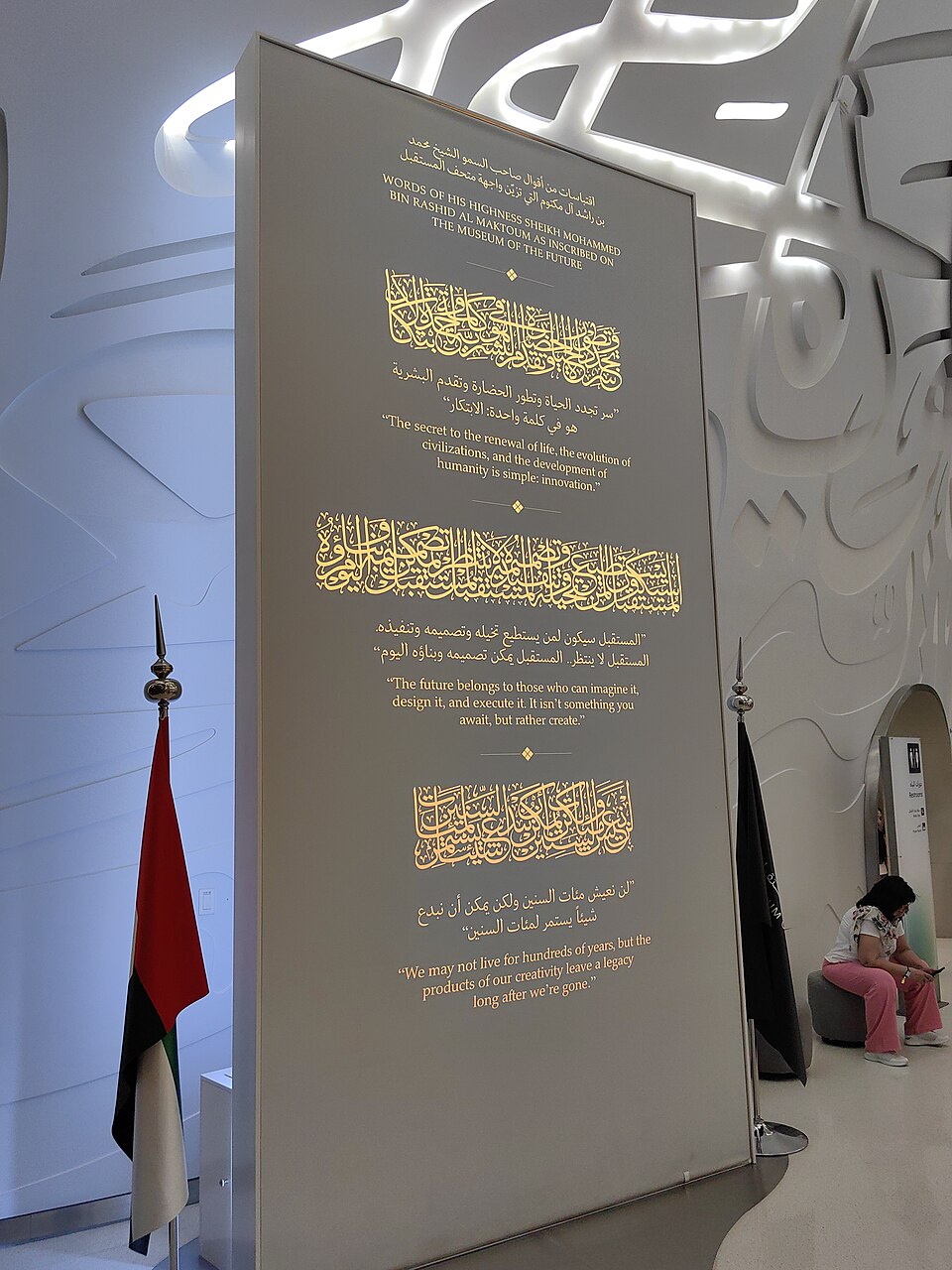
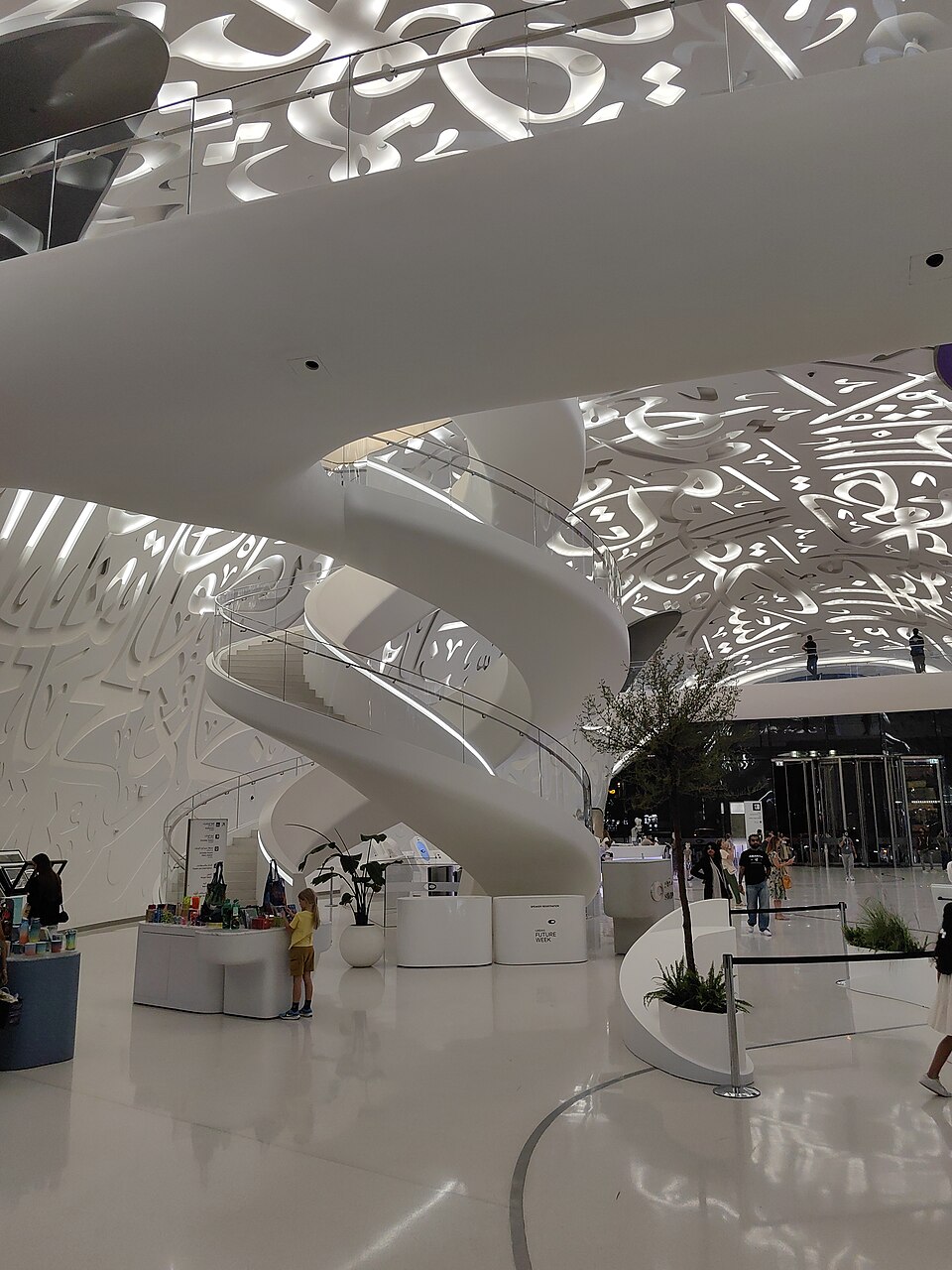
Photography and video are allowed for personal, non-commercial use, with one firm condition: existing light only, so no flash anywhere. Tripods and selfie sticks are not permitted, which the museum puts down to the safety of other guests and which also matters on a fixed route where everyone behind you is moving. The exception to watch is special exhibition galleries, where photography is often restricted; the museum's own advice is to ask a member of staff if you are unsure, and the ambassadors posted along the route are the people to ask. Inside, the hard part is light rather than permission. The floors are dim, staged and lit for atmosphere, so a phone will reach for a long exposure and the result will smear unless you brace against a wall or a rail. Look for the practical bright spots instead: the daylight coming through the calligraphic windows, which throws readable Arabic script across the interior surfaces, and the lobby with its view up the void. Outside, the facade is the picture most people came for. It reads as polished steel and shadowed script by day and as illuminated line-work after dark, and the green mound gives you a low angle that puts the whole ring in frame.
Checked 2026-08-26 · Source
The museum opens every day from 10:00 to 19:00, with last admission at 17:00. There is no weekly closing day and no midday break. Because entry is by timed slot, the last admission time is the practical limit on a visit: enter at 17:00 and you have two hours before closing.
An entry ticket is AED 169 per person for visitors aged four and above, giving full access to the museum's experiences and amenities. Children under four and People of Determination with one accompanying caregiver enter free, but still need a ticket: no pre-booking is required for these, and they are collected at the Customer Service Desk on arrival with valid proof of eligibility such as an Emirates ID.
The museum says the full exhibition experience takes two to three hours on average, and this guide plans on 150 minutes. Visitors may stay as long as they like within opening hours, but the route is a fixed sequence walked once. Families with children should allow more, since the Future Heroes floor on Level 1 is play rather than viewing.
No. The museum recommends the Dubai Metro as the best access — Emirates Towers station on the Red Line, connected to the building by a covered link bridge — and names bus routes 27, 29 and X22. Self-parking exists but is chargeable by the hour and the museum states twice that spaces are very limited and subject to availability. Its help pages contradict each other on valet parking, one answer offering it and another saying it is not available.
Yes, for personal and non-commercial use, using existing light only — no flash. Tripods and selfie sticks are not permitted. Photography is often restricted in special exhibition galleries, so ask a member of staff or one of the ambassadors along the route if you are unsure.
The museum was opened by the Government of the United Arab Emirates on 22 February 2022, in the Financial District of Dubai. It holds no historic collection: five exhibition floors above the lobby stage a projected future as walk-through environments — a space station, a mixed-reality rainforest and DNA library, a wellness floor, a near-future technology showcase, and a screen-free children's floor.
Loading the interactive map…
The interactive map could not be loaded.
Last updated:
Source: OpenStreetMap contributors, Wikidata ·