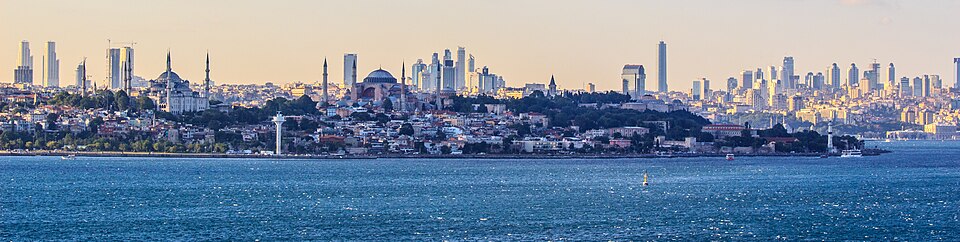
Sultan Ahmed Mosque
The Blue Mosque was built for Ahmed I between 1609 and 1617, and it is the only imperial mosque in Istanbul that faces Hagia Sophia across open ground rather than standing apart from it.
- Must see
- Historic monument
- Fatih
Language · 1 published
City guide · Türkiye
Two continents, three empires and one strait that everything else is arranged around. The old capital rewards a plan: the great monuments sit within a twenty-minute walk of each other in Fatih, and almost everything else is a ferry ride away.
Ranked by importance — sitelinks, pageviews and heritage status, not editor preference.
25 places match
Category
Typical visit duration
The Blue Mosque was built for Ahmed I between 1609 and 1617, and it is the only imperial mosque in Istanbul that faces Hagia Sophia across open ground rather than standing apart from it.
The Süleymaniye is Sinan's imperial mosque for Süleyman the Magnificent, founded in 1550 and inaugurated in 1557, and it is the one to see if you only see one.
The Spice Bazaar is a covered market hall in Eminönü that was paid for by an empire's tax farm and built to keep a mosque solvent.
The Galata Tower is the Genoese watchtower on the hill across the Golden Horn, built in 1348 as the Christea Turris — the Tower of Christ — at the highest point of their walled colony.
The Hippodrome was where Constantinople did its politics.
The Basilica Cistern is a sixth-century water store the size of a cathedral, under a street in Sultanahmet, built for Justinian I. Historical texts say 7,000 enslaved people built it.
Taksim Square is where modern Istanbul argues with itself. It is the head of İstiklal Avenue, the terminus of the metro, the hub of the municipal buses, and the place the country's politics spills into when it spills anywhere.
The Maiden's Tower stands on an islet in the Bosphorus, 200 m off the Üsküdar shore, and it is the one Istanbul landmark you cannot walk to.
The Chora holds the best late Byzantine mosaic and fresco cycle anywhere, and it is a long way from the tram, which is why the people who go are the people who came for it.
Hagia Irene is the Byzantine church that was never made into a mosque, and it is the reason it still looks like a Byzantine church inside.
The Theodosian walls kept Constantinople for a thousand years, and they are still standing across the city.
Older than almost everything around it by two thousand years, the Obelisk of Theodosius is a piece of pharaonic Egypt standing in the middle of a Turkish square.
A regular Şehir Hatları commuter ferry across the Bosphorus, the everyday version of the Long Bosphorus Tour: no sightseeing stop, no turnaround at Anadolu Kavağı, just a working boat moving Istanbul residents between the European and Asian shores on a…
Bozdoğan Kemeri, the Aqueduct of Valens, is the surviving bridge of the water system that made a city of a million people possible on a peninsula with almost no rivers.
The Galata Mevlevihanesi is the oldest Mevlevi dervish lodge in Istanbul, established in 1491 during the reign of Bayezid II on land that had belonged to İskender Pasha, a prominent governor of the period.
A single shaft of Egyptian porphyry stands in the middle of Çemberlitaş Square on Divan Yolu, banded with iron and blackened along one side.
The Fatih Mosque is where Mehmed the Conqueror is buried, and it stands on the site of the Church of the Holy Apostles — the mausoleum of the Roman emperors, Constantine the Great among them.
Anadoluhisarı is a siege engine in stone, built sixty years before the siege it was meant for.
The Şehzade is the mosque Süleyman the Magnificent built for a dead son, and it is where Sinan learned to build the ones that followed.
The Ecumenical Patriarchate is the senior see of the Eastern Orthodox world, and it occupies a walled compound in Fener on the Golden Horn.
İmrahor Camii is a small working neighbourhood mosque in Salacak, the shore quarter that runs south from Üsküdar square on Istanbul's Asian side.
Çırağan Palace is the last of the great Ottoman waterfront palaces, and the only one a visitor cannot walk into.
The Walled Obelisk, Örme Dikilitaş in Turkish and literally the masonry obelisk, stands 32 m tall on the spine of the old Hippodrome in what is now Sultanahmet Square, west of the Sultan Ahmed Mosque.
Rüstem Pasha Mosque does not sit on the street.
Sveti Stefan stands on the Golden Horn shore at Balat, and almost nothing about it is masonry.
Source: OpenStreetMap contributors, Wikidata ·
District boundaries come from OSM administrative relations, so a district page holds exactly the places inside it — plus, for the islands and the coast, the nearest district by proximity.
South of the Horn, in Fatih, the monumental core is walkable end to end: Hagia Sophia, the Blue Mosque, the Basilica Cistern and Topkapı sit inside one square kilometre.
North of the Horn, Beyoğlu climbs from Karaköy to Taksim and is where the city eats and drinks late. Across the Bosphorus, Kadıköy and Üsküdar are residential, cheaper and reached best by ferry rather than by bridge.
Checked 2026-08-23
One contactless card covers tram, metro, funicular, bus and ferry, and it is the only ticket most visitors need.
The T1 tram threads the monumental core; the M2 metro crosses the Horn to Taksim. Ferries are the fastest way between the European and Asian sides and cost the same as a tram ride. Traffic on the bridges is unpredictable enough that a taxi is rarely faster.
Checked 2026-08-23
Three days covers the monumental core in Fatih without rushing. Five lets you add Beyoğlu, a Bosphorus ferry and one of the Asian-side neighbourhoods.
Yes, outside prayer times. Shoulders and knees should be covered, shoes come off at the door, and women cover their hair; scarves are lent at the larger mosques.
The scheduled public ferry runs the same water as the tourist cruises for a fraction of the fare, and stops at neighbourhoods you can walk around before catching the next one back.
Fatih puts you inside walking distance of the monuments. Beyoğlu is livelier at night and still two tram stops away. The Asian side is cheaper and quieter but adds a ferry to every sightseeing day.
April to June and September to October are warm without the July heat or the cruise-ship peak. January and February are cold and wet but the queues disappear.
Set your days, your pace and the hours you actually want to be out. The planner works around closing days and travel time, and leaves room to eat.