
.jpg)
.jpg)
.jpg)

5 min walk · เขตบางรัก
Wat Hua Lamphong
- Must see · Heritage site
- Place of worship
Language · 1 published
Family attraction · เขตปทุมวัน, Bangkok
สวนงู สถานเสาวภา
| Monday | 09:30 – 15:30 |
|---|---|
| Tuesday | 09:30 – 15:30 |
| Wednesday | 09:30 – 15:30 |
| Thursday | 09:30 – 15:30 |
| Friday | 09:30 – 15:30 |
| Saturday | 09:30 – 13:00 |
| Sunday | 09:30 – 13:00 |
Checked 2026-08-25 · Source
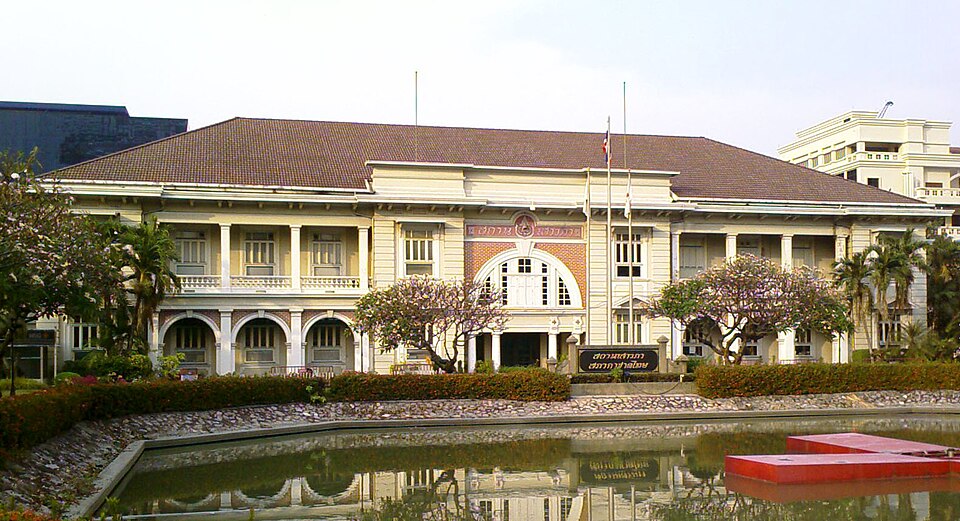
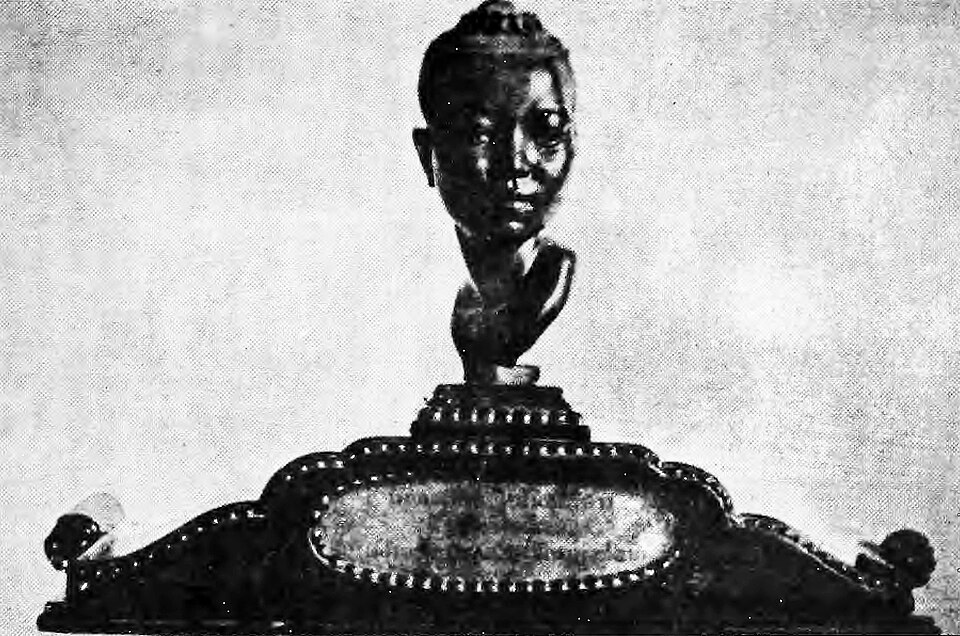
The Snake Farm at the Queen Saovabha Memorial Institute is the visitor-facing part of a working antivenom laboratory belonging to the Thai Red Cross Society, on Rama IV Road in Pathum Wan. It was founded on 22 November 1923 because Thailand had no antivenom of its own and venomous snakebite was common: Dr Leopold Robert, the institute's first director, raised the money to build a place to keep venomous snakes for milking so that serum could be produced from their venom. It was the second such snake farm in the world and the first in Asia, and the institute counts it as one of the Red Cross's defining units. It has been open to the public since 1929. Three missions run in parallel today — keeping and breeding snakes for venom and for conservation, teaching the public about snakes, venom and correct first aid, and research recognised by the World Health Organization, which designates the institute a WHO Collaborating Center for Venomous Snake Toxicology and Research.
Checked 2026-08-25 · Source
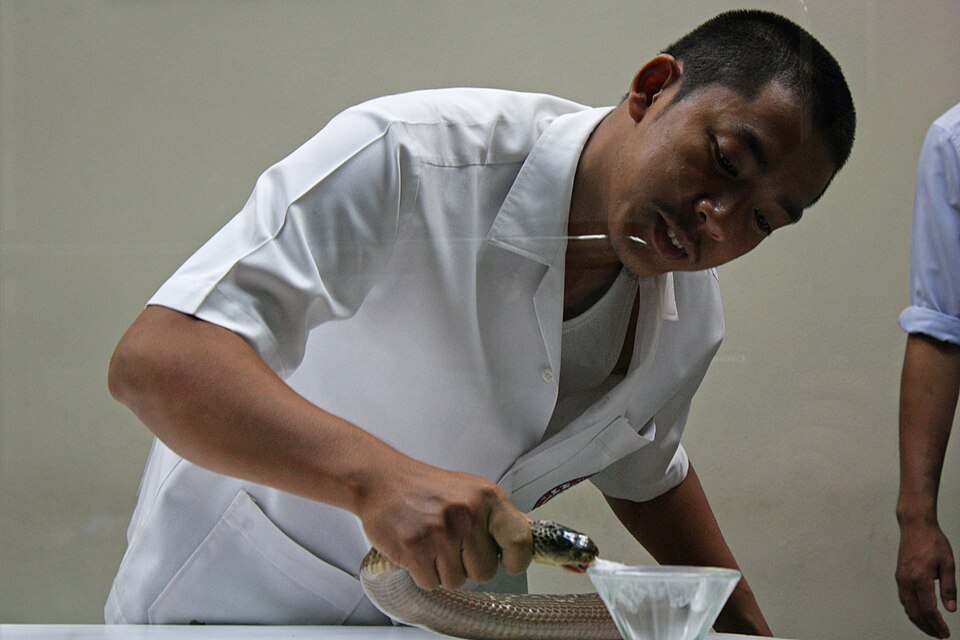
The display splits into two parts. Outdoors, around the Simaseng building, are the pits and enclosures holding live snakes. Inside the building are two floors. The first floor holds glass enclosures of live snakes — highly venomous species, rear-fanged species and non-venomous ones — each furnished to resemble the habitat the species actually lives in, plus the seating from which the venom-extraction demonstration is watched. The second floor is the exhibition: snakes, venom, and how to give correct first aid after a bite, taught through captioned panels with photographs, video, and the two demonstrations, all presented in Thai and English. The demonstrations are the spine of a visit rather than an extra. On Monday to Friday the venom-extraction demonstration runs at 11.00 and the snake-handling demonstration at 14.00; on Saturday, Sunday and public holidays there is one demonstration, snake handling, at 11.00. A separate Reptile Science Clinic operates on the same site, treating pet reptiles for the public; it is a veterinary service, not part of the exhibition.
Checked 2026-08-25 · Source
Ninety minutes, and the figure is set by the demonstration timetable rather than by the size of the display. The exhibition floor and the outdoor enclosures take about forty-five minutes at a normal pace; a demonstration and getting seated for it accounts for the rest. The efficient plan is to arrive around 10.15, walk the enclosures and the second-floor panels, sit down for the 11.00 demonstration, and finish afterwards on whatever was skipped. Arriving at noon on a weekday leaves a shorter, quieter visit with the 14.00 snake handling still ahead, which suits anyone who would rather not wait. Arriving after 13.00 on a Saturday or Sunday means arriving to a closed gate.
Checked 2026-08-25
Weekdays are the fuller visit. Monday to Friday the Snake Farm is open 09.30–15.30 and holds two demonstrations, venom extraction at 11.00 and snake handling at 14.00. On Saturday, Sunday and public holidays it opens 09.30–13.00 and holds a single snake-handling demonstration at 11.00 — so a weekend visitor who wants to see venom being milked has come on the wrong day, and one who arrives at half past eleven on a Sunday has missed the only demonstration and has ninety minutes left before closing. Public holidays follow the weekend timetable, not the weekday one, which is the trap most often sprung on visitors planning around a long weekend. The institute's own opening hours differ from the Snake Farm's: the institute works 08.30–16.30 Monday to Friday, and the Snake Farm's shorter day sits inside that.
Checked 2026-08-25 · Source
Admission is charged per person and at two different scales. For foreign visitors the institute publishes 200 baht for an adult, 100 baht for a school, college or university student on production of a student card, and 50 baht for a child up to 110 centimetres tall. For Thai visitors the same three categories are 40, 20 and 10 baht. The demonstrations are included; nothing inside the exhibition is separately ticketed. There is a donation channel that is not an admission — the institute accepts donations earmarked for the Snake Farm at its donation window or by bank transfer, and issues thank-you cards for gifts of 2,000–4,999 baht and of 5,000 baht upwards. The Reptile Science Clinic charges as a veterinary clinic and is unrelated to the visitor ticket.
Checked 2026-08-25 · Source

The address the institute publishes is 1871 Rama IV Road, Pathum Wan, Bangkok 10330, and the Snake Farm sits inside the Queen Saovabha Memorial Institute compound rather than on the street, so the approach is through the institute gate and then to the Simaseng building. This is central Bangkok rather than Rattanakosin: the site is on the Silom–Rama IV axis, a long way in character from the old city, and it pairs more naturally with Lumphini Park and the Silom end of a day than with the temples. The institute's telephone number for Snake Farm enquiries is 02-252-0161 extension 82452, and the general institute line is 02-252-0161. Because the compound is a hospital-grade facility, be prepared to be directed by staff at the gate rather than to find the entrance by signage alone.
Checked 2026-08-25 · Source
The timetable is the hazard here, not the snakes. Weekend and public-holiday closing is 13.00, three and a half hours earlier than on a weekday, and the single weekend demonstration is at 11.00, so a late start ruins the visit rather than shortening it. Public holidays follow the weekend hours. The venom-extraction demonstration exists only Monday to Friday. Beyond the clock: this is a working medical institute producing serum, not a wildlife park, and the animals are stock in a production process as much as they are an exhibit — visitors who expect a zoo's staging will find the enclosures plainer and the tone more clinical. Follow staff instructions at the demonstrations without improvising, particularly during snake handling, and keep children within reach at the outdoor pits. Captions are in Thai and English, so language is not a barrier, but the exhibition assumes an interest in first aid and toxicology rather than in spectacle. Anyone bringing a pet reptile for the clinic rather than visiting the exhibition needs different hours again: the clinic runs 09.30–15.00 on weekdays with a 12.00–13.00 break, takes its last case at 14.30, and is closed at weekends and on public holidays.
Checked 2026-08-25 · Source

Almost everything worth photographing here is behind glass, which sets the whole problem. Put the lens against the glass to kill reflections, switch the flash off — it bounces straight back and startles the animal — and accept a high ISO, because the enclosures are lit for the snakes rather than for a camera. The habitat furnishing inside each case is the reason a tight frame works better than a wide one: fill it with the animal and one branch. At the demonstrations, sit in the front rows on the aisle side and shoot at a fast shutter, since the interesting instant — fang to membrane, a hand behind a head — lasts a fraction of a second and cannot be repeated on request. The outdoor pits give the only unglazed views and the best of them are from directly above at midday, when the light reaches the floor of the pit. Do not lean over a rail for a better angle, and do not ask a handler to hold a pose.
Checked 2026-08-25
The institute publishes 09.30–15.30 Monday to Friday, and 09.30–13.00 on Saturday, Sunday and public holidays. That weekend timetable also applies on public holidays, so a long-weekend visit gets the short day.
Admission is per person. For foreign visitors the published rates are 200 baht for an adult, 100 baht for a student with a student card, and 50 baht for a child up to 110 cm tall. For Thai visitors the same categories are 40, 20 and 10 baht. Demonstrations are included in the ticket.
Monday to Friday, venom extraction is at 11.00 and snake handling at 14.00. On Saturday, Sunday and public holidays there is only one demonstration — snake handling at 11.00 — and no venom extraction.
It was founded on 22 November 1923 to keep venomous snakes for milking so that Thailand could produce its own antivenom, which it then lacked while snakebite was common. Dr Leopold Robert, the Queen Saovabha Memorial Institute's first director, raised the funds. It was the second snake farm in the world and the first in Asia, and the institute is now a WHO Collaborating Center for Venomous Snake Toxicology and Research.
Allow ninety minutes. The outdoor enclosures and the two exhibition floors take about forty-five minutes; the rest is the demonstration and getting a seat for it. Arriving around 10.15 and sitting down for the 11.00 demonstration is the plan that wastes the least time.
It is built to teach, and the exhibition is captioned in Thai and English, with the second floor covering snakes, venom and correct first aid after a bite. A child's ticket applies up to 110 cm in height. It remains a working antivenom laboratory rather than a zoo, so keep children within reach at the outdoor pits and follow staff instructions at the demonstrations.
Loading the interactive map…
The interactive map could not be loaded.
Last updated:
Source: OpenStreetMap contributors, Wikidata ·