


9 min walk
Osaka Castle
- Must see
- Historic monument
Language · 1 published
Museum · Osaka
大阪歴史博物館

| Monday | 09:30 – 17:00 |
|---|---|
| Tuesday | Closed |
| Wednesday | 09:30 – 17:00 |
| Thursday | 09:30 – 17:00 |
| Friday | 09:30 – 17:00 |
| Saturday | 09:30 – 17:00 |
| Sunday | 09:30 – 17:00 |
Checked 2026-08-26 · Source
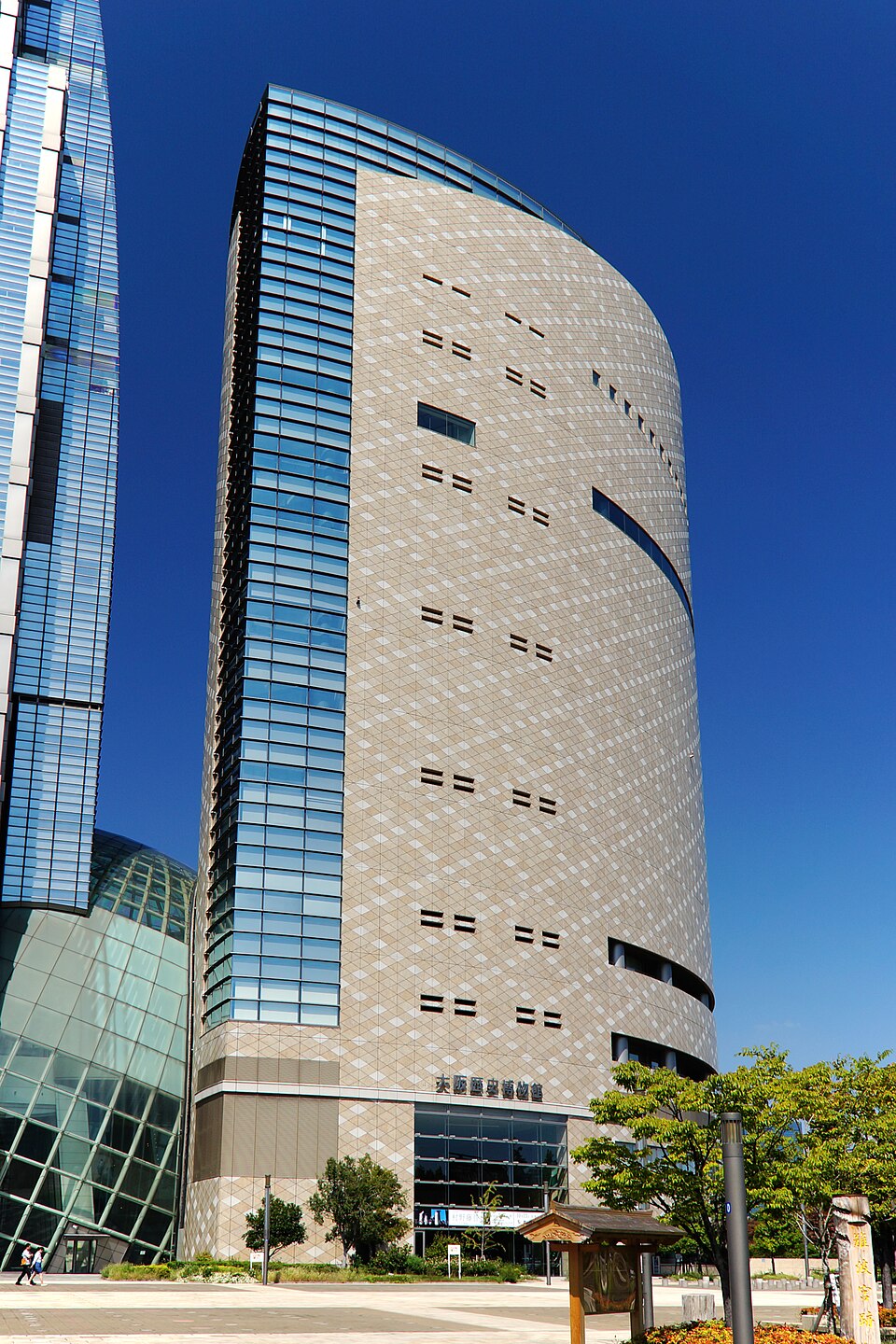
The Osaka Museum of History is the city's history museum, at 4-1-32 Otemae in Chuo-ku, immediately south-west of Osaka Castle Park. It opened on 3 November 2001 and is not a converted old building: Osaka City and NHK built it together as a single complex with the new NHK Osaka Broadcasting Station, on the site of the former municipal central gymnasium, as part of the city's plan to join the Naniwa Palace site to Osaka Castle Park. The ground under it decided what the museum would be. Excavation that began in 1987 and ran to 1990 turned up groups of storehouses belonging to the fifth century and to the earlier Naniwa Palace, and in 1991 the city resolved to preserve the remains rather than clear them. The museum therefore stands on the ruins it explains, and calls itself a site museum for the Naniwa Palace as well as a general history museum of the city. It succeeded the Osaka Municipal Museum, which had occupied the former Fourth Division headquarters beside Osaka Castle since 1960 and closed at the end of March 2001. Since 2019 it has been run by the Osaka Museums corporation, along with four other municipal museums.
Checked 2026-08-26 · Source
The permanent exhibition runs from the tenth floor down to the seventh, and the route is chronological: visitors take the lift to the top and work downwards. The tenth floor is the ancient city, built around a partial reconstruction of the Daikokuden of the Nara-period Naniwa Palace, with life-size vermilion-painted pillars seventy centimetres across, mannequins in court dress and video of court life. The ninth floor covers the age of Osaka Hongan-ji and the Edo-period water city, presented largely through townscape models at one-twentieth scale. The eighth floor is the Naniwa Archaeological Resource Centre, with a life-size replica excavation and real archaeological tools to handle. The seventh floor reconstructs the street corners of Shinsaibashi and Dotonbori in the late Taisho and early Showa years. Windows along the way look out over Osaka Castle and the excavated Naniwa Palace site. Downstairs, part of the excavation is left open at the first-floor entrance and can be looked at throughout opening hours. A smartphone guide covering fifty points on the four exhibition floors is sold at the first-floor information desk for 400 yen per unit in Japanese, English, Chinese and Korean. Special and featured exhibitions occupy separate galleries and are ticketed separately.
Checked 2026-08-26 · Source
The museum publishes two routes through the permanent floors and says the shorter of them, the Highlight Course, takes in Osaka's history in about an hour by concentrating on the life-size reconstructions, the scale models and the key photographs and film. The Complete Course is the same four floors walked slowly, stopping at the individual cases. An hour is therefore the operator's own floor, not a target. Ninety minutes is the figure to plan on: it covers the Highlight Course at a comfortable pace, leaves time for the models on the ninth floor, which are the part visitors linger over longest, and absorbs the wait for a lift. Add twenty minutes if the volunteer-led tour of the excavated remains is on and the timing works, and add an hour or more if a special exhibition is running and is of interest, since those are separate galleries with their own ticket. The hard constraint is the back end of the day rather than the front: the last admission is thirty minutes before closing, so arriving after four in the afternoon buys half an hour on four floors and is not worth the ticket.
Checked 2026-08-26 · Source

The museum opens at 9:30 and closes at 17:00, with the last admission thirty minutes before closing, at 16:30. It is closed every Tuesday; when a Tuesday falls on a national holiday it opens that day and closes the following day instead. It also closes from 28 December to 4 January. Those two rules catch more visitors than anything else here, because a Tuesday in Osaka is easily filled with Osaka Castle and Osaka Castle Park next door and the museum quietly missed. The useful hour to arrive is between 9:30 and 11:00. The floors are quietest then, the volunteer tour of the excavated remains has not yet drawn its queue, and the light through the tenth and ninth floor windows over the Naniwa Palace site and the castle is at its best before the afternoon haze. Arriving at 13:30 is the other good option, because the guided tours of the ruins leave at 14:00 and 15:00. Special exhibition runs, which the museum lists a year ahead on its site, are the busiest weeks. Osaka City can also close the museum at short notice when a special weather warning or storm warning is issued.
Checked 2026-08-26 · Source
Admission to the permanent exhibition is 600 yen for adults and 400 yen for high school and university students, who are asked to show student identification. Junior high school pupils and younger children enter free. So do residents of Osaka City aged 65 or over on production of proof, such as a senior travel pass or a driving licence, and holders of a disability certificate together with one carer; the digital Mirairo ID certificate is accepted in place of the paper one. Groups of twenty or more pay 540 yen and 360 yen respectively, and the museum asks groups to send its application form in advance rather than turn up unannounced. Individual permanent-exhibition tickets can also be bought online through the museum's own ticket page. At the desk, cash, Visa, Mastercard, JCB, American Express, Diners Club, Discover, iD, QUICPay, UnionPay and the usual Japanese QR wallets, PayPay, d payment, au Pay and others, are all taken. Special exhibitions carry their own charge on top of the permanent ticket, set per exhibition, so the total for a visit during a major show is higher than the 600 yen headline. The audio guide, at 400 yen a unit, is also extra.
Checked 2026-08-26 · Source
No car is needed and none is worth the trouble. The museum sits on top of a subway interchange: Tanimachi 4-chome station, served by the Osaka Metro Tanimachi and Chuo lines, has its exit 9 immediately beside the building, while exit 2 leaves a walk of roughly 300 metres east. Osaka City Bus stops at Banbacho, directly in front. From Kansai International Airport the museum is about seventy minutes by train, taking the airport line to JR Tennoji and changing to the Tanimachi line, or fifty minutes by car. From Itami it is about fifty-five minutes by train via Hankyu Osaka-umeda and the Tanimachi line, or forty by car. From Shin-Osaka, allow thirty minutes: Midosuji line to Hommachi, then the Chuo line one stop. Drivers have a car park on the second basement level, open from 08:00 to 21:00, restricted to vehicles no taller than 2.1 metres, charging 500 yen for the first hour and 200 yen for each subsequent thirty minutes. Bicycle parking exists but is small, and the museum asks visitors to come by public transport where they can.
Checked 2026-08-26 · Source

Umbrellas cannot be carried into the galleries: long objects are refused because of the risk to the displays, so a wet day means leaving one downstairs. Only pencils may be used for notes and sketches; pens and mechanical pencils are barred because ink and broken leads damage the cases. Eating and drinking are confined to the first-floor restaurant, Lunch Japonica, whose last order is at 16:30; a packed lunch has to be eaten outside the building, and the second floor rest corner has only vending machines. Coin lockers on the first floor take a 100 yen coin and return it, and anything too large for them can be left at the general information counter. Pushchairs are normally allowed and can be borrowed, but the museum may keep them out of the galleries when the floors are crowded. Wheelchairs can be borrowed at the counter, there are accessible lavatories on every floor, and a nursing room is on the first floor. Only guide dogs are admitted. The volunteer tour of the excavated remains depends on volunteers being available and can be cancelled without notice, so it is a bonus rather than a plan.
Checked 2026-08-26 · Source
Photography is allowed in the permanent exhibition for personal use, with clear limits. Anything carrying a "Do Not Photograph" sign is off limits. Cameras and phones must be hand-held: no flash, no additional lighting, no monopods, no tripods and no selfie sticks, the last three because they hit the cases and the other visitors. The film playing inside the galleries is not to be recorded. Other visitors and members of staff should be kept out of the frame, and photographing while walking, or standing over one exhibit for a long time, is asked against. Nothing shot inside may be reproduced, distributed or used commercially. Within those rules the museum photographs well, because so much of it is built rather than cased: the vermilion pillars of the Daikokuden on the tenth floor, the one-twentieth townscape models on the ninth, the replica excavation on the eighth and the reconstructed Taisho street on the seventh all take a hand-held shot without flash. The windows are the other subject. They look down on the excavated Naniwa Palace site and across to Osaka Castle, and morning is the better half of the day for both.
Checked 2026-08-26 · Source
No. The museum closes every Tuesday, and when a Tuesday is a national holiday it opens on that day and closes on the Wednesday instead. It also closes for the new year period, from 28 December to 4 January. On open days the hours are 9:30 to 17:00, with the last admission at 16:30. Osaka City may close it at short notice when a special or storm warning is issued.
The permanent exhibition costs 600 yen for adults and 400 yen for high school and university students with identification. Junior high pupils and younger go free, as do Osaka City residents aged 65 and over with proof and holders of a disability certificate with one carer. Groups of twenty or more pay 540 and 360 yen. Special exhibitions are charged separately, on top of the permanent ticket.
The museum's own Highlight Course covers the four permanent floors in about an hour; its Complete Course is the same route walked slowly. Ninety minutes is the realistic figure for a first visit, and a special exhibition adds an hour or more. Because the last admission is 16:30, arriving after 16:00 leaves too little time to be worth the ticket.
Yes, in the permanent exhibition and for personal use only. Items marked with a "Do Not Photograph" sign are excluded. Cameras and phones must be hand-held, with no flash, no extra lighting and no monopods, tripods or selfie sticks. The videos playing in the galleries are not to be filmed, other visitors and staff should be kept out of shot, and nothing may be reproduced, distributed or used commercially.
No. Exit 9 of Tanimachi 4-chome station, on the Osaka Metro Tanimachi and Chuo lines, opens beside the building, and exit 2 is about 300 metres away; the Banbacho city bus stop is in front. There is a car park on the second basement level, open 08:00 to 21:00, for vehicles up to 2.1 metres tall, at 500 yen for the first hour and 200 yen per further thirty minutes.
Part of the excavation is preserved and left open at the first-floor entrance, and can be looked at any time the museum is open. Volunteers also guide a twenty-minute tour of the remains on open days, leaving at 14:00 and 15:00, free of charge, for the first twenty people to sign up at the reception counter from thirty minutes before each departure. The tour depends on volunteers and may be cancelled without notice.
Loading the interactive map…
The interactive map could not be loaded.
Last updated:
Source: OpenStreetMap contributors, Wikidata ·