Monument historique · Şehzadeler, Manisa
Kurşunlu Hanı
Photographie

Horaires d'ouverture
| lundi | 09:00 – 18:00 |
|---|---|
| mardi | 09:00 – 18:00 |
| mercredi | 09:00 – 18:00 |
| jeudi | 09:00 – 18:00 |
| vendredi | 09:00 – 18:00 |
| samedi | 09:00 – 18:00 |
| dimanche | 09:00 – 18:00 |
Vérifié le 2026-09-02 · Source
- Aujourd'hui
- Ouvert aujourd'hui, 09:00 – 18:00
- Durée de la visite
- 45 min
- Accessibilité
- Non renseigné
- Prix
- Non renseigné
- Classement
- Remarquable
- Rang
- Rang 208 sur 519
À propos de Kurşunlu Hanı
Kurşunlu Hanı is a late-fifteenth-century Ottoman han in Manisa, built in 1488 as part of the Hatuniye Külliyesi beside Hatuniye Mosque. Hüsnüşah Sultan, the wife of Sultan Bayezid II, commissioned the building. Its importance lies in the connection between a surviving Ottoman commercial structure and the religious complex around it. The building is not only a historical reference in the Hatuniye area: its continued municipal cultural use gives the restored han a living place in Manisa’s creative life. This combination of Ottoman patronage, a courtyard-centred plan and active arts programming makes Kurşunlu Hanı distinct from a monument that is visited only for its exterior.
Vérifié le 2026-09-02 · Source
Qu'y a-t-il à l'intérieur
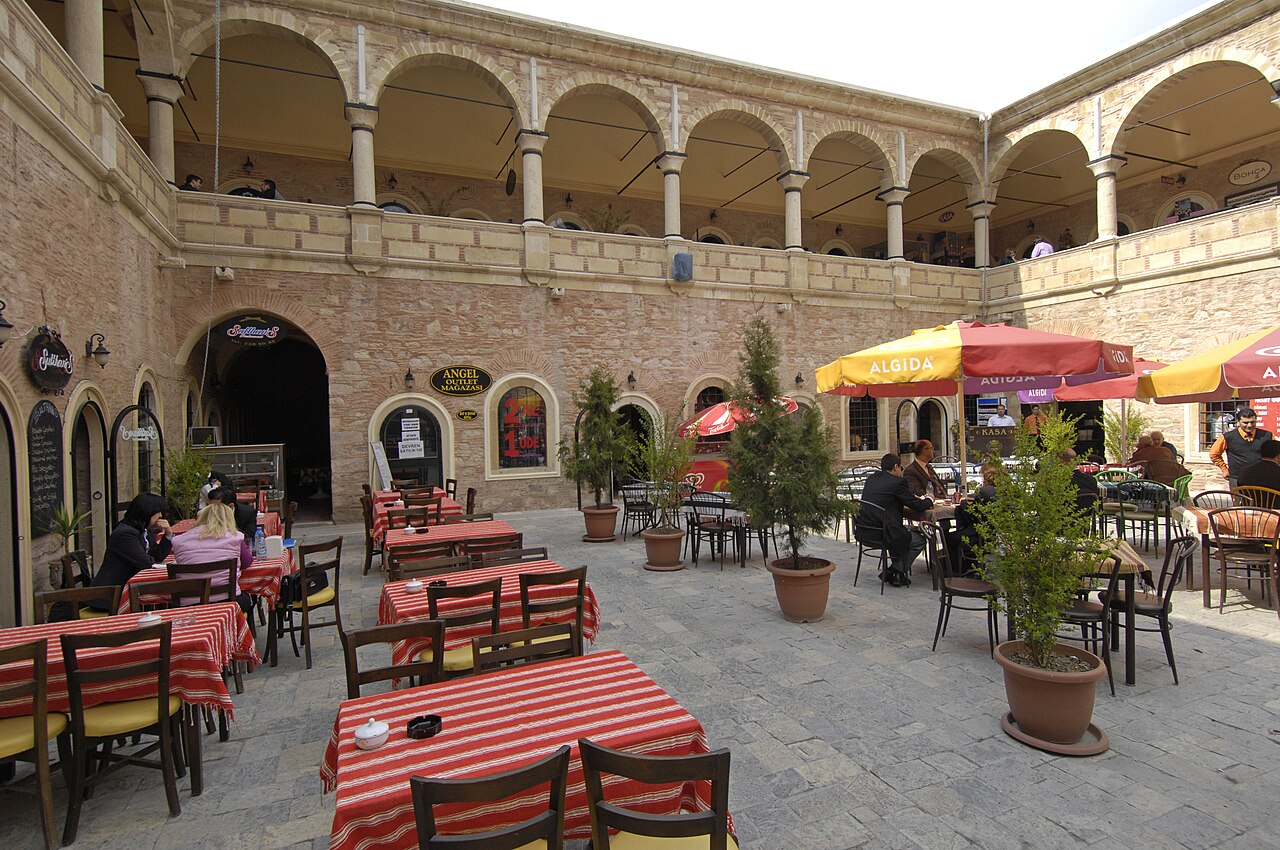
The building has a nearly square rectangular plan, two storeys and an open courtyard. Its arcaded circulation lets you read the han as an inward-looking structure, with rooms arranged around shared open space rather than around a single monumental façade. Today it is used as a municipal cultural centre for visual arts, music, traditional crafts and design. Course and workshop examples include Manisa cloth weaving, kitre doll making, modern painting, marbling, photography, wood painting, illumination and miniature. The courtyard is the key spatial feature to notice first, because it explains how the upper and lower rooms relate to the centre of the han.
Vérifié le 2026-09-02 · Source
.jpg)
Combien de temps passer
Allow around 30 to 45 minutes for a focused visit through the open courtyard and the lower-level circulation, with time to appreciate the two-storey arrangement and the han’s relationship to Hatuniye Mosque. If a course or workshop is taking place and visitors may observe without disturbing it, an hour can be worthwhile. Treat the centre as a working cultural venue, so the amount of interior space you can see may depend on activities in progress. Visitors interested mainly in architecture can keep the stop compact; visitors following Manisa’s craft traditions should leave room to absorb the programme and courtyard atmosphere.
Vérifié le 2026-09-02 · Source
.jpg)
Saison et foule
The Şehzadeler Municipality Culture Portal lists the centre’s hours as 09:00–18:00 and does not identify a regular closing day. Those hours fit a daytime heritage walk, when the courtyard, arcades and position beside Hatuniye Mosque are easiest to understand. A morning stop should feel more suitable for quietly reading the architecture; a visit during a scheduled course or workshop may show how the historic rooms are used today. Room access remains dependent on the programme. A weekday visit may be especially useful for seeing the centre in its municipal cultural role, while the listed hours also support a broader daytime walk through historic Manisa.
Vérifié le 2026-09-02 · Source
Billets
The municipality’s course information concerns organised courses rather than a universal visitor tariff, so it should not be converted into an admission claim. The practical conclusion is simply that no operator-sourced admission amount is recorded here. The cultural centre’s activity listings may describe participation arrangements for particular courses or workshops, but those details are distinct from entrance admission. This guide therefore records no price and makes no claim that ordinary entry is free.
Vérifié le 2026-09-02 · Source

.jpg)
Y arriver
Kurşunlu Hanı is at Ege Mahallesi, Borsa Caddesi 2/E, in Şehzadeler, Manisa. The official cultural inventory places it on the south side of Hatuniye Mosque, making the mosque a useful final orientation point after walking from central Manisa or continuing on foot from a public-transport stop. In the Hatuniye area, look for the historic han and its courtyard setting; the mosque’s position helps distinguish this destination from similarly named historic buildings elsewhere. The address is the clearest arrival reference, while Hatuniye Mosque provides the practical landmark for the final approach.
Vérifié le 2026-09-02 · Source
.jpg)
À quoi faut-il faire attention
The upper floor is reached by a stone staircase inside the arcade north of the entrance. The available building description identifies no step-free route to that level, so visitors who need step-free movement should expect access to be limited. The courtyard and lower-level areas are the more straightforward parts of the visit. Because the han is also used for courses and workshops, move carefully around historic surfaces and leave active rooms clear for participants and instructors. The two-storey layout is therefore important to plan around: seeing the courtyard does not guarantee access to every upper room.
Vérifié le 2026-09-02 · Source

.jpg)
Photographie
The open courtyard is the strongest photographic viewpoint for Kurşunlu Hanı’s two-storey composition and arcaded circulation. Frame the stone staircase and upper-level details where access permits, and use a wider view to show the han on the south side of Hatuniye Mosque, clarifying its place within the külliye. The building is an active cultural centre, so avoid close photographs of course participants, instructors or artworks without permission. Courtyard views can capture both Ottoman spatial design and present-day creative use. The contrast between the historic inward-facing plan and rooms used for contemporary craft activity gives photographs a specific Manisa context.
Vérifié le 2026-09-02 · Source
Questions courantes
When was Kurşunlu Hanı built?
Kurşunlu Hanı was commissioned by Hüsnüşah Sultan and built in 1488, corresponding to Hijri 894.
Who commissioned Kurşunlu Hanı?
The building was commissioned by Hüsnüşah Sultan, the wife of Sultan Bayezid II.
Which complex is Kurşunlu Hanı part of?
Kurşunlu Hanı was built as part of the Hatuniye Külliyesi together with Hatuniye Mosque.
What is Kurşunlu Hanı’s architectural layout?
It is a two-storey, open-courtyard building with a nearly square rectangular plan.
How is Kurşunlu Hanı used today?
It operates as a cultural centre hosting courses, workshops and cultural events in visual arts, music, traditional crafts and design.
Which courses and workshops are offered at Kurşunlu Hanı?
Examples include Manisa cloth weaving, kitre doll making, modern painting, marbling, photography, wood painting, illumination and miniature.
Où c'est
Chargement de la carte interactive…
La carte interactive n'a pas pu être chargée.
À proximité
Insérez-le dans un plan
Liens externes
Non enregistré Aucune source vérifiée ne l'a encore enregistré.Dernière mise à jour:
Source: Contributeurs OpenStreetMap ·