


3 min walk · London Borough of Southwark
Bridge Theatre
- Historic monument
Language · 1 published
Historic monument · London Borough of Tower Hamlets, London
| Monday | 09:30 – 18:00 |
|---|---|
| Tuesday | 09:30 – 18:00 |
| Wednesday | 09:30 – 18:00 |
| Thursday | 09:30 – 18:00 |
| Friday | 09:30 – 18:00 |
| Saturday | 09:30 – 18:00 |
| Sunday | 09:30 – 18:00 |
Checked 2026-08-26 · Source
Read from the OpenStreetMap access tags; anything not listed has no tag recorded.
Set the group type to family in the planner and the day window contracts to about three quarters of a solo day.
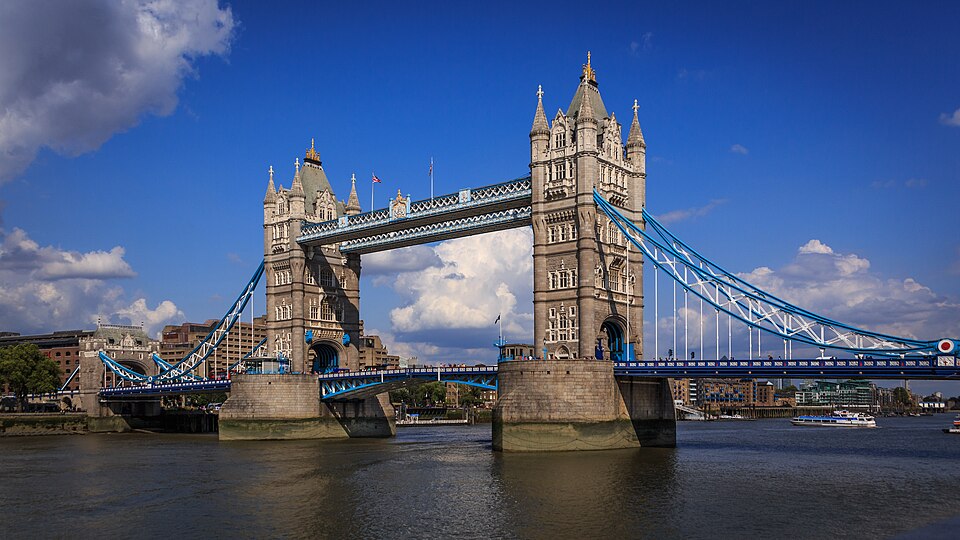
Tower Bridge is a working road crossing over the Thames beside the Tower of London and, separately, a paid attraction inside its own towers and engine rooms. It was built between 1886 and 1894 to a design by the City architect Horace Jones, engineered by John Wolfe Barry with Henry Marc Brunel, and it is a combined bascule and suspension bridge — the two raising leaves in the middle, the suspended spans either side, and until 1960 a cantilever element as well. It is Grade I listed and is one of five Thames crossings owned and maintained by the City Bridge Foundation, a charitable trust that dates back to 1282. Two things separate it from the rest of London's river views. It still lifts, around 800 times a year, on a schedule the operator publishes in advance. And the High-Level Walkways that link the tops of the two towers, closed to the public in 1910 and reopened in 1982, are open to ticket holders with glass floor panels set into them. The bridge itself is a public road and footway and costs nothing to cross; the inside is the ticketed part.
Checked 2026-08-26 · Source
A ticket covers three connected spaces. The visit begins in the North Tower, where a staircase climbs past displays on the architects, engineers, divers and riveters who built the bridge, with film from Victorian London. At the top are the High-Level Walkways, 70 metres from tower to tower and 43.5 metres above the Thames at high tide, holding the suspension cables and some of the 13 million rivets that hold the structure together. Two Glass Floors were installed here in 2014, one in the West Walkway on 1 November and one in the East Walkway on 1 December; each is 11.5 metres long and 1.8 metres wide, built from six panels of about 530 kilograms in five layers 70 millimetres thick, and the operator's figure is that each panel would carry an elephant or two black cabs. The top layer is sacrificial and is replaced roughly every eighteen months. The South Tower descends through the bridge's life after 1894 — incidents, works, staff uniforms and the original tower designs. Outside, the Blue Line leads to the Engine Rooms, with 80 bronze plaques set into the pavement alternating names and ornamental designs; 40 people are commemorated by name, among them Hannah Griggs, a cook employed from 1911 to 1915, and John Chalk, a rivet boy of fourteen.
Checked 2026-08-26 · Source

Allow an hour and a quarter, the duration recorded on this page, and treat it as ticket-check to gift shop rather than tower to tower. The towers and walkways themselves take about 45 minutes at a normal pace with a pause on each glass floor; the Engine Rooms take another 20 to 30, and they are a separate building reached on foot along the Blue Line, so the walk between them is part of the visit and is outdoors. Add time at the front: all bags are searched, the queue is on the bridge itself, and a pre-booked ticket does not fast-track anyone. Add more if a Bridge Lift falls during the visit, since the operator warns that a lift can delay entry. The 90-minute guided tours and the seasonal behind-the-scenes tours of the bascule chambers are longer commitments and are booked separately. Anyone planning to walk up rather than take the lifts should allow for the stairs in both towers.
Checked 2026-08-26

Tower Bridge opens daily from 09:30 to 18:00 with last entry at 17:00. It closes on 24, 25 and 26 December every year and opens late, at 10:00, on 1 January. The visit is worth timing around a Bridge Lift: the operator publishes every scheduled lift by date, time, vessel and direction on its Bridge Lifts page, and watching the bascules rise from the walkway above or the riverbank below is the one thing here that no photograph prepares you for. Lifts are free to watch from the street. Relaxed Opening runs on the second Saturday of each month between 09:30 and 11:30, with last entry at 11:10 — a low-capacity, reduced-soundscape session designed with neurodivergent visitors in mind. Early on a weekday is otherwise the quietest slot; the bridge took 913,247 visits in 2025 on the Association of Leading Visitor Attractions' table, five per cent down on the year before, and most of them arrive between late morning and mid-afternoon. The queue is outdoors, so check the forecast before choosing a time.
Checked 2026-08-26 · Source
Standard admission is £18.00 for an adult aged 18 or over, which is the price recorded on this page. Concessions are £13.50 and cover seniors aged 60 and over with valid identification, students aged 18 and over with valid identification, young people aged 16 to 17, and disabled adults; a child aged 5 to 15 is £9.00, a disabled child £6.80, and under-fives and companions of disabled visitors are free. Residents of Southwark, Tower Hamlets or the City of London pay £1.00 on a Local Ticket with photo identification. Under the government's Great British Summer Savings initiative the operator reduced those prices from 25 June until 1 September 2026 to £15.80 for an adult, £11.80 concession, £7.90 for a child, £6.00 for a disabled child, £0.90 for a Local Ticket and family tickets from £28.40, applied at the point of sale rather than to tickets bought earlier. Tickets can be booked up to eight weeks ahead and are also sold at the door. The National Rail Days Out Guide two-for-one offer applies to general entry only, against a full-price adult ticket, and requires a valid train ticket per person on the day. Groups of fifteen or more get a discount by arrangement with the bookings team.
Checked 2026-08-26 · Source

The ticket office and entrance are on the west side of the North Tower, at the northwest corner of the bridge. Tower Hill station, on the District and Circle lines, is a seven-minute walk with step-free access from platform to street and 500 metres to the ticket office; London Bridge, on the Northern and Jubilee lines, is step-free from train to street and one kilometre from the Engine Rooms entrance. Tower Gateway on the DLR and the National Rail stations at London Bridge and Fenchurch Street are all within walking distance. Buses 15, 42, 78, 100 and 343 serve the bridge, with step-free access from the Tower Bridge City Hall stop, 280 metres from the ticket office. Riverboats call at Tower Pier on the north bank and London Bridge City Pier on the south. Driving is a poor idea: Tower Bridge Road is a Red Route with no stopping at any time, and the nearest options are the Tower Hill coach and car park at 50 Lower Thames Street and the Minories car park on Mansell Street, both with Blue Badge bays.
Checked 2026-08-26 · Source

Security is thorough and slow: Tower Bridge operates a 100 per cent search policy, so every bag, pram, pushchair and wheelchair is searched. Shoulder bags and backpacks up to 45 by 35 by 20 centimetres are allowed; suitcases, wheeled bags and oversize items are not, and there is no left luggage. Glass items, bottles included, are not permitted near the Glass Floors. The queue is outside on the bridge and the Blue Line walk to the Engine Rooms is outdoors, so weather is a real variable. Pre-booking secures an entry time but grants no fast track, and a scheduled Bridge Lift may delay admission. Lifts are available in both towers and in the Engine Rooms, but the operator is direct that a Victorian bridge places limits on accessibility. Wear shoes you can climb stairs in. The glass floor panels are 33.5 metres above a live road, and visitors who are uneasy about heights should know that the Walkways can be crossed without stepping onto them.
Checked 2026-08-26 · Source

Handheld cameras, including phones, are permitted inside for personal use, with flash and with audio and film recording equipment that does not need a stand; tripods are prohibited inside the attraction. Images may be used only privately and non-commercially, which the operator's conditions extend to personal social media, blogs and websites. News, public relations, commercial or promotional shoots need permission through the City of London film team, and the operator asks that other visitors' privacy is respected — an intrusive photographer can be asked to stop or to leave. Practically, the Walkways have small camera windows cut for the purpose, because the lattice ironwork otherwise crosses every wide view. The mirrored ceiling above the Glass Floors is the operator's own suggested shot. The best view of the bridge is not from it: Butler's Wharf, Potters Fields Park and the riverside walk east of the Tower give the classic elevation, and a lift raising the bascules against a low winter sun is the frame worth planning a day around.
Checked 2026-08-26 · Source
Standard admission is £18.00 for an adult aged 18 or over, £13.50 concession, £9.00 for a child aged 5 to 15, £6.80 for a disabled child, and free for under-fives and for a companion of a disabled visitor. Under the Great British Summer Savings initiative those prices were cut from 25 June to 1 September 2026 to £15.80, £11.80, £7.90 and £6.00.
Yes. The road and footway across Tower Bridge are a public crossing and cost nothing, and Bridge Lifts can be watched from the street or the riverbank for free. The ticket buys the towers, the High-Level Walkways with their Glass Floors, and the Victorian Engine Rooms.
The bridge lifts around 800 times a year and the operator publishes each scheduled lift by date, time, vessel and direction on its Bridge Lifts page. Additional lifts may be scheduled at short notice during planned maintenance.
Tower Bridge is open daily from 09:30 to 18:00 with last entry at 17:00. It is closed on 24, 25 and 26 December every year and opens at 10:00 on 1 January.
No. Shoulder bags and backpacks up to 45 by 35 by 20 centimetres are permitted, but suitcases, wheeled bags and oversize items are not, and every bag is searched under a 100 per cent search policy. Glass bottles are not allowed near the Glass Floors.
Allow about an hour and a quarter. The towers and Walkways take roughly 45 minutes, the Engine Rooms another 20 to 30, and the two are linked by an outdoor walk along the Blue Line. A guided tour runs 90 minutes and is booked separately.
Loading the interactive map…
The interactive map could not be loaded.
Last updated:
Source: OpenStreetMap contributors, Wikidata ·