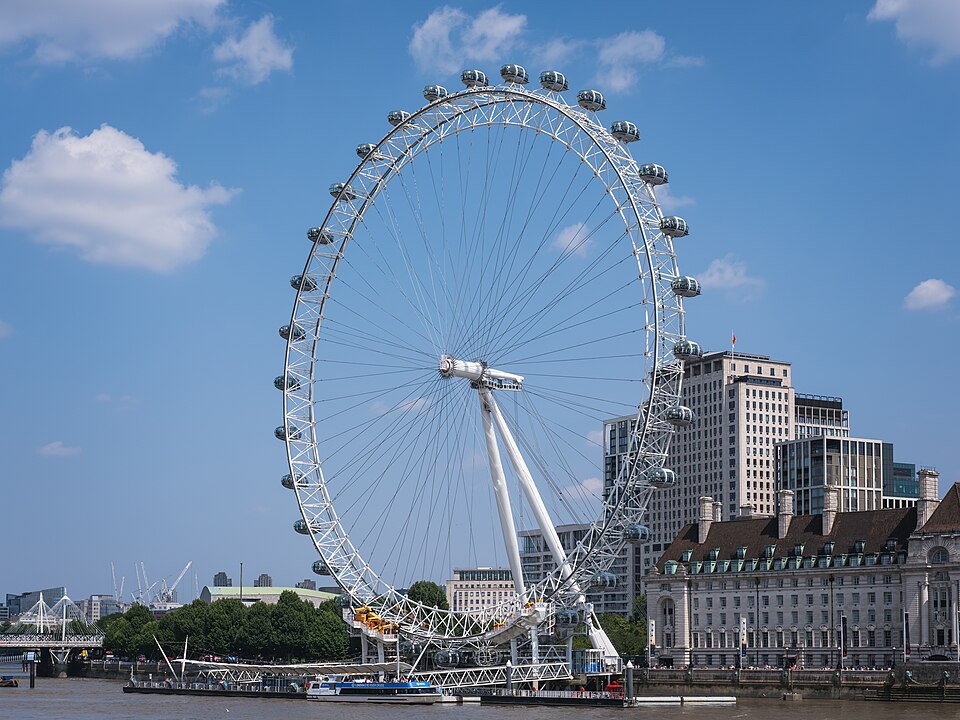
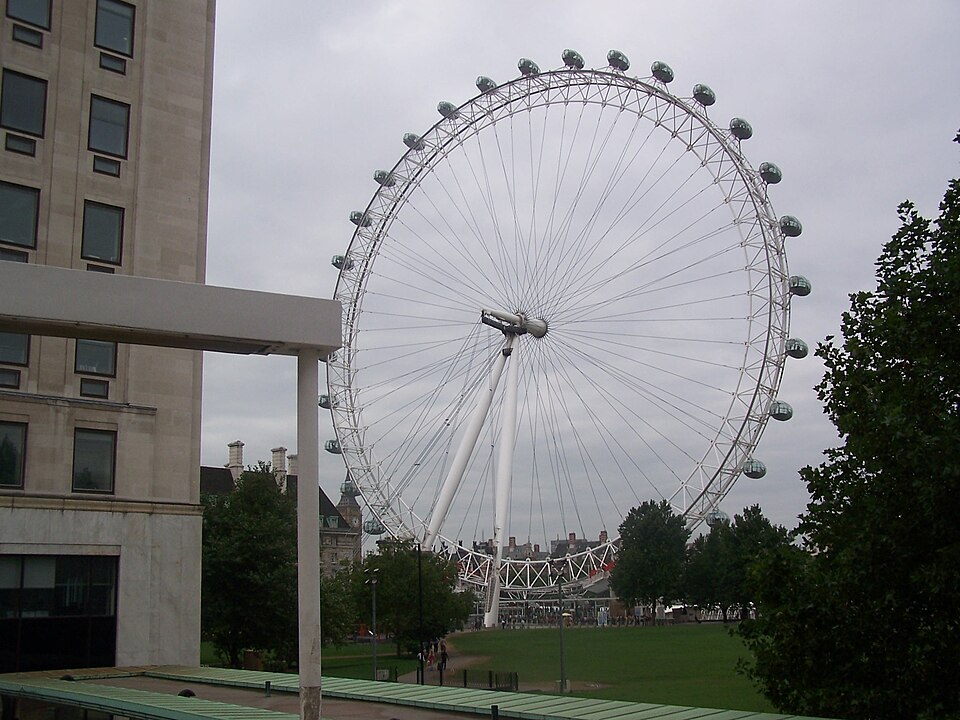
The London Eye is a 135-metre observation wheel on the South Bank of the Thames in Lambeth, carrying 32 sealed passenger capsules through one slow revolution that takes about 30 minutes. It was designed by the architects David Marks and Julia Barfield of Marks Barfield with Arup as structural engineer, and its wheel measures 120 metres across. The ceremonial opening was on 31 December 1999, the first passengers rode on 1 February 2000, and the wheel opened to the public on 9 March 2000. It was built under a five-year lease and meant to be temporary; permanent planning status was granted in 2002. The capsules are numbered 1 to 33 with no 13, each weighs 10 tonnes and each holds 25 people, which gives the wheel a theoretical capacity of 1,600 passengers an hour. The London Eye is the reason the South Bank skyline looks the way it does, and it has carried more than 85 million passengers since opening. It has changed sponsor name repeatedly — British Airways, Merlin, EDF Energy, Coca-Cola, and lastminute.com since 2020.
A visit to the London Eye is one rotation in one capsule, and the capsule is the whole of it. Each capsule is a sealed glass ellipse mounted on the outside of the wheel rim rather than hanging from it, which is why it stays level and why the view is unobstructed in every direction including downwards. There are 25 people to a capsule and a bench in the middle; nobody is assigned a seat and everybody circulates. The wheel turns at 26 centimetres per second, roughly 0.9 kilometres per hour, slow enough that passengers board and alight while it is still moving and never stops for them. What is inside is therefore the view: the Houses of Parliament and the Elizabeth Tower directly across the water, Whitehall and the government quarter behind them, the river bending east past Hungerford Bridge towards St Paul's and the City towers, and Westminster Bridge below. The operator also sells premium rotations with champagne, an afternoon tea served across two rotations with lounge access, and private capsules; those are the same wheel with catering added, not a different attraction.
Allow one hour for the London Eye. The rotation itself is about 30 minutes, a figure the operator prints on its own ticket pages, and the other 30 minutes go to the parts nobody photographs: the timeslot queue on Jubilee Gardens, the airport-style security search, and the walk through the ticket hall and the exit shop. That hour is the realistic figure for a pre-booked standard ticket arriving inside its slot. Visitors who buy at the ticket window on a summer afternoon should expect longer, because the walk-up queue and the boarding queue are separate and both are outdoors. The champagne and afternoon-tea experiences run longer by design — the afternoon tea is sold as two rotations, so budget closer to two hours for that. Nothing about the London Eye rewards lingering once the capsule doors open again; it is a fixed-length attraction and the hour is the whole of it.
Go at the end of the day. The London Eye publishes a closing time that moves with the season — its own site states that closing times vary through the year between 6.00pm and 8.30pm — so the last rotations in high summer finish in low evening light, and in winter the same late slot puts the city under lights instead. Both are better than flat midday sun, which washes the river out and puts reflections on the capsule glass. The first slot of the day is the other good answer, because the queues on Jubilee Gardens have not yet built. Weekends, English school holidays and the fortnight either side of Christmas are the heaviest periods; a weekday morning outside them is the quietest the wheel gets. The wheel does not run in high wind and can be stopped at short notice, so a booked slot is a booking for a slot rather than a guarantee of a ride, and the operator's own booking guarantee is the thing to read before travelling a long way for it.
The London Eye is ticketed and it is not cheap. On the operator's own tickets and prices page, read on 26 August 2026, a standard adult ticket is listed from £29 online against £39 as a walk-up, and a child ticket for ages 2 to 15 is listed from £26 online against £35 as a walk-up. Children under 2 go free. The same page lists a Flexi Fast Track adult ticket from £42.88, combined tickets with the river cruise, Madame Tussauds and SEA LIFE from £49, a five-attraction bundle from £59, the champagne experience from £49 per person online, afternoon tea from £85 per person, and a private pod from £850 for 2 to 25 guests. Every one of those figures is printed as a "from" price, which means it is the cheapest slot on the cheapest date and not what a given Saturday will cost. The operator also flagged that displayed prices carried a temporary VAT reduction valid until 1 September 2026, so prices read after that date may differ. Buy online and buy a timeslot; the walk-up premium is roughly £10 a head.
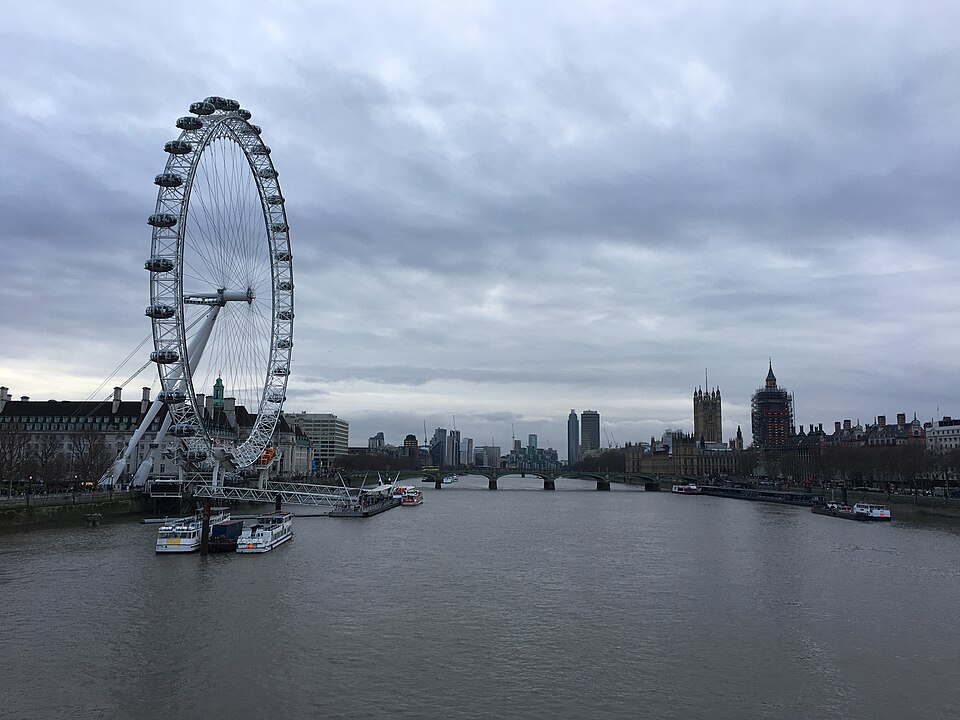
The London Eye stands at the western end of Jubilee Gardens beside County Hall, on the Lambeth bank between Westminster Bridge and Hungerford Bridge. The nearest Underground station is Waterloo, and Charing Cross, Embankment and Westminster are all within an easy walk — Westminster is the one to use if the approach across Westminster Bridge with the wheel ahead is wanted, which is the best arrival of the four. National Rail services connect at London Waterloo and London Waterloo East. From the north bank, the Golden Jubilee footbridges alongside Hungerford Bridge drop walkers directly onto the South Bank a few minutes upstream of the wheel. There is no useful reason to drive: this is central Westminster and Lambeth riverside, inside the Congestion Charge zone, with no visitor parking at the site itself. Arriving on foot along the South Bank from Southwark is the pleasant approach and takes about 20 minutes from Tate Modern.
Three traps. First, the "from" prices: the operator's tickets page quotes every fare as a starting price, so a peak Saturday slot can cost considerably more than the £29 adult figure that page prints, and the difference is only visible once a date is selected in the booking flow. Second, the timeslot: a standard ticket is for a specific arrival window and arriving outside it is the commonest cause of a wasted booking. Third, the closing time is not fixed — the operator's own site states that it moves between 6.00pm and 8.30pm across the year, so a late slot booked from memory of a previous visit may not exist on the chosen date. Beyond those: the security search is airport-style, so travel light; capsules hold 25 strangers and there is no private space in a standard ticket; the wheel is a fixed 30 minutes with no way to leave early; and the pavement between the Eye and Westminster Bridge is one of the most persistently worked stretches in London for street gambling and unlicensed ticket touts. Buy from the operator, not from the pavement.
The capsule glass is the problem and it is solvable. Curved glass throws reflections of everything bright inside the capsule, so press the lens close to the pane, shoot with the sun behind the wheel rather than in front of it, and wear dark clothing if the shot matters, because a pale coat becomes a ghost across the Thames. The best window is the arc between about the ten o'clock and twelve o'clock positions on the way up, when the wheel is high enough to clear the Whitehall roofline but the capsule is not yet at the top and the view down the river towards the City is still angled rather than flat. The photograph of the London Eye is a different job from the photograph from it: for the wheel itself, the Victoria Embankment on the north bank at dusk gives it whole with its lighting on and the river in front, and Westminster Bridge gives it with the Elizabeth Tower in the same frame. Both are free and neither needs a ticket.
Checked 2026-08-26
Common questions
How long does the London Eye take?
One rotation of the London Eye takes about 30 minutes. Allowing for the timeslot queue, the security search and the exit, a standard visit occupies about an hour in total.
How much does a London Eye ticket cost?
The operator's tickets and prices page, read on 26 August 2026, lists a standard adult ticket from £29 online against £39 as a walk-up, and a child ticket for ages 2 to 15 from £26 online against £35 walk-up. Children under 2 are free. All figures are 'from' prices and rise on peak dates.
Do you need to book the London Eye in advance?
Booking in advance is strongly advised. The operator charges roughly £10 more per person at the ticket window than online, and standard tickets are sold for a specific arrival timeslot, so the walk-up option costs more and offers less control over when the visit happens.
What time does the London Eye close?
The closing time changes through the year. The operator's own site states that closing times vary between 6.00pm and 8.30pm depending on the season and the day, so the closing time must be checked for the specific date rather than assumed.
How tall is the London Eye and how many capsules does it have?
The London Eye is 135 metres tall with a wheel 120 metres in diameter. It carries 32 passenger capsules, numbered 1 to 33 with no number 13, each weighing 10 tonnes and holding 25 people.
Is the London Eye worth it if the weather is poor?
On a low-cloud day the upper half of the rotation delivers very little, and the ticket is not refundable for weather that merely spoils the view. In high wind the wheel does not run at all, which is a different matter and covered by the operator's booking terms.
Nothing non-essential is set before you choose, in regions where consent is required. If you decline, ads still appear but they are non-personalised, and analytics is switched off entirely.

.jpg)
.jpg)
.jpg)
