


.jpg)
_-_WGA15979.jpg)

5 min walk · London Borough of Camden
Argyle Square
- Nature site
Language · 1 published
Historic monument · London Borough of Camden, London
| Monday | 09:30 – 20:00 |
|---|---|
| Tuesday | 09:30 – 20:00 |
| Wednesday | 09:30 – 20:00 |
| Thursday | 09:30 – 20:00 |
| Friday | 09:30 – 18:00 |
| Saturday | 09:30 – 17:00 |
| Sunday | 11:00 – 17:00 |
Checked 2026-08-26 · Source
Read from the OpenStreetMap access tags; anything not listed has no tag recorded.
Set the group type to family in the planner and the day window contracts to about three quarters of a solo day.
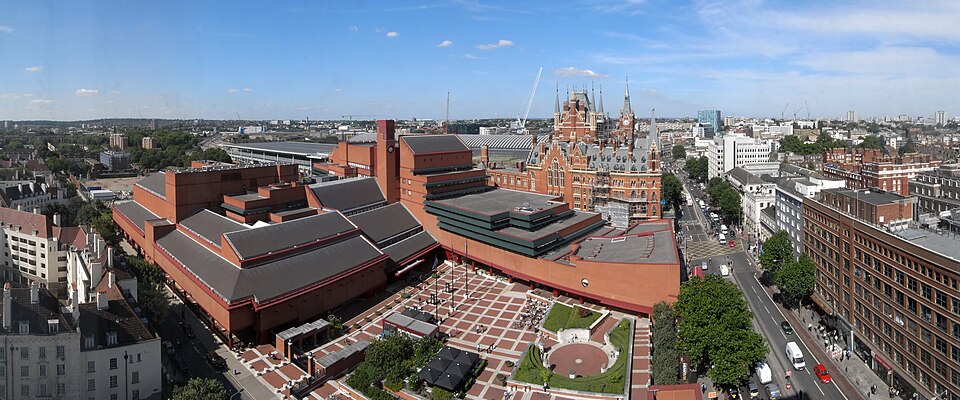
The British Library is the national library of the United Kingdom and, by collection size, one of the largest libraries in the world: more than 200 million items, including roughly 13.95 million books, 351,116 manuscripts, 8.27 million philatelic items and 6 million sound recordings. It was established on 1 July 1973 under the British Library Act 1972, which separated the national library from the British Museum, and it moved into its own building at 96 Euston Road in Camden — designed by Colin St John Wilson and Mary Jane Long, and opened by Elizabeth II on 25 June 1998. The building was granted Grade I listed status on 1 August 2015 for its architecture and history. For a visitor who is not a researcher, the British Library is a free public building with a permanent treasures gallery, a piazza of public sculpture, a great glass tower of royal books at its centre, and some of the best free reading and working space in central London. It is not a museum and it does not behave like one, which is much of its appeal.
Checked 2026-08-26 · Source
The centre of the building is the King's Library Tower, a six-storey glass tower holding the 65,000 printed volumes George III collected between 1763 and 1820, together with manuscripts, pamphlets and maps of the same period, standing in the middle of the entrance hall where everyone walks past it. The permanent draw is the Sir John Ritblat Gallery, the treasures gallery, which displays Beowulf, the Lindisfarne Gospels, the St Cuthbert Gospel, a Gutenberg Bible, manuscripts of Magna Carta, and works by Chaucer, Austen, Brontë, Carroll, Dickens and Woolf in a single darkened room. On the piazza facing Euston Road stands Eduardo Paolozzi's bronze Newton of 1995, made after William Blake's study of the same subject, along with work by Antony Gormley. There are eleven reading rooms at the St Pancras site, which need a free Reader Pass, and temporary exhibition galleries which are ticketed separately. The rest of what the building offers a casual visitor is space: free study desks, free wi-fi, cafés, a shop, and a free cloakroom and digital lockers on the lower ground floor.
Checked 2026-08-26 · Source
Allow 90 minutes for the British Library as a visitor rather than a reader. That covers the treasures gallery properly — an hour is not too much for a room containing Magna Carta and the Lindisfarne Gospels, and rushing it is the commonest mistake — plus the entrance hall and the King's Library Tower, the Paolozzi Newton on the piazza, and a coffee. Add an hour if a ticketed temporary exhibition is on and worth seeing. A visitor who intends to work rather than look should plan differently and much longer: the building holds free study space and free wi-fi and closes at 8pm on Monday to Thursday, which makes it one of the few places in central London where a whole working day is possible without buying anything. Anyone wanting the reading rooms themselves needs a free Reader Pass, and registration is a separate process with its own shorter hours, so that is not a same-hour decision.
Checked 2026-08-26
The British Library building opens at 09.30 Monday to Saturday and 11.00 on Sunday, and the useful difference between days is the closing time: 20.00 Monday to Thursday, 18.00 on Friday, 17.00 on Saturday and 17.00 on Sunday. A Monday-to-Thursday evening is therefore the distinctive slot — the treasures gallery is open until 8pm on those days, long after most London museums have shut, and it is markedly quieter after about six. Sunday is the shortest day, opening two and a half hours later than the rest of the week. Reading room hours differ again from the building's: Monday 10.00 to 20.00, Tuesday to Thursday 09.30 to 20.00, Friday and Saturday 09.30 to 17.00, and closed on Sunday. One live caveat: the Library states on its own visiting pages that it is still recovering from a cyber-attack, and advises checking the website for current service availability, so a visit that depends on a specific service should be confirmed on the day.
Checked 2026-08-26 · Source
Entry to the British Library is free. The Library's own visiting pages state that the library building opening hours cover the public spaces, the Members' Room, the permanent Treasures Gallery — described in the same sentence as free of charge to visit — and the Entrance Hall display space. The free Reader Pass, which is required for the eleven reading rooms rather than for the galleries, is also free, and is issued through a registration desk with its own hours: 09.30 to 17.45 Monday to Thursday, 09.30 to 16.15 on Friday, 09.30 to 16.45 on Saturday, and closed on Sunday. The cloakroom and digital lockers on the lower ground floor are free to use as well. What is not free is the temporary exhibition programme, which is ticketed separately; no price for a current temporary exhibition was read from the Library's own site for this entry, because the exhibitions listing has moved to a separate events site, so any exhibition price must be checked at bl.uk before visiting.
Checked 2026-08-26 · Source

The British Library is at 96 Euston Road, London NW1 2DB, standing directly alongside St Pancras railway station on the north side of Euston Road in Camden. That location is the single most convenient thing about it: St Pancras International, King's Cross and Euston are all within a few minutes on foot, which means the Library is reachable from the Eurostar platforms without using the Underground at all, and is a genuinely practical way to spend a couple of hours between trains. There is a second entrance on Ossulston Street at the upper level of the piazza, which is the one to use for the bicycle spaces behind the Paolozzi Newton sculpture and for the Blue Badge parking the Library provides on that street. Arriving from the front, across the piazza from Euston Road, is the better approach, because the piazza with Newton on it is part of the building and is missed entirely by anyone entering from the side.
Checked 2026-08-26 · Source

The most important practical point is the bag rule, because it catches people at the door: visitors to the reading rooms must leave coats and bags in the cloakroom or a locker, and visitors to the exhibition galleries must also leave backpacks in the cloakroom. The cloakroom and digital lockers are free and are on the lower ground floor, but the queue for them is a real part of the visit at busy times. Second, the reading rooms are not open to walk-ins: they require a free Reader Pass, registration has shorter hours than the building and closes entirely on Sunday, so a researcher arriving on Sunday afternoon cannot get one. Third, the Library states on its own pages that it is recovering from a cyber-attack and advises checking the website for current service availability — the catalogue and ordering systems were the parts affected, so this matters far more to readers than to gallery visitors. Fourth, closing times vary by day, and Friday closes two hours earlier than Thursday.
Checked 2026-08-26 · Source
The building rewards the camera more than most people expect, and the two subjects are the tower and the brick. The King's Library Tower is the shot: six storeys of leather spines behind glass in the middle of the entrance hall, best photographed from the upper galleries looking down its length rather than from the floor looking up, and best in the middle of the day when the roof light is doing the work. The exterior is red brick that goes orange in late afternoon sun and dull in overcast, so the piazza and Paolozzi's Newton of 1995 want a clear evening, with the bronze shot low and close so that the figure reads against the sky rather than against the brick behind it. The treasures gallery is a different matter entirely: it is deliberately dark to protect manuscripts, and photography rules there are set by the gallery rather than by the building. Check the signage at the gallery entrance rather than assuming, and never use flash near a medieval manuscript.
Checked 2026-08-26
Yes. The Library's own visiting pages state that the permanent Treasures Gallery is free of charge to visit, along with the public spaces and the Entrance Hall display space. Temporary exhibitions are ticketed separately.
The St Pancras library building opens 09.30 to 20.00 Monday to Thursday, 09.30 to 18.00 on Friday, 09.30 to 17.00 on Saturday, and 11.00 to 17.00 on Sunday. The reading rooms keep different hours and are closed on Sunday.
The Sir John Ritblat Gallery displays Beowulf, the Lindisfarne Gospels, the St Cuthbert Gospel, a Gutenberg Bible and manuscripts of Magna Carta, alongside works by Chaucer, Austen, Brontë, Carroll, Dickens and Woolf.
No, not to enter the building or the Treasures Gallery. A Reader Pass is required only for the eleven reading rooms. It is free, but it is issued at a registration desk with shorter hours than the building — 09.30 to 17.45 Monday to Thursday, 09.30 to 16.15 Friday, 09.30 to 16.45 Saturday, and closed on Sunday.
Not everywhere. Visitors to the reading rooms must leave coats and bags in the cloakroom or a locker, and visitors to the exhibition galleries must also leave backpacks in the cloakroom. The cloakroom and digital lockers are free and are on the lower ground floor.
ALVA's published table recorded 1,398,646 visits to the British Library in 2025, a rise of 3 per cent on the previous year, placing it 22nd among UK attractions. That is a fraction of the traffic at the British Museum, which recorded 6,440,120 visits in the same table.
Loading the interactive map…
The interactive map could not be loaded.
Last updated:
Source: OpenStreetMap contributors, Wikidata ·