
01
1 hr 30 min
Hagia Sophia
Hagia Sophia is the building that changed what a roof could do.
- Must see
- Historic monument
- Fatih
Language · 1 published
City guide · Türkiye
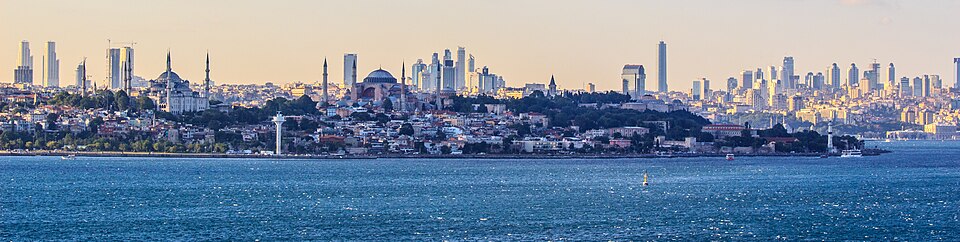
Two continents, three empires and one strait that everything else is arranged around. The old capital rewards a plan: the great monuments sit within a twenty-minute walk of each other in Fatih, and almost everything else is a ferry ride away.
Ranked by importance — sitelinks, pageviews and heritage status, not editor preference.
25 places match
Category
Typical visit duration
Hagia Sophia is the building that changed what a roof could do.
This is the main building of the Istanbul Archaeological Museums, the oldest purpose-built museum in Turkey and the one the whole complex is named after.
The Grand Bazaar is a covered city of shops that Mehmed II began building in the winter of 1455/56, within three years of taking Constantinople.
Yıldız is the palace a frightened sultan built uphill.
Rumeli Hisarı is a fortress built to close a strait, and everything about it follows from that one job.
Beylerbeyi Palace is the Ottoman court's summer address on the Asian shore of the Bosphorus, built for Sultan Abdulaziz between 1861 and 1865 by the architect Sarkis Balyan, with Hagop Balyan named alongside him.
Yedikule is a fortress built out of an older monument.
A novel and a building made in parallel, and neither is quite the illustration of the other.
The Turkish and Islamic Arts Museum is housed in the Ibrahim Pasha Palace, a stone mansion of 1524 that belonged to Pargalı Ibrahim Pasha, the second grand vizier of Suleiman the Magnificent.
Istanbul Modern opened on 11 December 2004 as Turkey's first museum of modern and contemporary art, installed in Entrepo No. 4, a customs warehouse from the 1950s standing on the Karaköy quay.
Pera Museum is a private art museum on the Beyoğlu ridge, established on 8 June 2005 by the Suna and İnan Kıraç Foundation.
Miniatürk opened on 2 May 2003 on the northeastern shore of the Golden Horn, and the idea behind it is straightforward: shrink the architecture of Turkey and the former Ottoman world to one twenty-fifth of full size and lay it…
Çamlıca Tower stands on Büyük Çamlıca Hill on the Asian side, the highest point overlooking the Bosphorus, and opened on 29 May 2021.
The Istanbul Naval Museum was founded in 1897 by Bozcaadali Hasan Husnu Pasha, then Ottoman Minister of the Navy, which makes it the first military museum established in Turkey.
This is a museum that used to be somebody's house, and the house has an unusually crowded guest list. From 1848 to 1884 the Emirgan mansion passed through a succession of high-ranking pasha families and Egyptian khedives.
The Haseki Hürrem Sultan Hamam is a twin bathhouse commissioned by Hürrem Sultan, wife of Suleiman the Magnificent, and designed by the imperial architect Mimar Sinan, built starting in 1556 between the Hagia Sophia and the Blue Mosque.
The Istanbul Aviation Museum is operated by the Turkish Air Force Academy in Yeşilköy, on the grounds of Istanbul's former main airport, and covers the history of Turkish military and civil aviation from the Ottoman era onward.
The museum occupies the Has Ahırlar, the former imperial stables, a long low range on the edge of Gülhane Park below the Topkapı walls, and it opened on 25 May 2008 under the Ministry of Culture and Tourism.
Çemberlitaş Hamamı is not a monument you look at.
Turkey's first private museum stands on the Bosphorus shore at Büyükdere, inside a nineteenth-century wooden yalı.
Source: OpenStreetMap contributors, Wikidata ·
District boundaries come from OSM administrative relations, so a district page holds exactly the places inside it — plus, for the islands and the coast, the nearest district by proximity.
South of the Horn, in Fatih, the monumental core is walkable end to end: Hagia Sophia, the Blue Mosque, the Basilica Cistern and Topkapı sit inside one square kilometre.
North of the Horn, Beyoğlu climbs from Karaköy to Taksim and is where the city eats and drinks late. Across the Bosphorus, Kadıköy and Üsküdar are residential, cheaper and reached best by ferry rather than by bridge.
Checked 2026-08-23
One contactless card covers tram, metro, funicular, bus and ferry, and it is the only ticket most visitors need.
The T1 tram threads the monumental core; the M2 metro crosses the Horn to Taksim. Ferries are the fastest way between the European and Asian sides and cost the same as a tram ride. Traffic on the bridges is unpredictable enough that a taxi is rarely faster.
Checked 2026-08-23
Three days covers the monumental core in Fatih without rushing. Five lets you add Beyoğlu, a Bosphorus ferry and one of the Asian-side neighbourhoods.
Yes, outside prayer times. Shoulders and knees should be covered, shoes come off at the door, and women cover their hair; scarves are lent at the larger mosques.
The scheduled public ferry runs the same water as the tourist cruises for a fraction of the fare, and stops at neighbourhoods you can walk around before catching the next one back.
Fatih puts you inside walking distance of the monuments. Beyoğlu is livelier at night and still two tram stops away. The Asian side is cheaper and quieter but adds a ferry to every sightseeing day.
April to June and September to October are warm without the July heat or the cruise-ship peak. January and February are cold and wet but the queues disappear.
Set your days, your pace and the hours you actually want to be out. The planner works around closing days and travel time, and leaves room to eat.