Monumento histórico · Innere Stadt, Viena
Burgtheater
Fotografía

Acceso e instalaciones
- Baños accesibles · Disponible
- Acceso sin pasos · Disponible
Leer desde las etiquetas de acceso de OpenStreetMap; todo lo que no aparece en la lista no tiene ninguna etiqueta registrada.
Establezca el tipo de grupo en familia en el planificador y la ventana del día se contraerá a aproximadamente tres cuartos de un día en solitario.
- hoy
- Horario no registrado
- Duración de la visita
- 1 hora
- Accesibilidad
- Sin escalones
- Precio
- No registrado
- Posición
- Imprescindible
- Rango
- Rango 29 de 5,640
Acerca de Burgtheater
The Burgtheater is Austria's national theatre and one of the most important German-language stages in the world.
Maria Theresa founded it in 1741 as the K.K. Theater nächst der Burg, next to the old Hofburg. The present building on the Ringstrasse opened in 1888, designed by Gottfried Semper and Karl von Hasenauer as part of the Ringstrasse redevelopment.
The two grand staircases carry ceiling frescoes painted in 1886-1888 by Gustav Klimt, his brother Ernst Klimt, and Franz Matsch, working together as the "Künstler-Compagnie." Gustav Klimt won the Kaiserpreis for this commission, three years before he broke from academic painting altogether.
Allied bombing gutted the auditorium in March 1945; only the staircases and the façade survived largely intact. The theatre reopened in 1955, one of the events that marked Austria's postwar cultural recovery.
Comprobado 2026-08-24 · Fuente
¿Qué hay dentro?
The main auditorium seats roughly 1,300 and keeps the horseshoe shape typical of a nineteenth-century court theatre, rebuilt after 1945 in a plainer style than the original gilded interior.
The two staircases flanking the entrance hall are the reason many visitors come without a ticket for a play: Klimt's frescoes fill the ceiling and lunettes above each flight, depicting scenes from theatre history including Shakespeare's Globe and the altar of Dionysus.
A smaller stage, the Akademietheater near the Konzerthaus, and a studio space, the Kasino am Schwarzenbergplatz, both operate under the Burgtheater's ensemble and programme, so "the Burgtheater" covers three buildings, not one.
Comprobado 2026-08-24 · Fuente

.jpg)
Cuánto tiempo dedicar
A performance runs two to three hours including one interval; German-language classics such as Schiller or Grillparzer tend to run longer than contemporary programming.
A guided tour of the staircases and auditorium, offered when no performance or rehearsal blocks access, takes about 50 minutes and covers the Klimt ceilings, the foyer and the main hall.
Visitors combining a tour with an evening performance should allow a break between the two, since the building empties and re-opens for the evening audience separately.
Comprobado 2026-08-24 · Fuente


Temporada y multitudes
Performances typically start in the early evening, and the ensemble's season runs from autumn through early summer with a break in July and August, when the building is used for tours and maintenance rather than staged productions.
Daytime staircase tours are quieter on weekday mornings; weekend slots fill first because they suit visitors combining the tour with a Ringstrasse walk.
Current performance and tour schedules are Not recorded here and should be checked on the day, since the repertoire rotates through the season.
Comprobado 2026-08-24
Entradas
The Burgtheater is known among Vienna's stages for selling inexpensive standing-room tickets (Stehplatz) shortly before curtain, alongside the full-price seated tickets sold in advance.
A staircase and auditorium tour is ticketed separately from a performance and does not include seating for a play.
Current prices for either are Not recorded; they should be checked on the Burgtheater's own box office page before a visit rather than assumed from a previous season.
Comprobado 2026-08-24


Llegar allí
The theatre sits directly on the Ringstrasse opposite the Rathaus. The Rathaus stop on U-Bahn line U2 is a two-minute walk, and tram lines 1, 2, 71 and D all run along the Ring and stop within sight of the building.
There is no dedicated visitor car park; on-street parking on the Ringstrasse is metered and limited, so arriving by U-Bahn or tram is faster than driving for an evening performance.
Comprobado 2026-08-24 · Fuente


Que tener en cuenta
Almost every mainstage production is performed in German with no surtitles, so a visitor who does not follow the language will find the staircase tour more rewarding than a full evening in the stalls.
Latecomers are not seated once the performance has started; ushers hold them at the door until the first interval.
Photography is prohibited inside the auditorium once a performance or rehearsal is under way, and bag checks apply at the cloakroom during busy evenings.
Comprobado 2026-08-24


Fotografía
The Klimt staircases are the shot worth the trip even without a ticket: the frescoes catch daylight best in the late morning through the tall windows facing the Rathauspark.
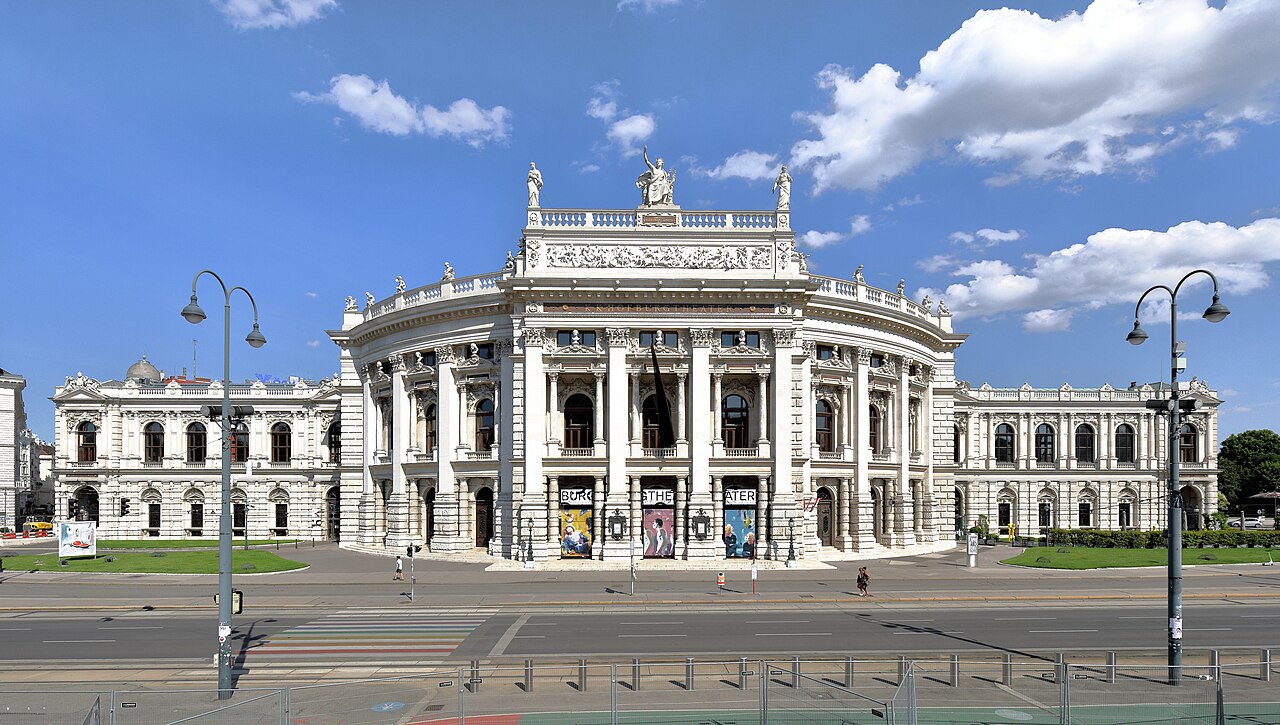
The Ringstrasse façade, with its curved colonnade and rooftop statuary, photographs well from across the tram tracks in the Rathauspark itself, which gives enough distance to fit the whole building in frame.
Inside the auditorium, photography is not permitted once a performance begins, so any interior shot has to be taken during a tour or before doors open.
Comprobado 2026-08-24
Preguntas comunes
Who painted the staircase ceilings?
Gustav Klimt, his brother Ernst Klimt, and Franz Matsch, working together in 1886-1888 as the "Künstler-Compagnie." Gustav Klimt won the Kaiserpreis for the commission.
Is the Burgtheater the original 1741 building?
No. The 1741 building next to the old Hofburg is gone; the current Ringstrasse building by Gottfried Semper and Karl von Hasenauer opened in 1888 and was rebuilt again after bombing gutted the auditorium in 1945.
Can I visit without seeing a play?
Yes, a separate guided tour of the staircases and auditorium runs on days without a conflicting performance or rehearsal, and covers the Klimt frescoes.
Are performances in English?
No. Almost every mainstage production is performed in German with no surtitles.
How many seats does the auditorium have?
Roughly 1,300, in the horseshoe layout typical of a nineteenth-century court theatre.
Where is the nearest U-Bahn stop?
Rathaus on line U2, a two-minute walk across the Ringstrasse.
donde esta
Cargando el mapa interactivo…
No se ha podido cargar el mapa interactivo.
cerca
Encajarlo en un plan
Enlaces externos
Última actualización:
Fuente: Colaboradores de OpenStreetMap, Wikidata ·