The Vienna State Opera keeps 435 places in the house where nobody sits down, and they are the reason a student in Vienna can see world-class opera more often than most people see a film.
Standing room — Stehplatz — is not a consolation prize or a leftover. It is a deliberate institution: a block of the house sold only on the day of the performance, at prices that start at €4 with a Bundestheater card, in a building where a seat in the same room can cost two hundred. The opera's own ticket information puts it plainly — the standing places are meant for the spontaneous visit.
They are spread across three levels behind and above the seats. Each place has the same subtitle screen the seats have, in up to eight languages, with English, German and the original language always among them.
What you get is the house at full strength: the Staatsoper's own orchestra, which is the Vienna Philharmonic under another name, a repertoire that changes almost nightly, and singers who are on the international circuit that week rather than resident for the season.
What you give up is a chair for three hours, and the certainty of a ticket until the morning of the day itself.
For anyone travelling with more curiosity than budget, it is the best value in the city by a distance — and it is a genuine Viennese habit rather than a tourist arrangement.
The mechanics are simple once you know them, and completely opaque until you do.
Standing-room tickets go on sale on the day of the performance, from 10:00 in the morning. They are not part of the advance sale that opens months ahead for the 1,700 seats — no amount of planning gets you one earlier, and no reseller legitimately has them.
The places are in three areas at different heights and different prices, behind the parterre and up in the galleries. Higher is further from the stage but often better placed for the sound and for seeing the whole stage rather than the near half of it.
Standing places have a rail. The Viennese custom is to claim your spot on the rail before the performance by tying a scarf to it, and it is honoured: the scarf holds the place through the intervals as reliably as a coat over a chair.
Every place has its own screen at the rail with the libretto in translation, which matters more here than in an opera house where you are handed a paper synopsis and left to it.
There is a cloakroom, and using it is not optional in practice — coats and bags in the standing areas are unwelcome in a space measured in shoulder widths.
Plan the evening as three hours on your feet at minimum, and up to five for a Wagner.
The performance is the shorter part of the commitment. Tickets go on sale at ten in the morning and the well-known productions go quickly, so the day has two appointments in it: the buying and the performance.
Arrive at the house well before the curtain if you want a place at the rail rather than a view of someone's head. An hour ahead is comfortable for an ordinary night; for a premiere or a famous cast, earlier again.
The intervals are twenty to twenty-five minutes and long enough to sit down somewhere, which by the second one you will want.
If three hours upright is not realistic, the answer is not standing room. It is a cheap seat in the upper gallery, bought in the normal advance sale.
The State Opera plays from September to the end of June and closes for July and August, when the house offers guided tours instead. A summer visit to Vienna cannot include a performance here, and that surprises a lot of people who arrive in August with the opera on their list.
Within the season, almost every night has something. The repertoire system means the programme changes from one evening to the next rather than running a single production for weeks, so a three-night stay in Vienna can take in three different operas.
Midweek nights in the deep winter are the easiest for standing room. Weekends, premieres, the famous Mozart and Puccini titles, and anything with a celebrated name in it are the hardest.
Check the calendar before fixing the dates of a trip rather than after. Nothing else about this experience is difficult, and this is the part that quietly decides whether it happens at all.
Standing-room tickets are sold only on the day of the performance, from 10:00, and the opera's own information gives the starting price as €4 with a BT-Card. The three standing areas are priced differently by height and sightline, and the exact figure for a given night is on the opera's own ticket shop, which is where to read it before going.
They can be bought online in the ticket shop when they are released, by phone, or in person at the box office — the same three routes as any other ticket in the house, and the reason the old advice about queueing on Operngasse for hours is out of date.
A ticket is one place, and the place is claimed at the rail once you are inside.
Everything else in the house — the seats, the subscriptions, the guided tours when the season is closed — is sold in the ordinary way, months ahead.
The State Opera stands at Opernring 2, on the Ring at Karlsplatz, which is one of the best-connected points in Vienna: U1, U2 and U4 all reach Karlsplatz, and the Ring trams stop directly outside.
From Stephansplatz it is a seven-minute walk down Kärntner Straße, which is the approach the building was designed for.
A single Wiener Linien ticket is €3.20, a 24-hour ticket €10.20, and tickets are validated before boarding rather than on the way out.
The standing-room entrance is not the grand staircase the seated audience uses; the house directs standing ticket-holders to their own way in, and the staff at the door will point you at it. Ask rather than joining the wrong queue in evening dress.
Three hours standing on a hard floor is a physical undertaking. Shoes matter more than clothes.
There is no formal dress code for standing room and nobody expects black tie, but the house is a formal room and the standard is what you would wear to a good restaurant. Sportswear and beach clothing read as a lack of manners rather than as a statement.
The scarf on the rail is a real convention, not a curiosity. Respect other people's, and tie your own before you go for a drink.
Sightlines vary sharply between places, and the cheapest area is cheapest for a reason. If the staging matters to you more than the singing, pay for the better standing area.
Late arrivals are not admitted mid-act. A first act can run over an hour, and the door closes when it closes.
And do not buy a "standing room ticket" from anyone outside the building. They are sold by the house on the day, and nowhere else.
Photography during the performance is not allowed, and in a standing area you are close enough to other people that a raised phone is an act against the room rather than a private choice.
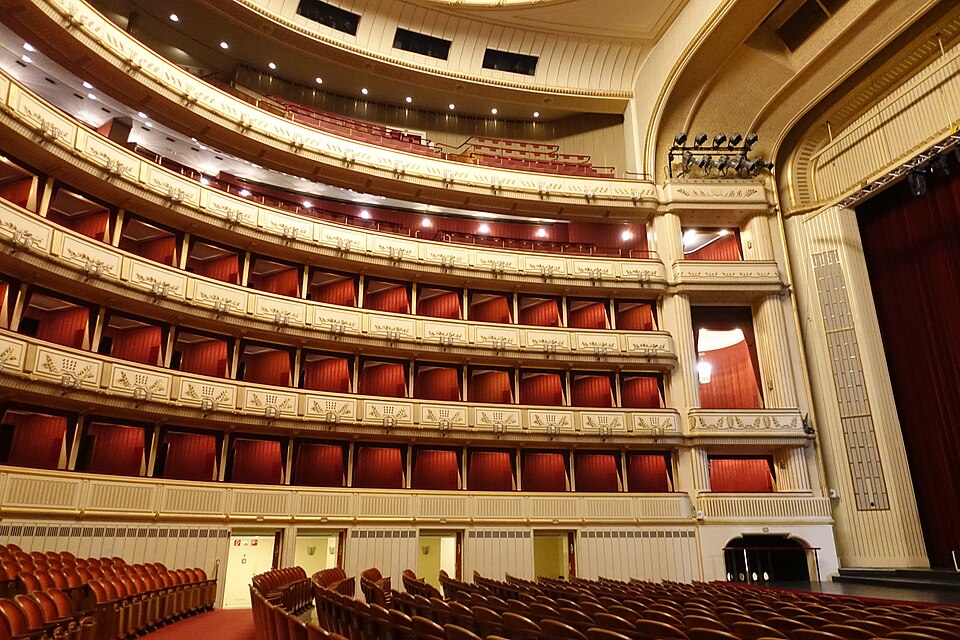
The auditorium before the curtain, the staircase and the foyers are the pictures, and they are extraordinary ones: the Renaissance-revival staircase, the Schwind foyer's frescoes, the tea room. Come early enough to walk them.
The house from the outside takes evening light on the Ring beautifully, with tram wires crossing the frame in a way that dates the picture to Vienna and nowhere else.
If the visit falls in July or August, the guided tour is the photographic route into the same building — the stage, the seats and the machinery are shown to the camera in a way no performance night allows.
Checked 2026-08-25
Common questions
How much does standing room at the Vienna State Opera cost?
The opera's own ticket information gives standing places as starting at €4 with a Bundestheater card; the three standing areas are priced differently by height and sightline, so read the figure for a particular night in the opera's ticket shop.
When do standing-room tickets go on sale?
On the day of the performance, from 10:00 in the morning, online, by phone or at the box office. They are never part of the advance sale that opens months earlier for seats, so no amount of planning gets one sooner.
How many standing places are there?
435, spread across three areas behind and above the 1,700 seats. Each place has its own subtitle screen at the rail with up to eight languages, English, German and the original language always among them.
What is the scarf on the railing about?
It is how a standing place is claimed. Tie a scarf to the rail at your spot before the performance and it holds through the intervals — a Viennese convention that is honoured rather than a superstition, and one worth respecting when it is somebody else's scarf.
Can I see an opera here in July or August?
No. The house does not play in July and August and offers guided tours instead, so a midsummer visit to Vienna cannot include a performance. The season runs from September to the end of June.
Is there a dress code for standing room?
Nothing formal is required and evening dress is not expected in the standing areas, but the room is a formal one and the sensible standard is what you would wear to a good restaurant. Sportswear and beachwear are out of place.
Nothing non-essential is set before you choose, in regions where consent is required. If you decline, ads still appear but they are non-personalised, and analytics is switched off entirely.
.jpg)