
1 min walk · Leopoldstadt
Gedenkort Winterantwort (Ilse Aichinger)
- High
- Historic monument
Language · 1 published
Activity · Innere Stadt, Vienna
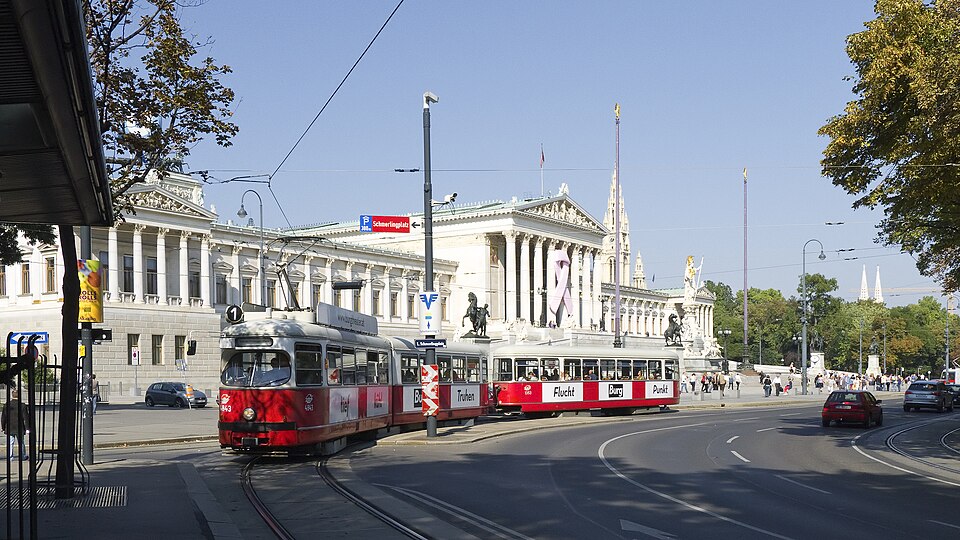
Vienna demolished its city walls and built a 5.3 km boulevard on the empty ring of ground, then lined it with every public building the nineteenth century thought a capital needed. Riding around it on a scheduled tram, for the price of a bus fare, is the cheapest architectural tour in Europe.
The decree was Franz Joseph's, in 1857 — "Es ist Mein Wille", it is my will — and the work went on until 1913, when the Ministry of War was finished. Parliament, the Rathaus, the Burgtheater, the two great museums, the university, the opera and the Hofburg's new wing all face the same road, each in the historical style its purpose was thought to demand.
Trams 1 and 2 each run along part of that ring as ordinary lines of the Vienna network, carrying commuters, shopping bags and schoolchildren. There is no commentary, no guide and no tourist premium — which is exactly why it works. You sit at a window in a working city and its monuments go past at walking pace with people getting on and off in front of them.
A yellow sightseeing tram with recorded commentary also circles the Ring at several times the price. This page is about the other one.
Checked 2026-08-25 · Source
The Ring is a circle, but no single line goes all the way round it. Trams 1 and 2 each cover a stretch and then turn off into the districts beyond, so a full circuit means riding one, stepping off, and picking up the other going the other way.
Riding clockwise on the 1 from Schwedenplatz takes you past the Urania and the Ministry of War, along the Stubenring and the Parkring to the opera. The 2 covers the other arc, past the Burggarten, the museums, Parliament, the Rathaus and the Burgtheater to Schottentor.
Between them the two lines pass, in order and without you moving: the State Opera, the Kunsthistorisches and Naturhistorisches museums facing each other across Maria-Theresien-Platz, the Hofburg's Neue Burg, Parliament with its Athena fountain, the Rathaus, the Burgtheater, the university, the Börse, the Postsparkasse a street away, and the Stadtpark with the gilt Johann Strauss.
The trams are a mix of low-floor ULF stock and older cars. The older ones have better windows for this purpose and the newer ones are easier to board.
A seat on the outer side, facing the buildings rather than the median, is the whole difference between a tour and a commute.
Checked 2026-08-25 · Source
A full circuit with one change takes about an hour, including the wait between lines.
Thirty to forty minutes is the honest riding time; the rest is the change and whichever tram you miss by a minute.
It is a good first hour in Vienna, before you know the city — it lays out where everything is in a way no map does, and afterwards the walking makes sense.
It is also a good last hour, in the dark, when the Rathaus and the museums are lit and the trams are half empty.
If you want to break it into pieces, the natural stops are the museums, Parliament and the Rathaus, and the ride works just as well as four short hops with walking in between.
Checked 2026-08-25
Any hour outside the two commuting peaks. Between about 07:30 and 09:00, and again from 16:30 to 18:30, the trams are full of people going to work and a window seat is not on offer.
Mid-morning and early afternoon are comfortable in any season. Sunday morning is the quietest hour of the week on the Ring, with the traffic gone and the buildings to yourself.
Winter is better than its reputation for this particular ride: the trams are heated, the light on the pale stone is low and long, and in December the Rathausplatz market puts a lit foreground in front of the Rathaus.
Summer afternoons are the worst combination — crowded cars, hot glass and the sun straight into the windows on the western arc.
Checked 2026-08-25
This is ordinary public transport and it takes an ordinary ticket. A single Wiener Linien ticket is €3.20, valid for 80 minutes from validation with unlimited changes, which is enough to do most of the Ring on one fare if you keep moving.
A 24-hour ticket is €10.20 and pays for itself on any day with more than three journeys in it. A weekly ticket is €28.90 on paper, or €25.20 as a non-transferable digital ticket.
Children under six travel free; six to fourteen pay €1.60 for a single, and under-15s travel free on Sundays, public holidays and Vienna school holidays.
Tickets are validated before boarding — at the blue machines in stations, or in the vehicle on trams and buses. An unvalidated ticket is treated as no ticket at all, and inspections on the Ring lines are frequent.
The yellow Vienna Ring Tram sightseeing service is a separate commercial product with its own, much higher fare.
Checked 2026-08-25 · Source
Any stop on the Ring will do, and the easiest place to start is wherever you already are.
Schwedenplatz (U1, U4) is the northern corner and the natural start for the 1. Schottentor (U2) is the northwestern one and the natural change point. The opera at Karlsplatz (U1, U2, U4) is the southern one and is where most visitors are standing when they decide to do this.
Coming in from the airport, the CAT and the S7 both reach Wien Mitte, two minutes from the Ring at Stubentor.
Trams run every few minutes on both lines through the day, so the timetable is not worth studying — go to the stop and take whichever comes.
Checked 2026-08-25
The single most common mistake is expecting one tram to go all the way round. It will not. Both lines leave the Ring, and the far end of the 1 is the Prater while the far end of the 2 is the outer districts — pleasant rides, but not the Ring.
The second is the direction. Sitting on the inner side of the car puts the median, the traffic and the trees between you and every building you came to see.
Ticket inspectors work these lines heavily, in plain clothes, and the fine is many times the fare. Validate.
The stops are announced in German only on some older cars, and the Ring's stop names are not the building names — Rathausplatz, Stadiongasse, Dr.-Karl-Renner-Ring are all effectively the Rathaus.
And pickpockets work the Ring trams as they work every tourist route in Europe; the crush at the doors is where it happens.
Checked 2026-08-25
Shooting through tram glass is a compromise, and it is worth knowing which compromises to make. Keep the lens close to the glass to kill reflections, shoot at 1/500 or faster because the tram vibrates more than it appears to, and accept that the picture is a moving one — a blurred foreground with the Rathaus sharp behind it is a better photograph than a clean frame of nothing.
The buildings themselves are better photographed from the pavement, and the ride is best used to find out which ones you want to come back to.
For the tram as the subject, stand on the outer pavement at a curve — the stretch in front of the Burgtheater and the curve at the opera both put the whole car into the frame with the architecture behind it.
Evening is the hour. The Rathaus, Parliament and the museums are floodlit, the tram windows glow, and the wet asphalt after rain doubles all of it.
Checked 2026-08-25
No. Lines 1 and 2 each run along part of the Ringstrasse and then turn off into the districts beyond, so a complete circuit means riding one, getting off, and picking up the other. The change is usually made around Schottentor or the opera.
An ordinary Wiener Linien fare: €3.20 for a single ticket, valid 80 minutes from validation with unlimited changes, or €10.20 for a 24-hour ticket. Children under six travel free and six to fourteen pay €1.60.
No. The Vienna Ring Tram is a separate sightseeing service with recorded commentary and a much higher fare. Lines 1 and 2 are scheduled city trams carrying ordinary passengers, which is what makes the ride cheap and unstaged.
About an hour with the change included; the riding itself is thirty to forty minutes. Broken into hops with walking between the museums, Parliament and the Rathaus, it can fill a half day.
The outer side, facing the buildings. The inner side faces the median, the traffic and the trees, and you will see very little of what you came for.
A boulevard 5.3 km long, laid out on the ground freed when Franz Joseph ordered the city walls demolished in 1857 and built up over the following half century — the last of it, the Ministry of War, finished in 1913. The opera, the two great museums, Parliament, the Rathaus, the Burgtheater and the university all face it.
Loading the interactive map…
The interactive map could not be loaded.
Last updated:
Source: OpenStreetMap contributors ·