
01
2 hours
1281 London Road
- Notable
- Nightlife venue
Language · 1 published
City guide · United Kingdom
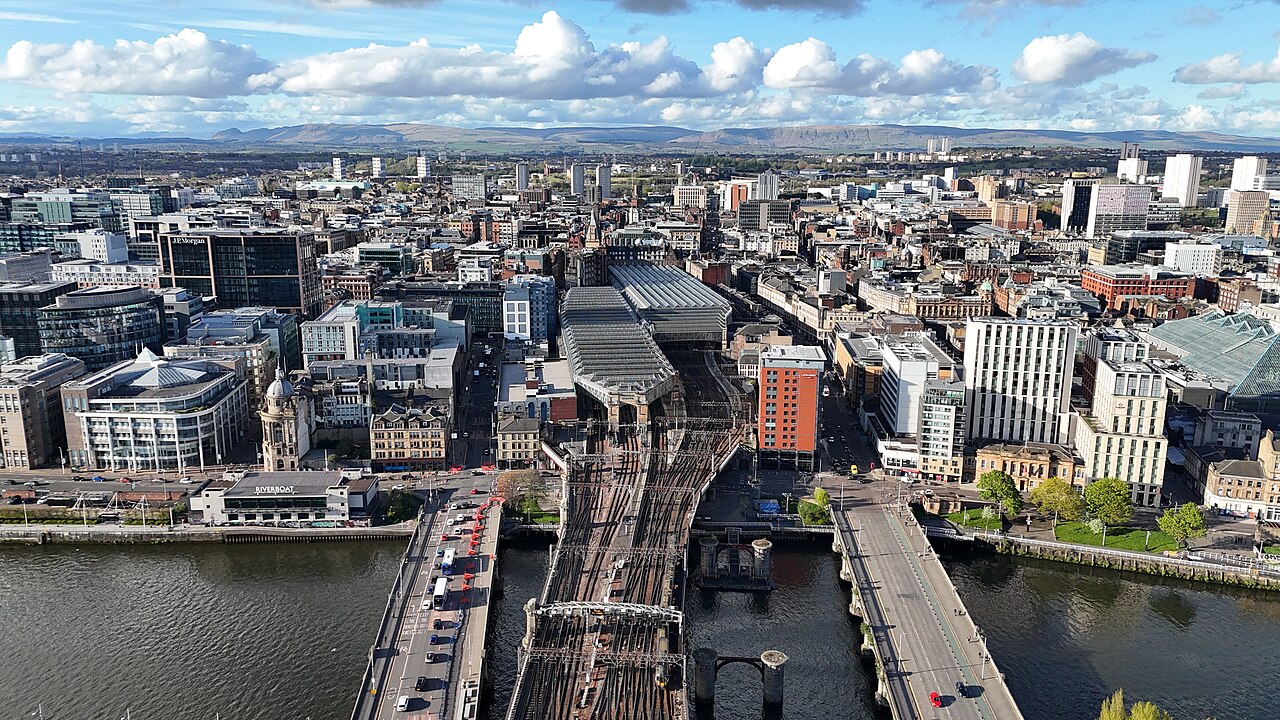
Glasgow sits on the Clyde in west central Scotland and holds around 632,350 people, with more than a million in the Greater Glasgow urban area and a density of 3,562 people per square kilometre against a Scottish average of 70. It is smaller now than it once was: the peak was 1,127,825 in 1938, and the urban renewal of the 1960s moved much of that population out to new towns. What is left is a Victorian merchant city built on shipping and Clyde money, and the collections that money paid for — Kelvingrove, the Burrell, the Hunterian — are what a first visit is usually built around.
Ranked by importance — sitelinks, pageviews and heritage status, not editor preference.
Glasgow spreads along the Clyde, but the visitor city is a set of bands. The city centre grid sits north of the river around George Square, Buchanan Street and Sauchiehall Street. Merchant City is the older commercial quarter at its eastern edge; the cathedral and the Necropolis sit just beyond. The West End, around the University of Glasgow, Kelvingrove and Byres Road, is the second centre and the one many visitors prefer after dark. South of the Clyde are the parks, museums and residential districts of Pollokshields and the south side. The river is more industrial memory than promenade in places, so the useful mental map is centre, east end, west end and south side.
Checked 2026-08-26
The Subway is the visitor shortcut. SPT describes it as the easiest way around the city centre and West End, with trains every four minutes at peak times and a full circuit of the fifteen stations taking 24 minutes. That loop connects Buchanan Street, St Enoch, Kelvinhall, Hillhead and Partick, so it joins the shopping core, the river edge and the university side without fighting traffic. It does not cover everything: use buses or trains for Pollok Country Park, the Burrell Collection, the south side and outer neighbourhoods. Inside the centre, walking is often faster than waiting, especially around George Square and Merchant City.
Checked 2026-08-26
Two to three. One day can cover the centre, cathedral and a short West End route, but it sells the museums short. A second day belongs to Kelvingrove, the university and Riverside; a third adds Pollok Country Park, the Burrell Collection or a deeper music-and-food route.
The city centre is easiest for a first visit because it keeps stations, restaurants and the Merchant City close. The West End is better for atmosphere, the university, Kelvingrove and evening streets around Byres Road, but it needs the Subway for fast central access.
Very useful for the city centre and West End, less useful outside that loop. SPT says the fifteen-station circuit takes 24 minutes and trains run every four minutes at peak times, which makes it the quickest way between Buchanan Street, Hillhead, Kelvinhall and Partick.
In clusters, yes. The centre and Merchant City are easy on foot, and the West End works as its own walking day. The Burrell Collection, Pollok Country Park and some south-side routes need bus, train or taxi planning.
May, June and September are the safest choices for daylight and walking weather. Glasgow's best days involve parks, murals, university streets and moving between museums, so a bit of mild weather changes the whole pace.
Set your days, your pace and the hours you actually want to be out. The planner works around closing days and travel time, and leaves room to eat.