National Museum of Scotland
The National Museum of Scotland is the national museum on Chambers Street, combining collections that range across Scotland, the natural world, science, technology, art and design.
- Must see
- Museum
Language · 1 published
City guide · United Kingdom
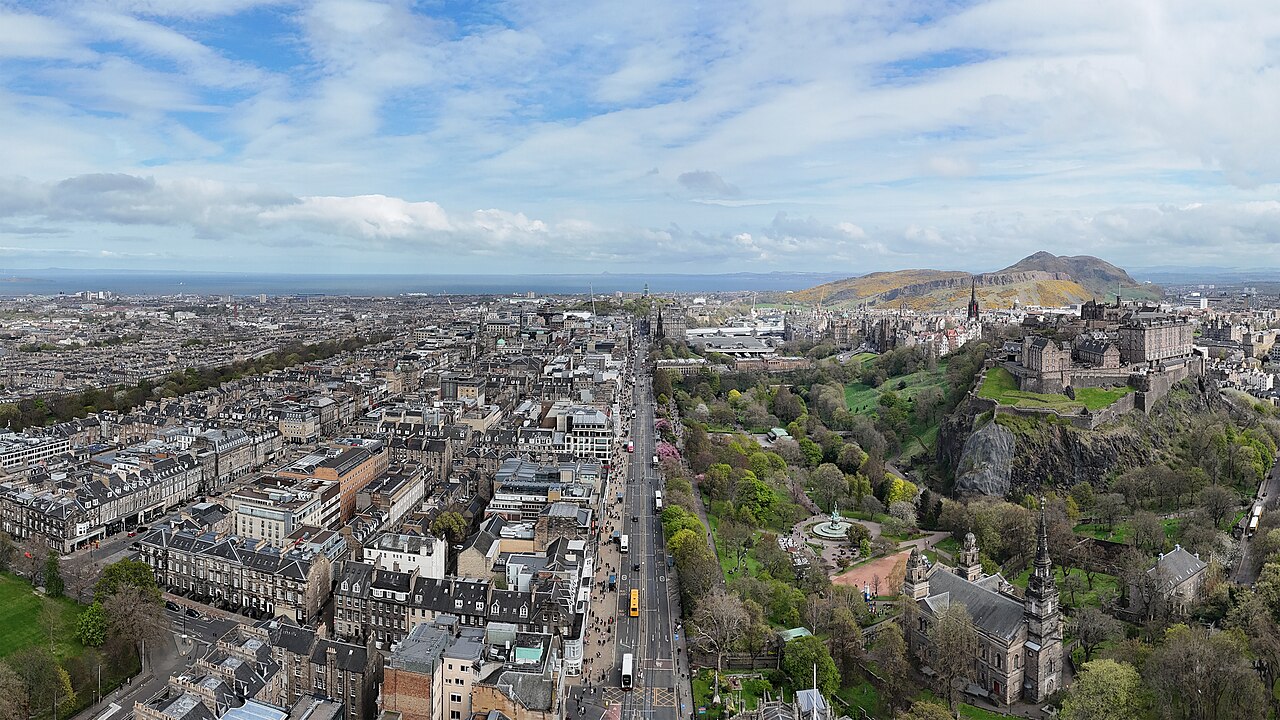
Edinburgh keeps two cities beside each other: the medieval Old Town along its ridge and the Georgian New Town laid out below it through the eighteenth and nineteenth centuries, listed together by UNESCO. Crossing between them takes minutes and moves several centuries, and it is the main reason 5.3 million visits landed here in 2023, 2.4 million of those from overseas. The resident figure is far smaller than the visitor count implies, 506,520 in 2020, and every August, when the Fringe takes over the halls, the gap is felt in the queues. The Firth of Forth bounds the city to the north, the Pentland Hills to the south.
Ranked by importance — sitelinks, pageviews and heritage status, not editor preference.
The National Museum of Scotland is the national museum on Chambers Street, combining collections that range across Scotland, the natural world, science, technology, art and design.
HMY Britannia is the former Royal Yacht, launched in 1953 for the British Royal Family and preserved in Leith by The Royal Yacht Britannia Trust.
Edinburgh is two planned worlds facing one another across a valley. The Old Town runs along the ridge from the castle to Holyrood, with the Royal Mile as its spine and closes dropping steeply to either side. North of Princes Street Gardens, the New Town is an eighteenth-century grid of Georgian streets, squares and crescents. Leith sits downhill at the old port, now tied back to the centre by tram and bus. Southside, Marchmont and the Meadows are university ground; Stockbridge and Inverleith are the gentler residential edge; Holyrood Park and Arthur's Seat form a rough volcanic block immediately beside the ceremonial city.
Checked 2026-08-26
Walk the Old Town and New Town, then use buses and trams for the rest. Edinburgh's core is compact but vertical: a route that looks short can involve stairs, cobbles and a stiff climb back to the Royal Mile. The tram is the clean line from the airport through Haymarket, Princes Street, St Andrew Square and onward to Leith and Newhaven; the airport says trams take about 30 minutes to the city centre and run frequently through the day. Lothian Buses fill the city grid and are usually the better answer for the Botanic Garden, Southside, Portobello and routes that do not sit on the tram line.
Checked 2026-08-26
Three to four. Two days cover the castle-to-Holyrood ridge, the New Town and one museum. A third adds Arthur's Seat, Leith or the Botanic Garden; a fourth gives space for a slower Royal Mile, galleries and an evening that is not just a recovery walk downhill.
The Old Town is the medieval ridge from Edinburgh Castle to Holyrood, with closes dropping steeply from the Royal Mile. The New Town is the Georgian grid north of Princes Street Gardens, planned around broad streets, squares and crescents.
The distances are friendly and the slopes are not. A map will make the Old Town look compact, but stairs, cobbles and ridge-to-valley climbs can slow a day sharply. Keep walks clustered and avoid treating Leith, the Botanic Garden and the Royal Mile as one casual loop.
It is the simplest rail-like link from the airport to the centre and onward to Leith. Edinburgh Airport says trams run to the city centre and beyond to Newhaven, with city-centre travel taking about 30 minutes.
Only if the festivals are the reason for the trip. August is exciting but expensive and crowded, and accommodation can reshape the whole visit. May, June and September are better for a city-first itinerary.
Set your days, your pace and the hours you actually want to be out. The planner works around closing days and travel time, and leaves room to eat.