Viewpoint · Kyoto
伏見稲荷大社
Photograph
.jpg)
- Today
- Hours not recorded
- Visit duration
- 2 hours
- Accessibility
- Not recorded
- Price
- Not recorded
- Standing
- Must see
- Rank
- Rank 13 of 10,058
What it is
Fushimi Inari-taisha is the head shrine of the Inari faith, and the shrine states that there are said to be around 30,000 Inari shrines in Japan below it. Its own texts date the enshrinement of Inari Okami on the Mitsugamine ridge of Inariyama to the first Day of the Horse of the second month of 711, when Irogu no Hatanokimi is said to have acted on an imperial order from Empress Genmei. The court raised the shrine to the highest rank for Shinto shrines in 942, and Sei Shonagon, writing around the year 1000, already described the climb to the shrine buildings as exhausting. That is the useful thing to know before arriving: this is not a walled compound with a ticket desk but a mountain. The precinct covers roughly 870,000 square metres, most of it the wooded slope of Inariyama, which at 233 metres is the southernmost of the thirty-six peaks of Higashiyama. The buildings at the foot of it are the front page of something much larger. Everything above the main hall is a network of paths, small shrines, prayer halls and stone markers that a visitor is free to walk into as far as their legs and their daylight allow.
Checked 2026-08-26 · Source
What's inside
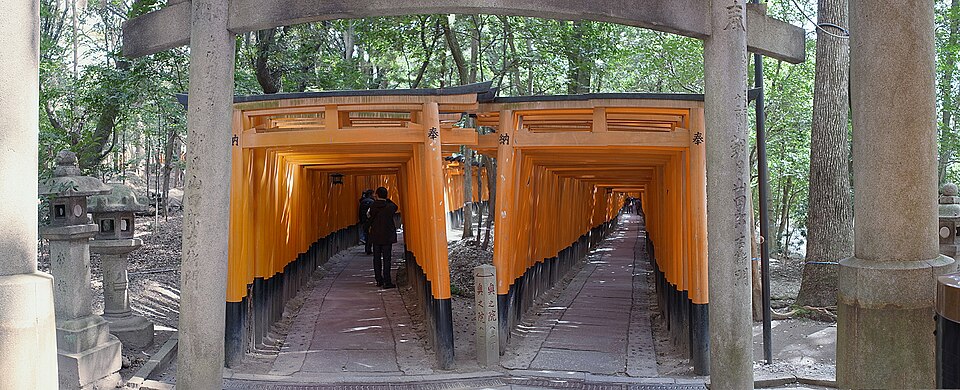
The approach ends at the Romon gate, which the shrine says was built in 1589 with a donation from Toyotomi Hideyoshi, pledged when his mother fell ill; a text in sumi ink found during a later dismantling confirmed the date. Behind it stands the Honden, where five deities are enshrined together under one roof in the Uchikoshi Nagashi-zukuri style with walls 10.6 metres high. It burned in the Onin fighting in 1468 and was rebuilt in 1499, and it is designated an Important Cultural Property. East of the main hall the Senbon Torii, the tunnel of donated vermilion gates, climbs through the Myobu-dani valley to the Okusha Hohaisho, the prayer hall usually called Okuno-in, from which the three peaks are visible directly behind. In its back right corner sit the Omokaru-ishi lanterns: make a wish, lift the stone top, and a lighter-than-expected weight is read as a yes. Further up are the pond called Shin-ike and Kumatakasha beside it, then Sannomine, Ainomine, Ninomine and Ichinomine, the summit at 233 metres, plus Mitsurugisha, Kojingamine, Gozendani Hohaisho, Miyuki Hohaisho and the Kiyotaki waterfall. Teichoan, a rest area with a café and a terrace by Yashimagaike pond, opened in December 2017.
Checked 2026-08-26 · Source
How long to spend
Allow two hours. The shrine publishes no suggested visit length of its own, so two hours is this guide's judgement, not a figure read off inari.jp, and the parts it is built from are worth separating because they let a visitor cut it honestly. The flat ground — the approach, the Romon, the Honden and the subsidiary halls beside it — takes twenty to thirty minutes at a normal pace. The Senbon Torii to the Okusha Hohaisho is a further fifteen to twenty minutes on the way up, longer in practice because it is where almost everyone stops to photograph. From Okusha the path turns into a genuine stepped hill climb, and the loop over the three peaks and back down is where the remaining hour goes. A visitor with only forty-five minutes should walk to the Okusha Hohaisho and turn round there; that covers the gate tunnel and the view of the peaks and skips only the climb. A visitor who wants the summit and the ring of otsuka stones should budget three hours and start with daylight to spare, because the upper paths are unlit and the descent is steeper underfoot than the ascent feels.
Checked 2026-08-26 · Source
Season and crowds
Early is the single most effective choice here, because the shrine's own precautions describe what the middle of the day looks like: it warns that the roads around its car parks are heavily congested, asks visitors to come by public transport, and points people at the Kyoto City Tourism Association's comfort forecast and its live cameras of the front and rear approaches before setting out. Nothing about the precinct closes to make an early start impossible, and the gate tunnel is a different place before the first trains from Kyoto Station fill it. For festivals, the shrine's calendar names the ones worth planning around. Hatsuuma Taisai, the anniversary of the enshrinement, begins at 8:00 on the first Day of the Horse in February and is the shrine's own great day. Motomiya-sai falls on the first Sunday or holiday in July after Doyo at 9:00, with Yoimiya-sai at 18:00 the evening before. Hitaki-sai is at 13:00 on 8 November, when more than 100,000 wooden tablets sent by worshippers across Japan are burned, followed by a mikagura performance at 18:00. The New Year period is the hardest time to visit casually: the shrine closes its precinct car parks from 30 December to 6 January and runs an entirely separate timetable.
Checked 2026-08-26 · Source
Tickets
No admission fee for the precinct appears anywhere on the shrine's own website, in Japanese or in English — not on the access page, not in the visitor requests, not in the FAQ. What the site does publish are offerings, which are a different thing from a ticket and are voluntary. A formal prayer rite is performed throughout the day, and the shrine gives its hours as 8:30 to 16:30 with the application to be completed by about 16:00, adding that it is open all year with no closing day and that festival days and the New Year period fall outside those hours. The initial offering for a rite runs in named tiers from 5,000 yen for the smallest to 100,000 yen for the largest, each returning a shrine tablet and offerings. Amulets and tablets are listed individually: 800 yen for the study and examination charms, 1,000 yen for most of the household, business and traffic-safety ones, 1,500 to 3,000 yen for the larger ones. Applications are taken at the prayer reception on the left side of the main hall, and the shrine office answers the telephone from 9:00 to 16:00. Because the shrine publishes no entrance charge at all, this guide records none.
Checked 2026-08-26 · Source
Getting there
The shrine is easier to reach than almost anything else in Kyoto, and no car is needed. Inari Station on the JR Nara Line sits directly opposite the approach — the shrine describes it as right next to the station, and it is two stops and about five minutes from Kyoto Station, which makes this the obvious arrival for anyone staying near the main station or arriving by shinkansen. The alternative is Fushimi-inari Station on the Keihan Main Line, five minutes' walk to the east, which is the better choice from the Gion and Sanjo side of the city because it avoids doubling back to Kyoto Station. By city bus, the Minami 5 line stops at Inari Taisha-mae, seven minutes' walk to the east. By car the shrine gives about twenty minutes from the Kyoto-Minami interchange on the Meishin Expressway and about ten minutes from the Kamitoba exit of the Hanshin Expressway, but it also says plainly that the roads around its car parks become very congested, that it asks visitors to use public transport, that parking is for worshippers only, and that staff will redirect drivers when the lots are full. The precinct car parks are closed from 30 December to 6 January.
Checked 2026-08-26 · Source
What to watch out for
The shrine published a list of prohibited acts on 1 January 2022 and enforces it: anyone doing these things is asked to stop, and to leave if they do not. Several of them catch ordinary tourists rather than bad actors. Eating or drinking is not allowed anywhere except the marked free rest areas, and that explicitly includes eating while walking or standing — the street food on the approach is meant to be finished before entering, not carried up the steps. Sitting on the ground is on the same list, as is shouting, leaving a pushchair outside the marked areas, and bringing a pet other than an assistance animal. Wedding dresses and other costumes judged inappropriate for worship are not permitted in the grounds. Feeding the wild birds and animals is prohibited, and so is smoking or any open flame in a wooded precinct. Beyond the rules, the hazard is the mountain itself. Above the Okusha Hohaisho the route is a long stepped climb on uneven stone with no lighting, and there is nowhere to buy water once past the lower shops. Wear shoes with a grip, carry a bottle, and turn back at a fixed time rather than at a landmark.
Checked 2026-08-26 · Source
Photography
This is one of the most photographed places in Japan and the shrine has written rules about it. Photography for commercial purposes is prohibited, as is photography in areas marked as prohibited, which includes the Main Hall, the other shrine buildings and anything beyond the tamagaki fences. Flying a drone or any other aircraft over the precinct is banned outright. The rule that catches most visitors is the last one: blocking worshippers from passing by photographing or filming on the narrow paths is explicitly listed as a prohibited act, and the Senbon Torii is exactly such a path. Set up, take the frame, and step aside. Practically, the gate tunnel is a dim corridor even at noon because the gates are packed close and the trees close over them, so the exposure problem is low light and high contrast rather than the reverse; a fast lens or a raised sensitivity does more than waiting for sun. The uphill side of the tunnel above the Okusha is thinner and quieter than the famous double row at the bottom, and the gates there carry the same donors' inscriptions. Early morning gives an empty path; late afternoon on the western slope gives the light.
Checked 2026-08-26 · Source
Common questions
Is there an admission fee at Fushimi Inari-taisha?
The shrine publishes no admission charge for its precinct anywhere on its own website, in Japanese or in English, and this guide therefore records none rather than assert a figure. What the shrine does publish are voluntary offerings: the initial offering for a formal prayer rite runs from 5,000 yen for the smallest tier to 100,000 yen for the largest, and amulets and tablets are priced individually from 800 yen for the study charms to 3,000 yen for the special charm. Those are paid at the prayer reception beside the main hall, not at a gate.
What are the opening hours?
The shrine does not publish opening or closing times for the precinct itself, and no gate hours appear on its access page, its FAQ or its visitor-requests page, so this guide does not state any. The hours it does publish are for services: prayer rites are performed from 8:30 to 16:30 with applications completed by about 16:00, and the shrine says it operates all year with no closing day. The shrine office answers the telephone from 9:00 to 16:00. Festival days and the New Year period run to a separate published timetable.
How long should a visit take?
Two hours is a fair allowance and it is this guide's judgement, since the shrine publishes no suggested duration. The flat ground around the Romon gate and the main hall takes twenty to thirty minutes. The Senbon Torii up to the Okusha Hohaisho adds fifteen to twenty minutes on the climb and usually more, because that is where people stop to photograph. The loop over the three peaks and back down accounts for the rest. Forty-five minutes is enough to reach the Okusha and return; three hours is the honest figure for the full circuit of the mountain.
How do I get there from Kyoto Station?
Take the JR Nara Line to Inari Station, two stops and about five minutes from Kyoto Station. The shrine describes its approach as right next to that station, so there is effectively no walk at the far end. From the Gion or Sanjo side of the city the better option is the Keihan Main Line to Fushimi-inari Station, five minutes' walk to the east. By city bus, the Minami 5 line stops at Inari Taisha-mae, seven minutes' walk to the east of the shrine.
Do I need a car, and is there parking?
No car is needed and the shrine would rather visitors did not bring one. It gives driving times of about twenty minutes from the Kyoto-Minami interchange on the Meishin Expressway and about ten minutes from the Kamitoba exit of the Hanshin Expressway, but in the same breath states that the roads around its car parks become very congested and asks that visitors come by public transport. Parking is refused to anyone not there to worship, and when the lots are full staff direct drivers elsewhere. The precinct car parks are closed entirely from 30 December to 6 January.
Can I take photographs, and are drones allowed?
Ordinary personal photography is fine in the open parts of the grounds. Drones and other aircraft are prohibited outright, photography for commercial purposes is prohibited, and so is photography in areas marked as prohibited, which covers the Main Hall, the other shrine buildings and anything past the tamagaki fences. The shrine also lists blocking worshippers from passing while photographing or filming on narrow paths as a prohibited act, which is aimed squarely at the Senbon Torii. Costumes and wedding dresses judged inappropriate for worship are not allowed in the grounds either.
Where it is
Loading the interactive map…
The interactive map could not be loaded.
Nearby
External links
Not recorded No verified source recorded this yet.Last updated:
Source: OpenStreetMap contributors ·