
.jpg)


5 min walk
Mangan-ji Temple
- Notable
- Place of worship
Language · 1 published
Place of worship · Kyoto
平安神宮
| Monday | 06:00 – 18:00 |
|---|---|
| Tuesday | 06:00 – 18:00 |
| Wednesday | 06:00 – 18:00 |
| Thursday | 06:00 – 18:00 |
| Friday | 06:00 – 18:00 |
| Saturday | 06:00 – 18:00 |
| Sunday | 06:00 – 18:00 |
Checked 2026-08-26 · Source
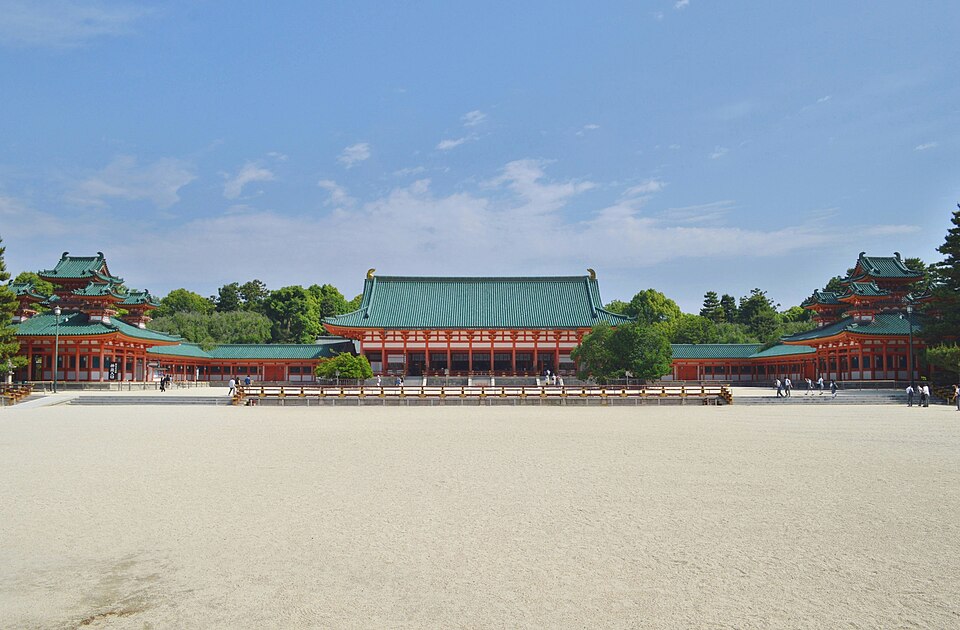
Heian Jingu stands in the Okazaki quarter of Kyoto's Sakyo ward, and it is younger than almost everything else a visitor comes to Kyoto to see. It was built in 1895 for the celebrations marking the 1,100th anniversary of the founding of Heiankyo, the imperial capital of Japan from the late eighth century to the mid-nineteenth, and it enshrines two emperors who bracket that span: Kanmu (737-806), the first emperor of the Heian period, and Komei (1831-1866), the last emperor to rule from the city. What makes the shrine unusual is that it is a reproduction rather than a survival. The halls copy the Chodoin, the State Hall complex of the original imperial palace where the emperor presided over affairs of state, at five-eighths of the size of the original, arranged symmetrically around a wide graveled courtyard. Several of them, including the Daigokuden outer hall of worship and the Otenmon main gate, are designated Important Cultural Properties of Japan. The shrine went up while Kyoto's economy was struggling and its population falling after the capital moved to Tokyo, one of a set of projects meant to mark the city's history and pull industry back to it, and it opened in the same year as a large industrial exhibition in the city. The precinct is free to enter; the four gardens behind it are not.
Checked 2026-08-26 · Source
Two quite different places share the site. The first is the courtyard: vermilion halls and gates around white gravel, with the Daigokuden at the head of it and the Otenmon at the entrance, and amulet counters at both. A goshuin seal is issued for 500 yen, and prayers are received between 9.00 and 16.00, though a rite in the main hall can mean a wait. The second is the shrine garden, entered from inside the courtyard, and it is where most of the visiting time goes. Four stroll gardens - South, West, Middle and East - wrap around the back of the halls; the shrine's Japanese page gives their total area as about 33,000 square metres and its English page as 30,000, so the two operator figures disagree by a tenth. They were laid out between 1895 and 1981, the West, Middle and East by the Kyoto garden-maker Ogawa Jihei VII (1860-1933), and were designated a National Site of Scenic Beauty in December 1975. The set pieces are specific and easy to find: the Garyu-kyo stepping stones across Soryu pond, cut from piers of the Sanjo and Gojo bridges built under Toyotomi Hideyoshi; the roofed Taihei-kaku bridge over Seiho pond in the East Garden, with Mount Kacho borrowed as a backdrop; the single waterfall in the West Garden; and the Chosin-tei teahouse, which is not normally open.
Checked 2026-08-26 · Source
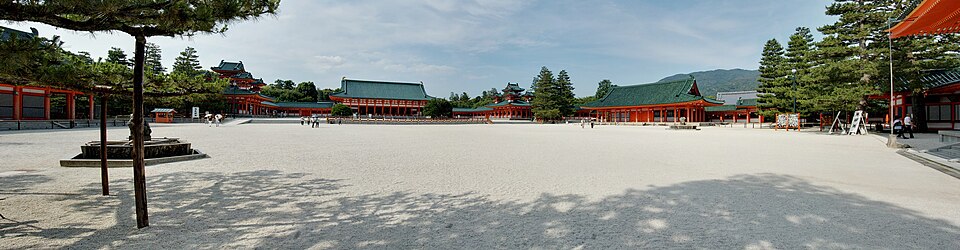
Allow an hour. The shrine's own English page puts the four gardens at about forty minutes when time is short, and that figure is the honest floor rather than a comfortable pace - it assumes a walk through without sitting down, in gardens that were built with benches and a bridge pavilion precisely so that people would stop. Add fifteen to twenty minutes for the courtyard, the two gates and the amulet counters, and an hour is what an ordinary visit costs. The recorded visit duration for this guide is sixty minutes on that basis. Two things stretch it. In the first half of April the weeping cherries in the South Garden draw a queue at the garden entrance and turn the forty minutes into an hour on their own; in early June the iris beds in the West Garden do something similar on a smaller scale. Two things compress it. A visitor who skips the garden ticket sees the courtyard in twenty minutes, which is a legitimate way to use a short morning, and a visitor arriving late is capped by the clock rather than by choice, because garden admission closes half an hour before the gates do and there is no discretion at the desk about it.
Checked 2026-08-26
The gates open at 6.00 all year, which is unusually early for a major Kyoto site, but the garden desk does not open until 8.30, so the first two and a half hours buy an empty courtyard and nothing else. That is still worth having in April. The garden's calendar is legible: weeping cherries in the South Garden through most of April, purple kakitsubata irises around Soryu pond from early to late May, some two hundred varieties of hanashobu iris in the West Garden peaking in early June when a yatsuhashi plank bridge is laid across Byakko pond, water lilies through summer, autumn colour, and snow. The shrine opens the gardens free of charge twice a year, in early June - 7 June in 2024 - and on 19 September, and those two days are correspondingly busy. Two events change the day rather than decorate it. The Jidai Matsuri falls on 22 October, when a procession in eighth- to nineteenth-century costume leaves the Imperial Palace at noon and walks to the shrine; on that date the garden desk is open only from 9.30 to 11.30 and the gates shut at 12.00. Noh is performed by torchlight in June, ticketed, with tickets usually going on sale in April.
Checked 2026-08-26 · Source
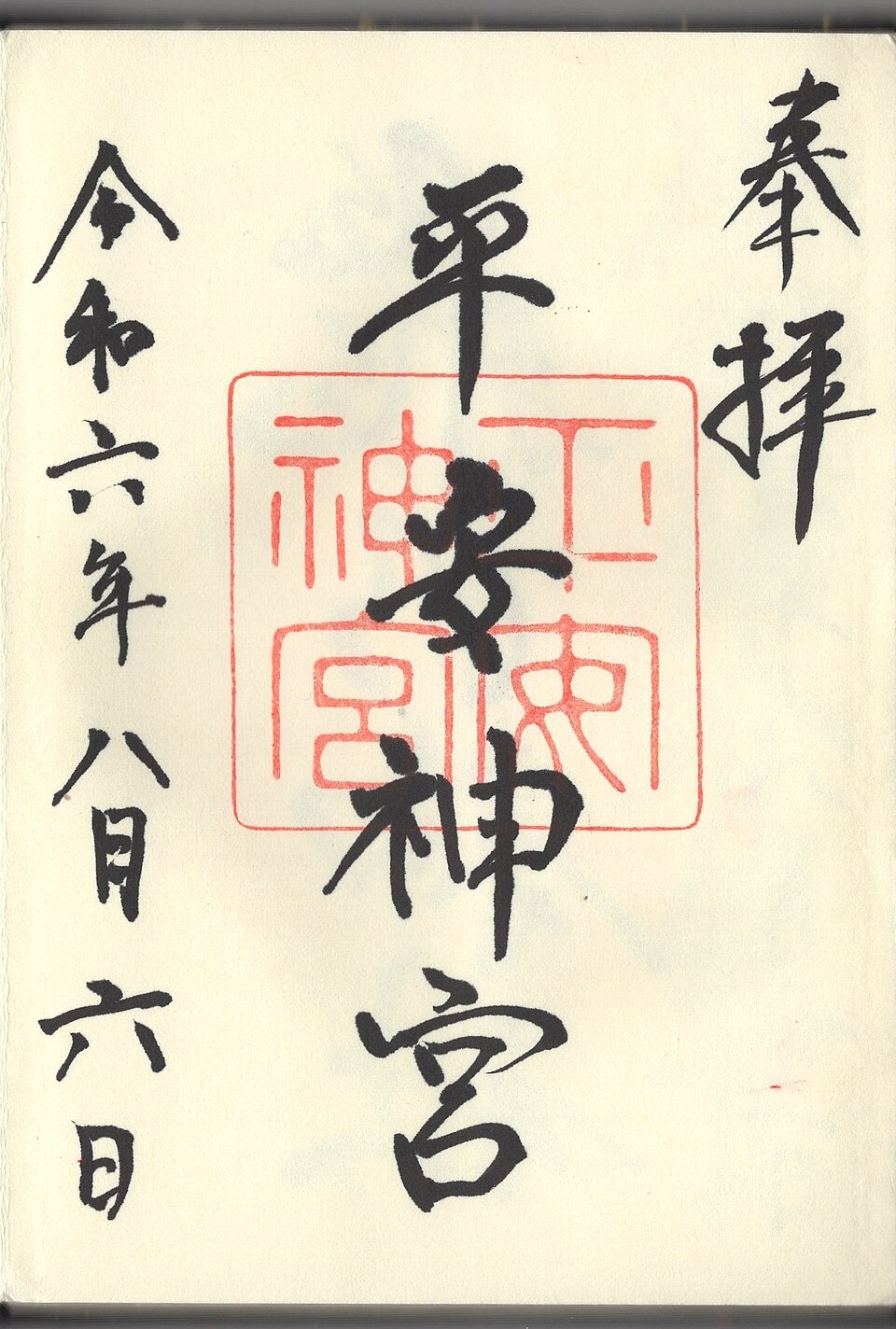
Walking into the precinct, praying at the Daigokuden and buying an amulet cost nothing. The garden is the only ticketed part, and the shrine's published rate is 600 yen for an adult and 300 yen for a child, which it defines as junior high school age and under; preschool children are free. Groups of thirty or more pay 550 yen an adult and fifty or more pay 500, with the child group rate at 250. School parties are cheaper again - 300 yen for high school, 200 for junior high, 150 for elementary and 30 for kindergarten - but only on presentation of a Kyoto school-trip passport or after a reduction application filed in advance. A visitor holding a disability certificate pays half the individual rate and so does one carer; organised groups of disabled visitors pay 100 yen a head with a prior application. A goshuin seal is 500 yen at the counters, and a tripod or monopod carried into the garden has its own fee, paid at the garden entrance. The shrine publishes no card or cashless policy on these pages, so bring cash for the garden desk. Twice a year - early June and 19 September - the garden is opened to everyone at no charge.
Checked 2026-08-26 · Source
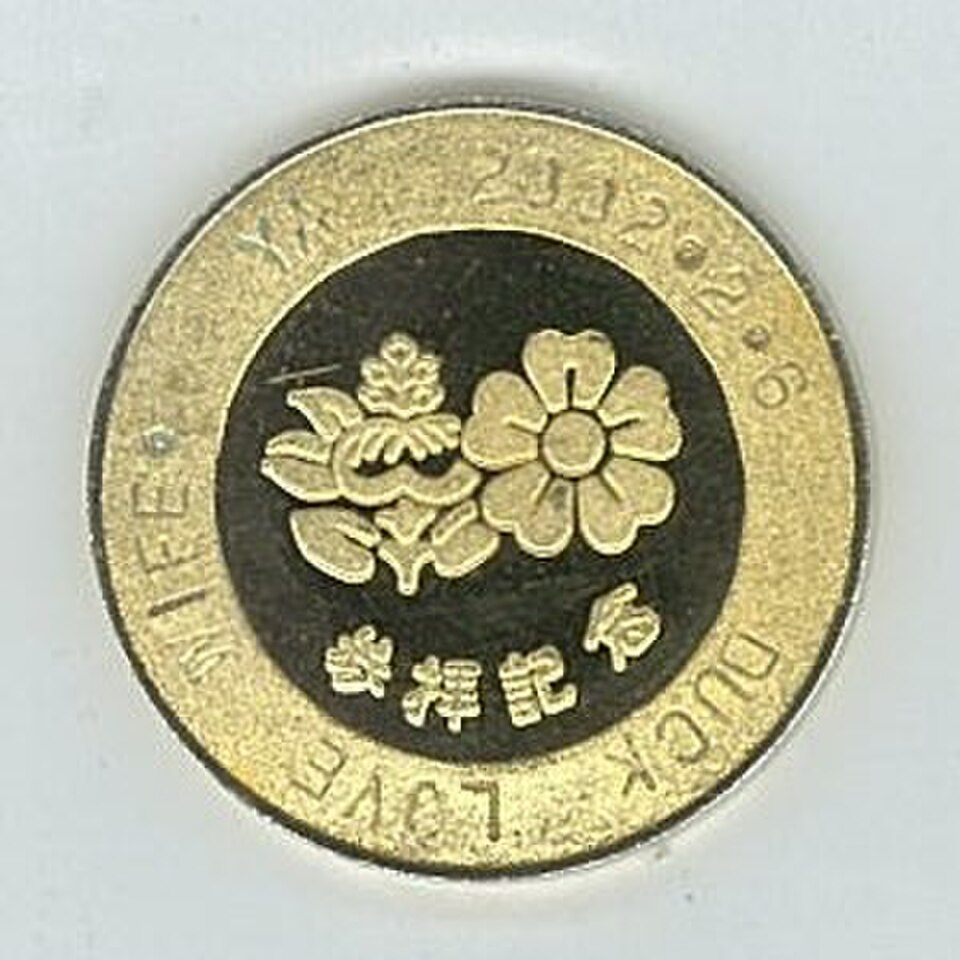
The address is 97 Okazaki Nishitenno-cho, Sakyo-ku, Kyoto 606-8341, and the shrine is comfortably reachable without a car. The nearest station is Higashiyama on the Tozai subway line: leave by exit 1 and it is a ten-minute walk. From the Keihan Oto line, Sanjo or Jingu-Marutamachi are both about fifteen minutes on foot. City buses drop closer than either. From Kyoto Station, routes 5, 100 and 110 reach the Okazaki-koen Bijutsukan Heian Jingu-mae stop in roughly thirty minutes, from where it is a five-minute walk north to the gate. From Hankyu Kawaramachi it is about twenty minutes on routes 5, 32 or 46 to the same stop or to Okazaki-koen Rohm Theatre Kyoto Miyakomesse-mae. From the Gion and Kiyomizu side, allow about twenty-five minutes on routes 201, 203 or 206 to Higashiyama-Nijo Okazaki-koen-guchi, then five minutes east, or route 100 to the museum stop. A car is the wrong choice here and the shrine says so itself: the drive from the Kyoto-Higashi interchange on the Meishin expressway takes about twenty minutes, but Heian Jingu has no car park at all. The paid lots around Okazaki Park, including the municipal Okazaki Park car park and Miyakomesse, fill badly in season, and the shrine recommends public transport or a taxi instead.
Checked 2026-08-26 · Source
Closing time is the trap, because it moves with the season and the shrine's own pages do not fully agree. The visitor FAQ, which matches what OpenStreetMap records, gives closing as 17.30 from 1 to 14 March, 18.00 from 15 March to 30 September, 17.30 through October, 17.00 from 1 November to 14 February and 17.30 from 15 February to the end of the month. A shrine news post dated 1 May 2025 gives a simpler and different split - 18.00 from 1 March and 17.00 from 1 November to the end of February. Both are the operator's; a visitor arriving in the first half of March or the second half of February should assume the earlier of the two. The garden desk always shuts thirty minutes before the gates, and on 22 October the whole place closes at noon for the Jidai Matsuri. Other rules are firm. Drones may not be flown anywhere in the precinct without prior permission, and the ban extends to the festival route. Eating and drinking in the precinct is in principle not permitted. There is no free Wi-Fi. Wheelchairs and pushchairs are welcome but meet steps and staircases. Pets should be carried or wheeled and cannot be present at a prayer; guide, hearing and service dogs are admitted normally.
Checked 2026-08-26 · Source
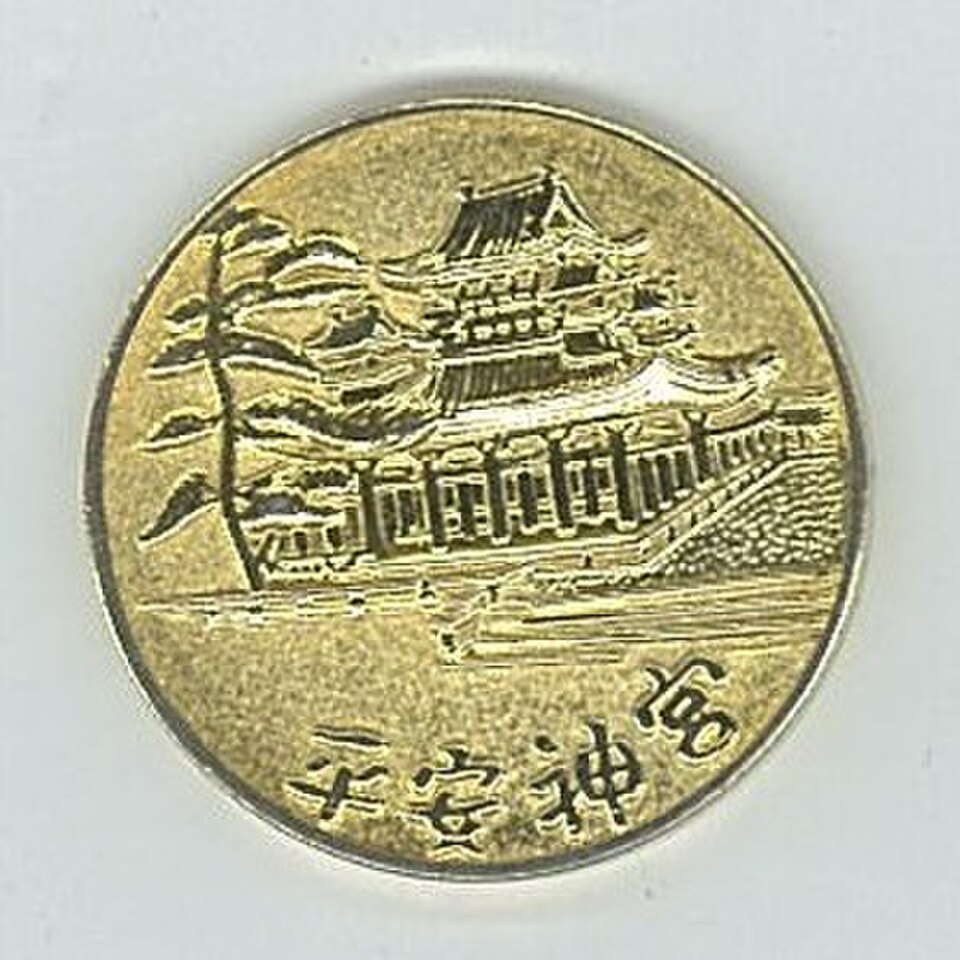
The rule that catches photographers is about legs, not lenses. A tripod or monopod may be taken into the garden only after paying a use fee at the garden entrance, and during the cherry blossom period from late March to mid-April, and on the two free-admission days, they are banned outright because of the crowds. The shrine also asks that nobody shoot from inside the fences or from within the planting beds, which rules out most of the compositions people climb for. Drones are prohibited across the whole precinct without prior permission. Within those limits the site gives up its pictures easily. The courtyard is the obvious one - vermilion posts and white gravel, best in the first hours after the 6.00 opening, when the light is low and the gravel is empty, though the garden desk will not be open yet. Inside the garden the two reliable frames are the Garyu-kyo stepping stones over Soryu pond, shot low from the bank rather than from the stones themselves, and the roofed Taihei-kaku bridge across Seiho pond with the Higashiyama ridge behind it. Midday sun on the courtyard gravel is unforgiving and the vermilion goes flat under it; late afternoon in the garden is kinder, but the gates close early enough in winter that the good hour and the closing hour are nearly the same.
Checked 2026-08-26 · Source
Entering the shrine precinct is free. Only the garden behind the halls is ticketed, at 600 yen for an adult and 300 yen for a child of junior high school age or under; preschool children enter free. Groups of thirty or more pay 550 yen an adult, groups of fifty or more 500 yen. Holders of a disability certificate pay half the individual rate, and one carer does too. The garden is opened free of charge twice a year, in early June and on 19 September.
The gates open at 6.00 every day of the year. Closing moves with the season: the shrine's visitor FAQ gives 18.00 from 15 March to 30 September, 17.30 through October, 17.00 from 1 November to 14 February, and 17.30 from 15 February to 14 March. A separate shrine news post dated 1 May 2025 gives a coarser split, with 18.00 from 1 March and 17.00 from 1 November to the end of February. The garden desk opens at 8.30 and stops admitting visitors thirty minutes before the gates close.
No. The shrine publishes no weekly closing day and its hours pages list the same opening time for every day of the year. The one date that behaves differently is 22 October, the day of the Jidai Matsuri, when the garden desk is open only between 9.30 and 11.30 and the gates close at noon. If a visit falls on that date, plan to see the procession, which leaves the Kyoto Imperial Palace at noon and walks to the shrine, rather than the garden.
About an hour for most people. The shrine's own English text says the four gardens can be covered in roughly forty minutes when time is short, and the courtyard, the two gates and the amulet counters add fifteen to twenty minutes on top of that. In the first half of April, when the weeping cherries are out, the garden alone can take an hour. A visitor who skips the garden ticket and only walks the courtyard needs about twenty minutes.
No. The shrine states plainly that it has no car park. There are several paid short-stay car parks around Okazaki Park nearby, including the Kyoto municipal Okazaki Park car park and the one at Miyakomesse, but the shrine warns that they become very congested in season and recommends arriving by public transport or taxi. The Tozai subway line's Higashiyama station is a ten-minute walk away and city buses stop five minutes from the gate.
Only after paying a use fee at the garden entrance, and not at all during the cherry blossom period from late March to mid-April or on the two free-admission days, when the garden is too crowded for them. Monopods fall under the same rule. The shrine also asks visitors not to photograph from inside the fences or the planting beds. Drones may not be flown anywhere in the precinct, or along the Jidai Matsuri route, without prior permission.
Loading the interactive map…
The interactive map could not be loaded.
Last updated:
Source: OpenStreetMap contributors, Wikidata ·