Historic monument · Kyoto
Ginkaku-ji Temple
銀閣寺
Photograph

.jpg)
Opening hours
| Monday | 08:30 – 17:00 |
|---|---|
| Tuesday | 08:30 – 17:00 |
| Wednesday | 08:30 – 17:00 |
| Thursday | 08:30 – 17:00 |
| Friday | 08:30 – 17:00 |
| Saturday | 08:30 – 17:00 |
| Sunday | 08:30 – 17:00 |
Also recorded: 09:00 – 16:30
Checked 2026-08-26 · Source
- Today
- Open today, 08:30 – 17:00
- Visit duration
- 45 min
- Accessibility
- Not recorded
- Price
- ¥1,000 per person
- Standing
- Must see · Heritage site
- Rank
- Rank 24 of 10,058
What it is
Ginkaku-ji is the popular name for Jisho-ji, a Zen temple on the eastern hills of Kyoto and, in its own words, one of the affiliate temples of Shokoku-ji, the head temple of the Rinzai Shokoku-ji branch that still runs it. The nickname belongs strictly to one building: the Kannon-den, the two-storey pavilion at the edge of the pond, which Ashikaga Yoshimasa named floor by floor, the lower one Shinku-den, the Empty Mind Hall, and the upper one Cho'on-kaku, the Wave Sound Pavilion. It carries no silver and never did. The temple presents the Kannon-den as the only surviving example of a Muromachi-period multi-storey building set inside a garden, following the reliquary hall of Rokuon-ji and the Ruriden of Saiho-ji, and treats it as a national treasure alongside the smaller Togu-do beside it. What a ticket actually buys is a garden circuit rather than a building visit. The temple states plainly that visitors normally see only the gardens: the Togu-do, the Hojo and the Rouseitei open to the general public during special spring and autumn viewings, and the Kannon-den itself is not open to the public at all. Read that way, Ginkaku-ji is a walk through a designed hillside with two closed masterpieces standing in it.
Checked 2026-08-26 · Source
What's inside
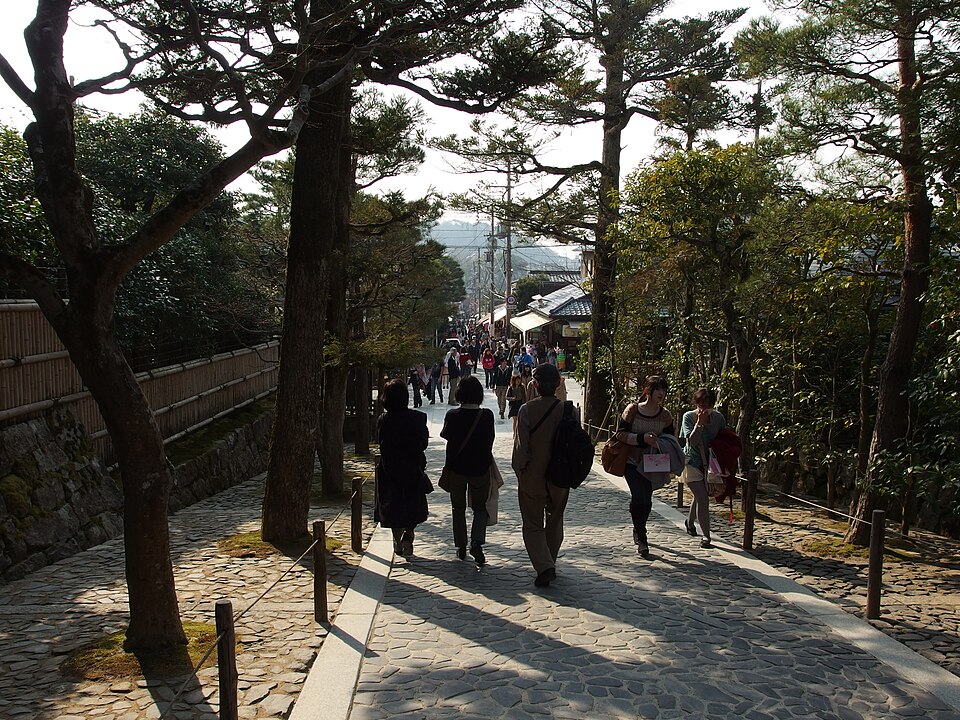
The route is a one-way loop and the temple numbers eighteen points along it. It starts at the Somon and runs fifty metres between the tall clipped hedges and bamboo fences the temple calls ginkakuji-gaki, a deliberately narrow corridor meant to divide the grounds from the world outside. The Chumon holds the reception where tickets are taken. Past it the ground opens onto the Hojo, the abbot's chamber built in the middle of the Edo period, which enshrines a Shakyamuni Buddha and holds paintings by Yosa Buson and Ike no Taiga, and in front of it the two sand forms: the Ginshadan, raked into stepped banks, and the Kogetsudai, a truncated cone. The temple is candid that the familiar story of moonlight reflected off the sand has little evidence behind it and may be a recent invention. The Togu-do stands across the pond, originally a Jibutsu-do enshrining Amida Nyorai. Beyond the pond the path climbs the hillside past the Sengetsusen waterfall, the Benzaiten and Hachiman shrines, the stone arrangement at the ruins of the Sosen-tei, and the Ochanoi, a tea well on the eastern slope. The high point is the Tenbojo viewpoint, which looks back down over the pavilion roof and out across the city, and the descent returns past the pond.
Checked 2026-08-26 · Source
.jpg)
How long to spend
The temple's own FAQ answers this directly: about thirty minutes. That is honest for the walking itself, because the loop is fixed, short and one-way, and nothing inside it can be entered. This guide records forty-five minutes instead, and the difference is not disagreement about the path but about the queue and the climb. Tickets are sold at the Chumon, one reception for everyone arriving, and on a spring or autumn morning the line can absorb ten minutes before the loop even begins. The hillside section is a further slow stretch: it is a stepped earth path, people stop at the Tenbojo viewpoint, and passing places are narrow. Forty-five minutes covers a visit that includes both without hurrying. Anyone who came for the Kannon-den and the sand forms and is willing to walk straight past the upper garden can be out inside the temple's thirty. Anyone arriving during one of the special spring or autumn openings, when the Togu-do, the Hojo and the Rouseitei admit the public, should plan longer than either figure; the temple publishes no duration for those visits and this guide records none. Add the walk from the bus stop separately, which is roughly ten minutes uphill from Ginkakuji-michi.
Checked 2026-08-26
Season and crowds
There is no closed day to plan around. The temple states that it is open all year round, and it keeps two seasons rather than one timetable: from 1 March to 30 November it opens 08:30 and closes 17:00, and from 1 December to the end of February it opens 09:00 and closes 16:30. The FAQ adds the detail the hours alone do not carry, a departure time twenty minutes after closing, 17:20 in summer and 16:50 in winter, and asks visitors to keep to it punctually. Entry is allowed up to closing time in both seasons. The first half hour after opening is the quietest part of any day here, and it is worth more at Ginkaku-ji than at most places because the loop is one-way and narrow: once it fills there is no way to step aside or double back. Winter shortens the day at both ends and brings the last light onto the hillside early. The temple warns that admission hours may change for special exhibitions, so a visit planned around the spring or autumn openings of the Togu-do and the Hojo should be checked against the temple's own access page first — it publishes no fixed dates for them.
Checked 2026-08-26 · Source
.jpg)
Tickets
Admission is 1,000 yen for the general ticket and 500 yen for primary and middle school students. The temple states there is no group discount. Both figures are new: the temple announced on 18 January 2026 that from 1 April 2026 the adult rate, which covers high school students and above, rose from 500 yen to 1,000 yen and the child rate from 300 yen to 500 yen. Children below primary school age remain free, and the reduced rate for visitors with a disability stays at 100 yen. Anyone working from a guidebook or a listing that still says 500 yen is reading a price that expired in March. The ticket is taken at the Chumon reception, a short way in from the main gate, and it admits the holder to the garden circuit only — the temple is explicit that the Kannon-den is not open to the public and that the Togu-do, Hojo and Rouseitei open to the general public during special spring and autumn viewings, which are ticketed and announced separately. The temple also notes that the admission fee may change for special exhibitions. This guide records no advance booking channel, because the temple's own pages describe none.
Checked 2026-08-26 · Source
.jpg)
Getting there
No car is needed and the temple would rather visitors did not bring one. The address is 2 Ginkakuji-cho, Sakyo-ku, in the north-east of the city, and the standard approach is the Kyoto City Bus. Routes 5, 7, 32, 102, 203 and 204 stop at Ginkakuji-michi, from which it is a short walk east and then uphill along the shop-lined approach. Routes EX100 and 105 stop at Ginkakuji-mae, which is closer. From Shokoku-ji, board at Doshisha-mae and take the 102 or 203 to Ginkakuji-michi; from Kinkaku-ji, board at Kinkakuji-michi and take the 102 or 204, which is the direct link between the two pavilions and avoids a change in the centre. On parking the temple says two things that need reading together. Its access page lists a lot open 08:40 to 17:10 with space for 12 buses and 40 cars, mainly for tour buses and taxis, which may refuse cars during busy periods. Its FAQ says the temple has no parking lot accessible to the public and directs visitors to municipal or coin-operated parking, naming the Kyoto Ginkaku-ji Kanko lot on 075-771-0783 — the same number the access page prints. The lot is next to the temple, not the temple's own.
Checked 2026-08-26 · Source
What to watch out for
The commonest disappointment here is expecting to go inside something. Nothing on the standard ticket can be entered: the Kannon-den is closed to the public permanently, and the Togu-do, Hojo and Rouseitei only during announced spring and autumn viewings. The second is the departure time. Closing is 17:00 in summer and 16:30 in winter, but the temple asks everyone to be out by 17:20 and 16:50 respectively, so arriving twenty minutes before closing buys a rushed loop, not a full one. Wheelchair access is possible over most of the circuit, with the exception of some of the scenic viewing points — the hillside path is the part that defeats it — and the accessible toilet is next to the gift shop. There are no guides on the grounds; commentary is provided only for the special viewings. There is no Wi-Fi. Pets are allowed but must be carried or kept in a carrier rather than walked on the temple path. The temple's contact number, 075-771-5725, is Japanese only, and it is also the number for anything left behind. Footwear matters more than it looks: the upper garden is packed earth and stone steps, and it is slick after rain.
Checked 2026-08-26 · Source
.jpg)
Photography
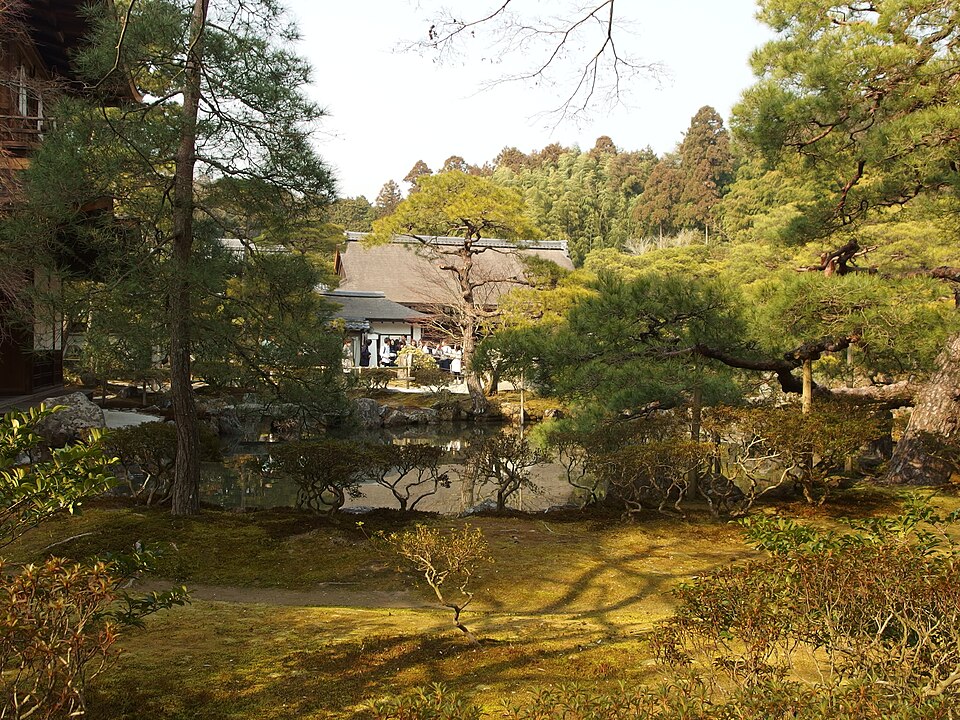
The three frames worth planning for are the pavilion across the water, the sand forms, and the view down from the hillside, and they do not want the same conditions. The Kannon-den is shot from the far side of the pond the temple calls Nishiki Kagami Ike, and the reflection is the picture: it wants the first half hour after opening, before the surface is disturbed and while the rail is thin enough to stand at. The Ginshadan and the Kogetsudai in front of the Hojo are white sand with no colour in them at all, so they exist only as shadow. Low raking light gives the raked banks their edges and the cone its shape; overhead midday sun flattens both into glare, and an overcast sky does the same more gently. The Tenbojo viewpoint on the slope is the wide shot, the pavilion roof below and the city beyond it, and it is the frame most often lost to haze — a clear morning after rain is the one to take it on. The whole route is one-way and narrow, so a tripod is impractical rather than forbidden, and stopping means standing aside first. Autumn colour and wet moss in the lower garden are the two conditions that repay a return visit.
Checked 2026-08-26
Common questions
Do you go inside the Silver Pavilion?
No. The temple states that the Kannonden — the pavilion itself — is not open to the public, and that visitors normally see only the gardens. The Togudo, the Hojo (the abbot's quarters) and the Rouseitei are accessible to the general public during special openings in spring and autumn only. A standard ticket buys the one-way garden circuit, from which the pavilion is seen from the outside across the pond and from the hillside path above it.
How much is admission to Ginkaku-ji?
1,000 yen for the general ticket and 500 yen for primary and middle school students, with no group discount. These rates took effect on 1 April 2026, replacing 500 yen and 300 yen; the temple announced the change on 18 January 2026. Children below primary school age enter free and the reduced rate for visitors with a disability remains 100 yen. The temple notes that the admission fee may change for special exhibitions.
What time does Ginkaku-ji open and close?
It keeps two seasons. From 1 March to 30 November it is open 08:30 to 17:00, and from 1 December to the end of February 09:00 to 16:30. The temple states that it is open all year round, so there is no weekly closed day. Visitors may enter up to closing time in both seasons, and the FAQ gives a departure time twenty minutes after closing — 17:20 in summer and 16:50 in winter — which it asks visitors to keep punctually.
How long does a visit take?
The temple's own answer is about thirty minutes. This guide records forty-five, which is the same walk with the ticket queue at the Chumon and an unhurried climb up the hillside path to the Tenbojo viewpoint included. Thirty is achievable by anyone who skips the upper garden. A visit during a special spring or autumn opening of the Togu-do or the Hojo takes longer than either figure, and no duration is recorded for those.
Is there parking at Ginkaku-ji?
Not the temple's own. Its FAQ says the temple has no parking lot accessible to the public and directs drivers to municipal or coin-operated parking, naming the Kyoto Ginkaku-ji Kanko parking lot on 075-771-0783. The temple's access page lists that lot as open 08:40 to 17:10 with room for 12 buses and 40 passenger cars, describes it as mainly for tour buses and taxis, and warns that cars may be refused entry during busy periods. City buses reach the gate and are the easier option.
Can a wheelchair use the temple grounds?
Mostly. The temple states that it is possible to visit in a wheelchair with the exception of some scenic viewing spots, and asks visitors to consult the map of the grounds; in practice it is the stepped hillside path to the upper garden and its viewpoint that is the obstacle, not the pond-level circuit. An accessible toilet is located next to the gift shop. The temple's contact number, 075-771-5725, is answered in Japanese only.
Where it is
Loading the interactive map…
The interactive map could not be loaded.
Nearby
In Kyoto
Same category
Fit it into a plan
External links
Last updated:
Source: OpenStreetMap contributors, Wikidata ·