史跡 · Fatih, イスタンブール
Rüstem Pasha Mosque
Rüstem Paşa Camii
写真


アクセスと設備
- 段差なくアクセス可能 · 利用可能
OpenStreetMap アクセス タグから読み取ります。記載されていないものにはタグが記録されていません。
プランナーでグループ タイプをファミリーに設定し、1 日の枠を 1 人の 1 日の約 4 分の 3 に設定します。
- 今日
- 営業時間の記録なし
- 訪問期間
- 20分
- アクセシビリティ
- ステップフリー
- 価格
- 入場無料
- 評価
- 必見
- ランク
- 8,133 の 36 をランク付け
Rüstem Pasha Mosqueについて
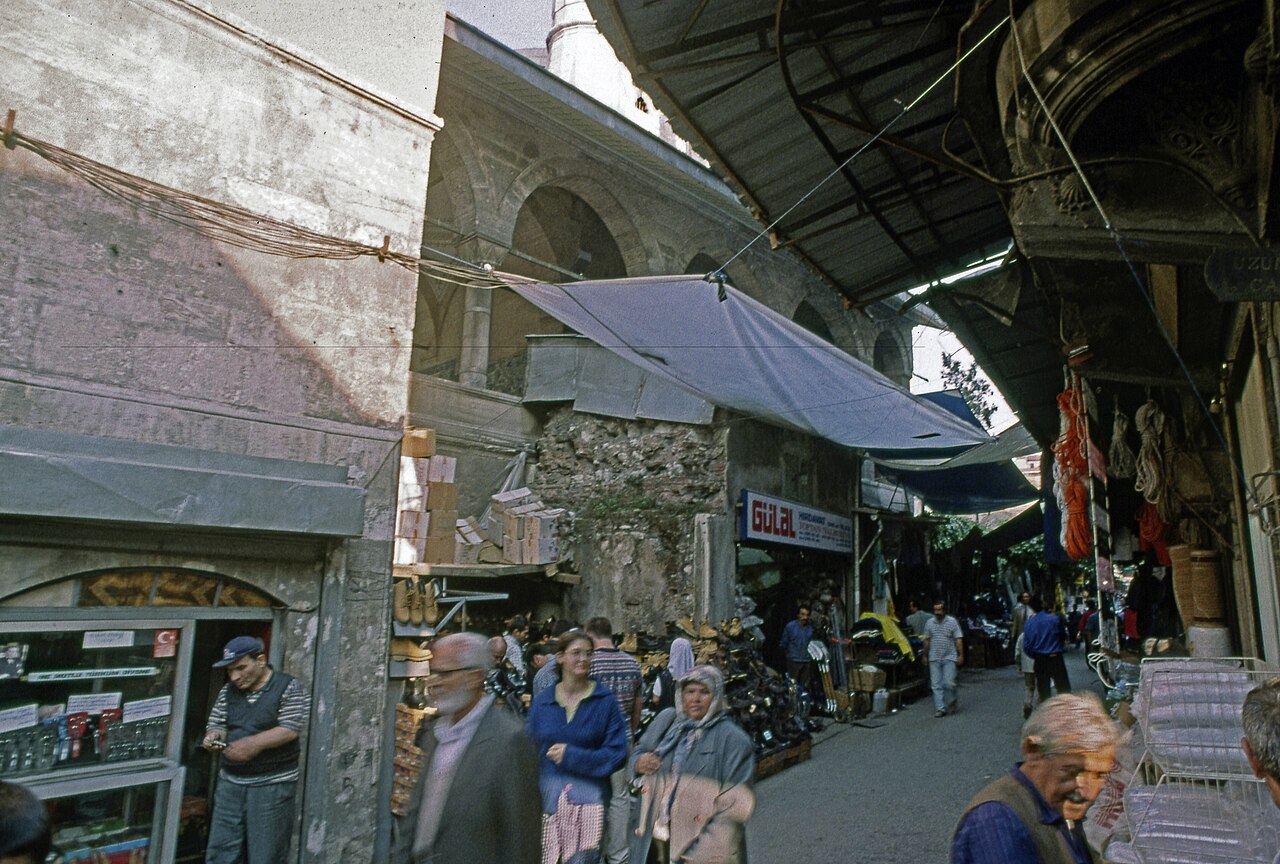
Rüstem Pasha Mosque does not sit on the street. It sits above it, on a high terrace raised over a block of vaulted shops in the Hasırcılar Çarşısı, the strawmat weavers' market in Tahtakale, a few steps inland from the Spice Bazaar.
It was designed by the Ottoman imperial architect Mimar Sinan for Rüstem Pasha, grand vizier and son-in-law of Suleiman I. Planning began in 1561, Sultan Suleiman I authorised the project in 1562, and the mosque was likely only operational by late 1563. The rents from the shops underneath were intended to pay for the complex standing on top of them, which explains the arrangement exactly: commerce on the ground, prayer on the floor above. One minaret marks it. Nothing at street level announces the building, and a visitor can walk the length of the market lane without ever noticing that there is a mosque overhead.
2026-08-24 を確認しました · ソース
中には何が入っているのか
The prayer hall is, in plan, an octagon inscribed in a rectangle. The main dome rests on four semi-domes placed not on the axes but on the diagonals of the building, and the arches carrying it spring from four octagonal pillars, two to the north and two to the south, and from piers projecting out of the east and west walls. Galleries run along the north and south sides, supported on pillars and on small marble columns, and a double porch of five domed bays fronts the entrance.
What people climb the stairs for is the tilework. Roughly 2,300 İznik tiles are arranged in around 80 different patterns, covering almost every vertical surface both inside and under the entrance porch, in rose buds, lotus palmettes and leaves. The qibla wall runs mostly to blues, turquoise and cobalt in many shades, and the tiles nearest it carry an early use of the tomato-red pigment known as Armenian bole. The mihrab is shaped as a half-dodecagon, with three windows set above its frames.
2026-08-24 を確認しました · ソース


見学時間の目安
Twenty minutes is the honest figure, and it is not a short-changed one. The mosque is a single prayer hall reached by a stair: there is no circuit to walk, no annexe, no museum sequence to work through. The time goes on the climb, on standing still in three or four places to read the tile panels at close range, and on the porch, where the tiling is easy to miss on the way in and easy to catch on the way out.
Anyone who cares about ceramics will stretch that to half an hour and never feel they are padding it. Anyone passing through on a bazaar morning will be back down in a quarter of an hour with the thing seen. Budget the walk to find the stair separately, because that part regularly takes longer than the visit itself.
2026-08-24 を確認しました


季節と混雑状況
No weekday timetable is published for this mosque, and none is recorded here, because no canonical source gives one. What the Istanbul Chamber of Tourist Guides publishes instead is the rule rather than the clock: the mosque closes to visitors fifteen minutes before each prayer and reopens once that prayer has ended, and it is closed to visitors on Fridays between 12:00 and 14:00.
Those closures move through the year as the prayer times move, so a mid-afternoon arrival in December and the same arrival in June are not the same gamble. In practical terms the room is small and it fills sharply through the afternoon, when the market below is at its busiest and the tour groups have worked their way up from the waterfront. The quiet hours are the ones just after the morning prayer, before the shops underneath have fully opened.
2026-08-24 を確認しました · ソース
チケット
There is no ticket. Rüstem Pasha is a working mosque and entry is free; the Ministry of Culture and Tourism's Kültür Portalı entry for it carries neither a fee nor a booking arrangement, because there is nothing here to book.
No queue, no gate, no counter, no timed entry. The only threshold is the shoe rack at the top of the stair. Donation boxes stand inside as they do in any mosque and are exactly that, voluntary; nobody will ask, and nobody is watching whether you contribute. The combined tickets and museum passes sold for Istanbul's ticketed monuments have no application here at all, and any guide offering to sell skip-the-line access to this mosque is selling a queue that does not exist.
2026-08-24 を確認しました · ソース


行き方
The mosque stands in the dense market grid immediately inland from the Eminonu waterfront, behind the Spice Bazaar, and the approach is genuinely the hard part of the visit. From the shore, walk into the Hasırcılar Çarşısı and watch the sides of the lane for a low arched opening set between shopfronts, easily mistaken for a storeroom door. The narrow, twisting flights of steps in the corners of the terrace lead up from there to the courtyard.
There is more than one such stair and they all arrive at the same place, so a wrong choice costs nothing. Asking a shopkeeper beats circling the block: they are asked this several times an hour and will point without breaking off a sale. Wheeled luggage and pushchairs do not work on these steps, and there is no lift and no level alternative.
2026-08-24 を確認しました


気をつけるべきこと
The stairs are the hazard here, not the mosque. They are narrow, worn smooth, poorly lit and turn back on themselves, and people coming down meet people going up with almost no room to pass. Take them one at a time and keep a hand on the wall. The terrace itself is uneven underfoot.
Inside, the tiles sit at arm's height and unprotected. Do not touch them, and mind a backpack when turning around in a hall this small. Shoes come off and go on the rack; carry a bag for them when the racks are full. Modest dress applies, with hair covered for women. And remember what the building has been through: it reopened for worship in 2021 after an extensive restoration, having spent years used for film storage. It is a functioning place of prayer again, not an exhibit with worshippers in it.
2026-08-24 を確認しました · ソース

写真
This is a tile interior, which means light rather than framing is the problem to solve. The hall is small and the windows sit high, so the contrast between a sunlit panel and a shadowed one is brutal. Expose for the tile and accept the blown glass; the reverse gives a correctly exposed window in front of a black wall.
Mid-morning, when the sun is off the direct axis, gives the most even wash across the qibla wall. Wide lenses earn their place here, because the panels only make sense as a continuous surface rather than as isolated squares. The porch is worth one frame on the way in and is usually empty of people, which the interior rarely is. Keep worshippers out of shot, never use flash, and do not plant yourself in front of the mihrab while anyone is praying.
2026-08-24 を確認しました
よくある質問
Is there an entrance fee for Rüstem Pasha Mosque?
No. It is a working mosque and entry is free. The Ministry of Culture and Tourism's Kültür Portalı entry for the mosque lists no fee and no booking arrangement, and there is no ticket counter of any kind at the top of the stair. Donation boxes inside are voluntary.
What are the opening hours?
No per-weekday timetable is published by any canonical source, so none is listed here. The Istanbul Chamber of Tourist Guides publishes the rule instead: the mosque closes to visitors fifteen minutes before each prayer and reopens once that prayer ends, and it is closed to visitors on Fridays between 12:00 and 14:00. Those closures shift through the year with the prayer times.
How long does a visit take?
About 20 minutes. It is a single prayer hall reached by a stair, with no circuit to walk and no annexe, so the time goes on the climb and on standing still in front of the tile panels. Finding the stair from the market lane often takes longer than the visit itself, and should be budgeted separately.
Who built the mosque and when?
It was designed by the Ottoman imperial architect Mimar Sinan for Grand Vizier Rüstem Pasha. Planning began in 1561, Sultan Suleiman I authorised the project in 1562, and the mosque was likely only operational by late 1563. It was raised on a terrace over a complex of vaulted shops whose rents were intended to support the complex financially.
How many tiles are there inside?
There are approximately 2,300 İznik tiles arranged in around 80 different patterns, covering almost every vertical surface both in the interior and under the entrance porch. The designs run to rose buds, lotus palmettes and leaves, and the tiles near the qibla wall show an early use of the tomato-red pigment known as Armenian bole.
Where is the entrance, and is it accessible?
The entrance is not at street level. Narrow, twisting flights of steps in the corners of the terrace lead up from low arched openings between the shopfronts of the Hasırcılar Çarşısı to the mosque courtyard. There is more than one such stair and all reach the same courtyard. There is no lift and no step-free route, so pushchairs and wheeled luggage do not work here.
どこにありますか
インタラクティブマップを読み込んでいます…
インタラクティブマップを読み込めませんでした。
近くの
計画に組み込む
外部リンク
最終更新日:
情報源: OpenStreetMap コントリビューター, Wikidata ·