博物館 · Sarıyer, イスタンブール
Rumeli Hisarı

営業時間
| 月曜日 | 閉店 |
|---|---|
| 火曜日 | 09:00 – 19:00 |
| 水曜日 | 09:00 – 19:00 |
| 木曜日 | 09:00 – 19:00 |
| 金曜日 | 09:00 – 19:00 |
| 土曜日 | 09:00 – 19:00 |
| 日曜日 | 09:00 – 19:00 |
2026-08-24 を確認しました · ソース
- 今日
- 本日の営業時間: 09:00 – 19:00
- 訪問期間
- 1時間 15分
- アクセシビリティ
- 未登録
- 価格
- €6.00 お一人様あたり
- 評価
- 必見
- ランク
- 8,133 の 26 をランク付け
Rumeli Hisarıについて
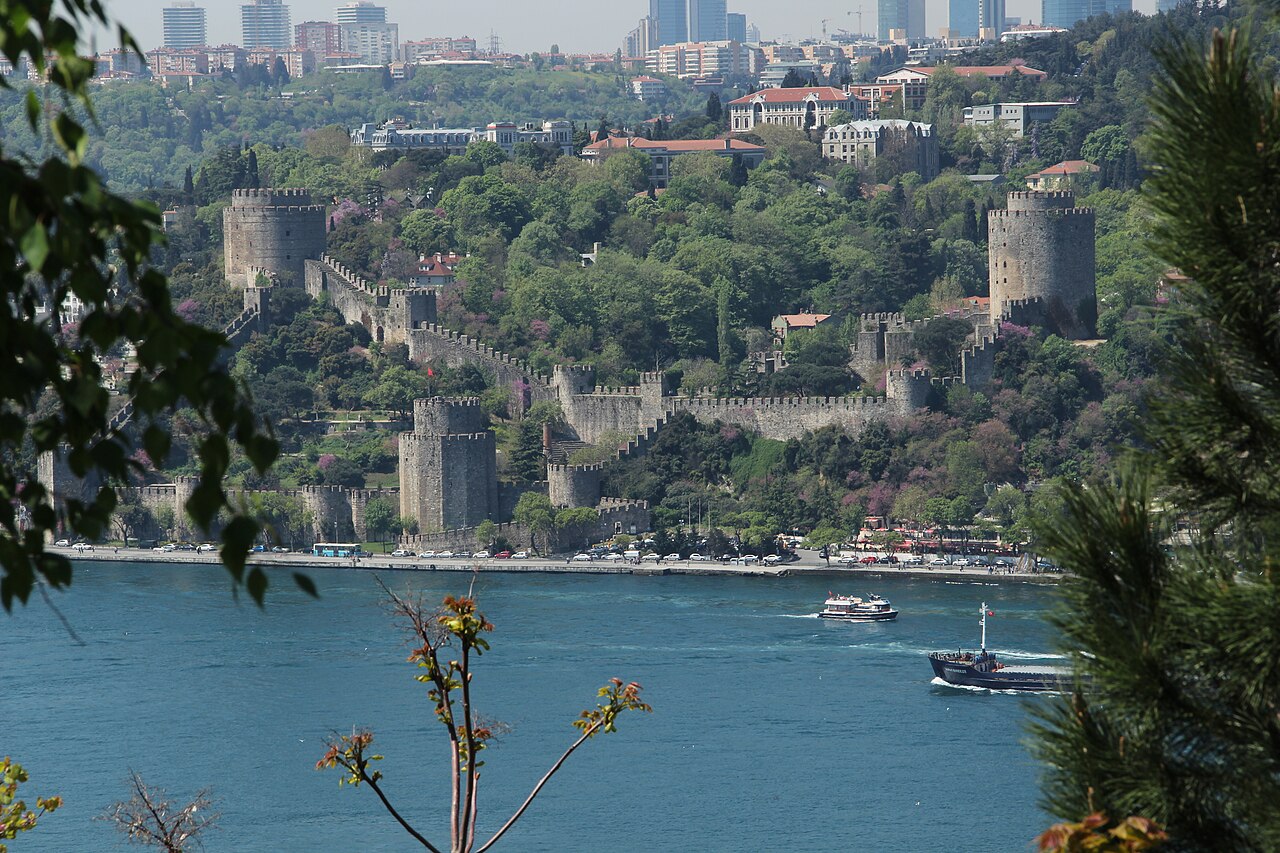
Rumeli Hisarı is a fortress built to close a strait, and everything about it follows from that one job. Mehmed II began it on 15 April 1452 and had it finished inside the same year, on the European bank at the point where the Bosphorus narrows to roughly 660 metres. Directly across the water stood Anadoluhisarı, raised by Bayezid I in 1393-1394. Between the two, cannon could reach any hull that tried to pass.
Its Turkish nickname says the strategy out loud: Boğazkesen, the strait-cutter. Within a year the grain and reinforcement route from the Black Sea to Constantinople was severed, and the siege that ended the Byzantine Empire followed. The enclosure covers some 31,250 square metres of hillside, and that hillside is not incidental — the ground itself is part of the defence, and it will be part of a visit too.
2026-08-24 を確認しました · ソース
中には何が入っているのか
Three great towers anchor the plan and each carries the name of the vizier who paid for it. Sarıca Pasha's tower stands to the north, cylindrical, 28 metres tall and 23.30 metres across, with walls seven metres thick over nine storeys. Halil Pasha's, down at the water, is a twelve-sided prism 22 metres high with walls of 6.50 metres, also nine storeys. Zağanos Pasha's holds the south, 21 metres high, the widest of the three at 26.70 metres, walls of 5.70 metres across eight storeys.
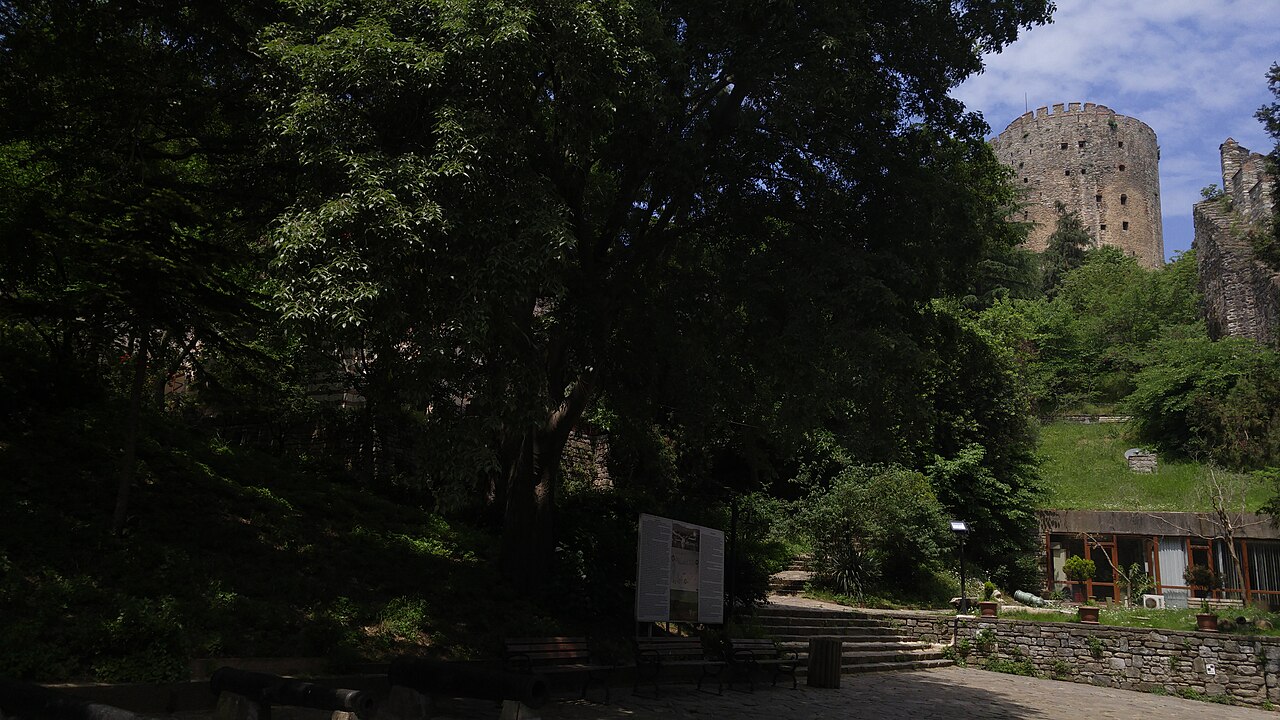
Linking them are curtain walls running about 250 metres north to south, punctuated by thirteen watchtowers — one four-sided, six many-cornered prisms and six cylinders — plus one small tower. Inside the enclosure are the remains of a mosque whose original minaret shaft still stands, a cistern that watered the garrison, and one surviving wall-fountain of the three that were built. What there is not, and this matters for planning, is a large indoor exhibition.
2026-08-24 を確認しました · ソース

見学時間の目安
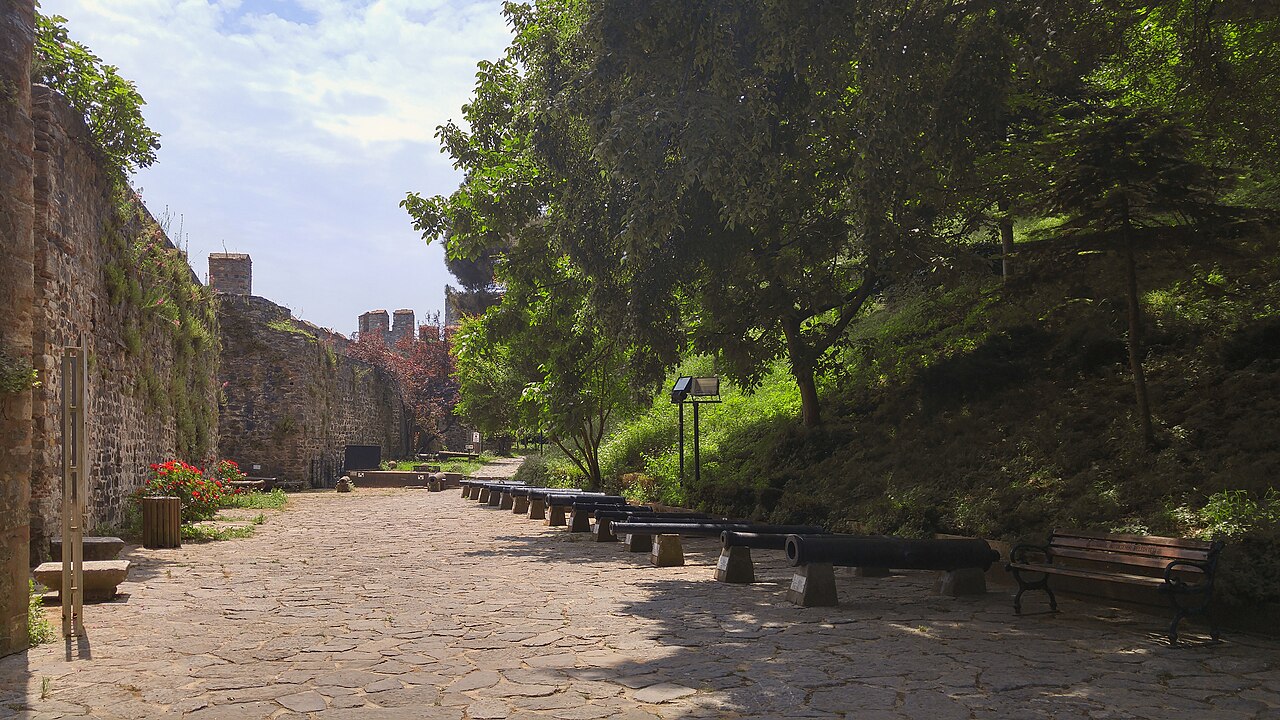
Seventy-five minutes is the honest figure, and almost all of it is spent walking rather than reading. The visit is a climb: in through the lower gate, up the sloped interior toward the upland towers, along what stretches of wall and stair are open, and back down. There is little in the way of display cases to slow anyone down, so the clock is governed by the gradient and by how often a person stops to look across the water.
Someone moving briskly and skipping the upper reaches can be out in forty-five minutes. Someone who sits on the grass for a while, which is the most pleasant thing to do here, will pass ninety without noticing. Budget the seventy-five, and treat the fortress as a walk with a view rather than a museum with a route.
2026-08-24 を確認しました


季節と混雑状況
The fortress is closed on Mondays. Through the summer season, 1 April to 31 October, it opens 09:00 to 18:00 with the box office shutting at 17:00; in winter it runs 09:00 to 17:00 with the box office closing at 16:00. That box-office hour is the one to plan around — arriving at 17:15 in August buys nothing.
Judgement on top of the timetable: the enclosure is open ground on a west-facing slope with very little shade, so a July afternoon here is a genuinely hot climb. The first hour after opening is both cooler and quieter, and it is also when the towers are least likely to have a queue on their narrow stairs. Note also that a source consulted for this entry carried an older schedule making Wednesday the closed day; the official museum page giving Monday is the one used here.
2026-08-24 を確認しました · ソース
チケット
Admission is 6 EUR per person, quoted in euros on the official museum page rather than in lira. Pricing a domestic monument in a foreign currency is common practice at Turkey's ministry-run sites and simply means the lira figure at the desk tracks the exchange rate on the day.
Remember that the box office closes an hour before the site does — 17:00 in summer, 16:00 in winter — so the last useful moment to buy is earlier than the closing time suggests. No concession structure is recorded here, and nothing else about the ticket is published in a form worth repeating, so anyone travelling on a museum pass or with children should ask at the window rather than assume.
2026-08-24 を確認しました · ソース

.jpg)
行き方
The clean approach is from above. The M6 metro is a short line off Levent whose far terminus, Boğaziçi Üniversitesi, opened on 19 April 2015; from there the F4 funicular, running since 28 October 2022, drops to Aşiyan on the Bosphorus shore. That funicular exists precisely because the hillside between the ridge and the water is steep enough to be unwalkable for most people, and it removes the hardest part of the journey.
From Aşiyan the fortress is a short way north along the shore road, and the walls are visible the whole way, which makes the last stretch hard to get wrong. Judgement: coming down by funicular and leaving along the water is far kinder than the reverse, because it puts the descent at the start of the visit and the flat walk at the end, when legs are already tired from the fortress itself.
2026-08-24 を確認しました · ソース
.jpg)
気をつけるべきこと
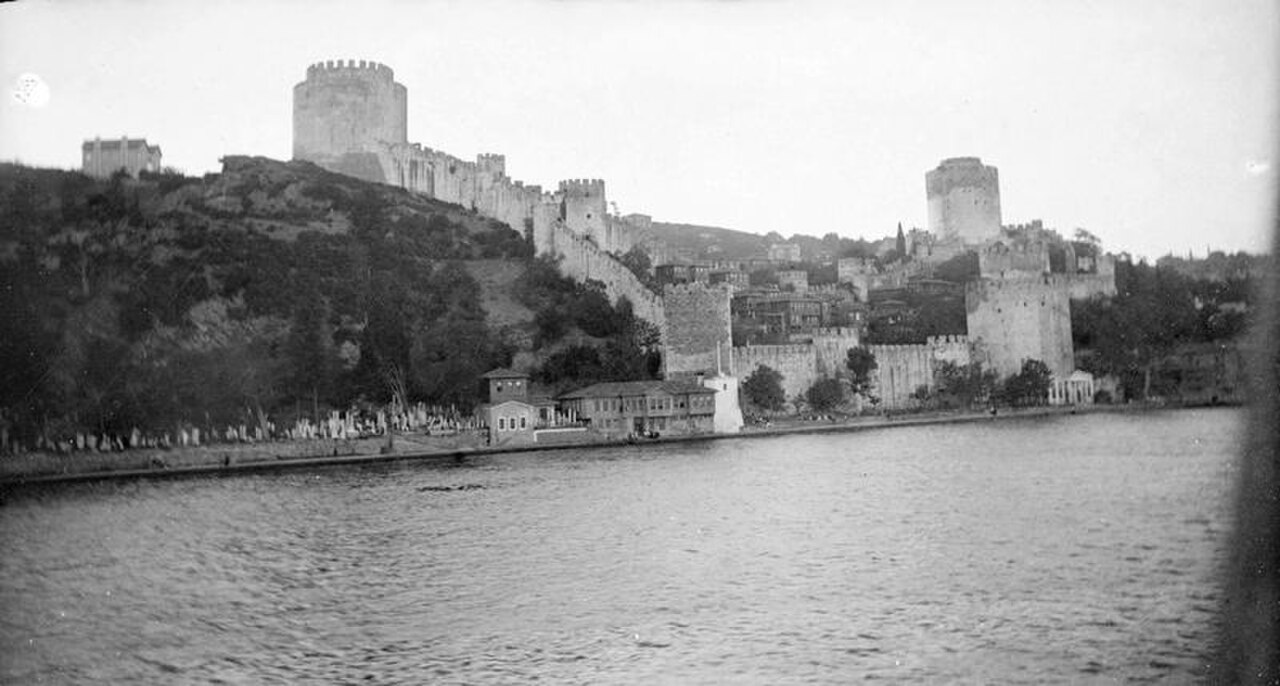
The building has been knocked about and repaired for five centuries, and the surfaces show it. An earthquake damaged it in 1509 and it was patched soon after; a fire in 1746 destroyed the wooden elements; Selim III oversaw further repairs; the modern restoration ran from 16 May 1955 to 29 May 1958, and it has held museum status since 1960. The result is a mixture of original and rebuilt fabric with steps of wildly inconsistent height.
Practical judgement: wear something with grip and a closed toe. Stone stairs on the curtain walls are worn smooth, several stretches have a drop on one side with minimal railing, and the interior slope is grass and gravel that turns slippery after rain. Sections of the towers close without notice depending on maintenance, so treat any particular tower as a bonus rather than a plan. Nobody should be carrying an open drink up those stairs.
2026-08-24 を確認しました · ソース
.jpg)
写真
The fortress sits on the western bank looking east, which sets the whole day's light. In the morning the sun comes up over the Asian shore and straight into the lens: anything shot across the water is backlit, the strait goes silver, and the towers are dark shapes. That is a real picture if it is what someone wants, but it is not a picture of the masonry.
Late afternoon reverses it. The sun swings behind the ridge and rakes across the towers from the west, which is when the banded stonework and the sheer thickness of those walls finally read. The strongest single position is partway up the slope between the two upland towers, high enough that the curtain wall leads the eye down to the water and the Fatih Sultan Mehmet bridge sits in the frame beyond. Wide lenses struggle to convey the height of a 28-metre tower from close up; step back down the slope and let the hill do the work.
2026-08-24 を確認しました
よくある質問
Why was Rumeli Hisarı built so quickly?
It was built to close the Bosphorus before a siege, and speed was the point. Mehmed II started construction on 15 April 1452 and the fortress was finished within that same year, in time to cut the sea route to Constantinople ahead of the 1453 campaign. Its Turkish name, Boğazkesen, translates as strait-cutter.
Which day is the fortress closed?
Monday. The official museum page gives Monday as the closed day, with the site open 09:00 to 18:00 in the summer season from 1 April to 31 October and 09:00 to 17:00 in winter. An older schedule in circulation makes Wednesday the closed day; the official page is the one followed here.
How much does it cost to get in?
Admission is 6 EUR per person according to the official museum page. The box office closes an hour before the site itself, at 17:00 in summer and 16:00 in winter, so buying a ticket has to happen well before the posted closing time.
How long should be set aside for a visit?
About 75 minutes. The enclosure covers roughly 31,250 square metres of sloped ground and the visit is essentially a climb up to the towers and back down, with very little indoor exhibition to slow the pace. Forty-five minutes is enough for a quick circuit; ninety is easy if the view holds your attention.
What is the easiest way to reach it without a car?
Take the M6 metro from Levent to its terminus at Boğaziçi Üniversitesi, then the F4 funicular down to Aşiyan on the shore, and walk north along the water. The funicular opened on 28 October 2022 and exists because the hillside is too steep to walk comfortably; using it downhill on the way in is the kindest option.
Are the three towers all the same?
No. Sarıca Pasha's tower to the north is cylindrical, 28 metres high with seven-metre walls over nine storeys; Halil Pasha's at the waterline is a twelve-sided prism 22 metres high with 6.50-metre walls; Zağanos Pasha's to the south is 21 metres high but the widest at 26.70 metres, with 5.70-metre walls over eight storeys.
どこにありますか
インタラクティブマップを読み込んでいます…
インタラクティブマップを読み込めませんでした。
近くの
計画に組み込む
外部リンク
最終更新日:
情報源: OpenStreetMap コントリビューター, Wikidata ·